The Warden, Talos-Pattern
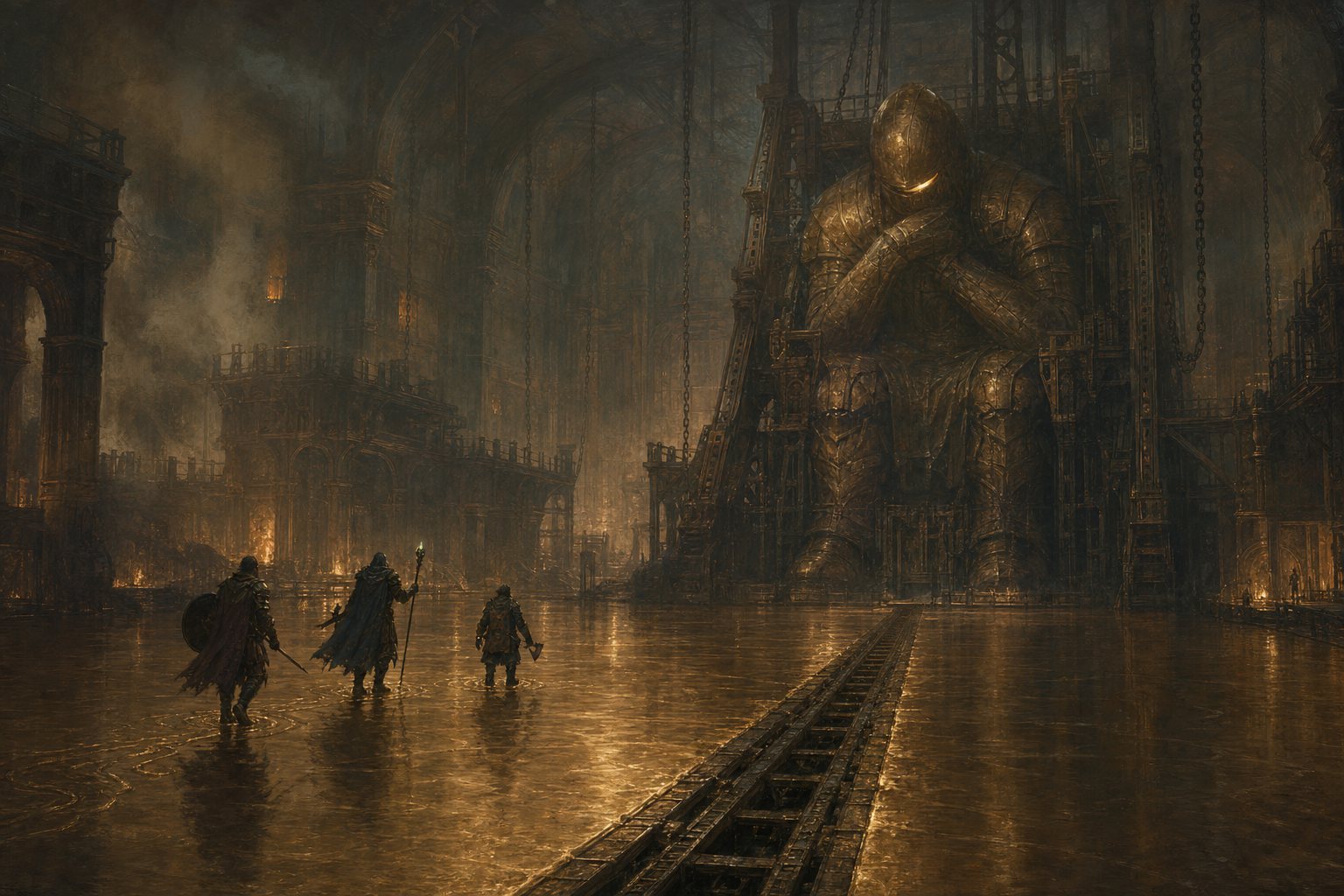
A foundry, and the floor of it is a single sheet of poured bronze with a gutter cut down the middle to a grated sump. A gantry crane hangs twenty-five feet up on rails. There is a casting pit in the far corner with cold slag in the bottom and the shape of a man still pressed into it, twenty feet from heel to crown.
The man is not in the pit. He is standing beside it with his back to you, perfectly still, and the light off your lamps runs up him like water.
He turns his head first, then his body, in that order, with a sound like a temple door. "The permitted number in this room is none," he says. "You are six. The door behind you is open. I will count to twenty."
"One."
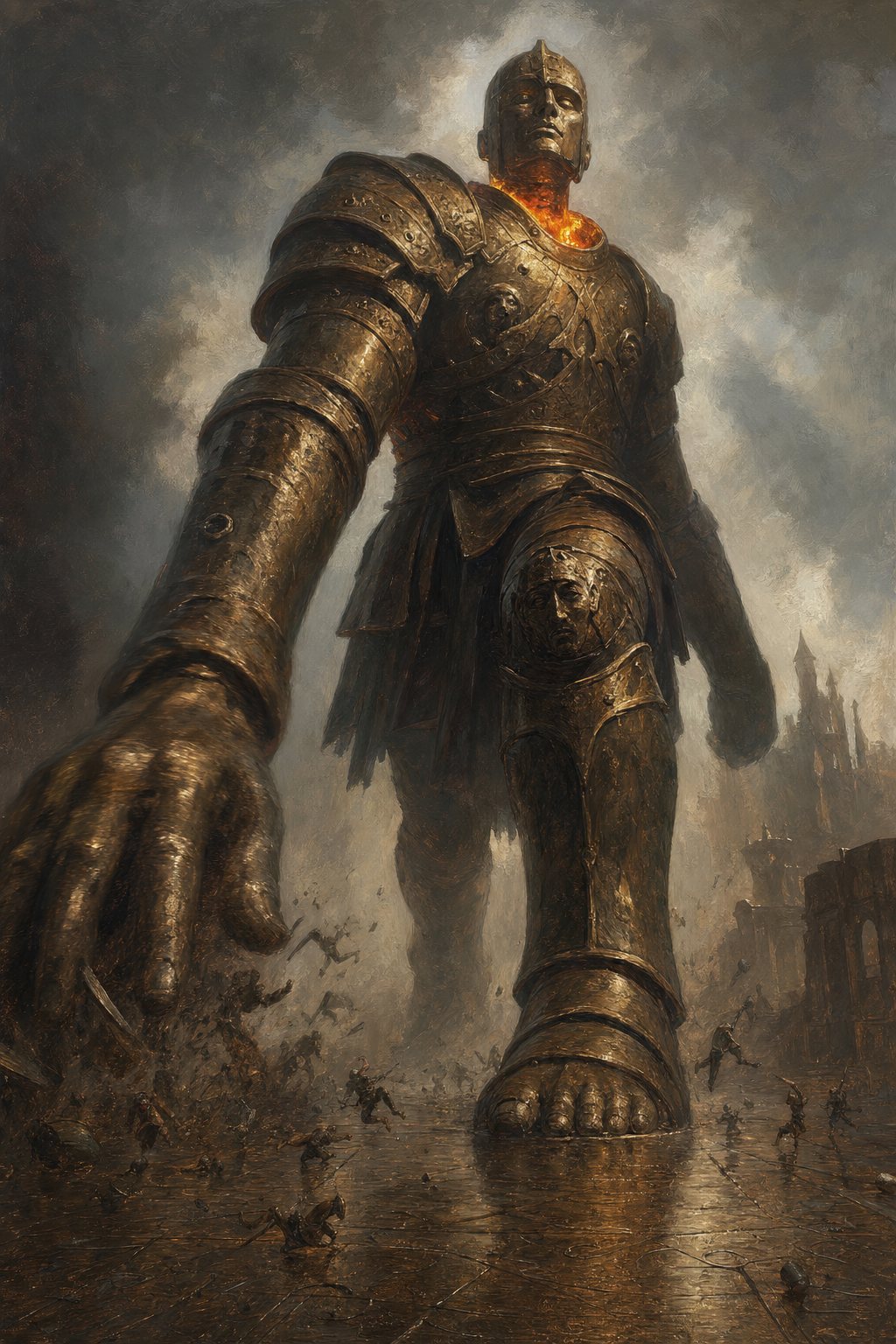
DM summary. A twenty-foot bronze colossus with a single vein of ichor and a plug in its ankle, and a foundry drain built for exactly this purpose. It obeys the rule it recites, it tells the truth, and it will genuinely let the party walk out — once.
The Boon
The Pourer's RoteOptional knowledge
The foundry's pouring chant, so the three sluice wheels go in the right order first time
What it is. Eight words of doggerel every foundry-hand in Knossos learns in his first week and never loses: level her, cut her, measure her, stand back. The Pourer's Rote is the order the sluices are worked in when bronze is running — plumb-bob, chisel, dividers — and it is not a secret, not magic, and worth nothing to anyone who has never stood next to a pour.
Where it comes from. Early, in the first three rooms: a clay tag on a dead smith's tool-roll off a loot roll, beside the dividers and plumb-line that name the marks; a lore room's work-tablets, the dullest thing on the shelf; an old man in a rest room who hums it and will say the words if asked. Late plant: it is cut at knee height into the lintel of the small south-east door, where a man kneels to check a mould. Give it as junk.
What it does here. It is the frieze's answer already in hand: plumb-bob, then chisel, then dividers. No Investigation DC 13 and no History DC 15 to read the panels, and — the part that matters — no wrong order: no 11 (2d10) steam, no Constitution DC 14, no reset with a twenty-foot bronze man walking at the wheels. The work is untouched: each wheel is still an action and a Strength (Athletics) DC 13, the wheels are still at the sump the Warden was told to guard, and the count still runs.
What it doesn't do. It is about pouring bronze, not about the thing the bronze was poured into. It says nothing about the vein or the ankle pin, so the Investigation DC 15 or History or Arcana DC 14 to find the plug is unchanged and half two costs the same. It turns no wheel and holds nobody off the sump. A party who never heard it reads the frieze, eats a lungful of steam, and runs this finale precisely as written.
Card and numbers or jump to the card ↓
Arena
Battle map: custom map. An 80 × 60 ft foundry: bronze floor, ichor gutter, three sluice wheels, and a 20-ft casting pit — every feature is a drawn line, so draw them; no printed page carries a bronze works. Browse the book if a page half fits your table better.
- Dimensions. 80 ft × 60 ft, ceiling 40 ft. The party enters by the small door in the south-east corner, which is the door it means when it says behind you.
- Light. Dim red from the banked forge along the west wall, plus whatever the party brought. The Warden itself does not need light and does not care.
- The bronze floor and the ichor channel. A gutter 18 inches wide and 6 inches deep runs the length of the room to a grated sump in the north wall. It is dry and it has been dry a long time. This is the drain the whole fight is about.
- The three sluice wheels. Bronze wheels at the sump, stamped with maker's marks: a plumb-bob, a pair of dividers, a chisel. Opening them in the right order opens the channel to the cistern below. Opening them wrong vents scalding steam. See Alternate Resolution.
- The casting pit. 20 ft square, 15 ft deep, in the north-west corner, with the Warden's own mould still in the slag at the bottom. It will not strike across the pit and it will not step in it — that is the work. A party that fights from the far lip of the pit takes half the punishment and should be allowed to notice.
- The gantry crane. A bronze traveller on rails 25 ft up, running east to west, carrying a hook and a two-ton counterweight. Reachable by the wall ladder (Athletics DC 12). Running the counterweight into the Warden costs a full action and a Thieves' Tools or Athletics DC 15: 44 (8d10) bludgeoning, DC 17 Strength save or knocked prone, and the crane is then spent.
- The frieze. Above the forge, three panels of Daedalan working-marks in the same three symbols as the sluice wheels. This is the puzzle's answer, and it is in the room where anyone can look at it.
Roster & Budget
One colossus and one sentinel that was already on its rounds.
| Count | Creature | XP each |
|---|---|---|
| 1 | The Warden, Talos-Pattern | 8,400 |
| 1 | Clockwork Sentinel | 1,800 |
Base 10,200 XP; ×1.5 for two bodies = 15,300 adjusted, against the APL 9 Deadly budget of 14,400. Six per cent over, and the puzzle hands back more than that: a party that drains the plug takes 120 hit points off the Warden without rolling an attack.
Do not add a third body. Three bodies double the base instead of multiplying by half again, and a boss this size plus anything at all lands north of 20,000. If your table wants more machines in the room, run the extra sentinels as scenery on their fixed patrol and let them be genuinely irrelevant — that is very much in character for Daedalan Automata (W03).
Phases / Clock
The count. Round zero is the count to twenty. It is real. The Warden counts one number per six seconds and does not act until it reaches twenty or until a creature attacks it, opens something sealed, or steps into the channel. A party that turns around and walks out lives, misses the finale entirely, and rolls a d20 again at the next exit. Almost nobody does this. Offer it anyway, out loud, because the offer is what makes the fight theirs.
Phase one — Cold. Speed 30 ft, resistant to nonmagical weapons, appallingly hard to hurt. It moves once and hits once and the room is big enough that it spends real turns crossing it. Cold damage slows it. This phase is a siege.
Phase two — Running Hot. Triggered by dropping to 112 hit points or by the ankle plug being drawn, whichever comes first. Visibly: the seams along its legs glow, ichor runs into the channel, and it starts making noise. It loses its resistance to nonmagical weapons, becomes vulnerable to cold, gains 10 ft of speed, and Furnace Vent recharges on 4–6. It also starts losing 30 hit points at the start of each of its turns if the plug is out.
The pooling clock. If the plug is drawn before the sluices are open, the ichor does not drain. It fills the channel in one round and then spreads: at the end of each round thereafter, 10 ft of floor either side of the gutter becomes molten hazard (entering or starting a turn there is 22 (4d10) fire damage). Four rounds of that and the party is fighting on islands. This is the wrong order and it is the party's fault and it is spectacular.
Combat Resolution
Six to nine rounds fought straight; three or four with the plug drawn.
- Round 1. It finishes the count and then walks. Not runs — walks, straight down the middle of the room, and says the rule again: "The permitted number is none." Its first attack is against whoever is standing in the channel, and if nobody is, whoever is nearest the sump, because the sump is what it was told to guard.
- Tactics. It fights to push people away from the sump and back toward the door it offered them. It will not strike across the casting pit, will not shove anyone into the forge or the mould, and will not damage a Daedalan fitting even to reach someone standing on one. It does not pursue past the casting doors.
- The Sentinel keeps its fixed patrol and pursues no further than 60 ft from it. Outrun the circuit and that half of the roster stops happening.
- The weakness, discoverable. Investigation DC 15 on its legs finds the seam and the pin at the right ankle. History or Arcana DC 14 on the Talos-pattern recalls the story every Greek child knows: one vein, one nail, and a woman who pulled it. Either one is enough to make the puzzle visible.
- Killing it by damage alone works and takes twice as long. Say plainly at the table that they can do this. Then let the fifth round of hitting a bronze man with a sword make the argument for them.
- When it stops, it stops mid-stride and stays standing. It does not fall. Nothing in the room is louder than that.
Alternate Resolution
Puzzle — open the drain, then draw the plug. Two halves, in that order, and the order is the puzzle.
Half one: the sluices. Three wheels, three marks, and the frieze above the forge shows the foundry's pouring sequence: plumb-bob, then chisel, then dividers — level the mould, cut the runner, take the measure.
| Element | Value |
|---|---|
| Reading the frieze | Investigation DC 13, or History DC 15 on Daedalan working-marks, or free for anyone who has spent a room in a Daedalan workshop and says so |
| Turning one wheel | One action and a Strength (Athletics) DC 13; two characters working together, no check |
| Wrong order | The wheel turns, nothing drains, and the sump vents steam: 11 (2d10) fire damage to that character, Constitution DC 14 for half. The sequence resets and may be attempted again |
| Solved state | The channel drains to the cistern with a noise like a swallowed river. Ichor poured into it now goes away instead of spreading |
| Fallback with no checks at all | Break the sump grate: 40 damage, AC 15, or Thieves' Tools DC 17. Loud, permanent, and it floods the tunnel below, which costs the party exit B |
If the party knows The Pourer's Rote, skip the frieze entirely and skip the wrong-order line of that table with it: no steam, no reset, no attempts spent learning what a chisel-mark means. What is left is three wheels, three actions, and the Warden's opinion about who may stand at the sump — which is the half of this that was always the interesting half.
Half two: the plug. A bronze pin the length of a forearm through the right ankle.
- Reaching it: the Warden must be prone, restrained, or stunned — the crane counterweight does this, so does anything that drops it — or a character must get inside its reach and stay there.
- Drawing it: Strength (Athletics) DC 16 as an action, at disadvantage while it is standing and upright. Automatic while it is prone or stunned. Thieves' Tools do not help; this is a nail in a giant and it wants pulling.
- Failure: the character is in melee with a bronze colossus and has spent their action. That is the whole cost, and it is enough.
- Success: the Warden loses 30 hit points at the start of each of its turns until it stops. Four rounds and it is done. It does not fight harder; it fights more urgently, and it says so: "I am losing."
With the drain open first, the party wins in four rounds having taken a fraction of the damage. With the plug drawn first, they win in four rounds standing on islands in a lake of molten bronze. Both are wins. Only one is a plan.
Scaling — APL 6 / 12 / 15
| APL | Adjustment |
|---|---|
| 6 | 169 hit points, no Furnace Vent, no Clockwork Sentinel. The frieze is legible with no check. DCs −2 |
| 9 | As written |
| 12 | 281 hit points, a fourth legendary action, and a second Clockwork Sentinel. DCs +1, steam vent 4d10 |
| 15 | 338 hit points, two Sentinels, and a third phase at 25% where it climbs into the casting pit and pulls the mould over itself: total cover from three sides, and the party must come to it. Add a lair action on initiative 20 — the crane traverses on its own. DCs +3 |
Exit to the Resolution
Boon Card
The Pourer's Rote
Remembered knowledge · eight words of foundry doggerel · optional, and never on the loot table
Appearance: a clay tag on a tool-roll, a line cut in a doorway, or a tune an old man hums · anyone who hears it once has it · thirty seconds to teach it to somebody else, and it cannot be stolen, burned, or forgotten
Level, Cut, Measure. The order of a Daedalan pour: the plumb-bob mark first, then the chisel, then the dividers. A character who has the Rote may state that order aloud at any time, with no check, and needs no Investigation or History check to read a frieze, tablet, or wheel-stamp that records it.
No Trial and Error. While a character working a set of Daedalan sluice marks can hear someone who has the Rote, they never work them out of order. No wrong-order penalty is rolled, nothing vents, and no sequence resets. The work itself is unchanged: each wheel still takes an action and its own check.
Only the Pour. It is a chant about moving hot metal safely. It says nothing about the thing that was cast: no vein, no ankle pin, no crane, no mould, and nothing about what a Talos-pattern will and will not do. Those are found the hard way, in the room, as written.
Worth Nothing to a Broken Sump. A party that smashes the sump grate instead of working the wheels gets no benefit from the Rote at all, and pays the same price for the shortcut that everyone else does.
Call the Pour. As a bonus action, a character who has the Rote calls the marks to anyone within 60 ft who can hear them, so the person with their hands on the wheels does not need to be the person who knows the sequence. In a room too loud for speech, the three marks can be signed instead — a plumb-line dropped, a chop, two fingers spread.
Creature Cards
The Warden is this finale's only inline card. The Sentinel belongs to Daedalan Automata (W03) and its numbers live in the bestiary; the patrol above is this room's.
Shared across rooms, so the full cards live in the bestiary: Clockwork Sentinel. Every mention above opens the numbers here on this page.
The Warden, Talos-Pattern
Huge construct, lawful neutral · CR 12 (8,400 XP)
AC 19 (cast bronze) | HP 225 (18d12 + 108) | Speed 30 ft.
Saves Str +11, Con +10 · Details Perception +6 · Resistant to bludgeoning, piercing, and slashing from nonmagical attacks · Immune to fire, poison, psychic damage · Immune to charmed, exhaustion, frightened, paralyzed, petrified, poisoned · Darkvision 120 ft. · Speaks Greek in a voice that comes out of the chest
Legendary Resistance (2/Day). If it fails a saving throw, it can choose to succeed instead.
Legendary Actions (3/Round). It spends 3 legendary actions each round, one at a time at the end of another creature's turn, and regains them at the start of its own.
The Instruction. It states aloud, at the start of each of its turns, the rule it is enforcing and what it is about to do about it. It cannot lie and it cannot act contrary to the rule as stated. A creature that argues the rule rather than the ruling — that it entered by a door the Warden opened, that it is carrying a Daedalan tool and is therefore staff — may make a Charisma (Persuasion) or Intelligence check against DC 17; on a success the Warden spends its entire next turn silent, working through it.
One Count of Grace. On being disturbed it counts to twenty aloud, one number per round of the count, and takes no hostile action until the count ends. It offers the door it brought the intruders through and it will not close that door while the count runs. Attacking it, opening something sealed, or entering the ichor channel ends the count on the spot. It offers this once and never again.
Will Not Break the Work. It never damages Daedalan fittings, moulds, rails, or the casting pit, will not strike across them, and will not shove a creature into them. A creature standing on the pit's lip or on a rail is attacked at reach only.
The Ichor Vein. One vein runs from crown to heel and a bronze pin seals it at the right ankle. Drawing the pin takes an action and a DC 16 Strength (Athletics) check, at disadvantage while the Warden is standing and automatically while it is prone, restrained, or stunned. Once drawn, the Warden loses 30 hit points at the start of each of its turns and cannot regain hit points by any means.
Running Hot. When it first drops to 112 hit points or below, or when the pin is drawn, its seams open. It loses its resistance to nonmagical bludgeoning, piercing, and slashing damage, becomes vulnerable to cold damage, its speed becomes 40 ft, and Furnace Vent recharges on 4–6.
Multiattack. Two attacks with the bronze fist, or one fist and one heel stamp.
Bronze Fist. Melee, +11 to hit, reach 15 ft, one target. Hit: 23 (3d10 + 7) bludgeoning damage, and a Large or smaller target is pushed 10 ft away.
Heel Stamp. Melee, +11 to hit, reach 5 ft, one prone creature or one Medium or smaller creature. Hit: 29 (4d10 + 7) bludgeoning damage.
Furnace Vent (recharge 5–6). It opens the plates across its chest and lets the foundry out. Each creature in a 30-ft cone makes a DC 19 Dexterity saving throw, taking 35 (10d6) fire damage on a failure or half as much on a success. Unattended cloth, rope, and oil in the cone catch light.
Stride. It moves up to 30 ft in a straight line, ignoring difficult terrain and stepping over anything Medium or smaller without harming it.
Trespass Logged. When a creature it can see opens, breaks, or crosses something it has declared sealed, it makes one bronze fist attack against that creature if it is within reach, and states the offence aloud whether or not it can reach.
Stride (costs 1). It uses its Stride bonus action.
Restate the Rule (costs 1). It repeats the instruction. Each creature within 60 ft that can hear it makes a DC 17 Wisdom saving throw or has disadvantage on its next attack roll against the Warden, because the thing is right and everyone knows it.
Fist (costs 2). It makes one bronze fist attack.