Corridor of Held Breath
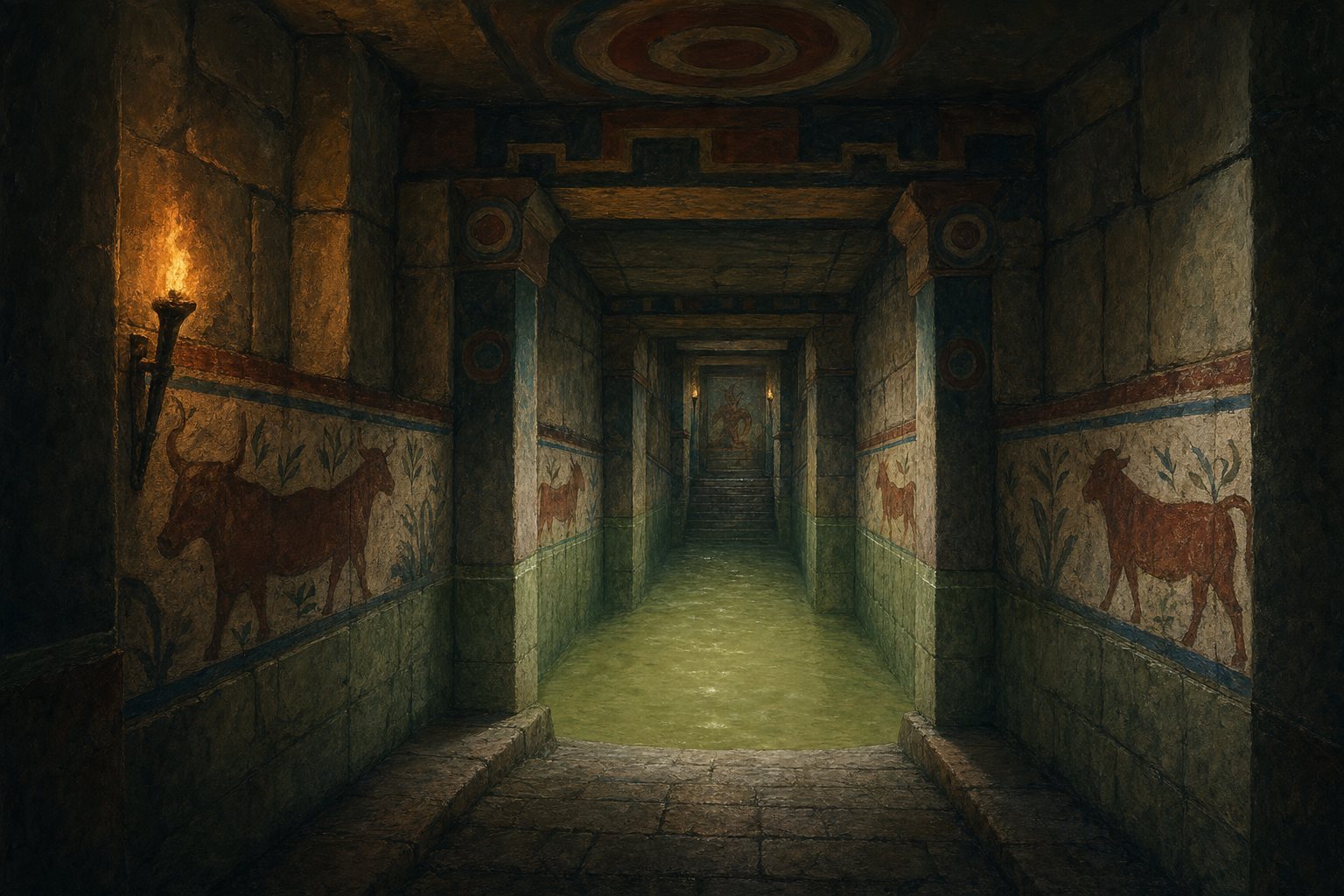
The corridor ahead of you slopes down and then up again, ninety feet of it, and the bottom of the dip is full of something that is not water. You can see the line of it against the wall — a level, oily, faintly greenish line at about the height of a man's chest, dead flat, not moving at all.
There is a lamp on the floor at the near edge, still upright, and it is out. Six feet past it, the corridor's fine grey dust has been disturbed in the shape of somebody's hands.
Far down the dip, the wall whistles once, very softly, and stops.
DM summary. Ninety feet of dead gas that pools in a dip, on a cycle that telegraphs. It is a rope-and-timing problem with an air-line valve for a party that looks up, and it has a dead crew's pack sitting in the middle of it as a bad idea made visible.
Terrain & Features
Battle map: custom map. A 90 × 8 ft dipped corridor — draw it as a line, shade the chest-high gas pool at the bottom of the dip. Browse the book if a page half fits your table better.
- Dimensions. 90 ft × 8 ft, ceiling 10 ft — a straight corridor, sloping down 6 ft to a flat bottom 40 ft long and back up again. It stays straight: from either lip the party can see the whole dip, the tracks in the dust, and the far side, and the room does not work if they cannot. Two anchor points: an iron ring at each lip, set for exactly this purpose by somebody sensible.
- Light. Whatever the party brings. An open flame gutters and dies at the gas line — that is the room's free warning and it should happen to the first torch carried in, not to a character.
- The gas. Heavier than air, seeps from a fissure at the bottom of the dip, and pools to chest height (4 ft) in the flat section. It is not poison so much as nothing: air with everything useful taken out of it, and it pulls the breath out of a held chest.
- The dust. Fine grey powder over the whole floor, undisturbed except for handprints. Anything that moves through the gas leaves a visible track, which means the party can see exactly how far the last people got.
- The air-line. A bronze pipe, 3 inches across, runs the length of the ceiling with a valve at the near lip and vents every 20 ft. It is an original fitting: the builders had to work down here too.
- The pack. At the 50-ft mark, in the deepest part of the dip, lying on its side. Somebody set it down to go faster and did not come back for it.
Traps / Puzzles / Checks
The gas, the cycle, and the valve. Every number a DM needs is in this table.
| Element | Value |
|---|---|
| Detecting the gas | Automatic. The line is visible, the lamp is out, and the whistle happens on a cycle. This hazard never ambushes anybody |
| Breathing it | 2d10 poison damage and one level of exhaustion, and the creature drops prone in the gas — which is worse, because prone is entirely inside it |
| Holding your breath | Free, but the gas pulls: at the end of each round spent with your head below the line, Constitution save DC 14 or you exhale (take the 2d10, as above). Standing upright in the flat section puts your head below the line — the party must crawl-walk, swim-crawl, or be dragged |
| Crossing distance | 90 ft total, and the 40 ft in the gas is the only part that costs anything. Two rounds at a Dash, three at normal speed, six at half speed — and half speed is what crawling under the line means, which is why a party without the valve or a rope is looking at three saves rather than two |
| The cycle | The fissure breathes on a 6-round cycle: 4 rounds low (gas at 4 ft) and 2 rounds high (gas to the ceiling, and the save becomes DC 17 and the damage 4d10). The wall whistles one round before it goes high, every time, without exception |
| Reading the cycle | Perception DC 12, or one full minute spent watching from the lip. Anybody who watches gets the whistle for free |
| The air-line valve | Spotting the pipe: Investigation DC 15 or passive Perception 15. Opening it: Thieves' Tools DC 14, or Athletics DC 16 on the seized handwheel, or two rounds with a hammer and no check at all if the party does not mind noise |
| Solved state | Valve open: the vents blow the pool down to knee height for ten minutes. The crossing costs one Constitution save DC 14 instead of three, the high phase becomes chest-height instead of ceiling, and a character who goes down can be walked out rather than dragged |
| Rope | The iron rings take a line the length of the corridor. A roped character who exhales and goes down can be hauled clear at Athletics DC 12, one round, from outside the gas. Without a rope, a rescue means going in. State that before anybody walks in unroped |
What the handprints say. Investigation DC 10, or simply looking: two sets of hands, going in, and one set of drag marks coming out. Somebody was recovered. Somebody was not, and the party will find them in the fissure alcove if they look — which is where the second half of the loot is.
Exits
Conditional — one roll on the loot table for the pack at the 50-ft mark, which costs exactly what the room says it costs: one extra round in the gas to stop, lift it, and go on, meaning one extra Constitution save DC 14.
There is no second roll. The other half of the previous crew is in the fissure alcove above the gas line (Investigation DC 13 once across), and what they have on them is a body, a name scratched into a belt-buckle, and the reason the pack was set down. Give the party that instead of treasure and do not apologise for it.
Scaling — APL 6 / 12 / 15
| APL | Adjustment |
|---|---|
| 6 | Constitution save DC 12, damage 2d10, cycle 8 rounds low and 2 high. The valve is already half open; the pool sits at chest height and the crossing costs two saves |
| 9 | As written |
| 12 | Constitution save DC 15, damage 4d10 low and 10d10 high, and the fissure has widened: the flat section is 60 ft, not 40. The valve is seized (Thieves' Tools DC 16) |
| 15 | Constitution save DC 17, damage 4d10 low and 10d10 high, cycle 3 rounds low and 3 high, and the air-line is broken 40 ft in — opening the valve now vents gas into the corridor for one round before it clears. All other DCs +3 |
- Pacing. Twelve minutes. Two of watching the whistle, two of arguing about rope, and the rest is the crossing. If you are behind schedule, hand them the valve for free (the previous crew left it half open), make it one save each, and run it in five.
- This room is the deck's suffocation room and it must never be a gotcha. Three free warnings, in this order: the dead lamp, the visible gas line, the whistle. Give all three before anybody rolls anything.
- Make somebody carry somebody. The best version of R068 is one character down at the 60-ft mark and two others deciding whether to spend a round on them with the whistle already sounding. Set that up by describing the rope rings early and then letting the party under-prepare.
- Do not let a bad roll kill outright. 2d10 and a level of exhaustion twice over is brutal but survivable at ninth level; if a character goes to 0 in the gas, they are stable and drowning-in-nothing rather than dying, and a rope-haul in the next round saves them. Say that plainly at the table if the mood turns grim.
- Table safety. This is a suffocation room, and for some tables that is a harder register than any monster in the deck. The softer framing: the gas puts a character out cold rather than choking them, and unconsciousness is the whole of it. Offer it before the first crossing, not after somebody goes down.
- Clue drip. Two objects: the bronze air-line itself, which is an original fitting and proves that the builders serviced this level from somewhere — follow the pipe (X14 or X19, Trace or Sign); and the previous crew's pack, whose contents the DM should choose to suit the live Resolution — a coil of good rope and a surveyor's chalk for X14, a wax-sealed jar for X17, a tide-table scratched on a shingle for X16.
- No warband, and nothing lives here, on purpose. Do not put a lurker in the gas. The room's tension is entirely arithmetic and adding a monster to a breath timer makes both worse.