The Honeyed Antechamber
Something sweet has gone wrong in here. The walls are furred with a black moss that has grown up out of the floor joints and over the votive niches, and every niche holds a cracked jar. The jars are weeping. What comes out of them is honey, thick and slow and going to vinegar, and it has run down the walls and pooled at the low end of the floor in a sheet you could not see the bottom of.
The moss is moving. Not in the wind — there is no wind — but in patches, the way a field moves when something walks through it.
DM summary. A votive antechamber that has become a larder, and everything in it eats. The party can spend smoke, honey, and ten minutes to walk through untouched, or they can spend hit points and a disease save each.
Terrain & Features
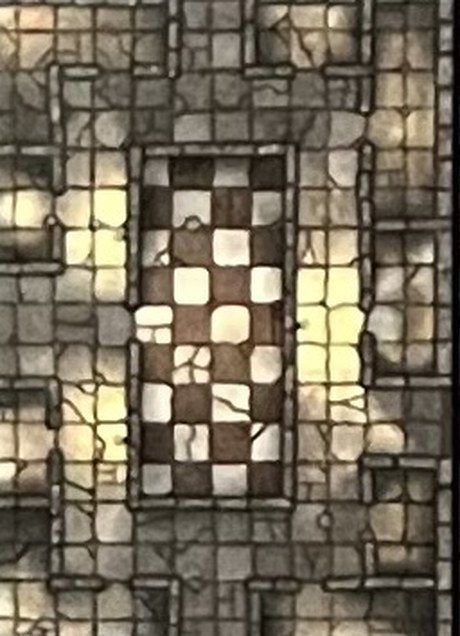
Battle map: The Chequered Rooms — page 23, 55 × 75 ft (one half of The Tiled Halls)
Take the larger chequered room at 50 × 30 ft: shade the western twenty feet as the honey sheet, hatch the north and south walls as moss to 8 ft, and tick the fourteen votive niches along them.
- Dimensions. 50 ft × 30 ft, ceiling 14 ft, sloping four feet down toward the west end. The party enters high, at the east.
- Light. Dim. Two of the votive lamps still burn, badly, in honey rather than oil, with a low blue flame that gutters and does not throw far.
- The honey sheet. The western twenty feet of floor is a pool of soured honey two inches deep. It is difficult terrain, and anything that moves through it at more than half speed makes an Acrobatics DC 12 check or goes down prone, loudly.
- The moss. Wall-to-wall on the north and south walls to a height of 8 ft. The Gnawing Swarms live in it, and it gives them total concealment until they move. Fire clears a 10-ft patch permanently.
- The niches. Fourteen votive niches, each with a jar. Eleven are cracked and empty of anything but crust. Three are intact and full — see Bypass, and see Loot.
- The rafter. A single cedar beam crosses the hall at 11 ft, put in to shore a sagging ceiling. It bears weight. Nothing on the floor can reach a creature standing on it, and the swarms will not climb to it while there is easier food.
Encounter
Six bodies, none of which wants a fight — they want a meal, and they are not particular.
| Count | Creature | XP each |
|---|---|---|
| 5 | Gnawing Swarm | 450 |
| 1 | Plague-Thing | 1,800 |
Base 4,050 XP; ×2 for six bodies = 8,100 adjusted, against the APL 9 Hard budget of 9,600. It sits 1,500 light and plays harder than that, because the Plague-Thing deals conditions rather than damage and the honey costs the party its movement. A party that fights here in the pool is fighting at half speed against things that do not have to.
Why they are not attacking yet. The swarms are feeding. The moss is thick with whatever the honey has drawn in for a decade, and a rat in a full larder does not investigate footsteps. The Plague-Thing is drifting in the pool at the low end, squatting over the richest part of it, and it notices heat and breath before it notices intent.
Round 1, if it comes to that. Two swarms pour off the north wall onto whoever is furthest into the room. The Plague-Thing does not move; it exhales, and the air over the pool goes grey. Everything within 15 ft of it makes its save. The other three swarms come off the walls at the end of round 1, one per subsequent round — they arrive hungry, not organised.
Tactics. The swarms go for whoever is bleeding, then whoever is prone. They will not leave the room and they will not follow past the honey line: outside the pool there is nothing worth eating. The Plague-Thing spreads its conditions through the swarms — anything a swarm has damaged this round is at disadvantage on its next save against the Plague-Thing — and it will not be baited out of the pool by anything less than fire.
Bypass Options
Green moss, honey crust, and a torch make a filthy smoke that the swarms cannot abide. Any open flame plus one round of feeding it — a torch, a flask of oil, a produce flame held to the wall — starts it.
- The cost, plainly: one flask of oil, or one torch consumed, or a 1st-level fire spell. This is a
resource-costbypass and the room means to charge you. - Success: the swarms retreat into the wall joints and stay there for ten minutes — long enough to cross and to work two niches. Survival DC 12 or Nature DC 12 tells a party that smoke is the answer before they burn anything; a druid, ranger, or anyone who has kept bees knows it free.
- The air. Smoke in a 50-ft room with one exit means everybody makes a Constitution save DC 11 at the end of the third round in it or spends a round coughing (no action, movement halved). Say this out loud before they light it so the choice is informed.
- Failure to keep it lit (a botched flask, a doused torch in the honey): the smoke fails halfway across and the swarms come off the wall on the round after — but only the two nearest, and the Plague-Thing stays in its pool.
The three intact jars are the toll. Break one against the moss at the far end of the hall and every swarm in the room converges on it within two rounds.
- Doing it: an Athletics DC 10 throw the length of the hall, or walk it over and set it down (no check, but you are standing next to the Plague-Thing). Nature or Insight DC 13 to work out that fresh honey outbids a decade-old crust.
- Success: the swarms are occupied for five rounds. That is enough to cross at half speed through the pool, or to cross at full speed along the rafter. Nobody rolls initiative.
- Cost: you give up one of the three jars, and the jars are this room's loot condition. Buying passage with the treasure is the intended trade and you should let them feel the arithmetic.
- Failure (the throw goes short, into the pool): the honey goes into the Plague-Thing's water and it comes out of the pool — one swarm converges, the rest stay put, and the party has one round to decide before the thing reaches them.
- Withdrawing instead: back out the way you came. The room does not pursue past the honey line. You lose this room's loot and clue, and you owe the DM a wandering-threat roll for the backtrack.
Traps / Puzzles / Checks
The jars. Recognising an intact jar from a crusted one is passive Perception 13, or Investigation DC 11 on a look. Getting one down from a niche without cracking it is Sleight of Hand DC 13; a failure costs the jar and calls one swarm to the spill.
The moss is not a hazard on its own and does not grab, bite, or spore. It is cover for things that do. Do not let it become a second monster.
Exits
Conditional — one roll on the loot table for each intact jar the party carries out, to a maximum of two rolls.
There are three jars. One is the honey bypass if they use it, and the room is built so that spending it is the smart play. A party that fights instead keeps all three, gets its two rolls, and pays for them in disease saves. Both outcomes are correct; neither is free.
Scaling — APL 6 / 12 / 15
| APL | Adjustment |
|---|---|
| 6 | Four swarms, no Plague-Thing. The pool is one inch deep and not difficult terrain. All DCs −2 |
| 9 | As written |
| 12 | Seven swarms and a second Plague-Thing at the west door. DCs +1, and the smoke lasts five minutes rather than ten |
| 15 | Seven swarms, two Plague-Things, and one Grave-Honey Flow sheeted over the rafter — which removes the rafter as a safe route and makes the room a fight in the honey. DCs +3 |
- Pacing: twelve minutes bypassed, twenty-five fought. The bypasses are the room. When you are behind schedule, hand the party the Nature or Survival read for free on entry — "the moss is full of rats and rats hate smoke" — and run it as a five-minute resource decision.
- Charge the resource and mean it. This is one of the deck's clearest attrition rooms: it is designed to take a flask of oil or a jar of loot out of the party's pockets rather than hit points off their sheets. If they get through having spent nothing, you undersold it.
- The disease is a condition, not a death sentence. The Plague-Thing's effects should be gone by the next long rest. Nothing in this room should end a character; it should make the next three rooms harder, which is worse and better.
- Clue drip. Two hooks, both physical: the votive jars are stamped with a potter's mark and a date — someone was still making offerings down here nine years ago (X06, X10) — and one niche holds no jar at all but a bundle of grey feathers, stuck in the honey, plucked and sorted by size (X17).
- Table safety. The register here is rot and vermin, not gore. If anyone at your table has a real problem with swarming insects or rats, the swarms are crab-things out of the cistern instead, which changes nothing mechanically and a great deal at the table.
- Callback. Keres & Plague (W20) never chase and never guard. If your table has met them before, the tell is that this warband has no plan: it is weather with teeth. Play them as an ecology the party is walking through, not an ambush.
Creature Cards
All three belong to Keres & Plague (W20) and recur across the deck, so the numbers live in the bestiary. The tactics above are this room's and stay here. The Grave-Honey Flow appears only in the APL 15 row and is listed so a DM scaling up has the card to hand.
Shared across rooms, so the full cards live in the bestiary: Gnawing Swarm, Plague-Thing, Grave-Honey Flow. Every mention above opens the numbers here on this page.