Carry Them Out
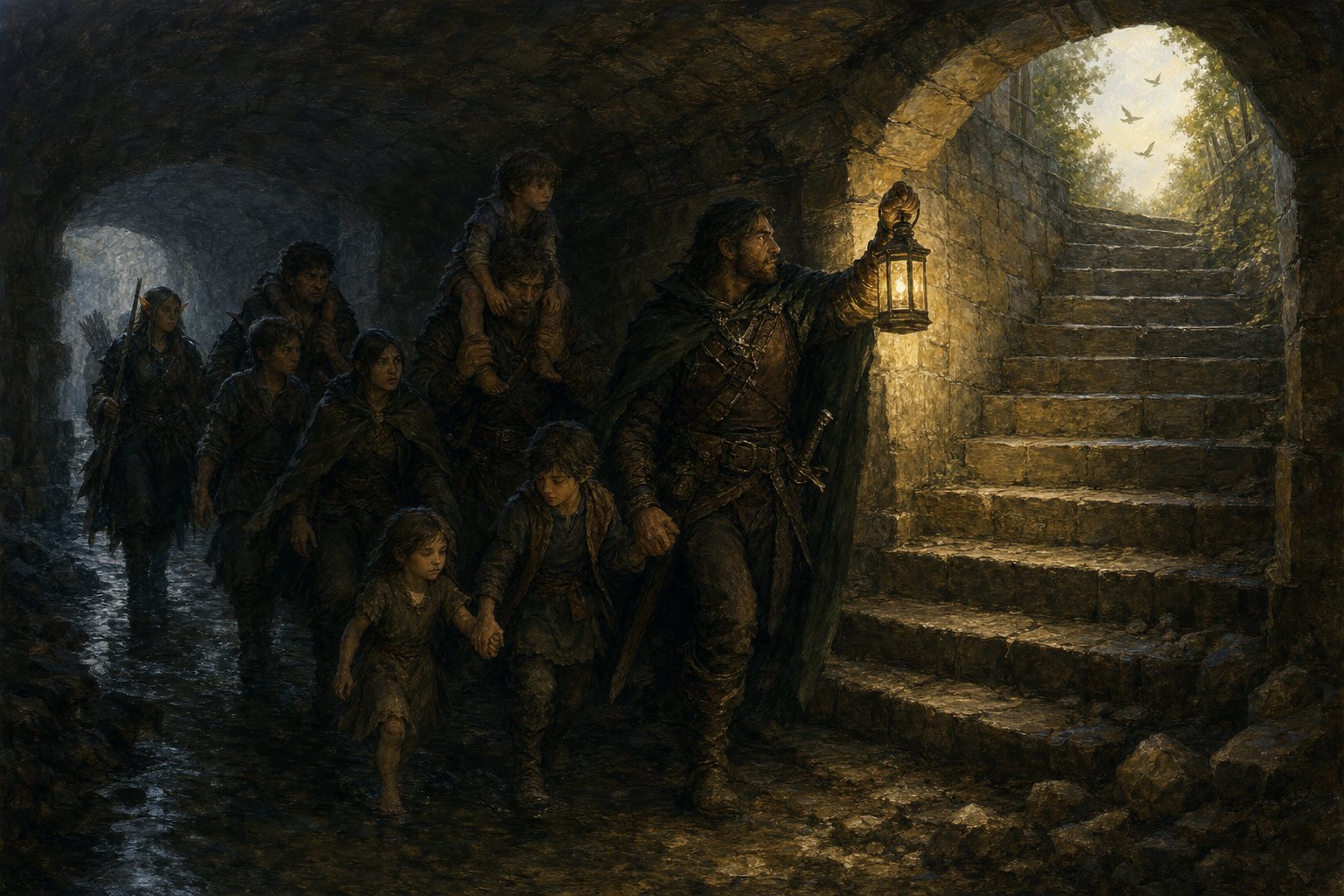
She is sitting with her back to the wall in the dark, and she has heard you coming for a long time, and she has decided what to say.
"Left, left, right, the room with the water, left, the room with the smell, right, right, and then it is the stair." She says it like a girl reciting a lesson. "That is from the room with the bronze teeth. I do not know where you came in."
The locket in your pack is a poor likeness. She has a harder face than the painter gave her.
The Way Out
Nobody maps the Labyrinth. But a person who has been inside it for nine days, alone, frightened, with nothing to do but survive and count, has learned it — not as a map, which the maze defeats, but as a sequence: turns, smells, sounds, the temperature of particular walls, the room where the water drips in threes.
The route exists only inside somebody's head, and that somebody has to walk it. They cannot draw it. They cannot dictate it usefully. They have to be there, at each junction, listening — and they have to be alive and able to travel and willing to do it with a party of armed strangers.
This is the Labyrinth's escort Resolution, and it is the only one where the way out is a person.
Requirements
| Requirement | Where it comes from |
|---|---|
| Finding them | R070 Shrine of the Missing Girl is the signpost — votives left by somebody keeping track of their own days. R091 Cell of the Chained Prophet is the alternative captive: older, madder, and better at it. R076 Alcove of the Kind Shade knows where they are and will say |
| Getting them travel-ready | Nine days of bad water and no sleep: they are at 4 HP, two levels of exhaustion, and one twisted ankle. A short rest, food, and a Medicine DC 12 fixes the body. The exhaustion is the real problem and rations are the real answer — R050 The Quiet Kitchen and R019 The Tallow Refectory exist partly for this |
| Their trust | Not a check. They have been hiding from things that walk in groups and carry weapons. They will come if the party puts weapons away, sits down, uses their name, and lets them set the pace. Roll nothing. Play the two minutes |
| A party that can escort | The route is 40 minutes of maze at a walking pace with a limping guide. Anything the party would normally run past has to be fought, talked past, or avoided at the guide's speed |
Clues
| Tier | Line to deliver |
|---|---|
| Whisper | Nine scratches on a wall, in a group of five and a group of four, at about the height of a child's shoulder. |
| Trace | A cache: a folded scrap of cloth, a knuckle of bread gone green, and a lamp-stub with an hour left in it, tucked into a niche where nobody tall would look. |
| Sign | Votives at a shrine — a hair-tie, a shoe-buckle, a bead — one for each day, left by somebody who was counting and who wanted the counting witnessed. |
| Proof | Her voice, somewhere ahead in the dark, reciting a sequence of turns to herself the way you would rehearse a psalm. |
| Path | The sequence, said out loud to the party, in full, from a landmark they recognise — and the admission that she does not know where they came in. |
| Door | The stair at the end of the recitation, exactly where she said it would be, with her standing at the bottom of it refusing to go first. |
Resolution Scene
Twenty minutes, and the decision is whether to trust a route only one person can see.
Phase one — the approach (5 minutes, no dice). They are hiding and they are good at it. Let the players find them by being quiet and unthreatening, not by rolling Perception. The scene's tone is set here: this is a person, not an objective.
Phase two — the walk (10 minutes). Six junctions. At each one the guide stops, listens for a slow ten seconds, and names a direction, and at two of the six the party's own instincts will disagree — the guide chooses the corridor that smells worse, or the one that is obviously a dead end, or doubles back through a room they cleared.
- The party may override the guide at any junction. Doing so costs one wandering encounter and puts them back where they started, and the guide does not gloat.
- One junction is genuinely wrong. The fourth. Something has changed since her last walk — a fall of masonry, a door barred, the Cartwheel Rotunda of R099 turned. She is upset by this out of proportion, because it is her one contribution and it failed. The party's job is to solve one junction for her, and the good version of this scene is a party who does that and then hands the lead straight back.
- Two encounters on the walk, neither of them optional and neither of them Deadly: the guide cannot run and cannot hide with six armoured strangers. Design them so the party's problem is protecting somebody slow, not winning.
Phase three — the stair (5 minutes). She stops at the bottom and will not go first. Nine days is long enough to stop believing in doors. Somebody has to go up and come back down and tell her it is really there.
Fallback
The guide is dead, or catatonic, or refuses, or the party never found them.
- The rhyme survives the guide. If the party spoke to them at all — even once, even through a grate — they have the sequence, badly, from the wrong starting point. R070's votives encode it too, in order, for a party who thinks to read them as a list.
- Walk it yourselves. Half speed, because the party is checking every landmark against a rhyme they half-remember, and one turn in it is wrong: at the fourth junction the party takes a wrong corridor and has to find their way back. One extra encounter, one extra hour, one wasted torch.
- Cost: the hour, the encounter, and — if the guide is dead — the entire reason a B07 party came in here. Do not soften that. Let them carry the body out; the family paid for their daughter and they will get her.
- The party still gets out. The route was always real.
Resolution-owned, never on the loot table.
- The person. That is the reward, and for a B07 party it is the whole contract. A noble house in Knossos now owes them something no coin covers.
- The counting rhyme, written down. Nine days of a frightened person's observations, which is the closest thing to a map of the Labyrinth's western range that exists. Grants advantage on any navigation check in the maze, and it is worth money to Minos's rivals.
- Their name for the maze, which is not the Labyrinth. Whatever a nine-day resident calls it, that is the name the party will use for the rest of their lives.
Scaling — APL 6 / 12 / 15
| APL | Adjustment |
|---|---|
| 6 | Four junctions instead of six, one encounter instead of two, and the guide is in better shape — one level of exhaustion, no injury |
| 9 | As written |
| 12 | Eight junctions, three encounters, and something is tracking the guide specifically — it has been hunting them for nine days and it knows their route. DCs +2 |
| 15 | As APL 12, and the guide is a liability the maze wants back: the finale's retinue has been sent for them by name. Two junctions are wrong instead of one |
- Table-safety first: this Resolution puts a captive, frequently a child, in danger, and it is entry-linked to the tribute Beginning. Check in before you run it. If the table would rather not, age the captive up — the surveyor from R091, a sailor, a priest — and change nothing else. The mechanics do not care and the scene works identically.
- She is not cargo and she is not a quest item. Give her opinions, a bad joke, one thing she is wrong about, and a strong preference about which corridor smells worst. The players will fight much harder for a person than for an escort mission.
- The fourth junction is the design's whole hinge. Her route fails once, in front of everybody, and the party gets to be useful to her instead of the reverse. Do not skip it and do not let it be easy.
- Never make overriding the guide correct. If the party second-guesses her they should lose time, never gain it. The one exception is the fourth junction, where she is genuinely stuck and knows it.
- The refusal at the stair is the ending, not the stair. Somebody climbs, sees the sky, comes back down into the dark on purpose, and tells her. Let a player do that, and then stop talking.
- If the party is out of time, three junctions, one encounter, and the stair. Ten minutes, and keep the refusal — it is eight seconds long and it is the best part.