Alcove of the Kind Shade
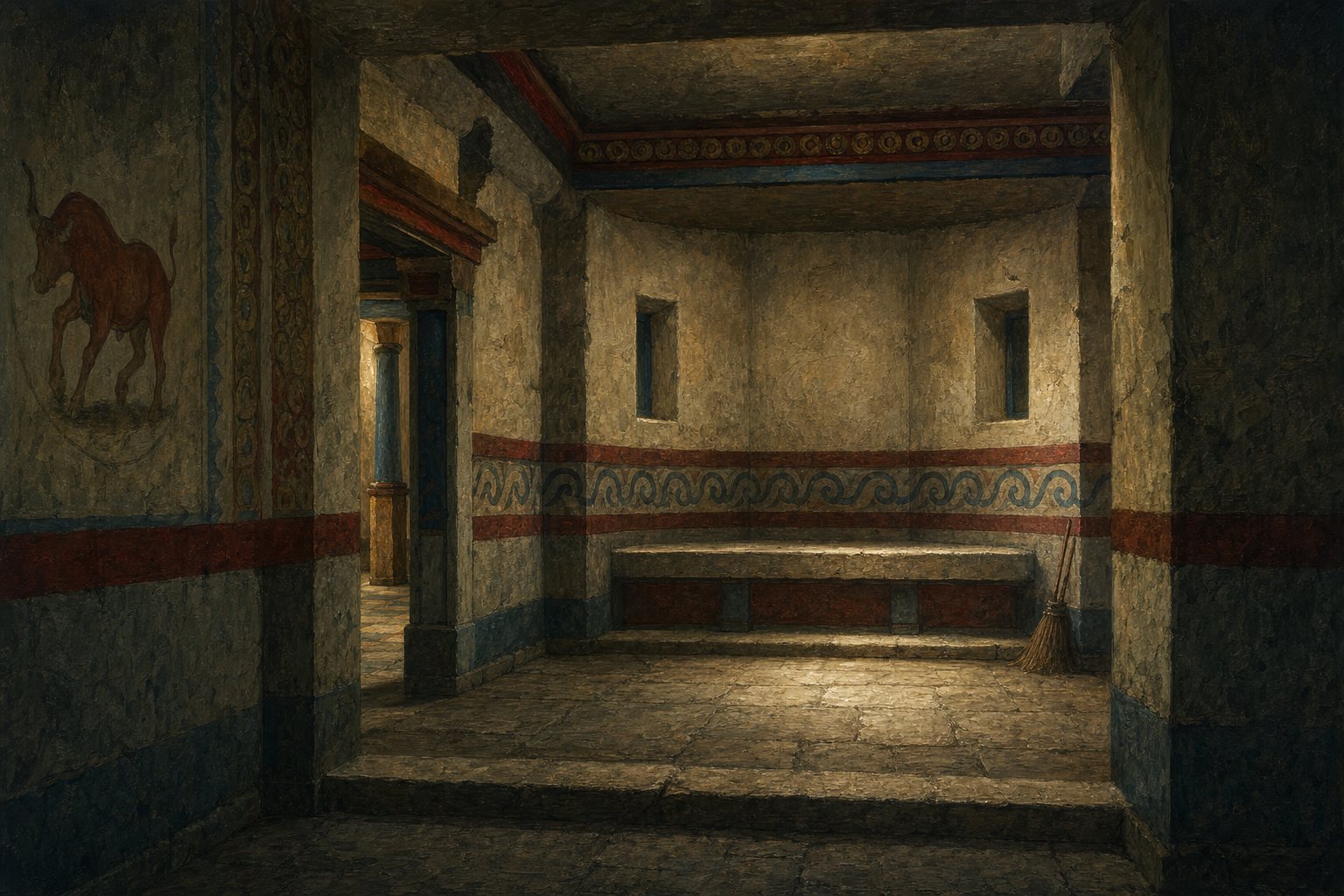
The corridor widens into a stone alcove with a bench in it, the sort of place a guard would have stood, or a servant would have waited. Somebody has swept it. The dust is in a neat line against the far wall and there is nothing in this maze that sweeps.
A young woman is sitting on the bench with her hands in her lap. You can see the wall through her. She looks up when your light arrives, and she does not stand, and she does not stop smiling, and what she says is:
"Oh, good. Come in, come in, there's room. Would you tell me — is it summer up there? I've rather lost the thread of it."
DM summary. Ligeia has been dead in this alcove for a very long time and she is glad to see people. She wants nothing, threatens nothing, answers what she can, and will sit with the party while they rest. She is the only friendly dead in the maze and the entire point of her is that the party gets to put their weapons down.
Terrain & Features
Battle map: custom map. A 15 × 12 ft alcove with a bench — sketch it and pull up a chair for the conversation. Browse the book if a page half fits your table better.
- Dimensions. The alcove is 15 ft × 12 ft off a corridor, ceiling 9 ft. Cramped, on purpose: four people and a bench, and everybody else in the corridor leaning in. The party will end up sitting on the floor, which is the correct posture for this room.
- Light. None until the party brings some, and she is very pleased about the light. She has no objection to it, she does not dim it, and she will ask somebody to hold a lamp up so she can see their face.
- The bench. Stone, three feet deep, dry, and long enough for two beside her. It has been swept. She cannot touch anything — the sweeping is two centuries of her moving air across it, patiently, and she is a little proud of the result.
- The line of dust. Against the far wall, in a heap, and it is the only thing in the room she has ever accomplished. If somebody says something kind about it, she will talk about it for a minute and a half.
- The nine names. Scratched low on the west wall, at sitting height, in nine different hands. Nine people have sat on this bench long enough to carve their names and then gone on. She knows all nine and can say them, and she will say what each of them was carrying and which way they went.
- Her threshold. She cannot cross the line of the alcove's arch and has never been able to. She does not make a tragedy of it. She has looked at that arch for a very long time and she is done being upset about it.
What She Gives
Nothing is bought here, nothing is bargained for, and there is nothing to roll.
- A short rest, safely. One short rest is available here, and while Ligeia is sitting with the party nothing wanders in. Skip the wandering-threat roll entirely; she watches the corridor and she will say, quietly, if she hears something. She has never been wrong.
- Straight answers, as far as she has them. She will answer anything the party asks about the maze as it was in her life and as she has heard it since. She hears a great deal: the alcove is on a corridor and things walk past it, and she has had two hundred years with nothing to do but listen. She does not lie, does not hedge, and does not speak in riddles. Where she does not know, she says "I don't know," which is a sentence the party will not have heard from anything else down here.
- What she genuinely knows: which of her two exits the water is behind and which is dry; what has walked past in the last day and how many legs it had; the nine names and what became of the ones who came back past her; and where the ones who are still alive down here are. That last is the important one — see the DM Notes.
- What she does not know: the way out. She has been looking for two hundred years and she will tell the party so without self-pity, and she will help them look. Do not let her solve the session. She is a witness, not a map.
- What she asks for: whether it is summer. Whether the fig tree by the Amnisos road is still there. Whether anyone still sings a particular song, and if a player will hum it. That is the whole of her price and it is not a price.
Traps / Puzzles / Checks
None, and this is the only room in the batch where that sentence is the design.
There is nothing hidden in this alcove, nothing to detect, no test of the party's manners, and no second-act reveal in which she turns out to have been feeding on them. Ligeia is exactly what she appears to be. If your players spend ten minutes checking her for a trick, let them find nothing at all, and let one of them notice that they have started assuming.
Exits
None, and she has nothing to give. Two hundred years in a stone alcove and she owns a bench, a heap of dust, and nine names on a wall.
If a player leaves something with her — a coin on the bench, a flower they have been carrying since the vineyard, anything — she cannot pick it up and will look at it for the rest of her existence. Say that gently, after the party has gone, in one sentence, and then never bring it up again.
- Pacing. Twelve minutes, and it is all conversation, which makes it the perfect room to roll after something that hurt. If you are behind schedule, run it in five: the greeting, the question about summer, the short rest, one useful answer, and the stair. Do not cut the question about summer.
- Play her happy. Not tragic, not sinister, not wistful — happy, in the way a person is happy when the door opens after a long day. She talks slightly too much. She interrupts herself. She asks people's names and uses them. The players will be waiting for the catch for about four minutes, and the moment they stop waiting is the moment this room earns its slot in the deck.
- She is the deck's answer to a table that has stopped trusting anything. After eight rooms of mechanisms and teeth, one dead girl who is simply glad of the company resets the emotional baseline, and the rest of the maze gets scarier for having a contrast. Guard that. Never make her a betrayal.
- The X05 line is the most useful thing she says. If Carry Them Out is live, she knows there is a child alive in the maze, she knows roughly where, and she will say so without being asked cleverly — she has been worrying about it. That is Proof or Path tier, delivered by an NPC's mouth, which is exactly what the clue cadence prescribes for a party who has missed three clues in a row.
- Clue drip. Two things here carry a clue: the nine names on the wall at sitting height, with what each of them was carrying (X10, X17, or X14 — pick the live one and let one of the nine have been carrying its requirement), and Ligeia herself, who is a witness to two hundred years of this corridor and can be asked a direct question (X05, Proof or Path).
- If X12 is live, she is on the list. Bring It Down Behind You requires the party to say out loud what they are doing about the people they have met and left alive down here, and she is one of them. She will tell them to do it anyway. She will say that she is not in the maze, she is in this alcove, and the alcove has held for two hundred years and will hold for two hundred more, and then she will change the subject because she can see they are upset. Let the players decide whether to believe her.
- Table safety. None needed, and that is worth noticing in a deck of drowning pools and petrified children. This is the room you point at when somebody asks whether the Labyrinth is relentlessly grim.
- Warband callback. Shades of the Maze (W09) reenact, ignore the silent, and hunt by sound. Ligeia does none of it. A party who has crossed a gallery holding their breath and then meets a ghost who is delighted to hear them talk has just learned that a warband is a set of tactics, not a moral category — and that is the best thing this room does that is not simply kindness.