The One-Eyed Smith and His Bronze Herd
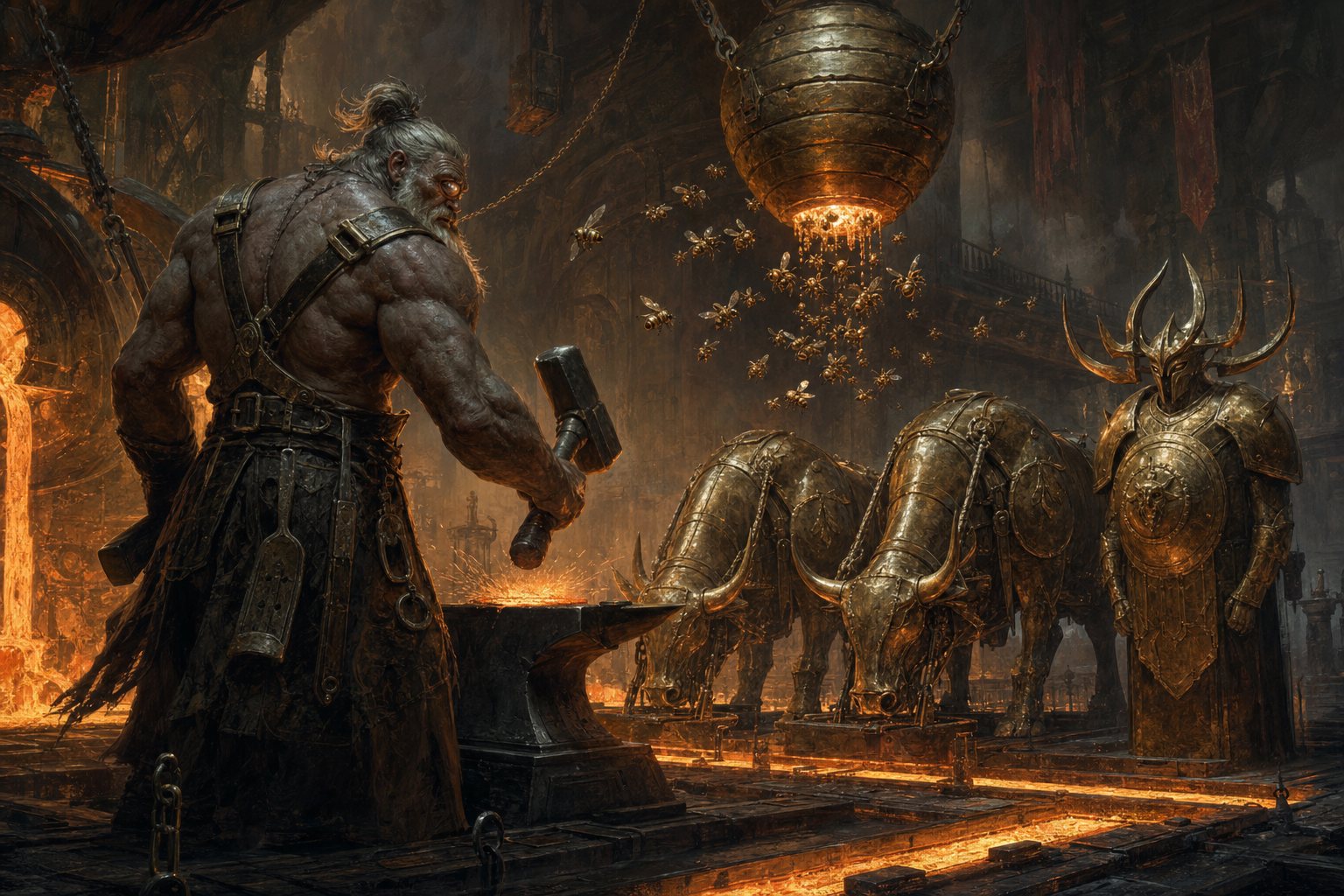
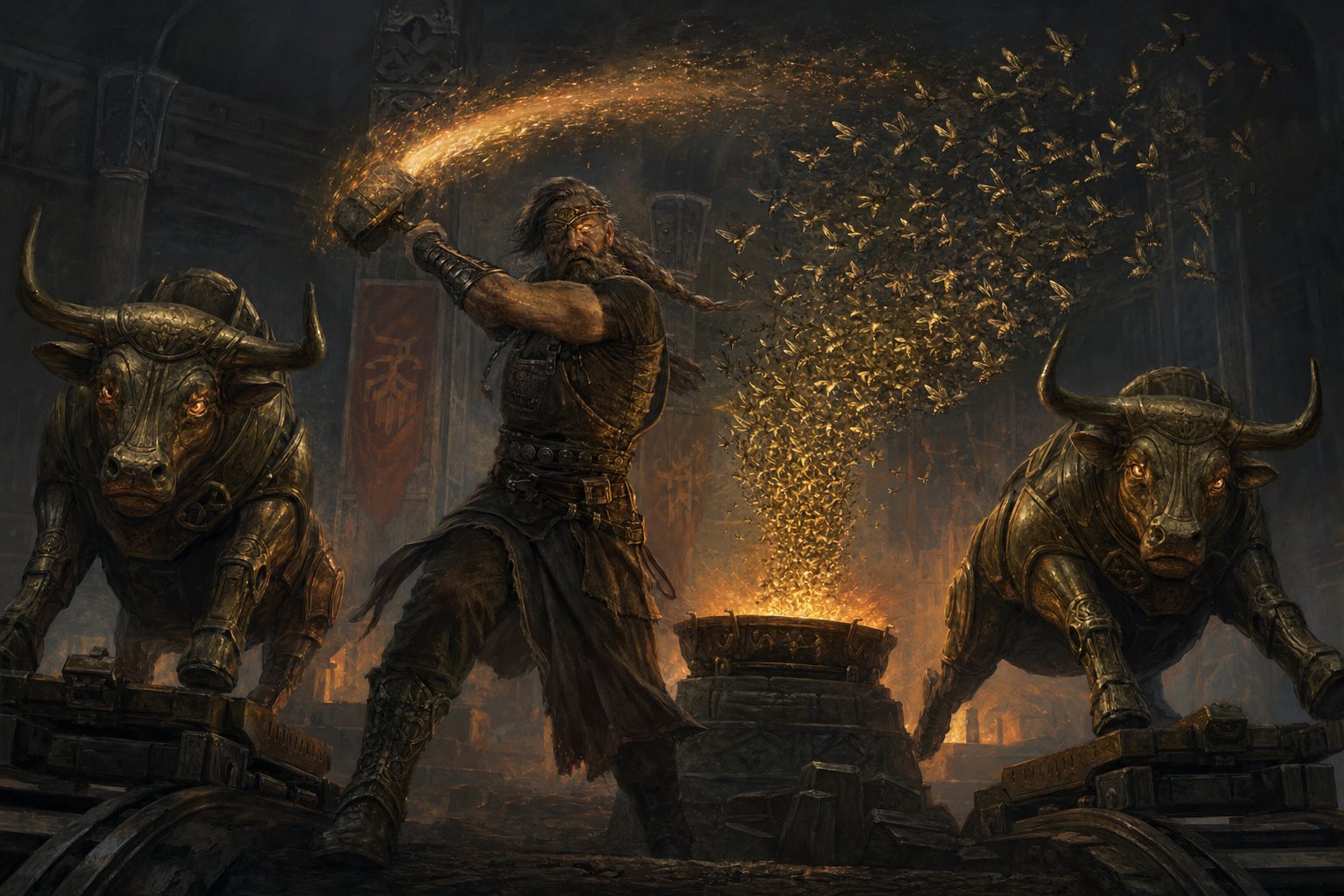
Heat first, then the noise: a bellows breathing somewhere, and the slow clank of something heavy walking a circle it has walked a great many times. The foundry is enormous and tidy. Rails run across the floor in long bright curves, worn silver, and on the rails a bronze ox is going nowhere in particular.
At the anvil stands a cyclops in a scorched apron, one eye milky, the other fixed on you. He sets the hammer down. He wipes his hands. He turns to a lectern beside the forge where a bronze ledger lies open, licks a thumb out of old habit, and says, with terrible politeness:
"What are you called?"
DM summary. A smith who has been alone so long he has started forgetting the words for things, and who will trade the way out for names to write down. The herd is not hostile. It becomes hostile when he says so, and he would rather not have to say so.
The Boon
The Amnisos MusterOptional knowledge
Sixty real names on a torn palace roll, which buys the gate without the party giving their own
What it is. A torn leaf off a palace roll: oxhide, ruled in columns, sixty names in three clerks' hands with a ration figure beside each. The Amnisos Muster is a harbour work-gang — oarsmen, a plaster-gang, two women who kept the tally — written out for a season nobody remembers. Every name belonged to somebody, and none of it is worth a copper to anyone alive.
Where it comes from. Early: a lore room's shelf, or the second thing on a loot roll from a chest of documents; a lost wanderer carrying rolls he cannot read trades it for water and a direction. Late: it is packing material in this foundry, wrapped round a crate by the quench trough. Hand it over as rubbish, which is what it is; nobody should learn they hold sixty names until Halkeus tells them.
What it does here. He asks for six names, one per traveller. This is sixty, it is genuine, and he can tell — so offered in Phase 1 the trade lands with no check. He takes it to the lectern and strikes all sixty into bronze before he does anything else, mouthing each one: several minutes of a giant saying strangers' names correctly, and the best thing in this room. Then the herd-gate opens. What the party keeps is the price below — their own names stay out of the ledger, no automaton of W03 ever learns them, and the PC who would not give a name never has to refuse.
What it doesn't do. It buys the gate and not the herd, and that is the trade rather than a discount. Six names were what told the oxen who these people are; sixty strangers' names tell them nothing, so nothing is hung on the yokes and the party crosses live rails as strangers, with the herd keeping its lanes and its speed. Nor does it help them fight: he fights no worse for having it, and the trade is off the moment the ledger is threatened. Names invented at the table are not this — a forged list is a lie he catches on Insight DC 16, which is the rude refusal and Phase 2. A party who never finds the roll makes the bargain exactly as written.
Card and numbers or jump to the card ↓
Arena
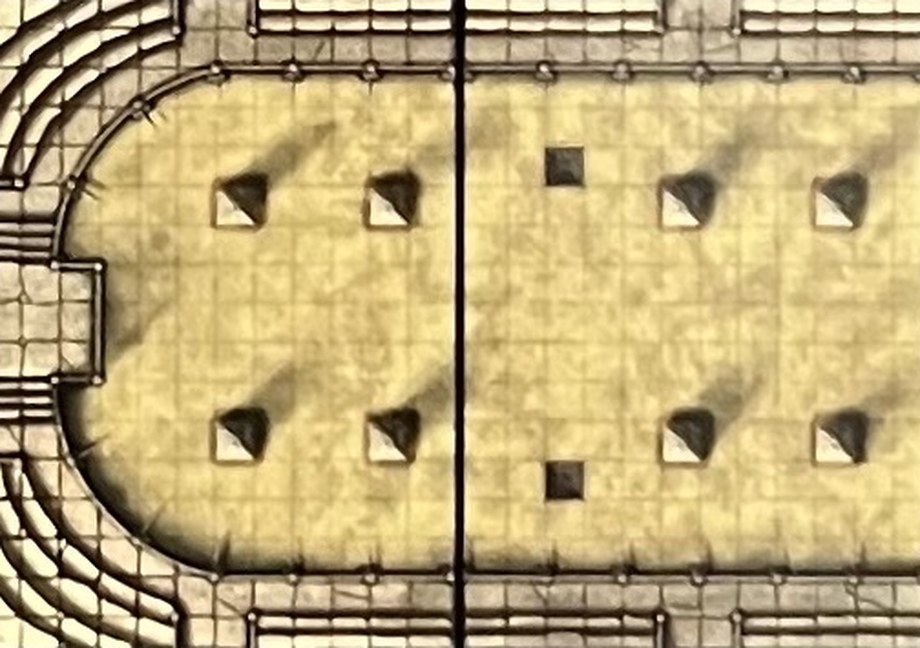
Battle map: The Hippodrome — pages 31 & 32, 110 × 75 ft
The hippodrome's rails are his rails: the printed track curves are the four bronze charge rails crossing the 80 × 70 ft works. Draw the forge and swing-arm crucible at the north-east, the 20-ft quench trough along the west wall, and the smoke hood over it all.
- Dimensions. 80 ft × 70 ft, ceiling 30 ft, with a smoke hood over the forge drawing up a shaft in the north-east corner.
- Light. Bright within 40 ft of the forge, dim at the walls. Everything is orange and everything has two shadows.
- The rails. Four bronze rails set flush in the floor in long shallow curves, crossing the room. The Bronze Oxen only move on the rails, at speed, in their lane. Standing on a rail is dangerous and standing between two is safe, and the party will work this out in about one round — which is exactly the Daedalan Automata deal: observation beats them, damage barely does.
- The crucible. A clay-lined crucible the size of a bathtub, hanging from a swing arm over the forge, full of molten bronze. The arm swings 25 ft. Tipping it (an action for Halkeus, Athletics DC 18 for anyone else) lays a line of molten bronze 30 ft long and 5 ft wide across the floor: 22 (4d10) fire damage on entry or on starting a turn in it, and after two rounds it cools to impassable ridged terrain that reshapes the room.
- The quench trough. 20 ft of standing water along the west wall. Anything red-hot dunked in it throws a cloud of steam: heavily obscured 15-ft radius for one round, and it is the only thing in here that blinds a Clockwork Sentinel.
- The bellows. A double bellows on the smith's blind side, worked by a foot treadle. Jamming it (Thieves' Tools DC 13, or a spear through the leather) drops the forge heat: the crucible cools in four rounds and cannot be poured, and Halkeus notices immediately and is genuinely upset.
- The ledger. Bronze sheets on rings, on a lectern, holding four hundred years of names in five scripts. This is the room's real object. He will not let it be damaged. He would let the party leave, unpaid, rather than see a page bent — and if they threaten it he stops being polite for the only time in the scene.
Roster & Budget
One smith, and a herd that is standing right there and is not doing anything.
| Count | Creature | XP each |
|---|---|---|
| 1 | Halkeus, the One-Eyed Smith (boss) | 7,200 |
| 2 | Bronze Ox | 1,100 |
| 1 | Clockwork Sentinel | 1,800 |
If he never calls the herd: 7,200 base ×1 = 7,200 adjusted, half the APL 9 Deadly budget of 14,400. He is a hard fight and not a deadly one on his own, and a party that jams the bellows and keeps him off the crucible will beat him.
If he calls the herd: base 11,200, ×2 for four bodies = 22,400 adjusted, 1.6× budget, with the rails and the molten bronze on top. That is the price of the wrong answer, and it is stated here so you can state it at the table.
The oxen are on the rails when the party arrives and will keep pacing their lanes throughout the conversation. Describe them going round. They are a clock nobody has started yet.
Phases / Clock
| Phase | Trigger | What visibly changes |
|---|---|---|
| 1 — The Ledger | On arrival | He asks names. He writes. Nothing else happens, for as long as the party will let it. The oxen pace. He offers water, which is clean |
| 2 — The Herd | An attack, a theft, a lie he catches, or a flat refusal delivered rudely | He says one word — a name, in a language nobody knows — and the oxen leave their lanes for the first time in a century. The Sentinel comes out of the alcove behind the forge |
| 3 — The Pour | Halkeus drops to half HP (98) | He swings the crucible and pours. The room is cut in two by a river of molten bronze, and he fights on whichever side the ledger is |
Round one, whichever way it goes. He asks their names and he waits. If they answer, he writes each one carefully in bronze with a stylus, mouthing it, and thanks them individually. If they attack, he puts his body between the party and the lectern before he swings at anybody. Both versions tell the table exactly who he is inside ten seconds.
Combat Resolution
Fighting him is entirely available and slightly shameful.
- Tactics. He fights in front of the ledger and gives ground toward it, never away. He throws ingots at anyone at range, and he is bad at it beyond 30 ft — one eye, no depth. He will not swing a wide blow near an ox, and he will not pour molten bronze across a rail his herd is standing on. His care for the herd is a tactical weakness and you should let the players exploit it.
- The eye. The milky one is dead; the good one is a target. A called ranged attack at AC 20 that deals 25 or more damage blinds him for one minute (a DC 16 Constitution save at the end of each of his turns ends it early). Blind, he keeps swinging, but he will not move — he cannot risk stepping on his own animals.
- The herd. Oxen are only dangerous in their lane and only while they have a straight run; break a rail (AC 17, 20 damage, or a crowbar and Athletics DC 15) and that ox is out of the fight, standing still and lowing. The Sentinel is on a fixed patrol until steam blinds it; damage barely matters to it and positioning does.
- What winning looks like. Halkeus down, or the herd broken and Halkeus stopping. He surrenders. At a quarter hit points he kneels, puts the hammer on the floor, and asks that the ledger be left where it is. A party that kills him after that has done something the maze will not punish them for and the table will remember anyway. Five to seven rounds, 30 minutes.
- What losing looks like. He does not pursue past the rails and he does not finish the fallen. He drags unconscious PCs clear of the bronze, which is the most unsettling thing he does all scene.
Alternate Resolution
A name for a passage. Roleplay, and the cost is real.
He wants names, spoken aloud and given freely, to write in the ledger. He is four hundred years down here, he has forgotten the word for sister, and the ledger is the only thing standing between him and being a machine that hits metal. He will trade the way out for six names — one per traveller.
The bargain, as he states it: "Your name, said properly, and I will strike it in bronze, and the herd will know you, and you may go through the herd-gate. Anyone who will not give a name may go back the way they came, and I will not stop them, and I will not open the gate."
| What the party offers | Result |
|---|---|
| Their true names, freely given | The gate opens. He stamps six bronze tags and hangs them on the oxen's yokes. The cost: any Daedalan automaton in this maze or any other can now read those names, and knows them. A named party can never again surprise a construct of W03, anywhere, and any such construct that has orders about them will act on those orders. That is a real price and it should follow them out of the session |
| False names | Insight DC 16 against the lie. He is not stupid and he has heard four hundred years of liars. Caught, he closes the ledger — that is the rude refusal, and it is Phase 2 |
| Five names and one refusal | He opens the gate for five and says, sadly, that the sixth may follow but the herd will not know them. Mechanically: that PC is attacked by any W03 automaton the party meets for the rest of the run, once, at the DM's convenience |
| A better trade | He will accept, in place of a name: a word he has lost (offer him sister, harvest, April, and mean it — Persuasion DC 15), a working song sung all the way through (Performance DC 16), or news of his brothers, true or kindly invented (Deception DC 18; if the lie is kind he lets it stand even if he catches it) |
| The name of the man who blinded him | He goes very still. There is no check. He opens the gate, gives them a bronze tag of his own making, and does not speak again for the rest of the scene. If nobody in the party has any idea who blinded him, this option simply never comes up — do not fish for it |
If the party is carrying the Amnisos Muster, it goes in the first row of that table and not the second: sixty real names, freely handed over, satisfy the bargain and open the gate, and no PC's name enters the bronze, so the campaign price in the first row is never paid. It is a trade and not a discount, and the herd is what they trade. Nothing is hung on the yokes, so the oxen are never told who these people are — the sixth-traveller clause in the third row, applied to all of them. The party leaves across live rails, with a herd keeping its lanes and its speed and giving way to nobody. Let him read the roll first. The scene is the reading, and it is longer and better than the negotiation it replaces.
Solved state. The herd-gate in the west wall grinds up on a counterweight. He returns to the anvil and starts hammering before the party is out of the room.
Scaling — APL 6 / 12 / 15
| APL | Adjustment |
|---|---|
| 6 | Halkeus at −25% HP (146), no Quench, and the crucible is already cool. One ox, no Sentinel. All DCs −2, and he asks for three names, not six |
| 9 | As written |
| 12 | Halkeus at +25% HP (244) and a third legendary action. Three oxen, two Sentinels, and the crucible refills from the forge two rounds after a pour. DCs +1 |
| 15 | Halkeus at +50% HP (293), a lair action on initiative 20 (a rail-switch throws: every creature standing on a rail makes a DC 17 Dexterity save or is struck for 16 (3d10) bludgeoning and knocked prone), and a second phase at a quarter HP where he takes the crucible off its arm and carries it. Add a Swarm of Bronze Bees from the smoke hood. DCs +3 |
Exit to the Resolution
- Pacing. 30–40 minutes if they talk, 30 if they fight. Behind schedule: he asks for one name from the whole party and opens the gate. Ten minutes, and it still lands, because the beat is the asking, not the negotiating.
- Play him slow and courteous. He is not menacing and he should not be played as menacing. He is a very large, very old, very lonely craftsman who will kill everyone in the room if the ledger is threatened, and the players should feel bad about the possibility long before it comes up.
- The names matter after tonight. If your table plays the Labyrinth as a campaign spine, write down what they gave him. Bringing back a construct in three sessions that greets a PC by name is worth more than any loot in this book.
- If the party is too strong, do not buff him. Call the herd early and pour the crucible on round two. The room does the work.
- Table safety. Molten metal, burns, and a mutilated eye. Nothing here needs a graphic description; the eye is milky, not ruined, and the bronze is described by its light rather than by what it does to a person.
- Clue drip. This finale delivers the Path tier. Two objects: the ledger, which contains every name ever given in this maze including one the party has been hunting (X05 Carry Them Out, X10 Ariadne's Thread — she gave her name at this lectern and he remembers her hands), and the workshop itself, which is Daedalan and has the frames, wire, and wax for wings racked by the quench trough (X17 The Wings of Icarus, X20 The Bronze Bird).
- Callback. A party that argued with the Bronze Warden in the atelier (R056), watched the oxen on their rails (R074), or bargained with a cyclops at the forge (R023) is meeting the two halves of that experience at once: an automaton logic that can be reasoned with, and a giant who would genuinely rather talk.
Boon Card
The Amnisos Muster
Knowledge · a torn leaf of a palace muster roll, sixty names in three hands · optional, and never on the loot table
AC 5, 1 hit point, and one spatter from the crucible ends it | Names sixty | Weight negligible
Appearance: a hide leaf a foot square, ruled in columns, ration figures down the right margin, torn along the top where it came off the roll — oarsmen, hod-carriers, a plaster-gang, two tally-women, and a boy listed twice
Sixty Ordinary Names. Real people, none of them present, none of them owed anything by the party. Reading the roll aloud takes about four minutes. Any character who can read Linear B, or who spends ten minutes with someone who can, learns that it is a harbour muster and nothing more.
He Can Tell the Difference. Halkeus knows a true roll from an invented one on sight and accepts this one with no check. A forged list, or sixty names made up at the table, is a lie he catches on his Insight DC 16, and he closes the ledger: that is the rude refusal, and it is Phase 2.
It Buys the Gate, Not the Herd. Offered during Phase 1, it satisfies his bargain in place of the six names he asks for, and he opens the herd-gate. What it cannot do is what the six names were for: no PC's name is struck in bronze, so the herd is never told who these people are. The oxen keep their lanes and keep their speed, and the party crosses the rails as strangers rather than walking through a herd that has been introduced to them.
Nobody's Name in the Bronze. No automaton of W03 ever learns the party's names or takes orders about them, anywhere, which is worth a great deal and costs exactly what it sounds like: no construct of W03 will ever pass them on a name either, here or in any other maze.
He Will Stop Everything to Read It. He takes it to the lectern and copies all sixty before he does anything else, and he will not be hurried. The party may move about the foundry while he works, which is when the wing-frames by the quench trough and the older pages of the ledger are theirs to look at unwatched.
What It Is Not. It is not leverage, not a weapon, and not worth a copper to anyone but him. It grants no bonus to any check, buys nothing from the herd, and is void the instant the ledger is threatened or a blow is struck.
Hand It Over. One character offers the leaf and says what it is. No check, no roll, no initiative — this is the entire mechanic, and it should take one sentence at the table.
Creature Cards
Halkeus is unique to this foundry. His herd is Daedalan Automata (W03) and runs throughout the deck, so those numbers live in the bestiary.
Shared across rooms, so the full cards live in the bestiary: Bronze Ox, Clockwork Sentinel. Every mention above opens the numbers here on this page.
Halkeus, the One-Eyed Smith
Huge giant, neutral · CR 11 (7,200 XP)
AC 16 (bronze apron and greaves) | HP 195 (17d12 + 85) | Speed 40 ft.
Saves Str +11, Con +9 · Details Insight +5, Perception +5 · Resistant to fire · Darkvision 60 ft.
One Eye. He has disadvantage on attack rolls against targets more than 30 ft away and on Perception checks that rely on sight at that range. A creature that attacks him from his blind left side has advantage until he spends a turn repositioning.
He Will Not Risk the Herd. He never uses an area effect, a wide swing, or the crucible where it would touch one of his own automata, and he will not move at all while blinded. Damaging an ox in front of him gives him disadvantage on his next attack roll, because he is looking at the ox.
The Ledger. He knows the name of every creature written in the bronze ledger and can always tell whether one is being spoken truly. While the ledger is threatened he loses Trait — He Will Not Risk the Herd and uses everything he has.
Legendary Bearing. He takes two legendary actions per round, spent at the end of another creature's turn, and regains them at the start of his.
Multiattack. Two attacks with the forge hammer, or one hammer attack and one thrown ingot.
Forge Hammer. Melee, +11 to hit, reach 10 ft, one target. Hit: 20 (3d8 + 7) bludgeoning damage plus 4 (1d8) fire damage if the hammer is hot, and the target makes a DC 17 Strength saving throw or is pushed 10 ft.
Thrown Ingot. Ranged, +11 to hit, range 60/240 ft, one target. Hit: 20 (3d8 + 7) bludgeoning damage. The ingot lands hot and the square it lands in deals 5 (1d10) fire damage to anyone entering it for one round.
Quench (recharge 5–6). He plunges hot metal into the trough. Steam fills a 20-ft radius centred on the trough: the area is heavily obscured until the end of his next turn, and each creature in it makes a DC 17 Constitution saving throw, taking 18 (4d8) fire damage on a failure or half as much on a success.
Catch It. When a creature within 10 ft would take an attack of opportunity from him, he may instead grab it — a DC 17 Strength saving throw or the creature is grappled and moved 10 ft, usually away from the lectern.
Call the Herd. He speaks one automaton's name. That construct immediately moves up to its speed and makes one attack.
Swing the Crucible. The crucible arm sweeps 25 ft. Every creature under its arc makes a DC 16 Dexterity saving throw, taking 11 (2d10) fire damage on a failure from spatter.
Pour. Costs 2 actions. He tips the crucible, laying a line of molten bronze 30 ft long and 5 ft wide. Entering the line or starting a turn in it costs 22 (4d10) fire damage. After two rounds it is cold, ridged, impassable to wheels and rails, and difficult terrain for everyone else.