The Marble Choir
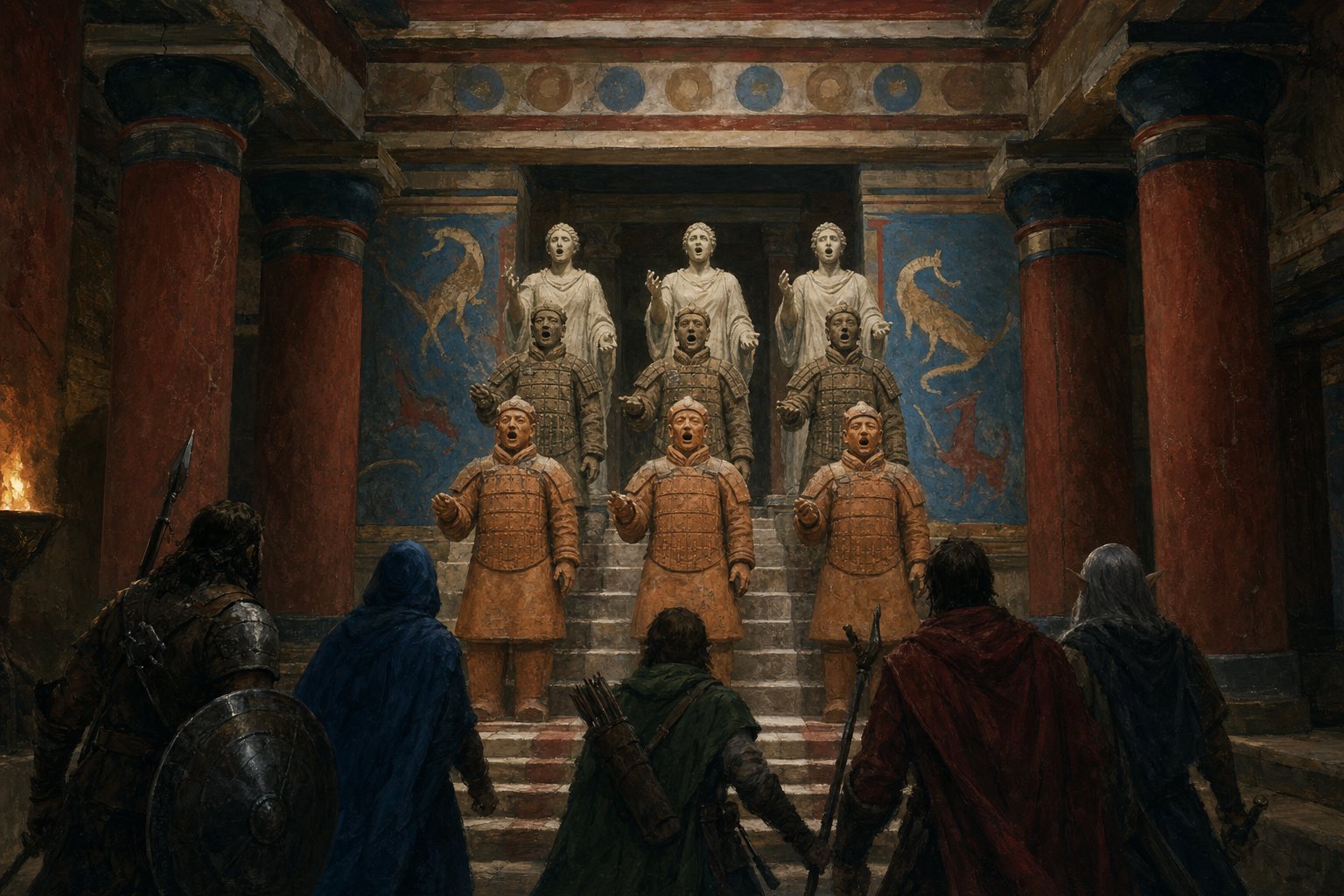
Nine figures stand on the choir steps of a temple the maze grew around, arranged in three ranks of three, mouths open. The three nearest you are fired clay, cheap and orange and repaired at the shoulders. The six behind them are marble. Above all of them, on a fluted plinth, stands a tenth, taller, one arm raised and bent at the wrist as if it had just brought something in on the beat.
The room is not silent. There is a hum in it, low and even and coming from everywhere at once, the sound a wet finger makes on the rim of a cup — and it has been going on, without a breath, for a very long time.
DM summary. The choir sings, and while it sings the song is the initiative order. Toppling the Choirmaster's plinth stops the music and hands the fight back to the party.
Terrain & Features
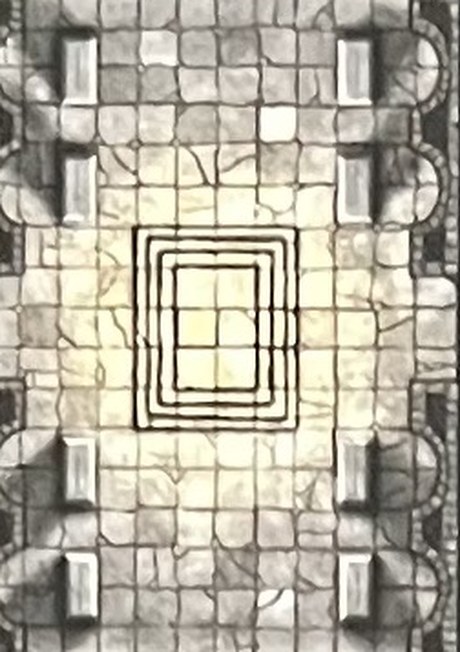
Battle map: The Altar Steps — page 27, 55 × 75 ft (one half of The Grey Warrens)
The printed steps and raised platform are the choir steps and the plinth's top step exactly. Draw the plinth as a 3-ft circle up there, and mark the colonnaded gallery as a 12-ft-up ledge line along both long walls.
- Dimensions. 60 ft × 40 ft nave, ceiling 30 ft. Three choir steps rise 18 inches each along the east end; the plinth stands 8 ft above the top step.
- Light. Bright. Twelve alabaster panes in the clerestory pass a milky daylight from lightwells above — enough to read by, and it does not go out.
- The choir steps. Difficult terrain going up, and a creature knocked prone on them slides down one step. Nine figures stand on them in ranks of three: three fired-clay soldiers on the lowest step, three marble choristers on the middle, three more marble at the top. Clay in front, marble behind — which is what anybody would do with nine bodies and only six good voices.
- The plinth. Fluted marble, 8 ft, 3 ft across at the base, standing free on the top step. AC 15, 30 HP, immune to poison and psychic. It is not fastened down. It has been upright for four hundred years because nothing has pushed it.
- The gallery. A colonnaded walk at 12 ft runs the north and south walls, 4 ft wide, reached by a stair behind the altar screen. From the north gallery a standing figure is level with the plinth's top and 10 ft from it.
- The altar screen. A pierced marble slab across the nave's north-east corner, 6 ft high — total cover, and it will take one good hit before it stops being a wall.
- The nave floor. Old, and it rings. Anything dropped here is heard by everything in the room.
Encounter
One rank of clay on the floor, six marble voices still standing, and a Choirmaster who never throws a punch.
| Count | Creature | XP each |
|---|---|---|
| 3 | Terracotta Soldier | 700 |
| 1 | Choirmaster of the Plinth | 3,900 |
Base 6,000 XP; ×2 for four bodies = 12,000 adjusted, against the APL 9 Hard budget of 9,600. That is a quarter over the line and the plinth is why: it is a stated, visible, one-action off switch standing in the open.
Two other numbers a DM should have in front of them:
- Plinth down in the first two rounds: three Terracotta Soldiers and nothing else. Base 2,100, ×2 = 4,200 adjusted — under Medium, over in four rounds, and the party should feel clever.
- The song left to run its full length: both marble ranks come down as well. Three Terracotta Soldiers, six Marble Choristers at 1,100 each, and the Choirmaster — base 12,600, ×2.5 for ten bodies = 31,500 adjusted. That is past Deadly and well past reasonable. Say the number out loud if the party spends round three arguing.
The song is the initiative order. While the Choirmaster is conducting, nobody rolls initiative. Instead:
- Everything in the room, PCs included, is assigned a voice — first, second, or third — in the order it crossed the threshold, dealing them out in turn.
- At the top of each round the Choirmaster calls a voice. Every creature of that voice acts, in whatever order its side likes. Then the next voice, then the next. The Choirmaster always calls first, second, third, and it never varies, because it is a hymn and hymns do not improvise.
- A character can change voice: sing over the line you are being given, as a bonus action, Performance DC 14. Success moves you into the voice that is about to be called. Failure costs you the bonus action and the nearest chorister turns its head to you.
- When the plinth goes over, the song stops. Roll initiative normally at the top of the next round, and every chorister loses its next turn — they are three bars into a hymn that has ended and it takes them a moment.
Round 1. The clay rank steps down off the lowest choir step and takes the nave floor, shoulder to shoulder. They do not run. The Choirmaster raises the other hand. Nothing attacks on the first voice of the first round — the choir is finishing a phrase, and you should let the party have that beat to decide what kind of room this is going to be.
The waiting ranks. At the end of every second round, the next rank of three marble choristers steps down and joins the front. Maximum two ranks, and the marble is a different animal from the clay: it sings, it does not shatter, and it is where the encounter's weight lives. The Choirmaster never leaves the plinth while the plinth stands; toppled with him on it, he lands prone, gets up, and fights on the floor like everyone else, which is much worse for him.
Tactics. Everything here fights in threes and will not break a three to chase one runner — a rank that loses a member closes up and keeps its frontage. A Terracotta Soldier that shatters leaves its own rubble behind as difficult terrain, so the clay rank is worth more dead than alive to whoever is standing behind it. Nothing pursues past the nave doors, nothing here has a ranged attack, and all of it is very hard to move.
Bypass Options
The choir accepts a voice. It does not check credentials.
- The approach: anyone who walks in singing on the beat is treated as choir. Performance DC 15 to hold the line, or Deception DC 16 to mouth it convincingly, once per character, made as the party crosses.
- Success: the singer is not a target. Choristers step aside for a voice they recognise, and a party where four of six are singing can walk the length of the nave and up the choir steps without a fight.
- One failure: that character's voice cracks. The Choirmaster's head comes round, and the next rank steps down a full round early.
- Two failures: the hymn breaks. Full engagement, and the party is halfway up the nave with marble on three sides — the worst place to start.
- Cost: anyone singing cannot cast a spell with a verbal component that round, and everyone at the table has to decide how seriously they are going to take this. Take it seriously. It is the best thing in the room.
The plinth is not fastened and the north gallery is 10 ft from it.
- Getting up: the stair behind the altar screen, no check, or Athletics DC 13 up a fluted column.
- Doing it: Athletics DC 16 with a spear, a pole, or a shield rim as a lever, or 25 damage to the plinth's base (AC 15, 30 HP), or any spell that shoves 500 lb.
- Success: the plinth goes over, the song stops, and the whole room loses a turn. Do this in round 1 and the fight is Medium and short.
- Failure: the plinth rocks and settles. The Choirmaster looks up at you and the third rank steps down immediately — it has decided you are the problem.
- Cost: whoever goes up is alone on a 4-ft gallery with a stair at one end, and marble climbs badly but it does climb.
The nave doors are behind the party, no check, and nothing here pursues past them. It costs the loot, the clue, and ten minutes.
Traps / Puzzles / Checks
Reading the room before it starts. The hum is audible from the corridor outside. Investigation DC 13 from the doorway: the clay rank is chipped and mended at the ankles and knees, and the marble behind it is not — the front three are the ones that have been walking, and they have been replaced more than once. Religion DC 14: this is a hymn to the maze's founding, it has nine voices and a conductor, and the conductor is the only part of it that is not interchangeable.
Exits
One roll on the loot table — the offertory chest set into the back of the plinth, which is why the plinth is hollow and why it is only 500 lb.
- After the fight, or after the plinth goes over: no check, the chest is on its side with the lid sprung.
- Without any of that: Sleight of Hand DC 15 to reach the chest while standing on the top step with a conducting Choirmaster above you. Roll on the same table and enjoy the nerve of it.
Scaling — APL 6 / 12 / 15
| APL | Adjustment |
|---|---|
| 6 | Six Terracotta Soldiers in two ranks, no marble and no Choirmaster — the song runs on a bronze pin in the plinth instead, and pulling the pin (Thieves' Tools DC 13) stops it. All DCs −2 |
| 9 | As written |
| 12 | The front rank is four, the ranks step down every round rather than every second round, and the Choirmaster's call skips a voice at random once per round — announce it, and let the party feel the floor move. DCs +1 |
| 15 | Twelve choristers in four ranks, two Choirmasters on twin plinths who cover each other's calls (both must fall to stop the song), and the choir steps become a lair action: on initiative 20 the marble sings a note and every creature on the steps makes a Constitution save DC 16 or is deafened until the end of its next turn — which, in a room where turn order is a song, is a genuine catastrophe. DCs +3 |
- Pacing: 20–25 minutes. The voice mechanic is worth the setup time and it will slow round one down. Write the three voices on a scrap and put a token on it so nobody has to ask twice.
- If you are behind schedule, skip the song. Roll initiative normally, keep the plinth and the ranks, and run it as a straight tactical fight with a visible off switch. Ten minutes, and none of the good stuff is load-bearing.
- If one player is dominating, the voice mechanic is your friend: put them on third voice and let the rest of the table act twice before they do. They will notice. That is the point of the room.
- If the party is nearly dead when they arrive, have the third rank stay on the top step throughout, and let the choristers close the doors behind the party rather than pursue — they want the nave, not the corpses.
- Table safety. Nothing intense here; the register is eerie rather than grim. If your table dislikes the "your turn is taken from you" feeling of the song, let the Performance check be made with advantage and remind them the plinth ends it.
- Clue drip. Two hooks: the name-tiles in the crypt under the plinth, which are the founders' names in a hand old enough to predate the maze (X08, X14), and the offertory chest, which holds coins of nine different mints and one thing that is not a coin (X10, X06 — anything the party has to give away later can be foreshadowed here). If your Resolution is X17, the lightwells above the clerestory are shafts, and shafts are the point.
- Callback. Clay & Marble recur. What a party should take away from this room and recognise elsewhere: the statues are slow, they are many, they are almost impossible to move, and there is always a thing keeping time for them.
Creature Cards
All three belong to Clay & Marble (W16) and recur across the deck, so the numbers live in the bestiary. The tactics above are this room's and stay here.
Shared across rooms, so the full cards live in the bestiary: Terracotta Soldier, Marble Chorister, Choirmaster of the Plinth. Every mention above opens the numbers here on this page.