The Chimera Triarch
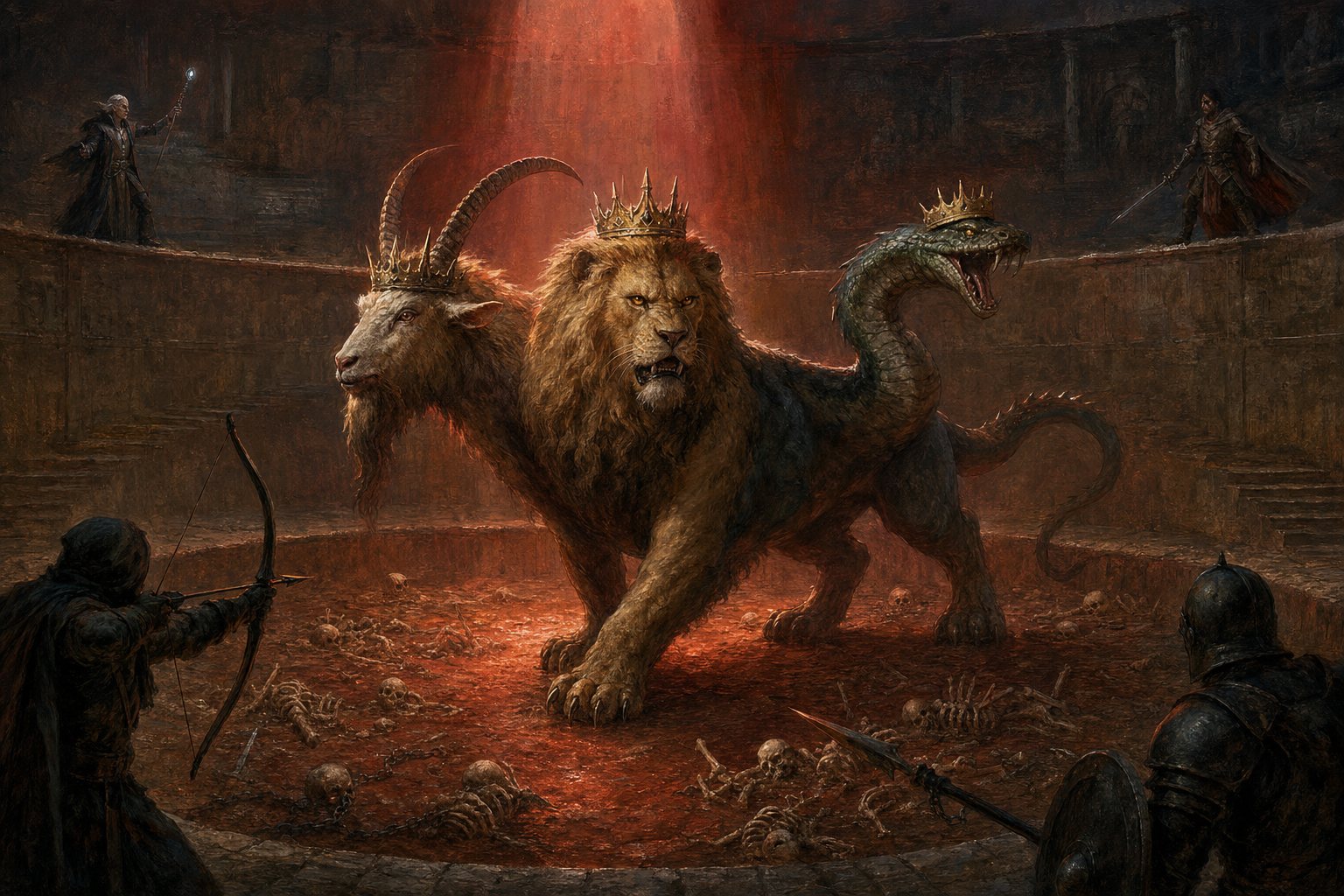
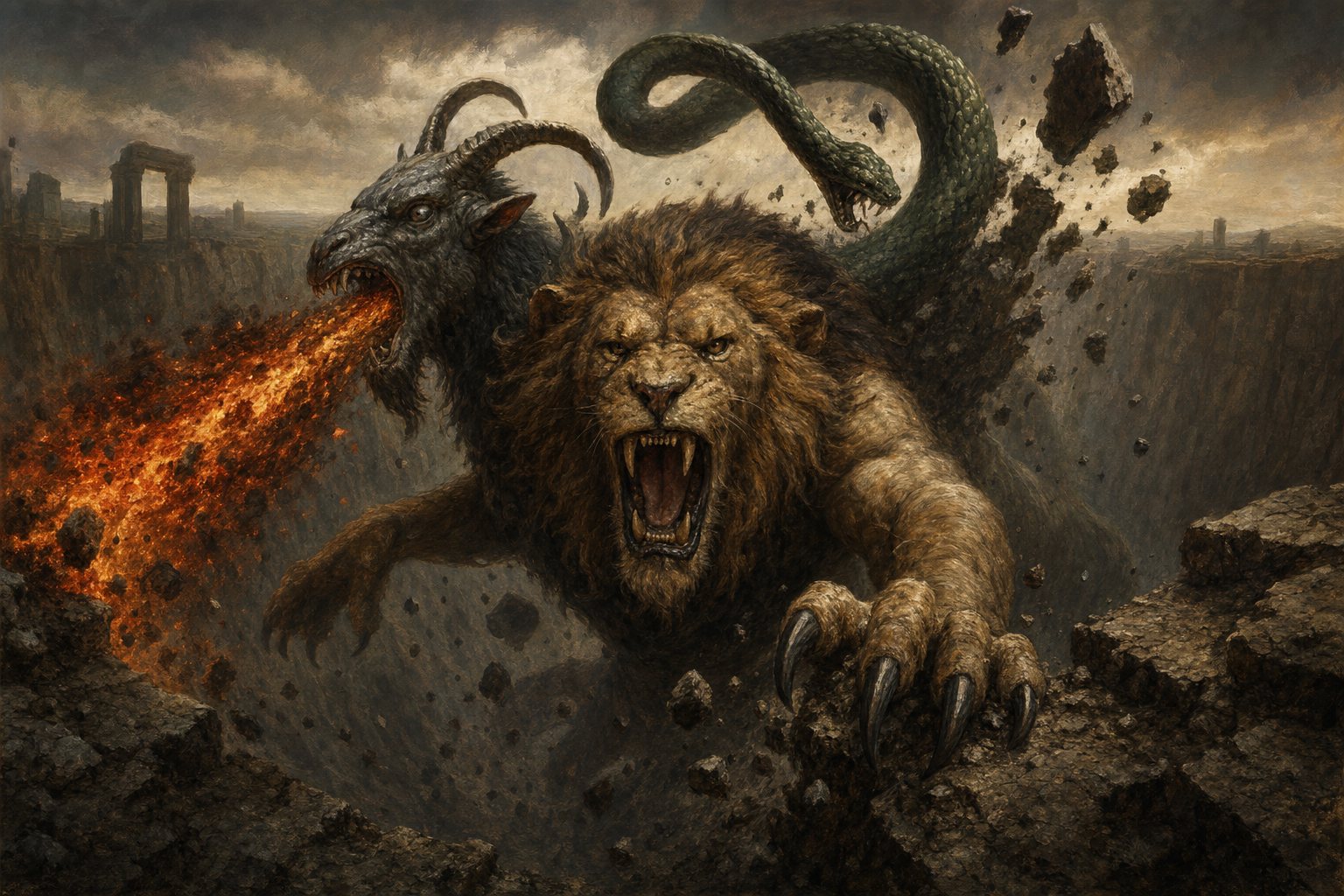
The yard is open to a shaft of red light and stinks of scorched fat. A pit of coals twenty feet across burns low in the middle of it, and above the coals, on chains, four iron cages sway with something alive in two of them.
On the far side, lying in the warm ash with its belly to the fire, is a thing with three heads. The lion's is asleep. The goat's is chewing. The serpent's is watching you, and it says — in Knossian Greek, in a voice like a kettle — "The middle one. Kill the middle one first."
The goat head stops chewing and turns to look at the serpent with what can only be described as betrayal.
DM summary. A three-headed hybrid that argues with itself out loud, in a burning yard full of things it keeps in cages. No talking your way out of this one: the Triarch is a fight, and the whole product is in the terrain and the three heads' opinions.
The Boon
The Keeper's ClapperOptional item
Three claps the goat head cannot ignore, and whoever swings it is the thing it comes for
What it is. Two tongues of thin bronze on a wooden block on a leather loop: a stockman's feeding-clapper, swung one-handed to bring a herd to the trough. The Keeper's Clapper is cracked at the shoulder, green with age, and makes a flat ugly noise that carries the length of the yard. Everything ever fed in this room learned that noise first.
Where it comes from. Early: the second thing on any loot roll in a room with tack or cages in it — the chimera yard (R016), the broken cages (R049) — or a drover at a rest point who trades it for a meal and calls it a feed-clapper, which is true and sounds like nothing. Late: it hangs here on the west rail with the meat hooks, black with soot. Never announce it: it is a farm tool, and somebody will take it because it is bronze.
What it does here. Three claps, and no more. Sounding it is an action and everyone sees who did it; the goat head answers, no save, the first two times. On the Triarch's next turn it must spend half its movement coming at the bearer by the shortest line. The serpent is not steered and picks its own target, but it is riding a body the goat is dragging, so a cone thrown that round is thrown from ground the party chose rather than ground it chose. Across the coal pit the goat takes 11 (2d10) getting there, and the 20-ft straight run that adds 11 (2d10) to its ram is a run the party chose. The third clap works and the serpent head has already named the trick aloud, so the Triarch spends its whole next turn on whoever swung it.
What it doesn't do. It charms nothing, damages nothing, does not steer the lion or the serpent, and is not a Turned Against Itself attempt. From Phase 3 — 40 hit points, one voice — it does nothing at all. A party who never finds it fights exactly the encounter written here.
Card and numbers or jump to the card ↓
Arena
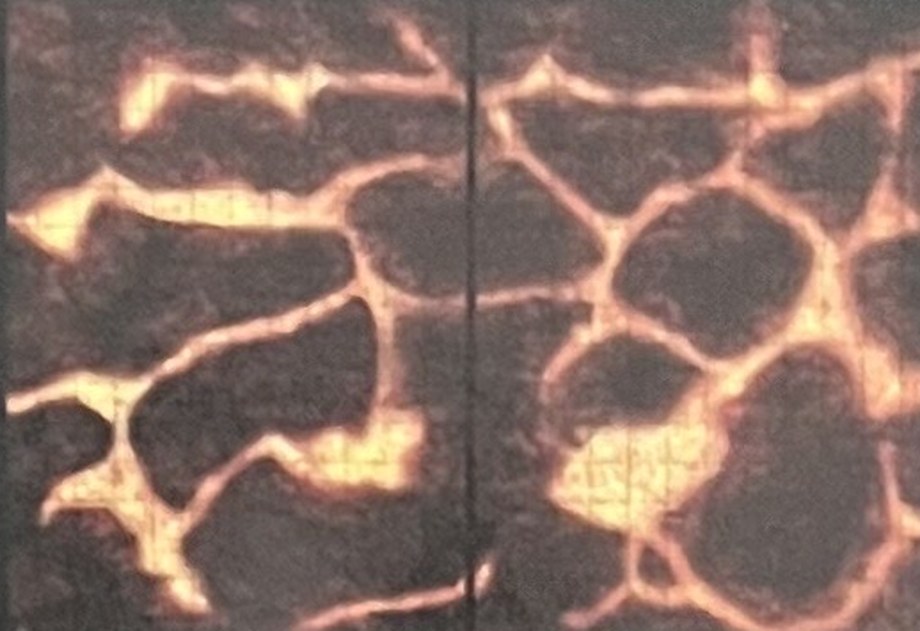
Battle map: The Fire Floes — pages 49 & 50, 110 × 75 ft
The fire floes are the sacrifice yard: pick the big central flow as the 20-ft coal pit and read the rest of the black rock as scorched ground. Chalk the bone ramp rising along the north wall, the four hanging cages 20 ft over the pit, and the cleat rail they run to.
- Dimensions. 80 ft × 60 ft, ceiling open to a 60-ft shaft that draws the smoke straight up. This was a sacrifice yard before the maze grew over it.
- Light. Bright orange within 30 ft of the pit, dim beyond, and everything moves because the light does.
- The coal pit. 20 ft across, 3 ft deep, dug in the centre. Entering it or starting a turn in it costs 11 (2d10) fire damage; being shoved in costs that plus a DC 14 Dexterity save or your pack catches. It is the single most useful object in the room for either side, and the lion head knows it.
- The cages. Four iron cages on chains, hanging 20 ft up over the coals. Two are occupied. The chains run to cleats on the east wall; cutting a cleat is an action (AC 15, 10 damage) and drops that cage into the pit. The goat head can and will open them from below with its horns.
- The bone ramp. A packed slope of centuries of offering-bone rising 12 ft along the north wall to a gallery. Difficult terrain, and anything Large or bigger that charges up it must make a DC 13 Dexterity save or slide back down prone. It is the only high ground and the Triarch cannot follow you up it at speed.
- The drain. A bronze grate 4 ft square in the south-west corner, under the ash, where the blood used to go. Grated, not locked, and there is a crawl behind it.
- The chain-hooks. Six meat hooks on running chains along the west wall. A PC can swing 20 ft on one (Acrobatics DC 12) or hook the Triarch's hide when it is adjacent (Athletics DC 16, giving it disadvantage on movement until it spends an action to tear free).
Roster & Budget
One boss with three action-economies, and two more things in the cages that it will let out when it stops enjoying itself.
| Count | Creature | XP each |
|---|---|---|
| 1 | The Chimera Triarch (boss) | 10,000 |
| 2 | Cage-Broken Hybrid | 1,800 |
Opening: the Triarch alone, 10,000 base ×1 = 10,000 adjusted, which is 69% of the APL 9 Deadly budget of 14,400. Do not let that number fool you. Three heads is three attacks and three save-or-suffers a round from one initiative count, and the coal pit does the rest.
Peak, from Phase 2: base 13,600, ×2 for three bodies = 27,200 adjusted, nearly double budget — but the Triarch is at half hit points when the cages open and the hybrids attack whatever is closest, including it. The practical curve is a hard fight, a spike, and a collapse.
Phases / Clock
| Phase | Trigger | What visibly changes |
|---|---|---|
| 1 — The Argument | Start | All three heads act. They talk the entire time and they disagree about tactics. Every round, one head does the thing another head just said not to |
| 2 — Cages Open | The Triarch drops to half HP (115), or any head is severed | The goat head rears and knocks the cage-pins. Two Cage-Broken Hybrids drop screaming into the ash and attack whatever is nearest. The Triarch stops talking. Its breath weapon recharges immediately |
| 3 — One Voice | Two heads severed, or 40 HP remaining | Whatever is left of it stops fighting cleverly and simply charges the largest group, through the coals if necessary, and does not stop |
Round one. The serpent head keeps giving orders. Read them out: "The one in the metal. Take the one in the metal first." The lion head does something else entirely. On the first round the Triarch takes only one action rather than its Multiattack, because the heads are still arguing about which — a free round the party will not notice they were given, and which you should never mention.
Combat Resolution
There is no alternate resolution here. It is a fight, it is meant to be, and the design work is in giving the fight a shape.
- Tactics. The lion head herds — it shoves toward the pit and it uses the pit every time it can. The goat head charges, and it will charge through its own allies. The serpent head hangs back over the shoulder, breathes fire down the line, and spends the whole fight being right about tactics that the other two refuse to follow.
- Severing a head. Each head is a separate target: AC 17, and 60 damage dealt to one head severs it. Damage to a head also counts against the Triarch's total hit points, so this is not a damage tax — it is a choice about where to spend the damage you are already dealing. A severed head removes its attack from the Multiattack, and the survivors gain +2 to hit and get visibly, badly angrier.
- The infighting lever, which is the fight's real bypass in miniature. The heads can be turned on one another. One action, one PC, one of these: Deception DC 18 (tell the goat head the serpent is steering it into the coals — it is), Persuasion DC 18 (agree loudly with the serpent, which makes the lion contrary), or Intimidation DC 16 aimed at the goat head specifically, which is a coward. On a success the heads bite each other: the Triarch takes 11 (2d10) damage and loses its Multiattack next turn, taking a single attack instead. This works twice, and the third attempt makes all three agree about something for the first time in their life, which is the party.
- Terrain that wins it. Shoving a head over the pit lip (Athletics contest vs +6) costs it 11 (2d10) fire and gives every ally advantage against it until the end of the round. Dropping a cage on it (a cleat, one action) deals 22 (4d10) bludgeoning, DC 15 Dexterity for half. The bone ramp is where a bloodied party goes to survive.
- What winning looks like. All three heads down. Expect five to eight rounds and 35–45 minutes. It has no retreat behaviour and will not flee; it is a species-grade monster and killing it is permitted and expected.
- If the party is losing, the Triarch's appetite is a mercy. Once it has taken a creature to 0 hit points it will stop for a full round to eat, in front of everyone. That is a round to drag someone out, and it is the honest warning that the drain crawl in the south-west corner is right there.
If somebody in the party is carrying the Keeper's Clapper, run this as a steering problem rather than a damage race. Three claps is three rounds in which the party decides where the goat head goes and where the cone lands, and three rounds in which one character is standing somewhere visible making a noise on purpose. It is worth roughly one shove into the coals and one breath that misses the party, and it costs the bearer the Triarch's whole attention on the third.
Scaling — APL 6 / 12 / 15
| APL | Adjustment |
|---|---|
| 6 | Triarch at −25% HP (173), no fire breath, and heads sever at 45 damage. No cages open; the hybrids are already dead in them. All DCs −2 |
| 9 | As written |
| 12 | Triarch at +25% HP (289) and a third legendary action. Add one Bronze-Barbed Manticore on the shaft lip, dropping tail spikes and hating the Triarch more than it hates the party — it will take shots at both. Heads sever at 75 damage. DCs +1 |
| 15 | Triarch at +50% HP (347), a lair action on initiative 20 (the coal pit spits — a random 10-ft square within 20 ft of the pit erupts, DC 17 Dexterity save for 22 (4d10) fire), and a second phase: at 40 HP the severed heads' stumps grow smaller replacements over two rounds, each with the same breath weapon at half damage. Four hybrids. DCs +3 |
Exit to the Resolution
- Pacing. 35–45 minutes, and it is the last fight of the night, so let it breathe. Behind schedule: skip Phase 2 entirely, leave the cages shut, and drop the sever threshold to 45 — a clean 25-minute boss.
- Voice the heads. This is the whole memorability of the encounter and it costs you nothing: the serpent is a clever, weary tactician, the lion does not speak at all, and the goat head is loud, aggrieved, and stupid. Let the players hear the serpent give a good order and the goat ignore it. By round three someone at the table will be trying to talk to the goat.
- Do not let them talk their way to a truce. The Triarch has no bargain to offer and the roster says combat only. The heads can be turned on each other, which is a tactic, not a resolution, and you should be clear about the difference if a player pushes.
- Table safety. Fire, burning, and a caged animal maimed by whoever stitched it together. If body horror is off the table, the hybrids are simply two big hungry dogs and nothing else changes.
- Clue drip. This finale delivers the Path tier. Two objects here carry it: the smoke, which goes up the shaft and out, in a steady draw a rope could follow (X17 The Wings of Icarus, X12 Bring It Down Behind You), and the cages, which were made outside and brought in — Knossian ironwork with a smith's mark that someone in the party may have seen on a gate (X19 The Bull-Gate Mechanism).
- Callback. A party that walked the chimera yard (R016) or the broken cages (R049) has already been taught that the Chimeric Menagerie fights itself when you give it a reason. Here that is not the way out — but it is still the way through, and a table that remembers it will feel clever at exactly the right moment.
Boon Card
The Keeper's Clapper
Wondrous item, uncommon · a stockman's bronze feeding-clapper on a leather loop · optional, and never on the loot table
AC 13, 5 hit points, and it can be thrown 20 ft to a friendlier pair of hands | Uses three claps, then it is done | Weight 2 lb
Appearance: two green bronze tongues on a soot-black block, the shoulder split, the leather loop sweated dark by somebody who wore it every day for years
Three Claps and No More. It sounds three times, and that is all it will ever do — the fourth swing splits the shoulder through and the clapper is scrap for good. Say the number remaining out loud after each one.
Somebody Has to Be Seen. The sound tells the room where the bearer is. Until the end of the bearer's next turn it gains no benefit from cover, invisibility, or obscurement against anything that answered the clap.
The Serpent Works It Out. After the second clap the serpent head names the clapper aloud and tells the others what it is. The third clap still works, and then the Triarch spends its entire following turn — movement, Multiattack, and legendary actions — on the bearer, and reaches it if it can.
Only the Animal Part Listens. It has no effect on a creature that has never been fed here, on anything with no ears, on the lion or serpent heads, or on the Triarch from Phase 3 — One Voice onward, whichever way that phase was reached. It deals no damage, opens no cage, and is not a Turned Against Itself attempt.
Call Them In. The bearer sounds the clapper. Any creature with an animal's head that was fed in this yard — the Triarch's goat head, and the Cage-Broken Hybrids — must answer on its next turn: it spends at least half its movement approaching the bearer by the shortest available line. No saving throw for the first two claps. The serpent head chooses its own targets throughout, but it is carried by the body the goat is hauling, so the party dictates where a cone is thrown from and not who it is thrown at.
Rattle It. Without spending a clap, the bearer may shake the block for a dry click that carries 10 ft: one Beast or Monstrosity of CR 2 or lower that can hear it looks at the bearer instead of at whatever it was looking at, until the end of that creature's next turn.
Creature Cards
The Triarch is unique to this chamber. What it keeps in the cages belongs to the Chimeric Menagerie (W07) and recurs across the deck, so those numbers live in the bestiary.
Shared across rooms, so the full cards live in the bestiary: Cage-Broken Hybrid. Every mention above opens the numbers here on this page.
The Chimera Triarch
Large monstrosity, chaotic evil · CR 13 (10,000 XP)
AC 17 (scarred hide) | HP 231 (22d10 + 110) | Speed 40 ft., fly 50 ft.
Saves Con +10, Wis +8 · Details Perception +8 · Resistant to fire · Darkvision 60 ft.
Three Heads, Three Opinions. The lion, the goat, and the serpent each speak, argue, and act. The Triarch cannot be surprised, has advantage on saving throws against being blinded, charmed, deafened, frightened, stunned, or knocked unconscious, and it says out loud what it intends to do about half the time.
Sever a Head. Each head can be targeted separately at AC 17. Sixty damage dealt to one head severs it; that damage also counts against the Triarch's hit points. A severed head loses its attack and its breath weapon, and the remaining heads gain +2 to hit for the rest of the encounter.
Turned Against Itself. A creature can use its action to set the heads at odds with a DC 18 Deception or Persuasion check, or a DC 16 Intimidation check aimed at the goat head. On a success the heads bite one another for 11 (2d10) damage and the Triarch takes a single attack in place of its Multiattack on its next turn. This can succeed only twice per encounter.
Eats What It Kills. When it reduces a creature to 0 hit points, it stops and feeds for one round, taking no other action. It cannot be reasoned with during that round and it does not defend itself well.
Legendary Bearing. It takes two legendary actions per round, spent at the end of another creature's turn, and regains them at the start of its own.
Multiattack. One bite from the lion head, one ram from the goat head, and one bite from the serpent head, or it replaces the serpent's bite with Furnace Breath when available.
Lion Bite. Melee, +11 to hit, reach 5 ft, one target. Hit: 19 (3d8 + 6) piercing damage, and the target is shoved 10 ft in a direction of the Triarch's choice if it is Large or smaller.
Goat Ram. Melee, +11 to hit, reach 5 ft, one target. Hit: 17 (2d10 + 6) bludgeoning damage, and the target makes a DC 17 Strength saving throw or is knocked prone. If the goat head moved at least 20 ft in a straight line first, add 11 (2d10).
Serpent Bite. Melee, +11 to hit, reach 10 ft, one target. Hit: 15 (2d8 + 6) piercing damage plus 10 (3d6) poison damage, and the target makes a DC 17 Constitution saving throw or is poisoned until the end of its next turn.
Furnace Breath (recharge 5–6). The serpent head breathes fire in a 30-ft cone. Each creature in the area makes a DC 18 Dexterity saving throw, taking 31 (7d8) fire damage on a failure or half as much on a success. Coals thrown from the pit set the ash alight in a 10-ft square of the Triarch's choosing until the end of its next turn.
Contradiction. When a creature within 10 ft moves away from the Triarch, one head that has not attacked this round makes an attack against it.
Herd Them. The lion head shoves one creature within 10 ft 10 ft in a straight line. If this pushes it into the coal pit, it takes 11 (2d10) fire damage.
Open a Cage. The goat head strikes a cage cleat. One hanging cage drops; anything in it lands in the ash and acts on the next initiative count.
Coil and Spit. Costs 2 actions. The serpent head makes one bite against a creature within 10 ft with advantage, and the Triarch moves up to half its speed without provoking opportunity attacks.