The Long Way Under
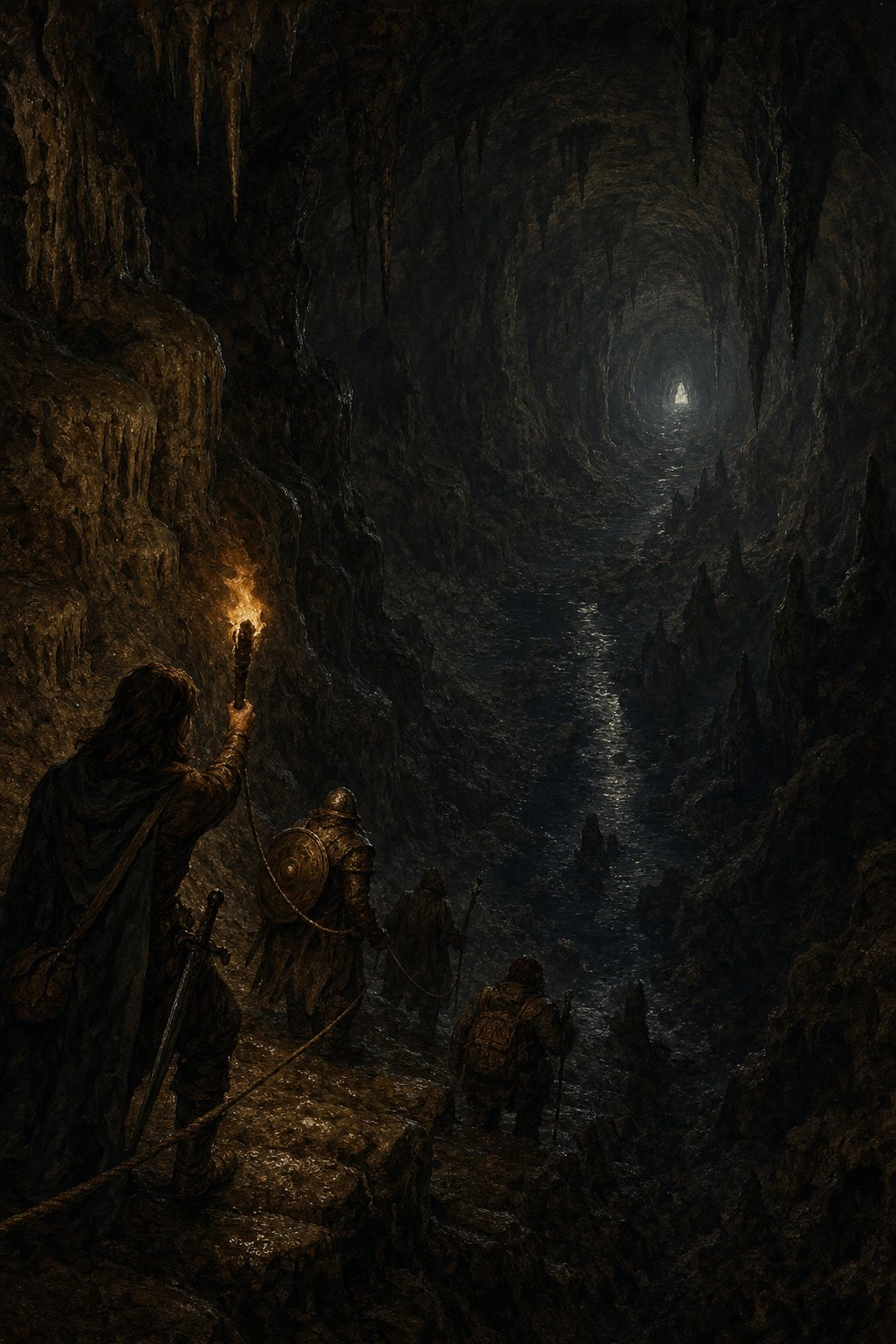
Four courses of dressed ashlar, laid by somebody who knew his trade, and then the wall stops being a wall.
Below the last course the stone is raw and scalloped and rounded, worn into shapes like the inside of a shell, and it is wet, and it goes down. There is a sound from it that you have not heard in two days: water running somewhere with no drain to run into and no cistern to fill.
The air coming up is cold, and it smells of wet rock, and underneath that — faintly, impossibly — of goats.
The Way Out
The Labyrinth is cut into limestone, and limestone has passages of its own that are older than Daedalus and were never part of anybody's plan. His masons hit them, swore, floored them over, and went on building. Go down far enough and the dressed stone simply gives out; beneath it is a river-cut cave system that drains inland and comes up in a shepherd's sinkhole a day's walk from the sea.
It is not especially dangerous. It is long. Thirty hours underground, most of it walking, some of it on hands and knees. Nothing in it wants to eat the party. What it does instead is take things away steadily: light, warmth, dry clothes, the food in the packs, and the strength in six pairs of legs.
Every problem the maze was posing — doors, warbands, the thing three rooms back — gets replaced by four: light, water, cold, and the arithmetic of what six people can carry. The way out is downward, on purpose, and the decision is committing to it, because somewhere around hour ten there is a point past which turning back costs more than going on, and the party should be told that before they take the first step.
Requirements
| Requirement | Where it comes from |
|---|---|
| Thirty hours of light | A torch is one hour, one pound, and 20 ft of bright — thirty of them is a sack of grain nobody can drag through a crawl. A lamp and a flask of oil is six hours for the same pound. Budget two lamps lit and one spare, fourteen flasks, and twenty tallow candles as the reserve. The tapped barrel in R005 The Chandler's Rest fills every flask and jar the party owns; R019 The Tallow Refectory burns nineteen candles down its table and has the tallow to cast twenty more |
| Food for two days, per person | Thirty hours of hauling is two days' rations each and about 2 lb a day to carry. R084 The Cool Cellar is the honest source — jars sunk to their shoulders in the floor, cheese, olives, salt fish, and a door that bars while they pack. R095 Larder of the Drakon has salt-wrapped meat by the stack, at the price of taking it off a sleeping serpent. R019 will feed them hot and send them off with bread |
| Water for the first ten hours | Two full skins each. R063 Bath of the Cold Spring runs clean and cold out of the lion's mouth and will fill everything without complaint. After the wade at hour eight, water is the one thing the caves have in surplus — running water only, never the still pools |
| Something dry, per person | The caves sit at cellar temperature forever and nothing down there burns: no wood, no dung, no dry moss. A wool cloak or fleece kept dry in an oiled sack. R019's bench blankets and table cloths do it; so do the old fleeces dry at the top of the bone-bowl in R053 The Nemean Den, if anyone fancies the reach |
| A rule for choosing passages | Downstream, always, and where the stream sumps take the left wall and keep it. Masons' chalk, cord, and a plumb bob from R062 The Mason's Unfinished Wall turn that rule into a marked route. R036 Hall of the Sunken Kraken is the confirmation: its water level is the caves' water level, and it rises after rain |
Clues
| Tier | Line to deliver |
|---|---|
| Whisper | The flagstones in this corridor are sweating, and one of them rings hollow underfoot — not a cellar's short knock, a long ring that takes a moment to come back. |
| Trace | Behind a fallen block the wall runs out: four courses of dressed ashlar and then raw stone, scalloped and rounded and wet, going down past the reach of your light. Nobody cut that. |
| Sign | A mason's plumb-line still hanging in a bored hole, the cord rotted to a thread, and beside it a chisel-mark note in a working man's shorthand: no bottom at 40. floored over. do not tell him. |
| Proof | In the sorted bone-heap of R053 The Nemean Den, a goat's skull with a shepherd's tar-mark daubed on the horn. Knossian goats pasture a day inland and never come near the sea. Something carried it here, and it did not come through the front gate. |
| Path | Scratched on the sherd floor at the dark end of R075 The Long Silence: a section drawing of the maze with a void under it, the stream drawn in, a tally of hours down one side, and at the far end one word — goats. |
| Door | A slot in the bedrock at the back of a collapse, four feet by two, with the stream falling into it and cold air coming out, and the lip worn smooth by four hundred years of water going the way the party is about to go. |
Resolution Scene
Twenty minutes, five legs, and the decision is at the mouth: everything you are carrying, weighed against thirty hours. Make them pack. Out loud, item by item, once.
Leg one — The Underfloor (2 hours). Sixty feet of chimney down beside the falling stream, hand and foot on wet rock. Athletics DC 12, roped. A failure is a twenty-foot slide, 2d6 bludgeoning, and one item off the belt into the water. Heavy armour comes down on a line or does not come down at all.
Leg two — The Mouseholes (4 hours). Nine hundred feet of bedding plane, eighteen to twenty-four inches of headroom, packs pushed ahead one arm's length at a time. Athletics or Acrobatics DC 13, one check for the leg. A failure means jammed for twenty minutes, one level of exhaustion, and a pack abandoned in the crawl — the party chooses which, and lives with it for twenty-six hours.
Leg three — The Cold Wade (3 hours). Six hundred yards of stream, knee-deep and then chest-deep for the worst forty feet, at the temperature of a spring in February. Constitution save DC 12 or one level of exhaustion; DC 15 in heavy armour, and taking it off first is the sensible answer nobody thinks of. This is the only water in this Resolution. Nobody swims and nothing floats out. On the far bank, the dry clothes matter or the exhaustion keeps coming every four hours.
Leg four — The Rift (2 hours). A traverse on a ledge a foot wide above eighty feet of black. Athletics DC 14, or DC 10 with the cord rigged as a hand-line, which is what the cord is for. A failure is a twenty-foot drop to a sloping shelf — 2d6, and roll for what they dropped; on a 1 or 2 on a d6 it was a lit lamp, and the party has just watched an hour of their budget fall out of the world.
Leg five — The Blind Miles (16 hours, including a rest). Four miles of walking passage, all of it the same: grey rock, black water, the same sound. Three navigation beats, Survival or Investigation DC 13 each, and a failure costs three hours of light doubling back. Somewhere in here somebody's lamp goes dry mid-sentence, and the table finds out whether the reserve candles got packed.
The sinkhole (1 hour). A shaft of jammed timber, bramble, and forty years of goat bones, with grey daylight at the top. Athletics DC 11, or DC 5 with a rope on anything up there. They come out on a hillside, inland, wet through, in thyme and goat droppings, with the sea a smudge on the horizon behind them and nobody in Knossos any the wiser.
Fallback
The light runs out short of the sinkhole. It is the likeliest failure in this Resolution and it is not a death sentence — from the Rift onward the passage does not branch, and downstream is out.
- The party ropes up — a cord, a hand on the shoulder ahead, half speed, everything by touch. Call it four hours in total darkness.
- The cost: two levels of exhaustion each (Constitution save DC 13 halves it to one), one pack lost in the water and not recovered, and every light-adjacent spell, charge, and consumable burned to nothing.
- One character gets separated for an hour when the line breaks at a squeeze. Play it. They are found — sitting down, facing the wrong way — and that scene is the best thing in the Resolution.
- They still come out. The last half mile is a grey that nobody trusts until somebody puts a hand into a bramble. Never make this branch a dead end, and never let a DC decide whether the party surfaces.
Resolution-owned, never on the loot table.
- The route, written down. The chalk marks, the cord, and the hour-tally, copied up: a working survey of a second way into the Labyrinth of Knossos that the palace does not know exists. Every thief, general, and archaeologist in the Aegean would like a word.
- A phial of moonmilk, scraped from a wall at hour twenty — cold white cave paste that goes on like curd. Once, rubbed into a wound, it removes one level of exhaustion or heals 1d8, and then it is a curiosity in a jar.
- The shepherd's household. Whoever owns the sinkhole feeds six ruined strangers, asks nothing, and will remember them. A hearth, a day's walk from Knossos, that no authority connects to the maze.
- Coming out unseen. The party surfaces inland, alive, and unrecorded. Every other way out of this maze is watched by somebody. This one is watched by goats.
Scaling — APL 6 / 12 / 15
| APL | Adjustment |
|---|---|
| 6 | Twenty hours, not thirty. All DCs −2, the Mouseholes are a stoop rather than a crawl, and exhaustion from this Resolution caps at one level per character |
| 9 | As written |
| 12 | Thirty-six hours. The Rift traverse is DC 16, the stream is up and the wade is DC 15, and something from the warren of R064 Warren of the Gnawing Dark has followed the smell of the packs down — two nights of gnawed straps and stolen food, never a fight |
| 15 | As APL 12, and it is raining on the surface. The stream rises an inch an hour, which puts a real clock on the Blind Miles, and a fresh collapse at hour twenty-six must be dug through: Athletics DC 17 and two hours of light |
- Do not run thirty hours in real time. Run six beats: the mouth, the crawl, the wade, the rift, the long walk, the sinkhole. Each beat is one line of description, one check from one player, and one cost. Twenty minutes at the table, and between beats you ask a single question — whose lamp is lit? — which is what keeps the montage from becoming a slideshow.
- Attrition must be a decision, not a tax. Never simply subtract. Offer the trade every time: wade the deep channel or spend two hours of oil going round; carry the third lamp or carry the food; strip the armour or roll at DC 15. A cost the party chose is drama, and the identical cost imposed is bookkeeping.
- Resist putting a monster down here. The enemy is cold and arithmetic, and this is the only ending in the deck that says so. One sound at hour nineteen, far off, that never resolves and never explains itself, is the correct amount of creature.
- Everything needed is inside the maze. If the party came in with nothing, R005 and R019 are the entire supply chain and the tally-board in R005 is the invitation. Never let a party be barred from this ending because of how they arrived.
- Say the point of no return out loud. Around hour ten, at the top of the Rift, tell them plainly: going back is now longer than going on. Committing is the Resolution; a party that commits without knowing has not decided anything.
- The squeeze is the scene to dial. Crawls distress players more reliably than any monster in this book. Offer the stoop version freely, and never trap a character in the dark alone unless the table has asked for that flavour of story.
- If the party is out of time, compress to three beats — the crawl, the wade, the sinkhole — hand them the light budget as done, and spend the words you save on the last ten feet: bramble, goat bones, and air that smells of thyme and hot dust.