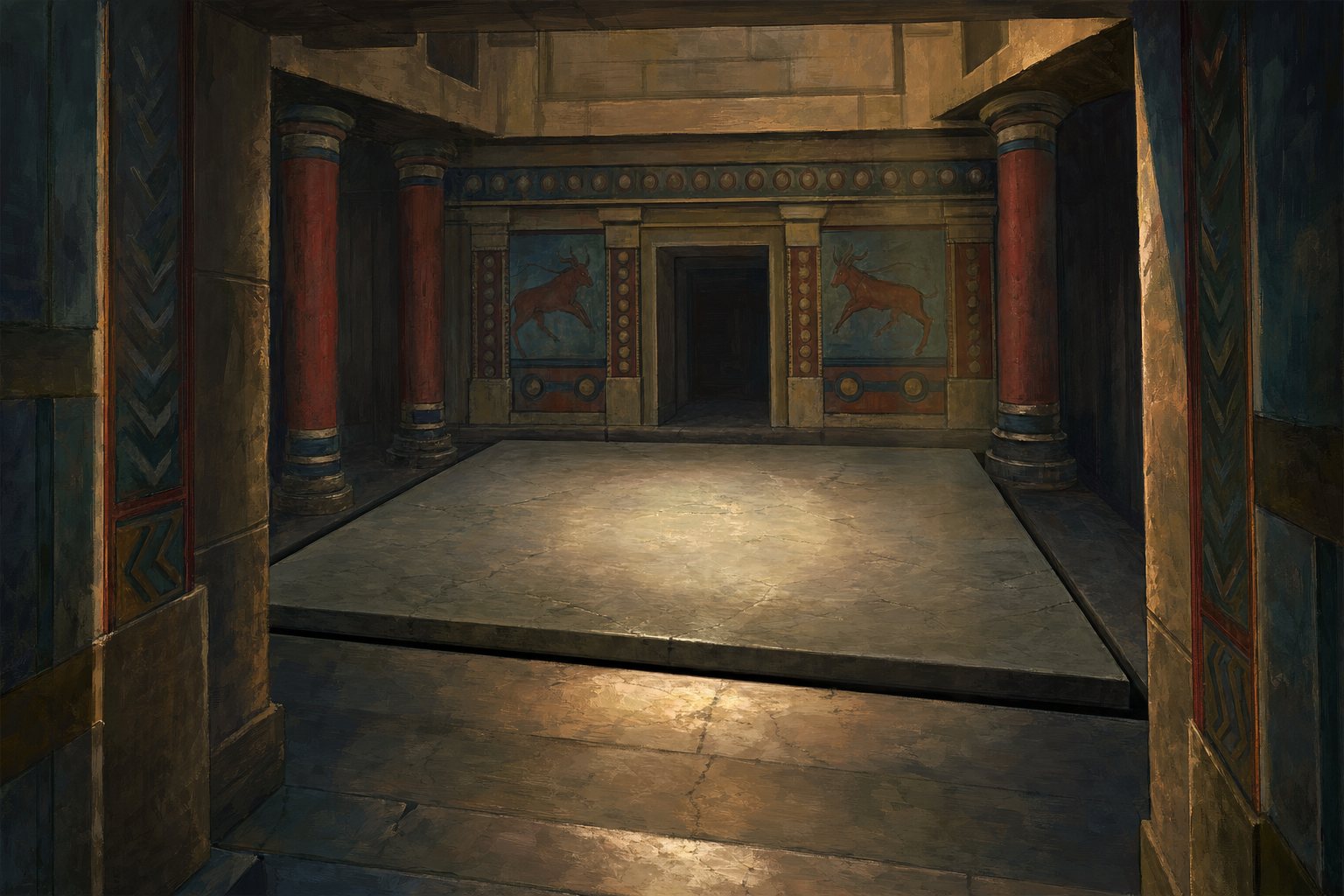
The floor of this hall is one slab, forty feet square, and it is not resting on anything you can see. There is a finger's gap all the way round it. When you put your weight on the near edge, the whole thing moves — a slow, enormous, unhurried inch — and forty ranks of clay soldiers standing on it lean with it, all together, and lean back.
There are sockets at the slab's four midpoints, cut for something. Six blocks of polished marble sit stacked against the wall behind you, each with a number chiselled into its face.
DM summary. A slab on a central pivot, six marble weights, and eighty hundredweight of dormant clay infantry standing on the tilting surface. Trim the slab level and a high door unlocks; get it wrong and the soldiers slide onto you. Nothing here is alive.
Terrain & Features
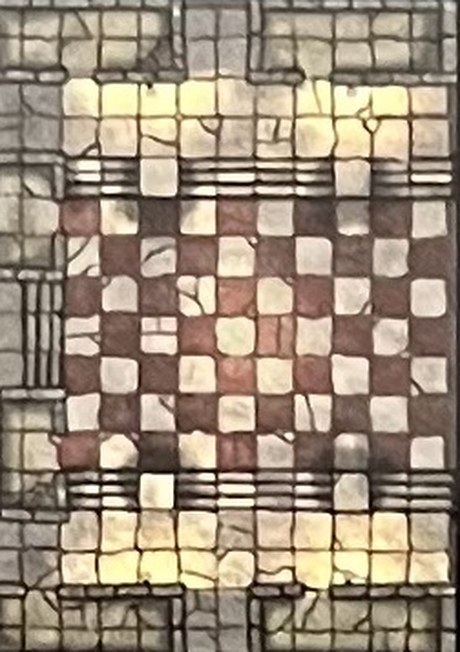
Battle map: The Hall, West End — page 29, 55 × 75 ft (one half of The Great Hall)
The chequerboard is the 40 × 40 ft slab, and the printed stepped border is the fixed walkway around it — mark the 6-inch gap between. Stand the twenty-four soldiers on the squares in six rows of four and track tilt beside the map.
- Dimensions. The hall is 60 ft × 50 ft; the slab is 40 ft × 40 ft in the middle of it, with a fixed 10-ft stone walkway all the way around and a 6-inch gap between. Ceiling 20 ft.
- Light. Two oil sconces still burning on the fixed walkway, north and south. Dim on the slab, bright on the walkway. Somebody maintains this room, and that should worry the party more than the slab does.
- The pivot. A single stone boss under the slab's centre. Investigation DC 13 from the walkway to see it through the gap and understand what the room is.
- The tilt. The slab tilts toward weight. Track it in degrees, and there are only four states that matter:
| Tilt | What happens |
|---|---|
| 0–5° | Level enough. Normal movement, and the east door's lock is only satisfied at 0° |
| 6–10° | The downhill half is difficult terrain. Loose objects begin to move |
| 11–15° | Dexterity save DC 13 at the end of any turn spent on the slab or slide 10 ft downhill |
| 16°+ | Everything slides. Dexterity save DC 15 or slide to the low edge and take 2d10 bludgeoning as the ranks arrive on top of you |
- The ranks. Twenty-four Terracotta Soldiers, in six rows of four, standing on the slab's northern half. They are dormant, they are not an encounter, and they will not animate — but each weighs 400 lb and they are the reason the slab is not level when the party arrives. They stand close in around the pivot, so all that mass pulls with far less leverage than it looks: at the socket line the ranks count as 150 lb of north-side load, and that is the number the mechanism uses. Two have already fallen and shattered; the shards are difficult terrain and are the room's warning about what sliding means.
- The six weights. Polished marble cubes, stacked on the walkway, chiselled 50 · 100 · 150 · 200 · 300 · 400 (pounds). Each takes one character an action to place in an adjacent socket, or two characters and a round to carry the 300 or the 400 more than 10 ft.
- The four sockets. North, south, east, west, at the slab's midpoints, each 5 ft in from the edge and each cut to take one weight and hold it.
Traps / Puzzles / Checks
The balance. The slab locks and the east door opens when the slab reads 0° with nobody standing on it — which means the weights must balance the ranks and each other.
| Element | Value |
|---|---|
| Starting state | The ranks put about 2° of tilt to the north. All four sockets empty, and the east door's bolt visibly out |
| The rule | North + 150 = South, and East = West, each within a 50 lb tolerance. The 150 is the ranks' load at the socket line, as above |
| Where the rule is written | On the north wall beside the door, in Knossian numerals: a load figure and two sums. Investigation DC 13 to read it as arithmetic rather than decoration, free for any character with mason's, engineer's, or ship's-cargo training |
| Placing a weight | One action in an adjacent socket. The 300 and the 400 need two characters to carry more than 10 ft |
| Weights beside a socket | A weight may be set on the bare slab next to a socket. It counts toward that side but is not locked, and it slides at 11° like everything else |
| Solved state | Slab at 0°, the bolt withdraws with a bang that makes everyone jump, and the east door opens. It stays open |
The two solutions, written out, so nobody has to do this at the table. There is one of each weight, so no two sockets can hold matching cubes — the party has to stack a side, which is the insight the room is asking for.
- Solution A (exact). North 50, South 200 (50 + 150 = 200). Remaining: 100, 150, 300, 400. East 400, West 300 + 100 = 400. The 150 stays off the slab.
- Solution B (inside tolerance). North 150, South 300 (150 + 150 = 300). Remaining: 50, 100, 200, 400. East 400, West 200 + 100 + 50 = 350 — a 50 lb difference, which the mechanism accepts.
- Accept any arrangement that satisfies both sums. This is arithmetic, not a riddle; there is no hidden intended answer and a player who finds a third valid layout has solved it properly.
Mechanical fallback (required, and it costs something). Chock the pivot: a crowbar, a broken soldier's torso, or a spear jammed into the gap under the boss. Thieves' Tools DC 15 or Athletics DC 16, ten minutes of work lying on the walkway with an arm under a forty-ton slab.
- Success: the slab is locked wherever it currently sits, permanently. Safe to cross, and the party can go anywhere on it.
- Cost: the east door never opens. Its bolt reads the mechanism, not the angle, and a chocked slab is a broken mechanism. The party keeps exits A and C and loses B.
- On a failure: the chock slips, the slab swings to 16°, and everybody on it makes the save. This is the room's one genuine injury and it is telegraphed by ten minutes of grinding.
Exits
None. The weights are marble, the soldiers are fired clay, and both are worth exactly what forty tons of building material is worth to six people on foot. The sconce oil can be decanted if somebody wants a pint of lamp oil, and that is the entire haul.
Scaling — APL 6 / 12 / 15
| APL | Adjustment |
|---|---|
| 6 | Four weights instead of six (50, 100, 150, 200) and the ranks count as 50 lb, so N 50 / S 100 and E 150 / W 150 solves it. Slide damage 2d10, all DCs −2 |
| 9 | As written |
| 12 | The ranks count as 250 lb and one weight is missing from the stack — it is in the pivot pit, and getting it means the crawl. Slide damage 4d10, DCs +1 |
| 15 | As APL 12, and the slab is live: it drifts 1° per round toward whichever half holds more weight, so the party is solving arithmetic on a moving floor. Slide damage 4d10, DCs +3. The two shattered soldiers are not shattered, and they are the only things in this deck's Balance Hall that ever animate |
- Pacing. Fifteen minutes, and it is a table-talk room: players enjoy weighing things and you should let them. If they are enjoying it, let it run to twenty; the deck can afford one arithmetic room.
- If you are behind schedule, cut to four weights and the APL 6 arithmetic, or simply let them find the slab already chocked by a previous crew and walk across. Four minutes.
- Tell them the walkway is safe, out loud, early. This room is only fun if the party knows they are volunteering. A puzzle you can decline is a better puzzle.
- Do not let the slab kill anybody. 2d10 and a slide is the ceiling at APL 9. If a character goes down under sliding clay, they are pinned rather than dying — an Athletics DC 13 from a companion frees them, and the fear was the point.
- The dormant soldiers are the room's whole atmosphere and they must stay dormant. Twenty-four clay men leaning in unison every time somebody shifts their feet is worth more than any fight the DM could put here. If a player attacks one to see what happens, it shatters, it does not wake, and the slab lurches — which teaches the lesson better than initiative would.
- Table safety. Crushing, pinning, and the underside of a forty-ton slab. If the table is uneasy about confinement, skip exit C entirely — it is the only part of the room that requires anybody to be under anything.
- Clue drip. Two objects: the pivot boss itself, which teaches in ninety seconds that this maze is held up by fewer things than it looks (X12, Sign tier — and X12 names this room as one of the three that teach it), and the load figure written by the door in a working engineer's hand, which is the same hand as the marks in the mason's corridor (X14, Trace).
- Warband callback. Clay & Marble (W16) are slow, many, and hard to move, and here they are none of those things because they are switched off. A party who has fought them will spend the first two minutes of this room refusing to believe the ranks are inert. Let them check. Let it cost them nothing but the two minutes.