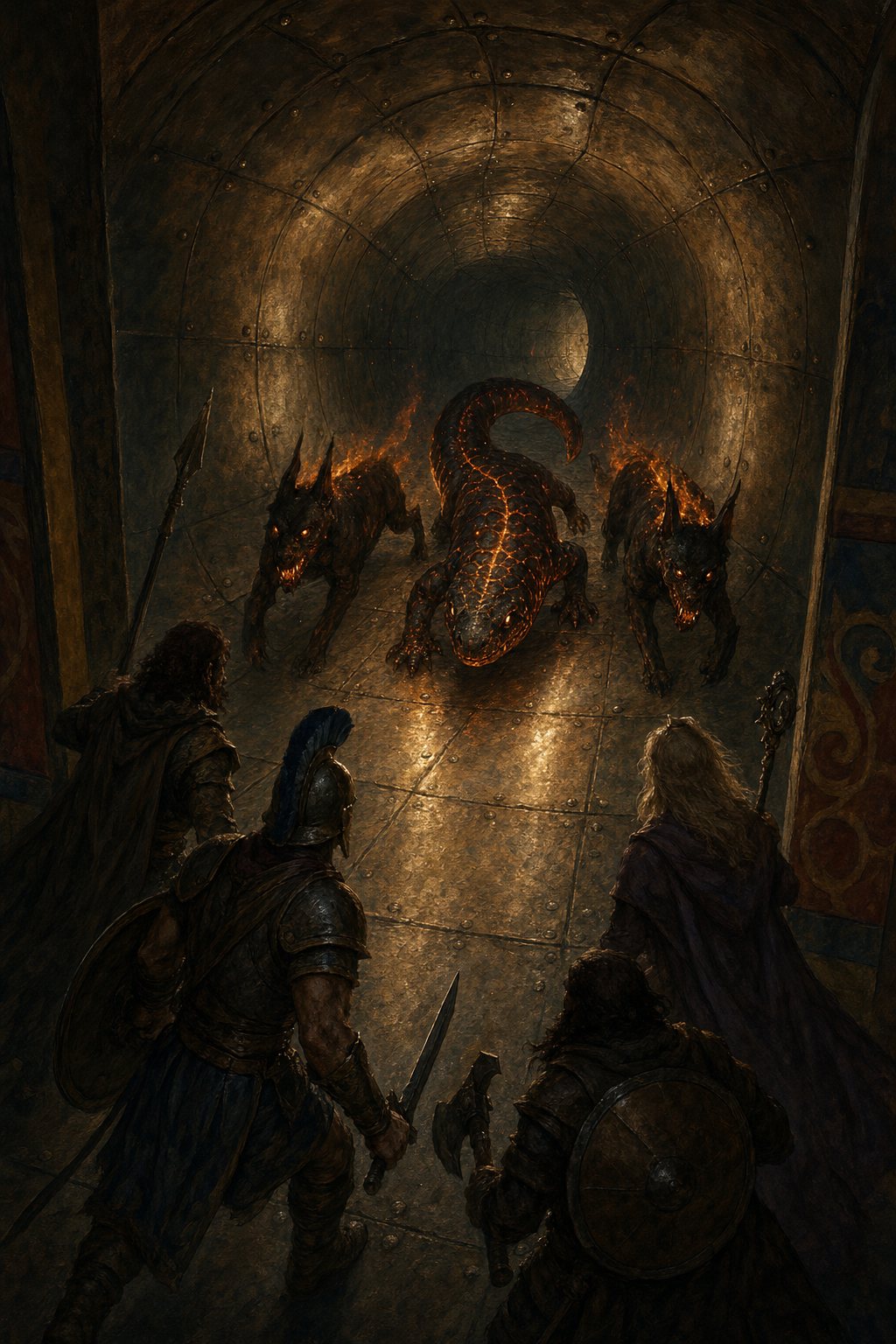
The passage narrows, slopes down, and turns to metal underfoot. Bronze plates, riveted, curving up and over into a low vault — and the curve is wrong for a corridor. It is the curve of a body.
Behind you the way in is a throat. Ahead of you the floor is a grating, and below the grating something red is turning over in its sleep.
The bronze is warm. Not hot. Warm, the way a pan is warm when someone has just put it on.
DM summary. The party is inside a brazen bull the size of a house and somebody has lit it. The room is a heat clock with a fire under the floor and three fire-things in the firebox; the way out is to kill the fire, not the hounds.
Terrain & Features
Battle map: custom map. The inside of a 30 × 20 ft bronze bull, floor grate and throat-pipe included — draw its outline; no page helps. Browse the book if a page half fits your table better.
- Dimensions. The belly is 30 ft × 20 ft, 12 ft at the spine and 5 ft at the flanks — a bronze barrel lying on its side. Nobody with a polearm is happy in here.
- Light. Red, from below, through the floor grate. It shifts. Everything in the room has a moving shadow and there are no corners to hide in.
- The floor grate. Bronze bars on a 4-inch pitch across the whole belly floor, over the firebox. Small enough to stand on, wide enough to see through, and wide enough for a Pyre-Hound to put a head through. Standing on it barefoot or in thin soles is 1 fire damage per round from round 1, which is a nuisance and a warning.
- The throat. The way in: a bronze pipe 8 ft long sloping up at 30 degrees to the bull's mouth, greased with rendered fat. The mouth-hatch closes behind the last person in — a counterweight, not a lock.
- The voice. The throat is a shaped pipe with reeds set in it. Anything shouted in the belly comes out of the bull's mouth as a bull's bellow, audible through three rooms of the maze. The party will work this out the first time someone swears.
- The tail hatch. North end, a bronze plate on a counterweight arm, standing open. This is the ash-door and it is the room's honest way out.
- The bellows-crank. Outside the bull's left flank, reachable through the tail hatch: a hand-crank on a shaft that drives the firebox bellows. Somebody has wedged a bar in it so it turns by itself off a falling weight. That is why the fire is coming up.
Encounter
Three hounds in the firebox and the thing that stokes it.
| Count | Creature | XP each |
|---|---|---|
| 3 | Pyre-Hound | 700 |
| 1 | Forge Salamander | 2,300 |
Base 4,400 XP; ×2 for four bodies = 8,800 adjusted, against the APL 9 Hard budget of 9,600. It sits 800 under budget and the heat clock is the difference — a party that treats this as a straight fight will be at 4d10 a round by the time they win it.
The heat clock. State it at the top of every round.
| Round | The bronze | Effect |
|---|---|---|
| 1–2 | Warm | Nothing. This is your warning and it is a real one |
| 3–4 | Hot | 1d10 fire at the start of your turn to anything touching bronze — which is the floor, so: everyone |
| 5–7 | Very hot | 2d10 fire, and a Constitution save DC 13 or one level of exhaustion. Metal armour is now a problem and you should say so |
| 8+ | Glowing | 4d10 fire per round. Leave. There is no version of this room where standing in it at round eight is correct |
The clock stops rising the moment the bellows are jammed, and falls one band per two rounds once the fire is out.
Round 1. The Salamander is in the firebox and does not come up — it is working. Two Pyre-Hounds put their heads through the grate and breathe. The third goes around and comes in the tail hatch behind the party, because that is what the hatch is for. Nothing here is subtle; the room is the subtlety.
Tactics. Pyre-Hounds herd. They will not close to melee if they can push the party toward the hot end instead, and one that dies ignites — 2d6 fire in a 5-ft radius, which in here means somebody. The Salamander comes up through the grate only if the bellows are threatened, and it is the one thing in the room that will follow the party out of it, for exactly one room, before the cold drives it back.
Cold does something concrete. Any cold damage on the Salamander makes it recoil into the firebox for one round; a hound that takes cold damage loses its ignition on death. Water works too: a waterskin on the grate buys one round of steam and blind.
Bypass Options
The bellows-crank on the outside of the flank is the actual encounter and it is reachable within one round of the tail hatch.
- Getting there: out the tail hatch, 15 ft along the bull's flank. No check, but you are outside the party and one hound will follow you.
- Jamming it: Thieves' Tools DC 15, Athletics DC 16 to snap the drive-bar, or any water or cold effect poured into the firebox vent, no check. A spear jammed into the crank works and is destroyed.
- Success: the clock stops where it is and begins falling. The Salamander comes out of the firebox furious, which is a fight in the open on the outside of the bull, with room to move — a much better fight than the one inside.
- Failure: the drive-bar slips and the weight drops a notch. The clock advances a full band immediately. A second attempt is allowed and there is time for exactly one.
- Cost: whoever goes is alone outside a bronze bull with a fire-hound.
The way in is still the way out for two rounds, and after that the grease in the pipe is on fire.
- The climb: Athletics DC 13 up the greased slope, and the mouth-hatch from the inside is Athletics DC 17 — or DC 13 if the bellows are already jammed, because the counterweight relaxes as the bull cools.
- Success: the party is back in the corridor they came from, out of the heat, having spent two rounds and learned exactly what this room is.
- Failure: you slide back down the pipe and land prone on the grate. In band 3 or higher that is the round's fire damage twice.
- Cost of withdrawing this way: the party leaves by the way they came, gains nothing, loses the clue, and the bull is still lit — which means somebody intends to use it, and that is worth thinking about.
Traps / Puzzles / Checks
The bull's voice, used on purpose. This is the room's hidden tool and a clever party will find it.
| Element | Value |
|---|---|
| Noticing the reeds | Investigation DC 13 in the throat, or free the moment anyone raises their voice |
| Using it | A deliberate sustained shout in the belly produces a bull's bellow audible three rooms off. Roll d6: on 1–2 the nearest wandering threat comes here — which is bad now and excellent later, because it will not be where the party is going |
| Reading the firebox | Investigation DC 14 through the grate: the fire is fed on a schedule and the ash is three days deep. This bull is in use |
| The clamp | The mouth-hatch counterweight, Perception DC 12 from the throat on the way in. Anyone who spots it can wedge it with a spear before the last person steps off — no check, and the trap simply does not close |
Exits
None. The inside of a brazen bull is designed to produce ash and it is very good at its job. Anything anyone ever brought in here is a grey line on the firebox floor.
The bellows-crank's drive-bar is good iron and a party that takes it has taken a crowbar, which is worth more than a roll and is not one.
Scaling — APL 6 / 12 / 15
| APL | Adjustment |
|---|---|
| 6 | Two Pyre-Hounds and no Salamander; the fire is untended and the clock advances a band every three rounds. Damage per band: 1d10 / 2d10 / 2d10. All DCs −2 |
| 9 | As written |
| 12 | Four Pyre-Hounds, two Forge Salamanders, and the clock advances every round from round 3. Band damage steps to 4d10 / 10d10. DCs +1 |
| 15 | As APL 12, plus the bull walks: the whole thing is on a rail and something outside starts it moving on round 4, so the floor is difficult terrain and the tail hatch swings. DCs +3. A second phase for the lead Salamander at half HP — it climbs into the throat and blocks exit B with its body |
- Pacing: 12–15 minutes, and it must not run long. This is a clock room. If it hits round eight the room has failed at its job, so drive it: call the band out loud, describe the metal, and make the tail hatch obvious from the start.
- If you are behind schedule, the bellows are already jammed when they arrive and the fire is dying — run it as two Pyre-Hounds in a hot corridor. Six minutes.
- If the party is nearly out of resources, let the mouth-hatch clamp be spotted on the way in at passive Perception 12 and let them wedge it. Then the room is a hard choice rather than a hard fight.
- The exit is the answer and it is visible from round one. Never let a party cook because they did not know the tail hatch was open. Describe it in the second sentence after the read-aloud.
- Table safety. This is the most intense room in this stretch of the deck: confinement, heat, and being cooked alive inside a famous instrument of execution. Flag it before you run it. The softer framing is a kiln — the bull is a pottery kiln shaped like a bull because Knossian potters were show-offs, the fire is for firing clay, and nobody has ever been put in here. Every mechanic survives that reframing intact.
- Clue drip. Two hooks: the three days of ash in the firebox, which proves the maze is staffed and on a schedule (X08, X10), and the rendered fat in the throat, which someone applied recently with a brush (X06, X05 — ask whose fat, and do not answer). If your Resolution is X19 or X20, the bellows assembly is Daedalan and the drive-weight is the same counterweight trick the bull-gate uses at scale.
- Callback. Salamander Forge fields heat, ignition on death, and a hard vulnerability to cold. A party that learns "carry one cold thing" here will thank you in R029 and R077.
Creature Cards
Both belong to Salamander Forge (W13) and recur across the deck, so the numbers live in the bestiary. The tactics above are this room's and stay here.
Shared across rooms, so the full cards live in the bestiary: Pyre-Hound, Forge Salamander. Every mention above opens the numbers here on this page.