Kennel of the Two-Headed
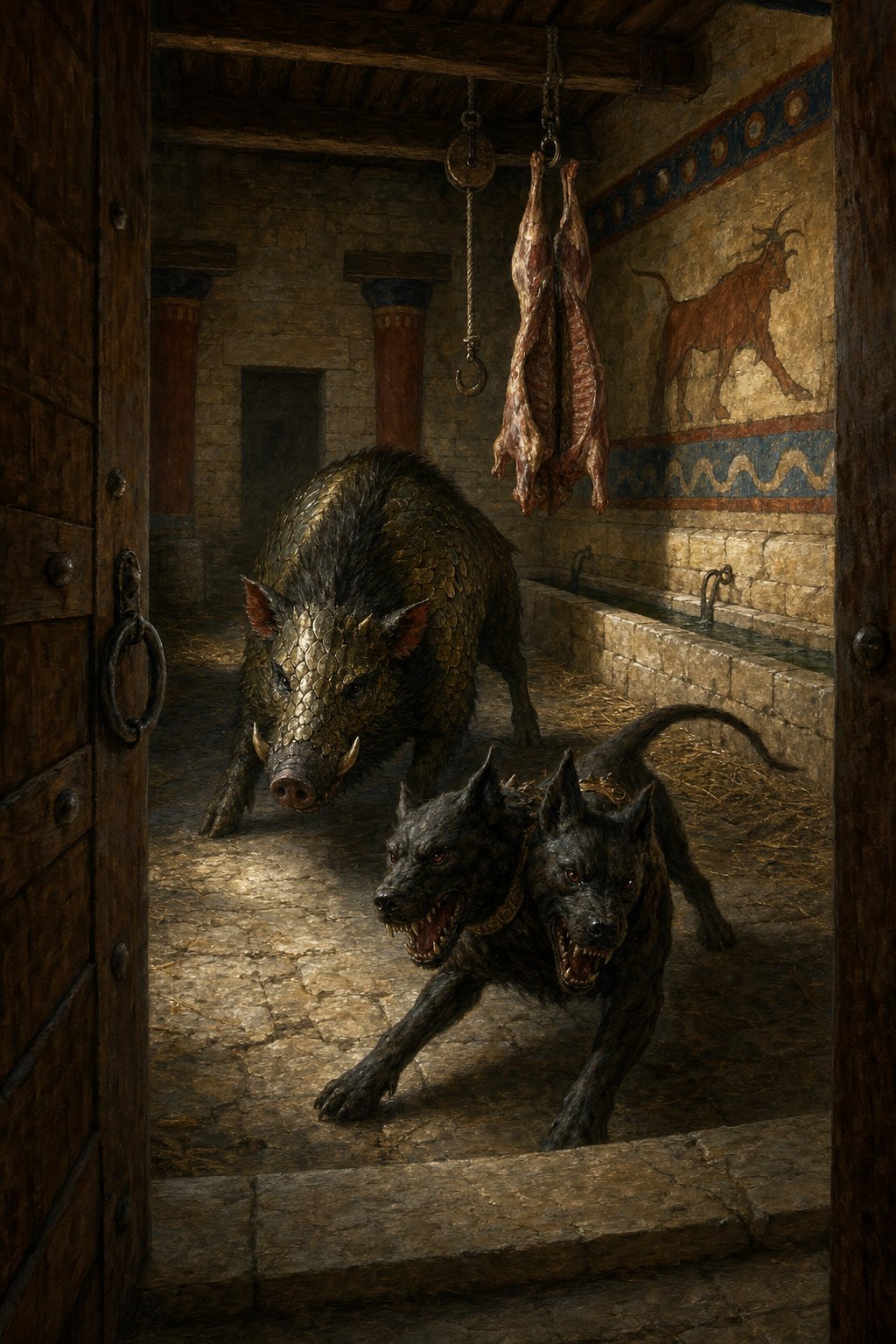
Somebody keeps dogs here, and keeps them well. A stone trough runs the length of the far wall. A hoist and a hook hang from a roof beam with two split carcasses on them, high enough to be out of reach and low enough to be smelled. Iron rings are set into the floor in a row of eight, and six of them have chains on them, and the chains are all lying slack.
Your light does not reach the far end. From out there comes breathing — overlapping, out of phase, two rhythms to a body.
DM summary. Six two-headed hounds off the chain in a room built for feeding them. The kennel-keeper's own tools are the bypass: there are two carcasses on the hoist and a whistle by the door, and a party that feeds the pack fights half of it.
Terrain & Features
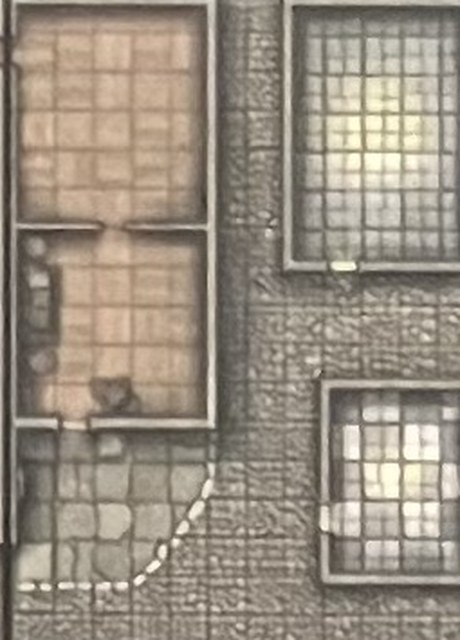
Battle map: The Back Yard — page 38, 55 × 75 ft (one half of The Roadhouse)
The back rooms' long outbuilding is the kennel at 55 × 30 ft: draw the 30-ft stone trough down one side, the eight chain-rings along the spine, and the hoist with its two hanging carcasses over the centre. Wall off the yard.
- Dimensions. 55 ft × 30 ft, ceiling 14 ft. Long, straight, and built for handling animals: the party enters at one short end and everything happens down the length.
- Light. None, and light is close to useless here. The dogs hunt by scent and are unaffected by darkness; a torch does not blind them, does not deter them, and does tell them exactly where the party's centre is. Extinguishing your light does not help you and does not hurt them. State this out loud the first time a player reaches for a lamp, because it inverts the assumption the deck has trained into them.
- The trough. Stone, 30 ft long, 2 ft deep, empty and scoured. It is half cover for anyone crouched behind it and it is where a fed dog goes.
- The hoist. A beam-and-pulley over the room's centre with two split goat carcasses on the hook, 9 ft up. The cleat is by the door. Releasing the cleat drops both carcasses — one action, Athletics DC 13 to control the drop so they land apart rather than in a heap.
- The chain-run. Eight floor rings in a line down the room's spine, six with 8-ft chains. The slack chains are difficult terrain across the middle 30 ft for anything that does not live here, and the dogs know exactly where every link is.
- The keeper's post. By the door: a stool, a chest, a leather apron on a peg, and a bone whistle on a thong. On the wall above it, scratched, a row of tally marks in three groups of different lengths.
Encounter
Six hounds in the dark, and twelve heads that do not want the same thing.
| Count | Creature | XP each |
|---|---|---|
| 6 | Two-Headed Death Dog | 700 |
Base 4,200 XP; ×2 for six bodies = 8,400 adjusted, under the APL 9 Hard budget of 9,600. The rest of the room's weight is the disease and the dark: six bite attacks a round that each carry a rot, in a room where the party cannot see the far end and cannot make themselves unseen.
The two-head rule, and it is the room. Each hound's heads act independently enough that anything which occupies one head halves the dog. A hound that is eating, that has been given a scent to follow, or that has been called by the whistle attacks with one bite instead of two and moves at half speed until the distraction ends. That is not a house rule, it is what the feeding trick on the bestiary card is for, and this room is where it is meant to be used.
Round 1. They come down the room in a loose line, not a charge — heads low, one head watching the party and one head watching the hoist, because the hoist is where food comes from and they have been listening to it swing for a day. The first dog to reach the party goes for whoever smells most of blood (the most wounded character, or the last one to have handled rations).
Tactics. They are animals and they behave like animals. They pull down single targets, they abandon a fight to eat, they will not step into fire, and they do not pursue past the door — this is their room and the food is in it. If three of the six are dropped, the remaining three back off to the trough end and hold there, snarling, and will let the party leave. Take that offer on their behalf if the table is tired.
Bypass Options
Two split goats, six dogs, and a floor of chains between them and the party.
- The check: Athletics DC 13 at the cleat to drop both carcasses apart from each other (a failure drops them in one heap, which occupies two dogs instead of four). Then group Stealth DC 12 to cross the chain-run while the pack is at the meat — a low DC, because the dogs are busy, not deaf.
- Success: four of the six are eating and halved for three rounds. The party can cross the room, or fight two dogs instead of six, or open the far door and go.
- One failure: two dogs stay off the meat. They are between the party and the far door and they are the two largest.
- Two failures: a chain catches an ankle. That character is prone in the chain-run, the pack notices, and the room is a fight — but a fight against a pack with four dogs' worth of distraction still in progress. This is a bad outcome, not a disaster.
- Cost: the carcasses are gone, which matters if the party wanted to carry meat onward, and the noise of the drop is heard through the far door.
The tally on the wall above the stool is not a count of days. It is three pitches.
- The information: Investigation DC 13 to see that the three groups of marks correspond to three notes, and that the longest group has been re-scratched repeatedly — that is the recall note, the one the keeper used most.
- The check: Performance DC 14 to get the note clean, or automatic for a character with a musical instrument proficiency who takes a round to try the whistle quietly first.
- Success: the entire pack goes to the trough and sits. Three rounds, and they will hold as long as the note is repeated once a round by somebody standing at the keeper's post — which means one character stays behind and catches up after. A party that works this out has beaten the room without a die of damage.
- Failure: the wrong note is the hunt note. All six come at once, at full speed, and they arrive angry. This is the worst outcome available in R071 and it is worth the risk — say so before the roll.
- Cost of withdrawing instead: the party can leave by the door they came in at any time; the pack does not follow. They lose the keeper's chest and the room's clue.
Traps / Puzzles / Checks
The rot. Every bite here carries the kennel's disease. A creature bitten makes a Constitution save DC 12; on a failure, its hit point maximum drops by the damage taken until it finishes a long rest, and it cannot regain hit points from a short rest. Six dogs biting twice a round makes this ugly quickly — cap it at one save per character per round, and say the cap out loud, or the room becomes arithmetic.
Treating it afterwards is Medicine DC 13 plus a healer's kit per patient, ten minutes; the cold spring in the deck's bath-house ends it outright.
Exits
One roll on the loot table, from the keeper's chest by the door — a working chest, not a treasure: leads, muzzles, a spare whistle, a purse, whatever the d100 says.
- No check if the pack is fed, whistled, or dead.
- Sleight of Hand DC 13 to open and rifle it while the pack is loose in the room, which is one round spent with your back to six dogs.
Scaling — APL 6 / 12 / 15
| APL | Adjustment |
|---|---|
| 6 | Four hounds, one carcass on the hoist. Disease save DC 10. All other DCs −2 |
| 9 | As written |
| 12 | Eight hounds, and a Calydonian Boar-Warden penned behind the far arch that comes through it on the second round of any fight, in a straight line, without stopping. DCs +1 |
| 15 | Eight hounds, two Boar-Wardens, and the keeper is home: a huntsman who does not fight but blows the hunt note every round from the far end, which the party must reach to stop. Disease save DC 15, other DCs +3 |
- Pacing. Twenty minutes fought, seven bypassed. The bypasses are the intended path and they are both physical objects the party can see from the doorway.
- If you are behind schedule, four dogs, both carcasses already on the floor and half eaten, and no disease. Eight minutes.
- Say the darkness rule immediately. "Your light does not help you here and does not hurt them" is the single most useful sentence in this room, and a party who hears it will start looking for a different lever, which is exactly what you want.
- Do not let the disease outlive the room. One save per character per round, and treatable in ten minutes with a kit. A rot that follows the party for three rooms is a tax on the session, not a consequence.
- If the party is nearly dead when they roll this room, run the three-dogs-and-back-off version: they drop two, the rest retreat to the trough, and the room ends in a standoff that the party wins by walking out. Beasts do this. It is not a mercy, it is behaviour.
- Table safety. Kept animals, a disease that eats hit point maximum, and being pulled down in the dark. Low intensity by this deck's standards, but if anyone at the table is uneasy about harm to animals, the whistle bypass exists precisely so the room can be solved without killing a dog, and you should make sure they know it is there.
- Clue drip. Two objects: the tally of pitches on the wall above the stool, which is somebody's working notes and in the same hand as marks elsewhere in the maze (X14, Trace — the maze has staff, and staff leave documentation), and the carcasses on the hoist, which are fresh, which means somebody restocked this room within the day (X05 or X03, Sign — there are living people down here on a routine).
- Warband callback. Beasts of the Hunt (W17) can always be solved with food, scent, or noise, and never with intimidation. A party who has met them and who walks in here reaching for their rations instead of their swords has learned the lesson this warband exists to teach. Reward it fully.
Creature Cards
Both belong to Beasts of the Hunt (W17) and recur across the deck, so the numbers live in the bestiary. The halving rule, the whistle, and the pack's willingness to break off are this room's and stay here. The Boar-Warden appears only in the APL 12 and 15 rows and is listed so a DM scaling up has the card to hand.
Shared across rooms, so the full cards live in the bestiary: Two-Headed Death Dog, Calydonian Boar-Warden. Every mention above opens the numbers here on this page.