Chamber of the Weighing Chain
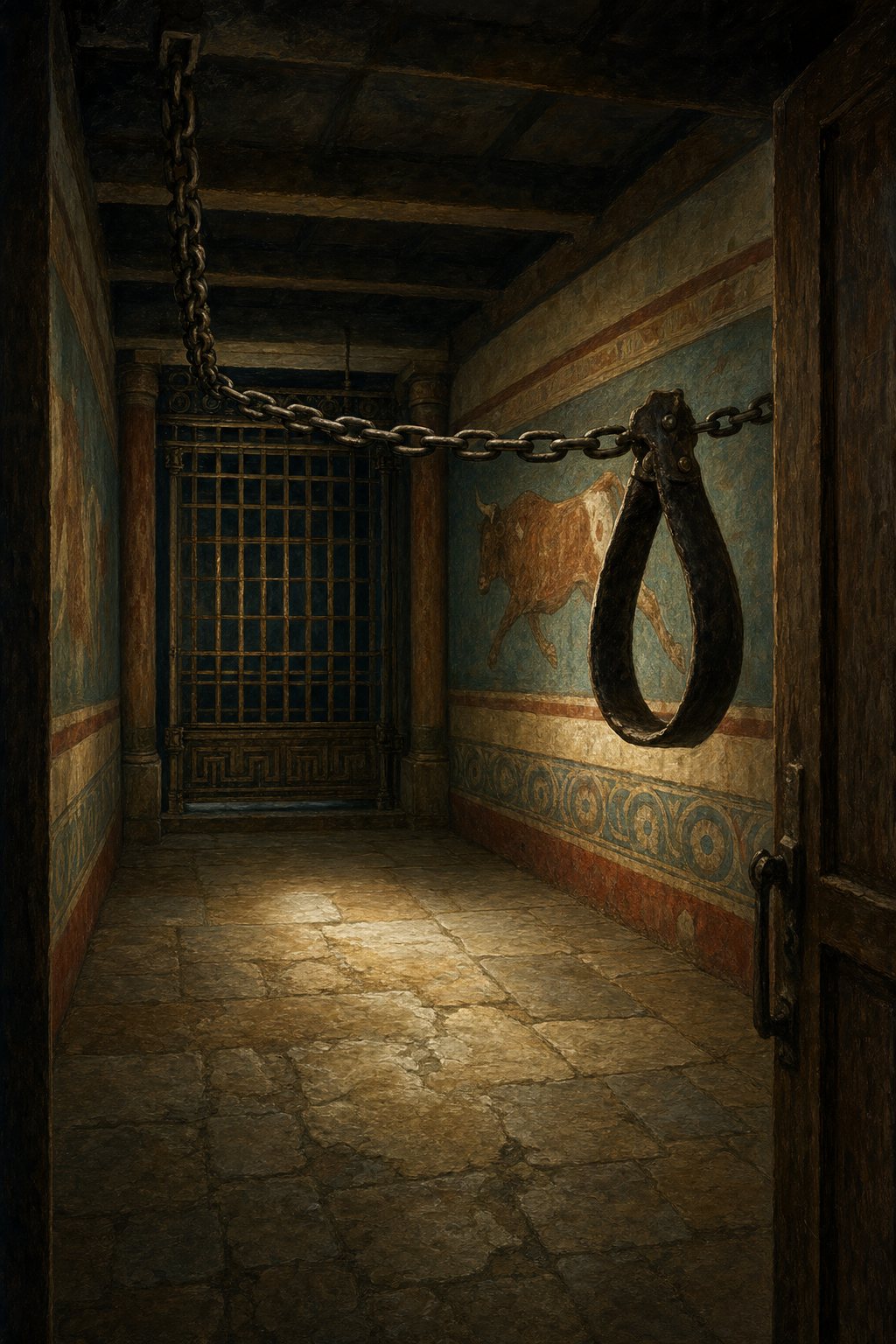
A chain as thick as a wrist comes down out of the dark ceiling, crosses the room at head height, and ends in a loop of bull-hide big enough to put your whole shoulder through. At the south end a bronze grille stands closed from floor to lintel. At the north end there is a pit in the floor with a stone cradle sitting in it, and beside the pit, stacked like firewood, a row of squared stone billets.
The dust here is printed all over with hoofprints, and the hide loop has been worn shiny and soft by something that used it every day for years.
DM summary. A counterweight lock designed to be operated by one creature with a bull's shoulders, and the party does not have one. The room is arithmetic and rope-work, it is solvable three different ways, and the loudest thing in it is what the hoofprints imply.
Terrain & Features
Battle map: custom map. A 40 × 30 ft floor under 45 ft of pulleys, chain, and cradle — side-view sketch; the answer is overhead. Browse the book if a page half fits your table better.
- Dimensions. 40 ft × 30 ft, ceiling 45 ft — most of the room is above head height and most of the answer is up there.
- Light. One guttering wall-lamp with maybe an hour left in it. The pulley tree at the top of the chamber is in darkness and nobody sees it from the floor without light or Perception DC 13.
- The weighing gate. A bronze grille, 10 ft wide, in the south wall. Its top rail is stamped with twelve bull-heads. It weighs what it says it weighs and it does not lift by hand.
- The pulley tree. Four bronze sheaves in an iron frame at 40 ft, of which one is currently reeved. Three hang idle with their pins in. A climb up the wall ladder to the frame is Athletics DC 14; there is a plank walk up there, 2 ft wide, no rail.
- The cradle and the pit. A stone cradle hangs on the chain's other end over a 12-ft pit. Empty, it weighs nothing worth counting.
- The billets. Five squared stones by the pit, each stamped on its face with bull-heads: one, two, three, five, and eight. They weigh what they say. A PC can carry the one, two, three, or five alone; the eight takes two people or an Athletics DC 13 to shift alone.
- The haul loop. Bull-hide, worn soft, hanging at 5 ft 8 in. Nothing about it is sized for a human and everything about it is sized for something that stood here comfortably.
Traps / Puzzles / Checks
The lock, stated plainly. The gate rises when the cradle carries more than twelve. If the cradle carries more than sixteen, it drops too fast, the chain jumps the sheave, and the mechanism jams — see Failure below.
| Element | Value |
|---|---|
| Trigger | Weight placed in the cradle; the balance is continuous, not a switch |
| Reading the stamps | Investigation DC 12, or free for any PC who looks at the gate's top rail and then at the billets. Do not gate this; it is the puzzle's premise, not its difficulty |
| Understanding the sheaves | Investigation DC 14 to see that three sheaves are idle, and that reeving them turns one person's pull into four people's |
| The safe band | Investigation DC 13 on the pit floor: the stone under the cradle is chipped to gravel from being slammed. Someone has overloaded this before. Below that DC, they learn the band the hard way |
| Solved state | The gate stands fully up and locks on its own pawl. It stays up. The party can come back through it, and so can anything else |
The three ways through.
- Load the cradle correctly. Any combination totalling thirteen to sixteen: 8+5, 8+3+2, 8+5+1, 8+5+2, or 8+5+3. Every solution needs the eight, because the other four together make eleven — which is the joke the builder was making, and a party that works that out deserves to be told they are right.
- Rig the tree. Reeve two or three of the idle sheaves (climb, Athletics DC 14; the rope is on the wall) and the haul becomes a group Athletics DC 13 for any four PCs. This is the route for a party with no head for numbers and good shoulders.
- Trip the pawl. Thieves' Tools DC 16 at the ratchet beside the gate post. The gate jerks up three feet and no further, held on the dog.
Failure and cost.
- Overload (seventeen or more): the cradle slams, the chain jumps its sheave, and the gate crashes down. Anyone in the gateway makes a Dexterity save DC 15 or takes 4d10 bludgeoning and is pushed clear. Re-reeving the jumped chain means the climb, and Athletics DC 15 at the top with somebody hauling slack below.
- A failed climb: 40 ft is 4d6 and prone, and the plank walk has no rail. Rope this one; the room is happy to be beaten by a party that ropes up.
- The three-foot gap: a body goes through prone, one at a time, one round each, and anything on the far side gets that round. A spear or crowbar left wedged under the gate holds it if the pawl slips, and is destroyed doing so.
Exits
None. Everything portable in this room is either a tool the party can carry away and use — the coil of rope, a bronze sheave pin, the crowbar — or a stone billet weighing more than a person. The mundane gear is worth having and does not consume a loot roll; if a player wants the rope, they have the rope.
Scaling — APL 6 / 12 / 15
| APL | Adjustment |
|---|---|
| 6 | The gate is stamped eight and the billets run 1/2/3/5, so 5+3 and 5+2+1 both work; the safe band is generous. All DCs −2 |
| 9 | As written |
| 12 | The eight-billet is gone — hoofprints lead away with it — leaving 1/2/3/5 against a gate of twelve, so the party must rig the tree or trip the pawl. DCs +1 |
| 15 | As APL 12, plus the pawl is bronze-welded shut and the plank walk is rotten: any PC who spends two consecutive rounds up there makes a Dexterity save DC 17 or the plank goes. DCs +3 |
- Pacing. Ten to fifteen minutes, and it is almost all table talk, which is exactly what this room is for after a fight. Behind schedule: have the cradle already loaded to eight, so the party only has to find one more billet worth five or better. Four minutes.
- Do not let the arithmetic become homework. Put the five billets physically in front of the players if you can — five dice, five coins, five scraps of paper with numbers on them. It turns a maths problem into a table activity and it takes twenty seconds to set up.
- The hoofprints are the horror and they are free. Nothing in this room fights. Somebody worked here every day, and the tally chalked on the gate post counts hauls, not days, and it is in the hundreds. Let the players decide what that means; do not explain it.
- If one player is dominating, hand the tree to somebody else: the climb, the reeve, and the haul are three different characters' moments and the room has jobs for all three at once.
- Clue drip. Two objects here take a clue well: the chalk tally on the gate post, a count kept by someone who could count, which suits X14 (A Thread of Your Own Making); and the bull mask on the peg by the drovers' door, hung up rather than lost, which suits X19 (The Bull-Gate Mechanism) — this gate and that one were built by the same hands and use the same pawl.
- Table safety. One crushing image: a bronze grille coming down on whoever is under it. If that lands badly, the overload throws the gate up off its guides and drops the cradle into the pit instead — same DC, same damage, no one pinned.
- Warband callback. Bull-Kin rooms are about force applied in a straight line. This is the same idea with the creature removed, and a party who has met them will read the hide loop correctly before you finish describing it.