The Riddle Bridge
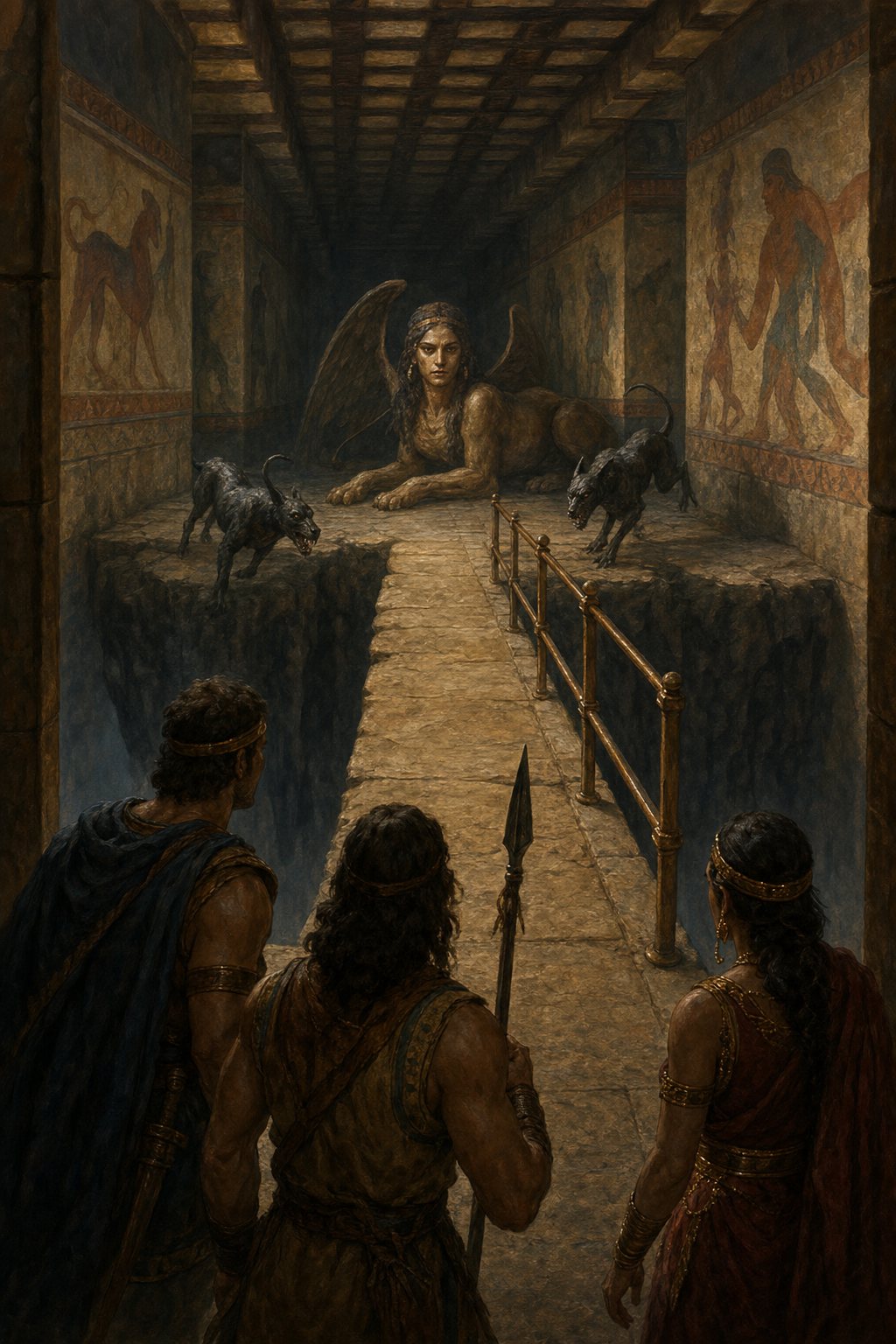
The corridor ends at nothing. A chasm sixty feet across cuts the maze in half here, and a single span of bronze-railed stone crosses it, five feet wide, with no rail on the left-hand side where something took it away.
Halfway across, sitting on the span with its forepaws crossed and its wings folded flat along its back, is a lion with a woman's face. It has been waiting long enough to be bored and it looks up at you the way a toll-keeper looks up at a cart.
"Three," it says. "As always. Send whoever thinks."
DM summary. A gatekeeper who states its terms before it does anything else. Three riddles for the crossing, a toll for a party that cannot answer them, and a fight that only happens if somebody breaks the bargain first.
Terrain & Features
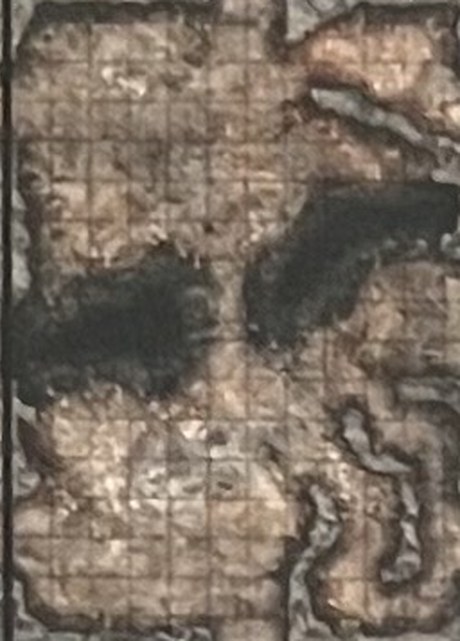
Battle map: The Bridged Pit — page 16, 55 × 75 ft (one half of The Broken Galleries)
The bridged pit is the riddle chasm, span and all: extend the pit's edges with drawn lines so the gap crosses the whole page, keep the bridge as the 5-ft stone span, and chalk the sphinx's perch on the far lip.
- Dimensions. The chasm is 60 ft across and 80 ft deep to a rubble floor, in a natural fault the maze was cut through rather than around. The party arrives on a 20 ft × 20 ft landing on the east lip.
- Light. The sphinx keeps four oil cressets on iron stands, two per lip, and they are lit. It likes to see faces when it asks.
- The span. 5 ft wide, dressed stone, sound. A bronze rail on the north side only — the south rail is gone and the sockets are sheared, which is a thing the party should be told before anyone decides to shove anybody.
- Falling. 80 ft to rubble: 8d6 bludgeoning, and a Dexterity save DC 12 to catch the north rail if you go off within 5 ft of it.
- The perch. A ledge on the west lip, 8 ft above the landing, where the sphinx sleeps. Behind it is a low tunnel it uses and nobody else does.
- The stair. On the east lip, cut into the chasm wall, spiralling down and away northward at a shallow grade. Wet, worn, and entirely free to use.
- The hound. A Riddle-Hound paces the east lip, between the landing and the bridge-head. It has never once attacked a person who was in the middle of answering a question.
Encounter
Only if the bargain breaks. The sphinx says so in advance, in as many words, and it means it.
| Count | Creature | XP each |
|---|---|---|
| 1 | Lesser Sphinx | 5,000 |
| 1 | Riddle-Hound | 1,100 |
Base 6,100 XP; ×1.5 for two bodies = 9,150 adjusted, against the APL 9 Hard budget of 9,600. The bridge does the rest: 5 ft of frontage, one missing rail, and an 80-ft drop mean a party of six fights this two at a time.
What breaks the bargain. Attacking it. Lying about an answer after it has been accepted. Crossing the span without settling. Touching the cressets. It tells the party all four, unprompted, before the first riddle.
Round 1, if it comes to that. The sphinx does not open with claws. It stands up, walks backward along the span to the west lip — keeping the party on the narrow — and then rolls initiative, having given everyone one more chance to stop. The hound closes the east bridge-head so nobody leaves that way without going through it.
Tactics. It fights on the span and only on the span, because the span is where it is worth two of anybody. It shoves rather than kills: a creature it hits twice in a round is pushed 10 ft along the bridge and must save or go over the open side. It disengages upward when below a third of its HP and asks, from the air, whether the party would now like to answer the third riddle. Let them. It means it. It has nothing to gain from a corpse.
Bypass Options
The riddles themselves are under Traps / Puzzles / Checks below; these are the three ways past the sphinx that do not involve answering them.
The sphinx would honestly rather be paid. It names its price in this order and takes the first thing offered:
- A true thing said aloud that the speaker has not told the rest of the party. No check. The player has to actually say something, in character, and it has to cost them. This is free in gold and expensive in every other way, and it is the best outcome in the room.
- Two hundred drachmae of worked metal, or one magic item, handed over.
- An hour of service: the party fetches something from the chasm floor. Eighty feet down and back, Athletics DC 14 twice, and there are bones down there.
- Failure to pay anything at all is not an attack. The sphinx simply sits back down in the middle of the span and goes to sleep, and the party can take the stair like everyone else who could not afford it.
The span's underside carries a maintenance cable and the chasm wall has a six-inch ledge running to the west lip.
- The climb: Athletics DC 16 to get onto the cable and traverse, then Stealth DC 15 to do it without the hound's nose finding you. Roped, a failure costs a rope and a rope burn instead of a fall.
- One failure: you are hanging 80 feet over the dark and the sphinx has leaned over the edge to watch. It will not attack a person already being punished by gravity — that is beneath it — but it will describe your situation to your friends in some detail.
- Two failures: you fall. 8d6, and the party is now split across an 80-ft drop with a bored sphinx between them.
- Cost: the hound waits at the top of the far ledge, and the party arrives on the west lip having very publicly refused to pay a toll.
The east stair is free, unguarded, and goes on for a very long way. It costs nothing but the clue and about twenty minutes of walking in the dark.
Traps / Puzzles / Checks
The toll: three riddles, two right to cross. The party may confer for one minute per riddle, out loud, and the sphinx enjoys listening. A player who is stuck may hand it to their character instead: Intelligence check DC 15, once per riddle, and yes, the character is allowed to be cleverer than the person playing them. Say that at the table before the first riddle so nobody sweats.
Riddle the first.
"Two men make me. One walks over me. One falls under me. To both of them I am exactly the same."
Accepted: a bridge · a plank, a span, a road over a gap · a wall (argue it and it counts — a wall is the same to the man it keeps out and the man it keeps in). A clever fourth: anything that is genuinely indifferent between the lucky and the unlucky — a coin, the sea, a law, a door. If the player argues it in one sentence, accept it. The sphinx does.
Riddle the second.
"I have a thousand corners and not one room. I have a door for every man who comes in and none at all for the man going out."
Accepted: the Labyrinth · a maze, a knot, a net · a shell or a spiral. A clever fourth: a life, a war, a debt. Accept anything that names a thing easy to enter and hard to leave.
Riddle the third.
"The more of me you take, the more of me you leave behind you."
Accepted: footsteps · footprints, tracks, a trail · years, or time. A clever fourth: breath, debts, names. This one is old and some players will know it cold; that is fine, and answering instantly should be rewarded with the sphinx looking mildly cheated.
Two of three right: it stands aside, and it tells the party one true thing about the maze on the way past (see the clue drip).
Fewer than two: it names the toll instead — not a fight. See the first bypass.
Exits
None. It collects tolls and keeps nothing — everything it has ever been paid went over the south side of the bridge within a day, which is why the rail is gone and why the chasm floor is such an interesting place. Do not let the party fish it out. Eighty feet down there are four hundred years of coins, three skeletons, and a very good reason nobody has been back up.
Scaling — APL 6 / 12 / 15
| APL | Adjustment |
|---|---|
| 6 | No hound. Two riddles, one right to cross, and the sphinx takes 50 gp as a toll. All DCs −2 |
| 9 | As written |
| 12 | The hound's mate is awake on the west lip — two Riddle-Hounds — and the sphinx asks a fourth riddle of its own devising: any question the DM genuinely does not know the answer to, asked of the party, answered honestly. DCs +1 |
| 15 | A Lesser Sphinx and a Whispering Laurel rooted at the span's near post, and the laurel lies exactly once across the three riddles. Two Riddle-Hounds. DCs +3, and the sphinx fights with the bridge: on initiative 20 the span's stones lift and settle, and every creature on it makes a Dexterity save DC 17 or is knocked prone |
- Pacing: 15–20 minutes, most of it the players talking to each other. Riddle rooms run long because tables enjoy them. That is a good use of time exactly once per session; if this is the second riddle room the party has rolled, cut to one riddle and the toll.
- If you are behind schedule, open with the sphinx already halfway through the terms and run riddle three only. Six minutes.
- If the table hates riddles, say so first, out loud: "this one's a riddle room — do you want to solve them or roll for them?" Rolling is Intelligence DC 15 three times and it is not a lesser way to play.
- Never let this become a fight by accident. The sphinx narrates the rules before it does anything, gives a warning when the bargain frays, and walks backwards before it attacks. If initiative is rolled here, it should be because a player looked at 9,150 adjusted XP on a five-foot bridge and said yes.
- The hound is the tell. It will not attack anyone who is still answering. A party that works that out has found a genuinely free action: keep talking, keep asking, and the hound cannot touch you.
- Clue drip. Two hooks: the one true thing the sphinx says on the way past, which is where a Sign- or Proof-tier clue for any live Resolution belongs and should be spoken in the sphinx's voice, not the DM's; and the cressets, which are filled with good oil by somebody who is not the sphinx, on a schedule (X10, X08). If your Resolution is X06, the sphinx is an outer voice of the oracle and will direct a party that behaves well inward — say the word "downward and left of the water" and mean it.
- Callback. Sphinx & Riddlers always talk first. If your table meets them again, the party should already know that the correct opening move is to shut up and listen, and that the claws are a failure state on both sides.
Creature Cards
Both belong to Sphinx & Riddlers (W15) and both recur, so the numbers live in the bestiary. The Sphinx is this room's centrepiece, but R044, R094, and F13 field her again when scaled up. The tactics above are this room's and stay here.
Shared across rooms, so the full cards live in the bestiary: Lesser Sphinx, Riddle-Hound. Every mention above opens the numbers here on this page.