Stairwell of the Nine Dead
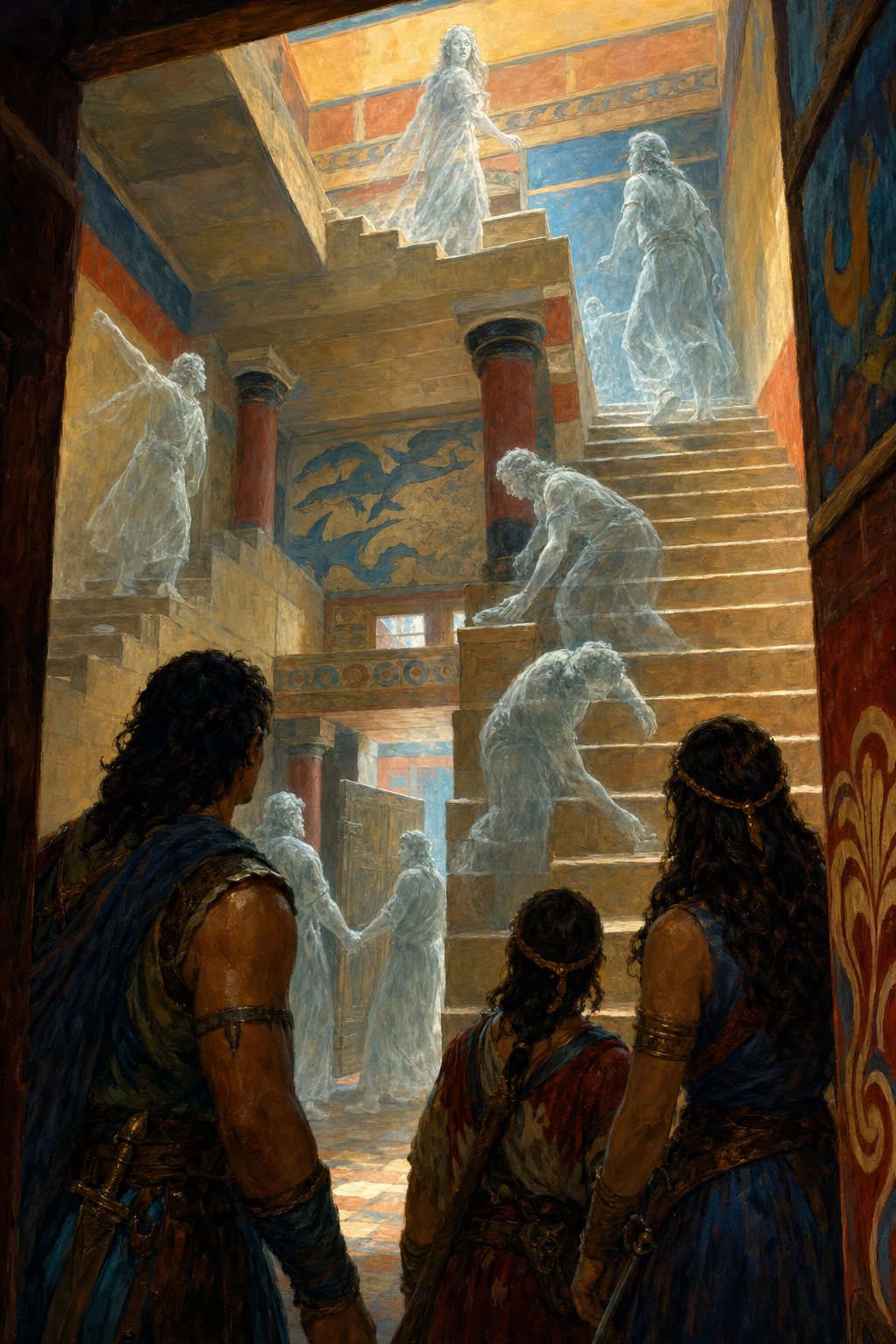
The stair goes up around a square well, four flights and three landings, and it is full of people. Nine of them, grey as breath on cold glass, and every one of them is busy: a man on the third step setting down a lamp that is not there, a woman on the ninth turning back to call a name, two more at the first landing shouldering a door that has been open for a century.
None of them looks at you. Then the man sets down his lamp again, and the woman turns back again, and you understand that you have walked into the last minute of somebody's very bad day, and it is still going.
DM summary. Nine shades running a sixty-second loop of their own deaths up a four-flight stairwell. Move as the dead moved and the stair lets you up. Break the choreography and the loop notices you.
Terrain & Features
Battle map: custom map. A 30 × 30 ft open-well stairwell 60 ft tall — sketch the square well and four flights; the fight is on the stairs, not a floor. Browse the book if a page half fits your table better.
- Dimensions. 30 ft × 30 ft in plan, 60 ft tall — four flights of eleven steps around a square open well 12 ft across, with landings at 15, 30, and 45 ft. The party enters at the bottom.
- Light. Whatever the party brings, plus the shades themselves, who shed a dim grey light within 5 ft. Their light does not help anyone see anything useful.
- The well. Open, unrailed, 60 ft top to bottom. A fall from the top flight is 6d6 and lands on stone. Say the drop is there, every flight.
- The steps. Worn, uneven, and in three places broken — the third step, the landing edge at 30 ft, and the fourth-flight turn. Each broken place is where one of the nine died.
- The door at the first landing. Bronze, standing open, jammed with a wedge that the two shades are still shouldering against. It is genuinely wedged. It is genuinely open.
- The tenth figure. Not part of the loop. Standing on the top landing, facing down the well, is a shade that does nothing at all until somebody makes a noise that is not in the script. See the encounter.
Encounter
This fight happens only if the party breaks the choreography, and the room shows its steps for free to anyone who watches a minute.
| Count | Creature | XP each |
|---|---|---|
| 4 | Lost Wanderer | 700 |
| 1 | Sighing Shade | 1,800 |
Base 4,600 XP; ×2 for five bodies = 9,200 adjusted, against the APL 9 Hard budget of 9,600. The 60-ft open well is not in that number and is worth more than the shortfall: this is a fight on stairs, and stairs decide it.
Why nothing is attacking. The nine are not guarding anything and do not know the party is there. A Lost Wanderer repeats its last hour and is harmless the entire time — until it is interrupted. Interrupting it is the only hostile act available in this room, and the party can avoid it completely.
Round 1, if it breaks. The interrupted Wanderer and three others come out of the loop — grey, confused, and furious about it. The Sighing Shade on the top landing comes down the well, through the air, and it goes for whoever is loudest. The five witness-shades stay in the loop and keep re-enacting through the middle of the fight, which is both unnerving and mechanically useful cover.
Tactics. The Wanderers fight on the stairs, in the way, and try to push living things toward the well — treat any successful shove as a 15-to-45-ft fall risk and give the target a Dexterity save DC 13 to catch a step. The Sighing Shade ignores any creature that has made no sound since it descended; a party that goes silent mid-fight can watch it drift past them looking for the noise. Nothing here pursues out of the stairwell at either end. Wanderers that lose their target for two rounds return to the loop and resume setting down lamps that are not there, which is the room's best and saddest exit ramp from a fight.
Bypass Options
Match the four stations and walk up through a private tragedy without touching it.
- The checks: none, for a party that watched a loop. Performance DC 14 per missed station otherwise.
- Success: the top landing, four rounds, no initiative. The party arrives having set down a lamp, said a name, touched a door, and looked down a well, and if your table does not go quiet for a second on that fourth one, nothing will do it.
- One failure: one Wanderer breaks off and follows the offender up the stair, asking a question in a language nobody speaks. It does not attack for two rounds. Matching its station in that window puts it back in the loop.
- Two failures: initiative, as above.
- Cost: setting down a light source on the third step means the party is climbing a dark stair with one less lamp. That is deliberate.
The shaft is open, the walls are dressed stone with a century of iron fittings in them, and nothing in the loop looks up.
- Climbing: Athletics DC 16 for 60 ft of chimney-work in the well, or DC 12 with a rope anchored at the top landing, or free with a climb speed or flight.
- Success: the party bypasses every station and every shade. Nobody is ever interrupted.
- Failure: a fall from wherever they are — 2d6 at the first landing's height, up to 6d6 near the top — into the middle of a loop that is now looking at them.
- Cost: somebody has to get to the top first to anchor the rope, which means one character solves the stair alone. That is a fine scene for one player and a bad one for four; offer it, and say the DC out loud before anyone commits.
The Sighing Shade hunts sound and the Wanderers hunt interruption. A party that does neither can walk straight up the middle of the stair.
- The check: group Stealth DC 15, and the real cost is procedural: no talking at your actual table for the duration, which players enforce on each other far better than any DC.
- Success: the stations do not matter. Silence is a complete solution, and this is the version of the room that a party of rogues will find first.
- One failure: the Sighing Shade turns toward the noise and begins to drift down the well. The party has two rounds to get to a landing door before it arrives.
- Two failures: initiative, and the fight starts with the Shade in the middle of the party rather than above them.
- Withdrawing instead: the bottom door is behind the party the whole time and nothing follows them out of it. The cost of withdrawing is a wandering-threat roll and the four landing doors they never opened.
Traps / Puzzles / Checks
The loop. Ten rounds, then it restarts, and it has run without variation for a very long time. Nine shades, four of which are stations the party must match. The other five are witnesses: they crowd, they pass through people, and they can be ignored entirely.
| Round of the loop | Station | What the dead do | What a living body must do to pass |
|---|---|---|---|
| 1 | Third step | A man crouches and sets down a lamp | Set down a light source on the third step. It can be picked up again at the top |
| 3 | Ninth step | A woman turns back and calls a name up the well | Say a name out loud — any name, including your own |
| 5 | First landing | Two men shoulder the bronze door and wedge it | Put a hand on the door as you pass, and leave the wedge alone |
| 8 | Fourth-flight turn | A man stops, looks down the well, and does not jump | Stop on the turn for one full round and look down. Nobody has to do anything else |
| 10 | — | All nine go still, then begin again | The loop resets. A party mid-stair simply picks up at the next station |
- Reading a station: Insight DC 13, or Perception DC 13 to watch it twice. Watching one full loop from the bottom (ten rounds, no risk) hands the party all four stations with no check at all, and that is the intended play. Reward patience.
- Matching a station: no check for a party that knows what it is doing. For a party improvising, Performance DC 14 per station.
- Missing a station — walking past without doing the thing — is what breaks the loop. The shade of that station stops, turns, and looks at the person who interrupted it. That is the trigger.
- Solved state: a party that matches all four stations reaches the top landing and the shades never once acknowledge them. The tenth figure steps aside. The loop continues, forever, behind them.
Exits
None. Nine dead people, and nothing on them: they are shades, and whatever they carried is where their bodies are, which is not here.
A player who searches the broken third step finds the lamp — the real one, bronze, crushed flat, oil long gone. It is worth nothing and it is the best souvenir in this part of the maze. Let them take it.
Scaling — APL 6 / 12 / 15
| APL | Adjustment |
|---|---|
| 6 | Three Wanderers, no Sighing Shade — the tenth figure is another Wanderer. Three stations instead of four (drop the fourth-flight turn). DCs −2 |
| 9 | As written |
| 12 | Six Wanderers and the loop is eight rounds, which means less watching time per station. DCs +1, and a Wanderer that returns to the loop re-emerges hostile the second time it is interrupted |
| 15 | Six Wanderers and a Wraith of the Long Silence in place of the Sighing Shade — blind, deaf to silence, and the reason the silent bypass becomes the only bypass worth attempting. DCs +3, and the well is webbed with old rope that makes the climb DC 18 |
- Pacing: twenty minutes, and ten of them are watching. When you are behind schedule, cut to two stations (the lamp and the name), tell the party the loop exists in your second sentence, and run it in eight minutes.
- Run the loop out loud and repeat yourself word for word. The same sentence, the same lamp, the same name, every ten rounds. The repetition is what teaches the players that this is a script they can join, and it costs you nothing but nerve.
- The name the woman calls should be a player's choice. When a character says a name aloud at the ninth step, ask whose. Do not comment on the answer.
- Do not let the fight be the outcome of one bad roll. Every trigger here has a two-round grace window built in, and a Wanderer that loses interest goes back to its lamp. If the table is enjoying the puzzle, keep giving them exits from the fight.
- Clue drip. Two hooks: the crushed bronze lamp on the third step, which has a household mark and a wick trimmed for a long walk (X14, X17), and the wedge under the landing door — cut from a chair leg, carved with a tally of days by somebody waiting on this stair (X05, X10).
- Table safety. Nine people re-enacting their own deaths on a loop is the register, and the man on the fourth-flight turn who looks down and does not jump is the sharpest image in it. If your table would rather not, he is looking for somebody below rather than considering the drop, and the station is unchanged.
- Callback. Shades of the Maze (W09) are triggered, not aggressive: sound, interruption, and attention are what set them off. A party that has crossed a colonnade of sighing shades in silence already knows the grammar of this warband, and this room asks them to do the harder version — not silence, but participation.
Creature Cards
Both belong to Shades of the Maze (W09) and recur across the deck, so the numbers live in the bestiary. The tactics above are this room's and stay here.
Shared across rooms, so the full cards live in the bestiary: Lost Wanderer, Sighing Shade. Every mention above opens the numbers here on this page.