Colonnade of Sighing Shades
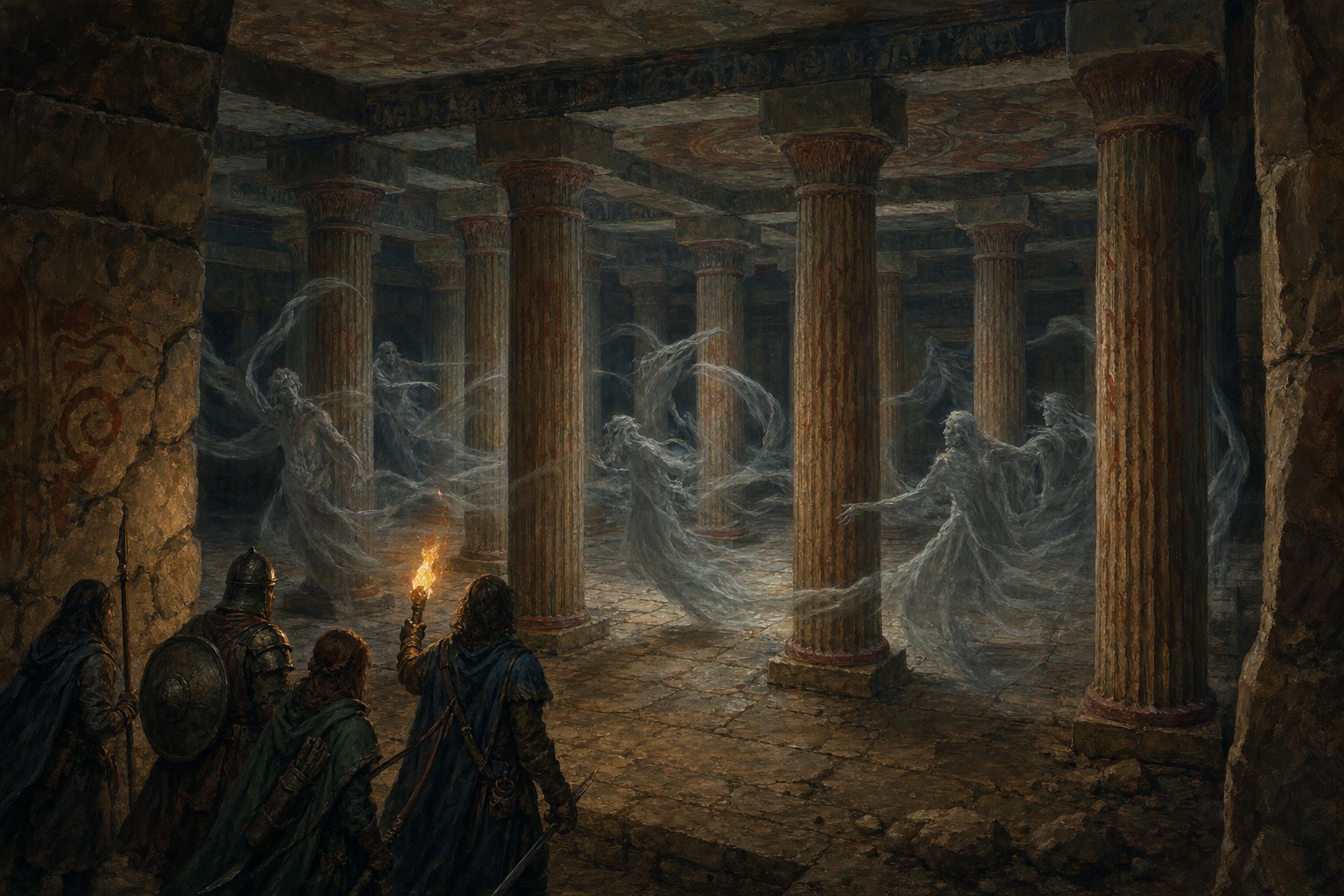
Twelve columns in two rows, older than the maze around them and finer than anything else you have seen down here — fluted, painted once, the paint gone to ghosts of red. Between them the air moves in long slow breaths, in and out, in and out, and each breath has a voice in it that is almost a word.
Nothing here has eyes. You can tell that immediately and you could not say how.
DM summary. A hundred feet of colonnade with a blind, deaf-to-silence wraith host standing in it, and the only rule that matters is that they hunt sound. This is a room the party crosses on tiptoe with their mouths shut, and it is the deck's purest test of whether your players can stop talking.
Terrain & Features
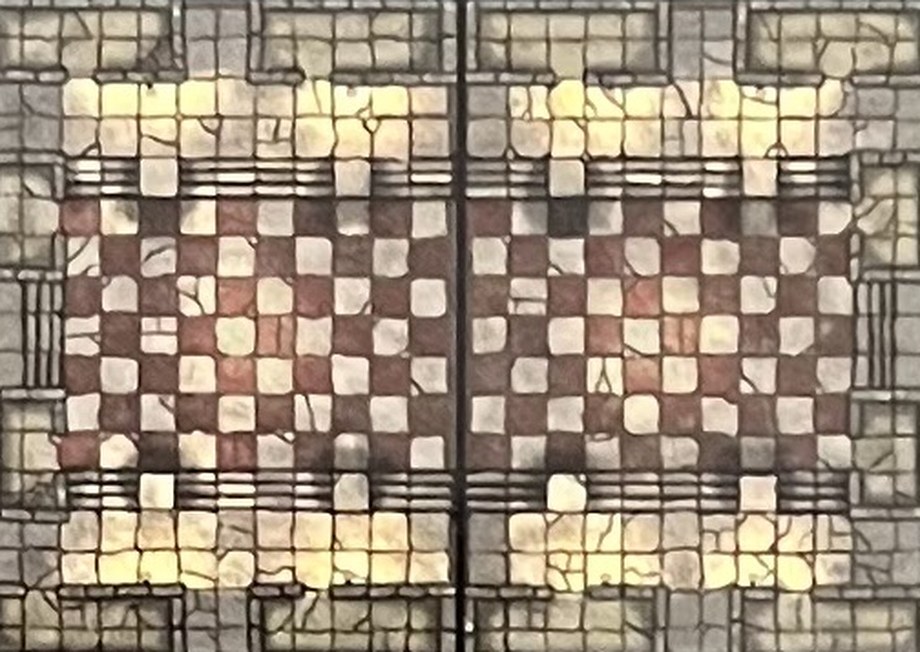
Battle map: The Great Hall — pages 29 & 30, 110 × 75 ft
Wall the great hall down to a 100 × 30 ft processional: rule two long walls 30 ft apart the length of the spread, draw the twelve columns in two rows of six, and shade the last 40 ft as drifted votive sherds.
- Dimensions. 100 ft × 30 ft, ceiling 22 ft, a processional hall with the maze's rough limestone cut straight through both end walls. Twelve columns in two rows of six, 15 ft apart, each 4 ft thick — full cover from anything that could see, which is nothing here.
- Light. Dark. No lamps, no phosphorescence, and the shades neither need nor notice light. A torch is safe. A torch dropped is not.
- The floor. Broken votive pottery for the last 40 ft of the hall, a shin-deep drift of it against the west wall. Crossing the sherds is the loudest thing in the room: treat it as difficult terrain and add a sound token (below) for anyone who crosses it at more than half speed.
- The offering bowls. Bronze bowls on low plinths at the second, fourth, and sixth column-pairs, all three still holding coin and burnt seed. They ring like bells if knocked.
- The draught. Air moves down the hall from the north end at walking pace. Anything thrown with the draught carries; anything whispered upwind is heard at the far end. Volunteer which way the air is going before anybody throws anything — this is the room's one piece of tactical information and hiding it helps nobody.
Bypass Options
The intended path, and it costs nothing but discipline. Group Stealth DC 15, rolled once for the whole party at the halfway columns, with advantage if every player has agreed in advance to run the crossing in mime and hand signals.
- Success: the party reaches the far end and the procession never breaks step. Award this loudly afterwards — it is a rare thing for a table to do.
- One failure: one sound token per failing character, resolved on the clock above. A character who wants to catch a dropped item before it lands may spend their reaction and roll Dexterity (Acrobatics) DC 14 to eat the noise.
- Silence, the spell: a globe of magical silence is a total pass for anyone inside it, and any caster who thinks of it has earned the room. It also makes the caster's own party deaf to each other; that is a fair trade and a fun one.
- Cost of withdrawing instead: the party can withdraw the way they came at any token count below three. They lose the loot condition and this room's clue, and they should be charged the time.
The shades go to the loudest thing. Nothing says it has to be a person. Throw a bronze bowl, a helmet, or a purse of coin down-draught to the north end: Sleight of Hand DC 13, or Athletics DC 13 for a straight hard throw (the draught is worth advantage on either).
- Success: all three converge on the noise and stay there four rounds, which is enough to cover the 50 ft still ahead of a party at the halfway columns at half speed — not the whole hall, which would take seven.
- Failure: the throw falls short and lands among the party's own feet. One sound token, and the shades are now closer than they were.
- The trick only works once. The wraith is deaf, not stupid. A second thrown object in the same crossing draws it toward the throwing arm instead.
The shades are a procession, and a procession accepts mourners. Any character who falls in step at the back of the pacing line — matching pace, head down, no sound — is not a target while they keep step. This needs no roll to start and Wisdom (Insight) DC 14 to notice is possible at all; breaking step, stumbling, or reaching the turn at the north wall and failing to turn with them is one sound token.
- Success: the party rides the procession to the north end over four rounds and steps out of it at the gate. It is the slowest route and the safest.
- Failure: the character who broke step is standing inside the line of them when the clock advances, which is the worst place in the room to be. They take the first shade's attention automatically.
- Do not let this become a Charisma check. There is no talking to these. The wraith has no name left and the shades are a recording.
Encounter
A wraith and two shades, standing in the colonnade the way people stand in a queue, and none of them knows you are here.
| Count | Creature | XP each |
|---|---|---|
| 1 | Wraith of the Long Silence | 8,400 |
| 2 | Sighing Shade | 1,800 |
Base 12,000 XP; ×2 for three bodies = 24,000 adjusted, against the APL 9 Deadly budget of 14,400. That is not a typo and it is not a mistake. This fight is two thirds again past the Deadly line and it is written that way on purpose: the room is a crossing, not a contest.
Why it is not already attacking. The Wraith of the Long Silence is blind and always has been. It hunts by sound alone and it has heard nothing but its own company for a long time. The two Sighing Shades are re-enacting a procession that ended centuries ago — they pace the colonnade north to south, turn, and pace back, and they will keep doing it forever unless a living thing makes a noise.
The sound clock. Track sound tokens. The party accrues one for each of: speaking above a whisper; casting anything with a verbal component; a failed Stealth roll; crossing the pottery drift at speed; ringing a bowl; a dropped object; opening the north gate without oiling it.
| Tokens | What happens |
|---|---|
| 1 | The nearest Sighing Shade stops walking and turns its head. Nothing else |
| 2 | Both shades converge on the source and stand around it. The wraith turns toward them. The party has one round to get out of that spot |
| 3 | The wraith crosses the hall in one move and initiative is rolled |
If the party fights anyway. Say this out loud at the table, once: this can kill the party, and that is the honest cost of poking it. The wraith is incorporeal, moves through the columns, and hunts the loudest thing in the room — which in combat is the party's front line. The shades drain resolve from behind. There is no terrain answer and no clock that saves them; the only mercy the room offers is that all three of them stop at the doorways. Nothing here follows the party out of the colonnade.
Exits
One roll on the loot table, conditional: the party must leave the colonnade with fewer than two sound tokens and someone must take the seed-and-coin offering from a bowl without ringing it — Sleight of Hand DC 14, or automatic for anyone who thinks to fill the bowl's weight with sand or a fistful of pottery as they lift the coin.
A ringing bowl is a sound token, and everyone at the table will know it the instant you describe the note.
Scaling — APL 6 / 12 / 15
| APL | Adjustment |
|---|---|
| 6 | Drop the wraith entirely; two Sighing Shades and the procession. DCs −2, and the clock is four tokens, not three |
| 9 | As written |
| 12 | Add a third Sighing Shade and a Lost Wanderer that follows the party whispering questions — it is harmless, and it is loud. DCs +1 |
| 15 | Two Wraiths of the Long Silence at opposite ends of the hall, so the party is crossing between them, and the clock is two tokens. DCs +3. The draught reverses every third round, which changes which end of the hall a thrown object is safe to throw at |
- Pacing: fifteen minutes, and most of it is quiet. This is the room where you drop your own voice, ask the players to speak in whispers at the real table, and let a silent crossing take four minutes of genuine held breath. Behind schedule? Cut to a single Stealth roll and narrate the crossing — but keep the moment where a shade stops and turns its head, because that image is the whole room.
- The rule the players must be told. Tell them plainly, in character voice, before they commit: these things have no eyes and they are listening. A stealth room that hides its own rule is a gotcha, and the escapability law is worthless if the party cannot see the way past.
- If someone talks anyway, and someone always does, do not punish the player for the character's honest mistake. Advance the clock, describe the head turning, and give them the round of grace the clock promises.
- Table safety. The register here is dread, not gore. If breath-holding or enforced silence is uncomfortable at your table, run the crossing as descriptions rather than as a real-table silence game; nothing mechanical changes.
- Clue drip. Two objects: the painted procession on the column shafts, in which one figure is carrying a spindle and is the only one facing the wrong way (X10), and the sea-salt crust on the northern column bases, 60 ft underground, which has to have come from somewhere (X16).
- Callback. Shades of the Maze (W09) are always a rules problem rather than a damage problem — sound here, choreography elsewhere, names on a stair. A party that has met them before should start the room by asking "what is the rule this time", and that instinct is the reward.
Creature Cards
All three belong to Shades of the Maze (W09) and recur across the deck, so the numbers live in the bestiary. The sound clock and the procession are this room's.
Shared across rooms, so the full cards live in the bestiary: Wraith of the Long Silence, Sighing Shade. Every mention above opens the numbers here on this page.