Gauntlet of Turning Blades
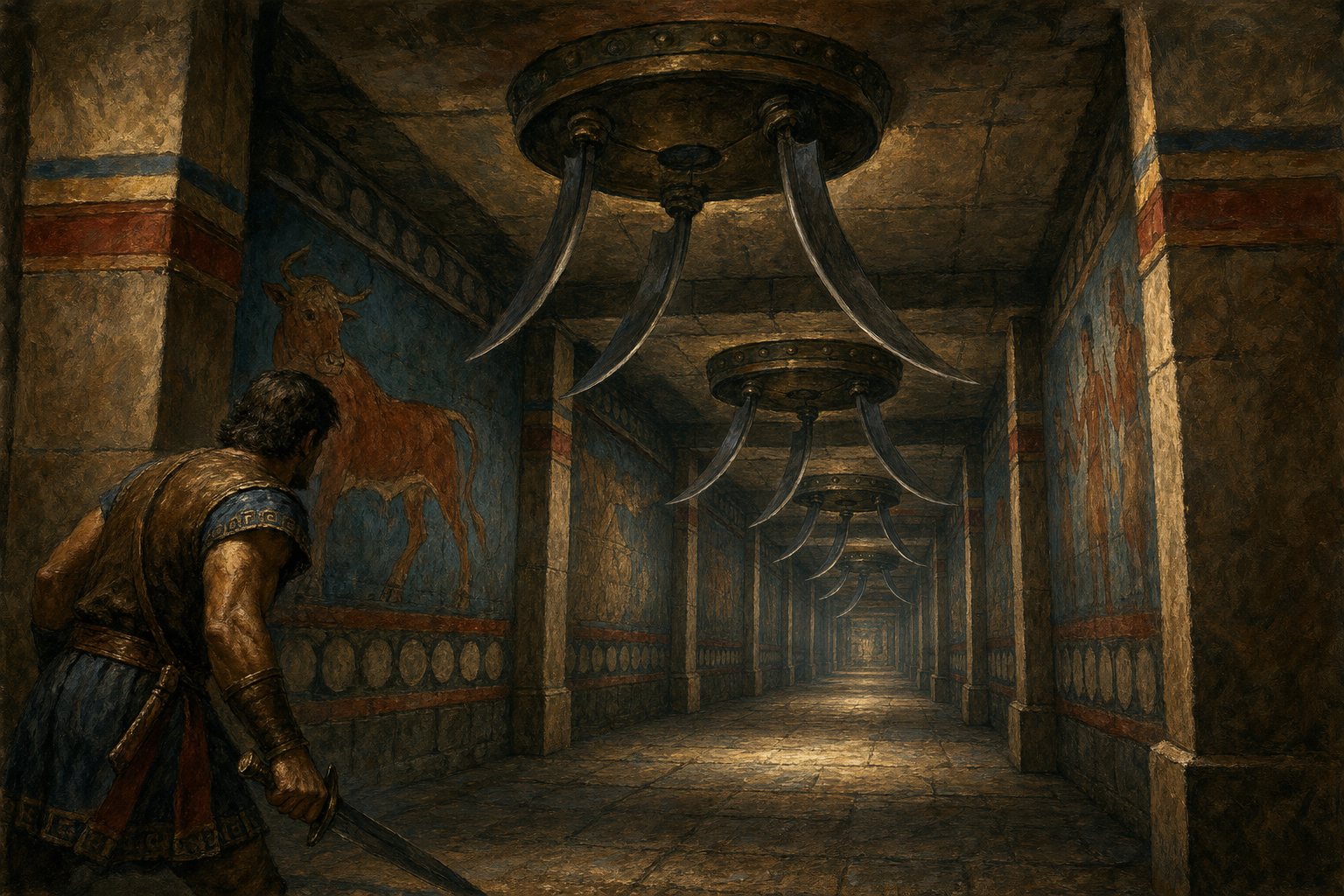
The corridor ahead is seventy feet of dressed stone and it is being cut into slices. Three bronze drums are set into the ceiling at intervals, each one hung with four curved blades the length of a man's arm, and each drum turns a half-revolution and stops, turns and stops, sweeping the air down to a foot above the floor.
They are not turning together. Listen for ten seconds and you can hear it: a beat, a beat, a rest, and then all three at once, which sounds like a temple gate closing.
DM summary. Seventy feet of bladed corridor with a four-count rhythm that the party can hear, learn, and beat. Nothing in here is hidden. The only way to be hurt is to move on the wrong count.
Terrain & Features
Battle map: custom map. A 70 × 10 ft blade corridor — the room's own text says it: put it on the mat as a single line of squares and mark the three drum bands. Browse the book if a page half fits your table better.
- Dimensions. 70 ft × 10 ft, ceiling 12 ft. Straight, level, and featureless except for the drums. A corridor, not a chamber; put it on the mat as a single line of squares.
- Light. A gas lamp burns at each end, unreachable behind grilles. This room is deliberately well lit. The party can see every blade, and they should.
- The three drums. At 20–30 ft, 40–50 ft, and 60–70 ft from the entrance. Each sweeps its own ten-foot band, floor to shoulder height.
- The pockets. The stone between the bands — 0–20 ft, 30–40 ft, and 50–60 ft — is untouched by any blade. A pocket holds three Medium creatures comfortably and six uncomfortably.
- The drive shaft. A bronze shaft runs the length of the corridor in a channel at ceiling height on the west side, with an inspection hatch at the entrance apron, unlocked, because whoever maintained this expected to come back.
- The cart. A two-wheeled hand-cart stands against the wall at the apron, loaded with sand-bags. It was here to be pushed and nobody pushed it.
- The leavings. Inside the bands, against the walls: a bronze greave, half a shield, a boot. Nothing gory — the blades are very sharp and the drains are very good.
Traps / Puzzles / Checks
The rhythm, stated once and then never varied. The corridor runs a four-count cycle, one count per round, and it never breaks step:
| Count | What sweeps | What it sounds like |
|---|---|---|
| 1 | Drums 1 and 3 | Two beats, together, from either end |
| 2 | Drum 2 | One beat, from the middle |
| 3 | Nothing | A rest. The whole corridor goes quiet |
| 4 | All three | The gate-closing sound |
The rule the party is looking for: you may pass drums 1 and 3 on counts 2 or 3, and drum 2 on counts 1 or 3. Nobody may be in any band on count 4.
- Learning it: watch one full cycle — four rounds — and make Perception DC 12. Success is the table being told the rule in the words above. Do not make them infer it; make them use it.
- Reading it instead of watching: Investigation DC 14 on the drive shaft and the drums' linkage gives the same information in one round rather than four.
- A caught character: Dexterity save DC 15, 4d10 slashing on a failure and half on a success. A creature that is prone or crawling takes no damage at all, because the blades stop a foot above the floor — tell the party this the first time somebody is hit, because it is the room's mercy and it is meant to be found.
- A clean crossing looks like this, for a party with 30 ft of movement, and you should say it out loud if they get stuck: move on count 2 into the first pocket, move on count 3 through the middle band into the second pocket, wait out counts 4 and 1, and walk out on count 2. Five rounds, no damage, no checks past the first.
Stopping it (two ways, both allowed):
- Jam the shaft. Through the inspection hatch: Thieves' Tools DC 16 or Athletics DC 17 with a spear or a bar. Success stops all three drums for three rounds, after which a relief clutch bangs and they re-engage on count 1. Three rounds is enough for the whole party to walk the corridor at full speed. Failure snaps whatever they used and costs the item.
- Feed it the cart. Shove the loaded hand-cart into a band: Athletics DC 13. The drum shears the cart, screams, and stops permanently — one band down, two to go, and the noise is enormous. Roll d6; on a 1 or 2 the DM owes the party a wandering-threat encounter within two rooms.
Solved state. Either a drum is dead and the rhythm is simpler, or the shaft is jammed and there is no rhythm for three rounds, or the party has learned the count and walked it. All three are wins and none of them costs hit points.
Exits
None. What is in the bands is a greave, half a shield, and one boot, and any of it can be fished out with a spear-shaft on a count 3 by a player who wants to spend a round on it. Let them have the greave. It is dented, it is worth four drachmas, and it does not consume a d100 slot.
The sand-bags on the cart are worth mentioning: eighty pounds of ballast, and a very good way to test a trap in any room the party meets later.
Scaling — APL 6 / 12 / 15
| APL | Adjustment |
|---|---|
| 6 | Two drums, not three, and the cycle is three counts with the rest on count 3. Blades 4d10, save DC 13, and the "crawl under" mercy is announced free on entry |
| 9 | As written |
| 12 | Blades 10d10, save DC 16, and the rest count comes every fifth round instead of every fourth — the rhythm is still learnable, but the pockets have to be used. DCs +1 |
| 15 | Blades 10d10, save DC 18. Four drums, and drum 4 runs a two-count cycle out of phase with the rest, so there is no universal rest — the party has to solve it band by band. DCs +3, and the maintenance crawl is occupied by the shaft's governor housing and requires Acrobatics DC 16 |
- Pacing: ten minutes. When you are behind schedule, open the room with the Perception check already made — describe the four-count rule as something the party works out in the first ten seconds — and run the crossing as three rounds of movement calls. Five minutes and it still feels like a set piece.
- Count out loud, at the table, every round: "one — two — rest — all three." This room is a rhythm game and it only works if the players hear the beat. If your table starts saying the count along with you, the room has done its job.
- The prone mercy matters. A trap that can do 4d10 needs an out, and this one's out is lie down. A party that works out that the corridor is survivable on your belly has beaten the room without rolling anything, and that is a fine outcome.
- Nobody dies here without warning. The blades are visible, lit, audible, and rhythmic; the damage band is high because everything about the danger is on the table. If a character does go down in a band, they went down having been told the count.
- Clue drip. Two hooks: the boot in the second band, which is small and laced the way a palace servant laces (X05, X08), and the inspection hatch's maintenance chalk — a service date, a shaft number, and a name (X20, X14).
- Callback. Every mechanism room in this maze rewards observation over damage. A party that has beaten a Sentinel's patrol or a bellows lock should walk in here and immediately start counting instead of drawing steel, and you should let them feel clever about it.