Stair of Falling Names
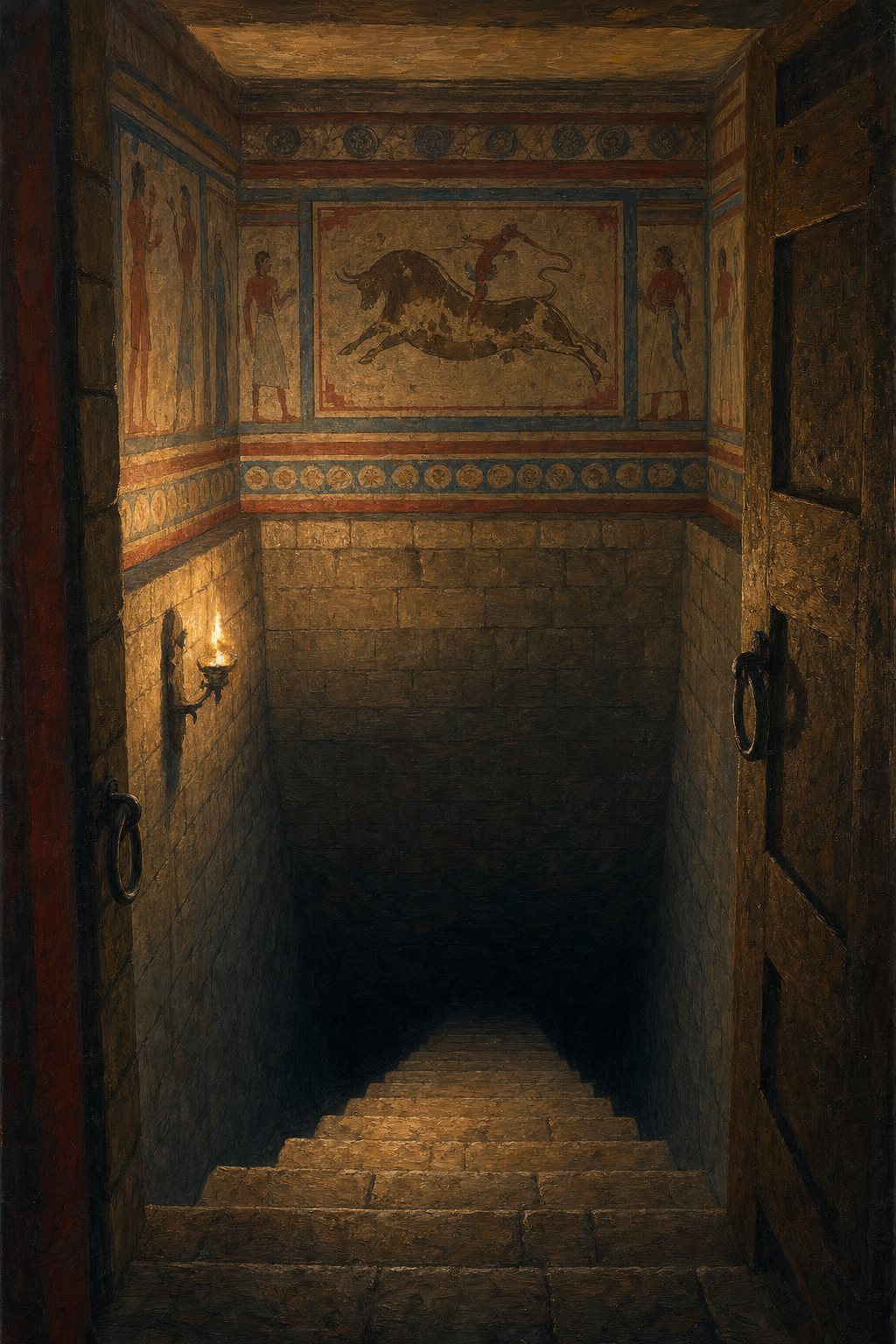
Forty steps down a square shaft, eight feet wide, cut clean, with no rail and a long dark drop off the open side.
The first person to put weight on the top tread hears a whisper come up out of the stone. It is a name. It is not anybody's language, but it is unmistakably a name — two syllables, said the way you say a name at a funeral.
The second step says a different one. So does the third.
DM summary. A memorial stair with nine booby-trapped treads in it. The names cut into the stone are the men who died building the maze; the names on bronze plates are the men who finished the job and went home, and those treads are the ones that fall.
Terrain & Features
Battle map: custom map. An 8 × 8 ft stair shaft 100 ft deep — a side-view sketch of the four flights beats any floor plan. Browse the book if a page half fits your table better.
- Dimensions. 8 ft × 8 ft and 100 ft deep — all of this room's size is vertical, and the footprint is the smallest in the deck. A stone stair runs down two walls in four flights of ten treads, with three landings at 20-ft intervals. The inner side of every flight is open to the drop.
- Light. None. Nothing here has needed light. The whispering makes people want to hold a lamp out over the drop, which is a fine way to lose a lamp.
- The treads. Forty, each 8 ft wide and 10 inches deep. Every one carries a name. Thirty-one are cut into the stone. Nine are cut into bronze plates set flush into the stone, and it is the plates that are hinged.
- The drop. From any flight to the landing below is 20 ft. From the top flight to the shaft floor is 100 ft, but nothing falls that far — the landings catch you, which is the whole reason the stair is survivable and you should establish it early.
- The whisper. Weight on a tread produces one name, spoken once, at conversational volume, from the stone underfoot. It is audible to everyone. It is not magic anyone can dispel; it is the stair doing what it was built to do.
- The swept landings. All three landings are clean. Not weathered-clean — swept, recently, by someone with a brush, who also straightened the votive cups at the second landing.
- The named door. At the second landing, a bronze door with a single name on it and no handle, hinge, or keyhole.
Traps / Puzzles / Checks
The falling treads. Nine of forty, distributed across all four flights, none in the first three steps.
| Element | Value |
|---|---|
| Trigger | Full weight on a bronze-plated tread |
| Telegraph | The plate drops a half-inch with an audible groan before it goes — one clear beat of warning, every time, no exceptions |
| Detect by eye | Perception DC 14 with a light held low; the plates are a different colour and sit a hair proud |
| Detect by touch | Automatic. Feeling each tread before stepping on it works every time and costs 10 minutes instead of one to descend |
| Effect on a failure | The tread hinges down. Dexterity save DC 14 or fall to the landing below: 2d10 bludgeoning, prone. A roped character takes 1d6 and a rope burn instead |
| Disarm | Thieves' Tools DC 15 per tread pins the hinge. Or lay a spear, plank, or shield across the gap — Athletics DC 10, no risk, and it costs you the spear |
| Solved state | All nine found and chalked. The stair is then just a stair and the party can run down it in a single round |
The whisper, answered. This is the room's second layer and it costs nothing to trigger.
If a character answers a name — says "here", repeats it, replies to it, or speaks their own name into the shaft — a Lost Wanderer takes a step with them. Track answers:
| Answers | What is on the stair with you |
|---|---|
| 1 | A cold spot on the tread behind whoever spoke. Nothing else |
| 2 | A shape at the edge of the light, going down at the same pace, one flight below |
| 3 | It is walking with the party. It is a Lost Wanderer, it is harmless, and it will not stop |
The Wanderer is not a fight. It repeats the last hour of its life on a loop: it walks down, it says a name, it turns at the second landing, it goes up. It does not attack and it cannot be reasoned with. It follows the party out of the room and stays until somebody interrupts it — and interrupting it, per Shades of the Maze, is the one thing that makes it dangerous. It also, on its loop, does something extremely useful: it turns left at a junction that no longer exists, which tells an attentive party where a wall used to be.
Do not roll initiative in this room. If a player attacks the Wanderer, that is the next room's problem and you should say so out of character: "You can, and it will not stay harmless."
Exits
None, and the reason is the best thing in the room. There is nothing here to take because somebody has been tidying. The landings are swept. The votive cups at the second landing are upright and in a row. Someone in this maze looks after the dead, on a schedule, with a brush, and they have been doing it for a very long time.
Do not explain who. If the party leaves a coin at the second landing, note it and have it be gone the next time anybody looks.
Scaling — APL 6 / 12 / 15
| APL | Adjustment |
|---|---|
| 6 | Six plated treads, none in the first flight, and the plates are visibly green against grey stone: Perception DC 12. Falls do 2d10 and land on a landing every 15 ft. All DCs −2 |
| 9 | As written |
| 12 | Twelve plated treads and two of them are paired — the second goes when the first does, so a party strung out on one flight loses two people. Falls do 4d10. DCs +1 |
| 15 | As APL 12, and the whisper has stopped being a memorial. Answering a name once puts a Sighing Shade on the stair; three answers puts a Wraith of the Long Silence at the bottom, and it is hunting by sound in a stone shaft. DCs +3. Say nothing on the way down and it never knows you were there |
- Pacing: 6–8 minutes, and this is a
quick-room. When you are behind schedule and the d100 gives you this, run it exactly as written — four flights, two Perception checks, one tread that goes, out the bottom. It is the best compression in this stretch of the deck. - If you have time to spend, spend it on the whisper. Say the names out loud, invent them, and say them the way you would read a memorial. Forty names takes ninety seconds and it will silence a table.
- The telegraph is not optional. Every plate groans before it goes. A DM who drops someone twenty feet without the warning beat has broken the promise made in the content spec and the party will stop trusting your traps for the rest of the session.
- If somebody insists on going down by touch, let them, and charge the ten minutes. It is a complete and correct solution and the cost is a wandering- threat roll on the corridor above.
- Table safety. A memorial to workers who died building the thing the party is trapped in, read out one name at a time, lands heavier than its mechanics suggest. That weight is the point, but if your table would rather not sit in it, the whispers can be the maze mispronouncing the names of everyone who has ever walked the stair — including, eventually, the party's.
- Clue drip. Two hooks: the swept landings and the straightened votive cups, which prove somebody living and gentle is down here on a round (X10, X05, X06), and the name on the bronze door, which is a name a party may hear again — put a Sign-tier clue on it and let the door be the thing that says it. If your Resolution is X14, the Wanderer turning left at a junction that no longer exists is a survey point, and a party with chalk should be writing it down.
- Callback. Shades of the Maze run on sound and reenactment. What the party should carry out of this room: the dead here are on loops, the loops are information, and the fastest way to make a harmless one dangerous is to interrupt it.
Creature Cards
The Wanderer belongs to Shades of the Maze (W09) and recurs across the deck, so the numbers live in the bestiary. It does not fight here; the loop above is this room's and stays here.
Shared across rooms, so the full cards live in the bestiary: Lost Wanderer. Every mention above opens the numbers here on this page.