Cage of the Storm-Crows
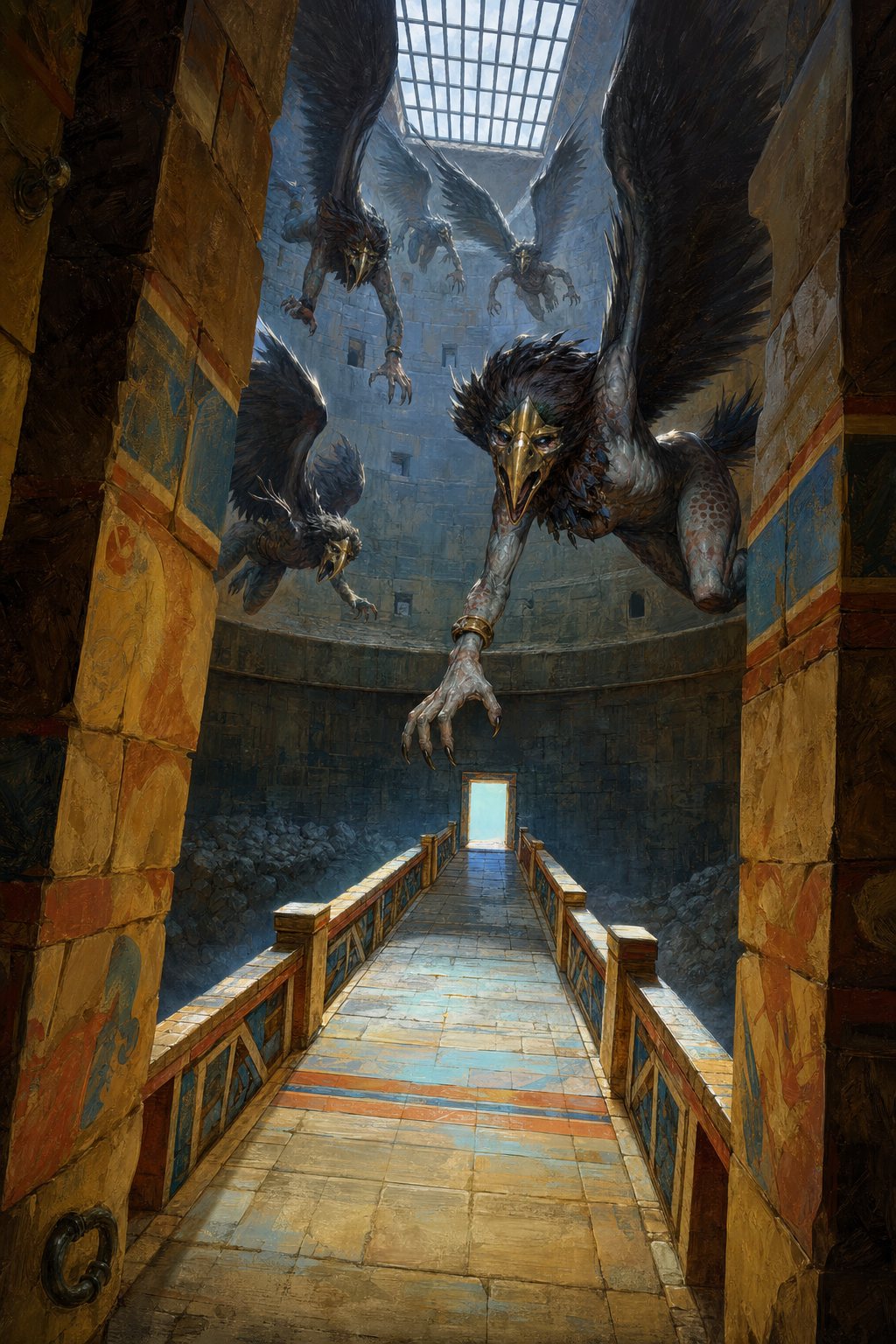
The corridor ends in a doorway with nothing beyond it but air. You are standing on a gallery, forty feet up the inside of a stone shaft forty feet across, and the shaft goes down eighty feet into a mound of pale rubbish and up eighty feet into a square of grey daylight crossed by bars.
Iron perches spiral the walls. Cage frames hang on chains at every level, some of them still shut. This was an aviary. Somebody kept birds here on purpose.
Something with a bronze beak drops past your face at speed, screaming, and takes your torch with it.
DM summary. A vertical fight in an aviary shaft, where the flyers own the Z axis and the party owns a broken ring gallery. The lime cage on the winch is the equaliser and it is visible from the doorway.
Terrain & Features
Battle map: custom map. A 40-ft-diameter shaft 160 ft tall fought from a broken ring gallery — chalk a circle and track heights; the fight is vertical. Browse the book if a page half fits your table better.
- Dimensions. A shaft 40 ft in diameter, 160 ft floor to grate. The party arrives on the ring gallery at 40 ft, which is 5 ft wide and runs the full circumference — broken in three places, with gaps of 10, 15, and 8 feet.
- Light. Grey daylight from the grate at the top, enough to see shapes and not faces. The party's own torches are targets; see round 1.
- The gaps. The 8-ft gap is a jump (Athletics DC 10). The 10-ft gap has a plank bridge with three planks missing (Acrobatics DC 12, or lay a spear and go free). The 15-ft gap is not crossable — the gallery is a C, not an O, and knowing that is worth a round to anyone who looks.
- The cage frames. Eleven old aviary cages, 4 ft cubes of iron bar, hanging on chains at every level. Cut a chain (AC 12, 8 HP) and a cage swings on its remaining chain in a 20-ft arc: Athletics DC 13 to aim it, and anything flying in the arc makes a Dexterity save DC 14 or takes 2d8 and is knocked 20 ft along the shaft.
- The lime winch. At the gallery's north end, a hand-winch and a cage three-quarters full of slaked lime dust, left there by keepers who used it to put birds down without touching them. This is the room's answer and it is in plain sight.
- The nest litter. The shaft floor at −80 ft: eight feet of twigs, bone, wire, and bright rubbish. Soft enough to survive a fall into (halve falling damage), dry enough to burn very well indeed.
- The grate. 80 ft above the gallery, bronze, in the shaft's mouth. Daylight comes through it. Nobody is climbing it today — the last 40 ft of wall is dressed smooth and the grate itself is Athletics DC 20 to shift.
Encounter
Two harpies working the height, three crows working the nerves.
| Count | Creature | XP each |
|---|---|---|
| 2 | Bronze-Beak Harpy | 1,800 |
| 3 | Storm-Crow | 450 |
Base 4,950 XP; ×2 for five bodies = 9,900 adjusted, against the APL 9 Hard budget of 9,600. Level on paper, and the shaft is the thumb on the scale: five flyers against six people on a broken five-foot ledge is a positioning problem first and a damage problem second.
Round 1. The crows act first and they do not attack. They go for light — each crow takes one torch, lamp, or lit object, contested by Sleight of Hand or Athletics against +5, and carries it out into the middle of the shaft. Two of the three then drop what they took. A lamp dropped into eight feet of dry nest litter starts a fire, and the fire is the room's second half.
The harpies open from above, out of easy bow range, and sing. The song pulls one target toward the gallery's edge (see their card) — which is exactly what a 40-ft ledge over a rubbish heap is for.
Tactics.
- Nothing lands. Storm-Crows never touch down and Bronze-Beak Harpies land only to snatch. If the party has no ranged option they will spend the fight being pecked, and you should let that be uncomfortable for two rounds and then make sure somebody notices the cages and the winch.
- The harpies snatch and drop. A grappled character is carried up and released. From the gallery it is a 40-ft drop into litter (2d6, halved to 1d6 by the litter) rather than a death — say the litter is soft, out loud, before anyone is carried, or the fear is unfair.
- The fire. If the litter catches, it is a slow bloom: light and heat from round 3, and thick smoke filling the shaft from the floor up, 20 ft per round. Smoke reaches the gallery at round 7 and makes the whole shaft heavily obscured. Flyers hate it more than the party does — a harpy in smoke has disadvantage on attacks and will climb above it, which cedes the gallery entirely.
- Nothing pursues out of the shaft. They will not follow into a corridor where they cannot get above you.
Bypass Options
The winch cage is on the gallery, four feet from where the party arrives, and what it does is obvious to anyone who has ever kept birds.
- Doing it: Athletics DC 14 to crank the cage up to mid-shaft, and then someone must hold the crank — one action every round, or the cage drops back.
- Effect: the lime hangs in the air in a 30-ft column through the middle of the shaft. Any flyer that enters or starts its turn in it makes a Constitution save DC 13 or has its flying speed halved and must land or perch by the end of its next turn. Bronze-Beak Harpies will not fly through lime at all and know exactly what it is.
- Success: the column splits the shaft. The flyers work one side of it and the party crosses the other, and a fight that was five-on-six in the air is suddenly two-on-six on perches.
- Failure: the cage tips early and the lime goes down the shaft instead of across it. It is gone, and everyone below is coughing.
- Cost: one character is on the crank, in the open, doing nothing else. That is a real price and it should be paid by somebody who volunteers.
The shaft floor is beneath the harpies' interest. They hunt the gallery; they do not hunt the rubbish.
- The descent: climb down the wall's cage-brackets, Athletics DC 14, three checks, 80 feet. A failure on any check is a fall onto litter from whatever height you reached — halved damage, and loud.
- Crossing the floor: group Stealth DC 13 through eight feet of dry twigs. Nothing on the floor is worth a harpy's time.
- One failure: a crow notices and drops a cage-bar 80 ft onto the party: 2d10 bludgeoning to one character, no attack roll, and everything above now knows where the party is.
- Two failures: both harpies come down the shaft to the litter, where they are much worse off than in the air — this is the best bad outcome in the room and a party that stumbles into it has still improved its position.
- Cost: the drain at the shaft's foot (exit C) is where this ends, and it is a crawl. Nobody carries a body out that way.
The corridor the party came in by is behind them and nothing here will follow into it. It costs the loot roll, the clue, and the feathers.
Exits
One roll on the loot table — the keeper's box, bolted under the winch frame on the gallery, where the lime, the hoods, and the spare jesses live and where keepers keep the things they do not want the birds to have.
- Before or during the fight: Thieves' Tools DC 13 on the box's lock, which is a two-hundred-year-old ward lock and not a serious one.
- After the fight: no check, or Investigation DC 12 in the nest litter instead — harpies collect bright things and eighty feet of shaft has been collecting them for a century.
The feathers are not loot and they are the reason to come here. A dead Bronze-Beak Harpy yields feathers by the sackful, sound, oiled, and the right grade. If your Resolution is X17 and the party has no wax cellar, this is the ugly alternative the Wings requires — Resolution-owned, not rolled, and it costs a fight rather than a roll.
The grate at the top is not an exit and you should say so cleanly. It is daylight, it is 80 feet up a smooth wall, and it is bronze. It is a Door-tier image for X17 arriving early, and a party that sees the sky here and cannot reach it will remember this shaft for the rest of the session.
Scaling — APL 6 / 12 / 15
| APL | Adjustment |
|---|---|
| 6 | One Bronze-Beak Harpy and three Storm-Crows, and the gallery is broken in one place instead of three. All DCs −2, and the lime cage is already cranked to mid-shaft |
| 9 | As written |
| 12 | Three harpies and five crows, and the crows work in a pair-and-drop pattern: one grapples, one takes the dropped item. DCs +1, and the winch chain is rusted — Athletics DC 17 for the first crank |
| 15 | Four harpies, six crows, and a matriarch: give one harpy 50% more hit points, a second phase at half HP where she stops singing and starts throwing cages, and a lair action on initiative 20 — the whole squall crosses the shaft at once and every creature on the gallery makes a Dexterity save DC 16 or is shoved 5 ft, which on a 5-ft ledge is the whole point. DCs +3 |
- Pacing: 20–25 minutes. Vertical fights run long because everyone wants to measure. Put the shaft on the mat as a side elevation rather than a top-down — a column with the gallery as a line across it — and the whole table will get it in ten seconds.
- If you are behind schedule, cut to two harpies and no crows, put the party on an unbroken gallery, and run it as a straight four-round exchange. Eight minutes.
- If the melee characters are miserable, and they will be for two rounds, that is by design and it has a stated fix. Make sure the cages on chains and the winch get described twice before round three. A fighter who cuts a cage loose and swings four hundred pounds of iron through a harpy has had a better round than any archer in the party.
- Do not kill anyone with a drop. The litter at the bottom is eight feet of dry twigs and it halves falling damage. Establish that in the read-aloud's aftermath, before the first snatch, and the harpies become terrifying without being lethal.
- The fire is optional and it is good. If a crow drops a lamp into the litter, run the smoke clock — it is the two-phase turn this room wants, it drives the flyers up, and it gives the party a deadline that is on their side for once.
- Table safety. Being picked up and dropped is a helplessness beat and it is the room's signature. Flag it if heights are an issue at your table; the mechanics survive being run as "carried and set down hard on the far gallery" with no fall at all.
- Clue drip. Two hooks: the grate and the daylight, which is the strongest X17 image in this stretch of the deck and also tells any party that the maze has a top; and the bright rubbish in the litter, which is a century of what harpies stole from people walking past — a spool, a signet, a child's sandal, whichever your Resolution wants (X10, X05, X08). If your Resolution is X17, the vent tally in R006 is what names which shaft this is, and a party that has both has a plan.
- Callback. Harpy Squall never lands, always works the vertical, and always goes for what you are holding rather than what you are wearing. If your table meets them again, they should already know to tie their lamp down.
Creature Cards
Both belong to Harpy Squall (W05) and recur across the deck, so the numbers live in the bestiary. The tactics above are this room's and stay here.
Shared across rooms, so the full cards live in the bestiary: Bronze-Beak Harpy, Storm-Crow. Every mention above opens the numbers here on this page.