Cyclops Larder
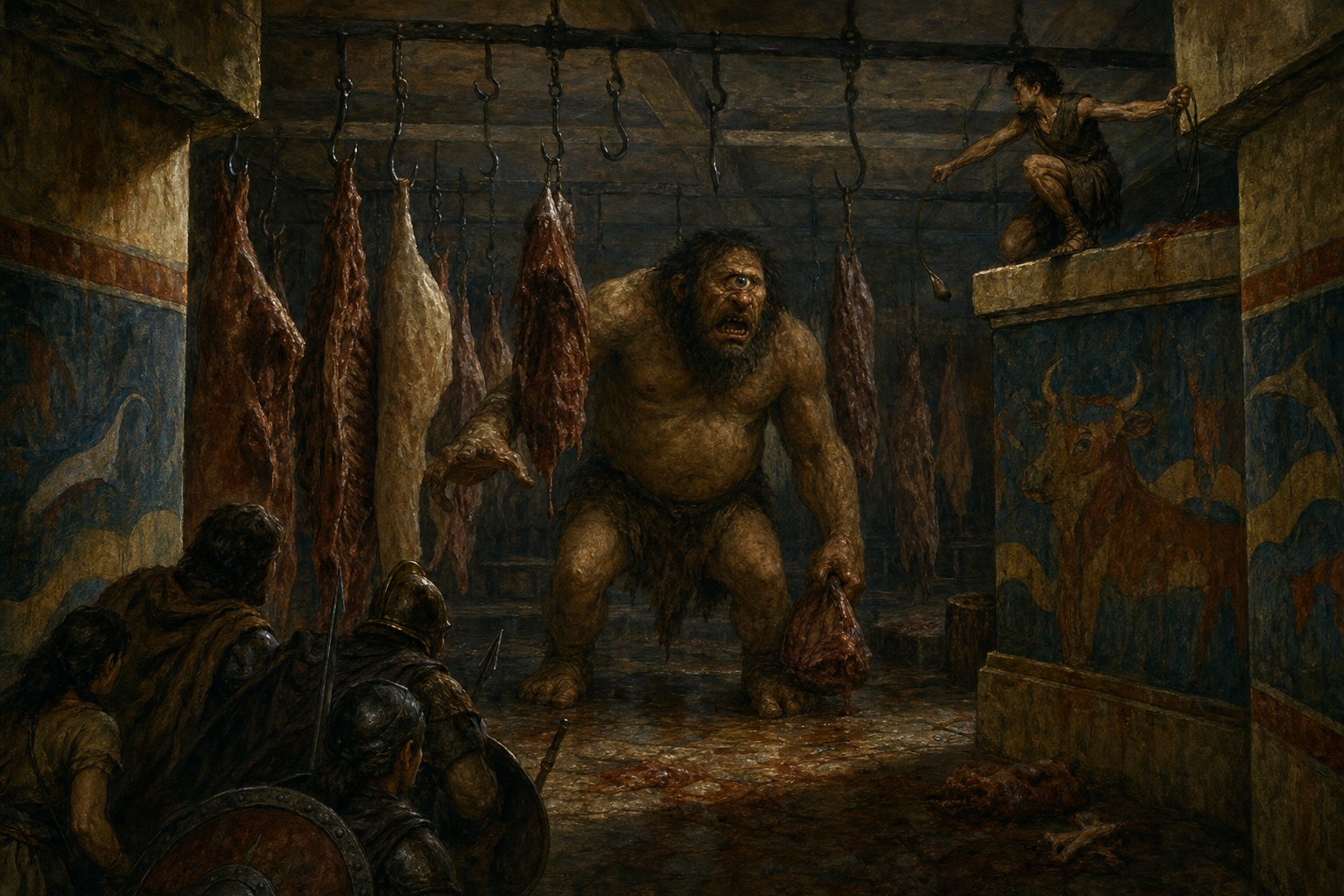
Cold air, and the smell of a butcher's yard in summer. Iron hooks hang in rows from a rail that crosses the whole ceiling, and on the hooks hang sides of meat — goat, boar, something long and pale that you decide is a calf. Between the rows, at a block the size of a door, a one-eyed thing the height of two men is working a cleaver down through a joint with the flat patience of a man who has all night.
It has not looked up. Behind it, in a lit alcove, three more of its kind are throwing knucklebones and arguing about the count.
DM summary. A working larder with a working butcher in it. The hanging meat is a curtain the party can cross behind, the cleaver's rhythm is the timing, and nothing here has to happen at all.
Terrain & Features
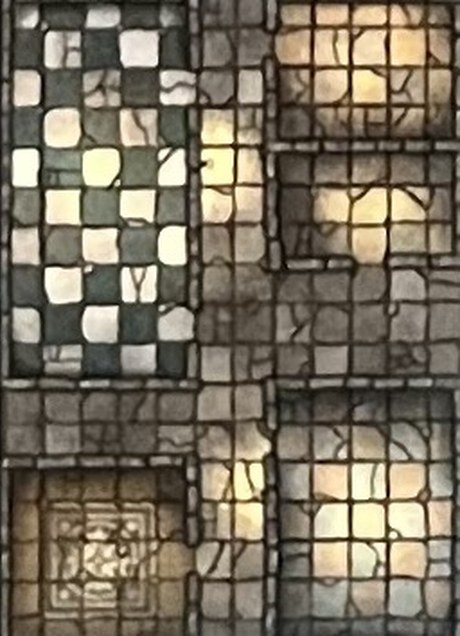
Battle map: The Service Rooms — page 24, 55 × 75 ft (one half of The Tiled Halls)
The plain chambers suit the larder: wall the biggest to 60 × 40 ft, rule the four meat rails as ceiling lines with carcass dots, draw the 8 × 4 ft block dead centre, and mark the brazier alcove at the north-west.
- Dimensions. 60 ft × 40 ft, ceiling 16 ft. The party enters at the south-east corner, behind the last row of hooks.
- Light. Bright in the alcove (a brazier, north-west), dim under the meat rail, dark at the south wall. The butcher works by feel as much as light.
- The meat rail. Four parallel rails at 10 ft, each hung with eight to twelve carcasses on rolling hooks. Between the rows the sight lines are fully blocked; the carcasses can be pushed along the rail with one hand, silently with care, and with a shriek of iron without it.
- The block. A limestone bench 8 ft by 4 ft, thirty feet in from the east wall, dead centre of the room. The cleaver comes down on it once per round — see the count, below.
- The floor. Sanded, and the sand is packed with old bone chips and grease. It is not difficult terrain. It is loud: anything moving at full speed across it is heard, no check.
- The offal chute. A 3-ft square iron door in the south wall behind the last hooks, with a wooden trough leading into it. It goes down and out. It is filthy.
- The tally board. A slab beside the alcove, chalked with a count of joints owed to somewhere deeper in the maze. The number is 40. Twenty-two are struck through. This matters — see Bypass, and see DM Notes.
Bypass Options
The four hung rows make a corridor the length of the room, and the cleaver covers the noise once a round.
- The check: group Stealth DC 15, made once, with advantage if the party moves on the count of 10 and only moves on that count (which means crossing in four rounds instead of two).
- Success: the party reaches the west door unseen. The cyclops finishes the joint, and the slingers finish the argument, and nobody rolls initiative.
- One failure: a hook squeals on the rail. The cyclops stops, lifts its head, and looks — at the meat, not at the party. Everyone freezes: one Dexterity (Stealth) DC 13 to hold still, and on a success it goes back to work. The party has lost a round and nothing else.
- Two failures: it sees a shape between the carcasses and bellows for the alcove. Full initiative, all four, and the party is standing in an aisle.
- The pale carcass. Whoever leads the crossing brushes past the long pale side of meat and gets a good look at it. See the table-safety line in DM Notes before you describe it.
The cyclops is behind on a quota and it is not stupid. Anything that closes the gap between twenty-two and forty is worth more to it than four strangers.
- The offer: any substantial quantity of meat or provisions — a party's worth of rations, a slain beast from an earlier room, a conjured animal, three days of salt pork. Persuasion DC 13, or DC 10 if the offering is on the floor in front of it before anyone speaks.
- Success: it takes the offering, marks the board, and jerks its head at the west door. It does not escort you and it does not care what you do next. The slingers laugh at you the whole way across.
- The cost, plainly: you lose the rations. State the loss in items, not hand-waves — a party that leaves this room hungry is a party that will feel R050 when it comes up.
- Failure: it is insulted rather than hostile. It sets the cleaver down, which is worse than it sounds, and gives the party one round to leave by the door they came in before it calls the alcove. Withdrawal is still on the table right up to the end of that round.
- What will not work: coin. It has no use for money and nowhere to spend it. Let a player try, and let it hand the drachmas back.
The iron door in the south wall drops into a trough that carries the waste out of the larder and down.
- Getting it open: Athletics DC 13 to lift the iron door quietly, or Thieves' Tools DC 12 on the counterweight to do it silently.
- The crawl: 30 ft of greased stone at a shallow angle, Acrobatics DC 12 to control the slide. Failure means arriving fast and noisily at the bottom — 1d6 bludgeoning, and a wandering-threat roll for the noise.
- The cost: everyone who takes it is filthy for the rest of the session. Disadvantage on Stealth against anything that smells until they can wash — R050 and R063 both have water — and advantage for anything tracking them by scent.
- Withdrawing instead: the party can leave the way they came at no cost but time and a wandering-threat roll. The larder does not follow. It has forty joints to do and it is behind.
Encounter
Four bodies, and the biggest of them is in the middle of a job.
| Count | Creature | XP each |
|---|---|---|
| 1 | Forge-Thrall Cyclops | 3,900 |
| 3 | Gang Slinger | 1,100 |
Base 7,200 XP; ×2 for four bodies = 14,400 adjusted — exactly the APL 9 Deadly budget. There is no clock and no hazard padding it. This is simply four large creatures with reach and thrown rocks in a room with a low ceiling, and it will take a party apart.
Why it is not already attacking. The cyclops is working. It is behind on a quota — the tally board says forty and it has done twenty-two — and it has been swinging a cleaver in a cold room for hours. Its one eye is adapted to the block in front of it, not the dark at the south wall, and the cleaver strike deafens it to anything quieter than a shout. The three slingers are off-shift, lit, loud, and arguing; they are not watching the door because nothing has ever come in through it.
The count. The cleaver falls once per round, on initiative count 10 — a wet crack, then a grunt, then the drag of the joint being turned. On that count, every Stealth check in the room is made with advantage, and any single noise the party makes is covered entirely. A party that watches for two rounds (Perception DC 10, or free if anyone says they are timing it) is told the cadence in plain words: it swings on the ten, every time.
If the party fights anyway. Say this to the table before initiative, not after: four of them, all bigger than you, in a room where you cannot spread out. Round 1 the slingers throw — three rocks at 60 ft, no cover for anyone standing in an aisle — and the cyclops closes to grapple the heaviest-armoured character and puts them on the block. It grapples, it drags, and it does not let go until it is blinded or dead. This encounter can kill two characters in three rounds, and if the party starts it in the open, it probably will. That is the honest cost of poking it, and the room offers three ways not to.
Tactics. The cyclops fights one target at a time and will not switch off a grappled victim. The slingers are dangerous at range and useless inside 10 ft — they backpedal rather than swing, which makes closing on them the correct play if the fight happens. A hit to the cyclops's eye (attack at −5 to hit, or any blinding effect) halves the whole encounter's danger, and the slingers will not approach the block while their foreman is swinging blind. None of them pursues past the offal chute; the meat is their job and the job is in here.
Exits
Conditional — one roll on the loot table, and the condition is the alcove.
The slingers' stakes are on a crate by the brazier: knucklebones, a fistful of coin, and whatever the last three parties were carrying. Reaching it requires the alcove to be empty (they are drawn out by any commotion at the west end) or the fight to be over. Sleight of Hand DC 14 to lift the stakes with the slingers still arguing twenty feet away; failure is initiative with all four.
The meat is not loot. A player who wants to carry a joint out may — it is forty pounds and it is evidence of nothing good — and it is worth exactly one bypass in some other room, which is a better use than a d100 roll.
Scaling — APL 6 / 12 / 15
| APL | Adjustment |
|---|---|
| 6 | One cyclops, one slinger. The other two are asleep in the alcove and stay asleep unless the fight lasts three rounds. DCs −2 |
| 9 | As written |
| 12 | Two cyclopes working two blocks on alternating counts — which means there is no round without a cleaver, and no round with two. Four slingers. DCs +1 |
| 15 | Two cyclopes, five slingers, and the rail is loaded: any carcass pushed hard swings the length of the row and knocks a creature prone (Strength save DC 15). The cyclopes take turns, so the count is unreliable. DCs +3 |
- Pacing: fifteen minutes bypassed, thirty-five fought, and you do not want the thirty-five. When you are behind schedule, give the party the count for free on entry — describe the cleaver twice, on the ten, before anyone asks — and run this as a single group Stealth check and a description.
- Do not hide the arithmetic from the table. The whole point of a Deadly avoidable room is that the players choose. Let them see four bodies, let them see the ceiling, and let them work out that this is not a fight they were offered. If they choose it anyway, run it straight and let it cost.
- The tally board is the best thing in the room. Somebody deeper in the maze ordered forty joints of meat. Somebody is expecting delivery. Let a player ask. Do not answer.
- Clue drip. Two hooks: the tally board itself, chalked in a neat Knossian hand that does not belong to anything with one eye (X08, X06), and the bundle of personal effects hung on a spare hook by the alcove — a belt, a sandal, a locket — which is the strongest X05 object in this batch of rooms.
- Table safety. This room is a butcher's shop and one of the carcasses is human. That is the intensity flag (
body-horror) and it is worth a sentence before you run it. Softer framing: the pale carcass is a large deer, the personal effects are a scavenged pack, and the larder feeds the maze's beasts rather than its owners. Nothing mechanical changes; the bypasses and the count all still work. - Callback. The Cyclopean Gang (W11) are labour, not monsters — they have shifts, quotas, and opinions about the count. A party that has met them at a forge or a gate should recognise the same tell here: these things can be bargained with, and they are far more dangerous when you interrupt their work than when you talk to them.
Creature Cards
Both belong to the Cyclopean Gang (W11) and recur across the deck, so the numbers live in the bestiary. The tactics above are this room's and stay here.
Shared across rooms, so the full cards live in the bestiary: Forge-Thrall Cyclops, Gang Slinger. Every mention above opens the numbers here on this page.