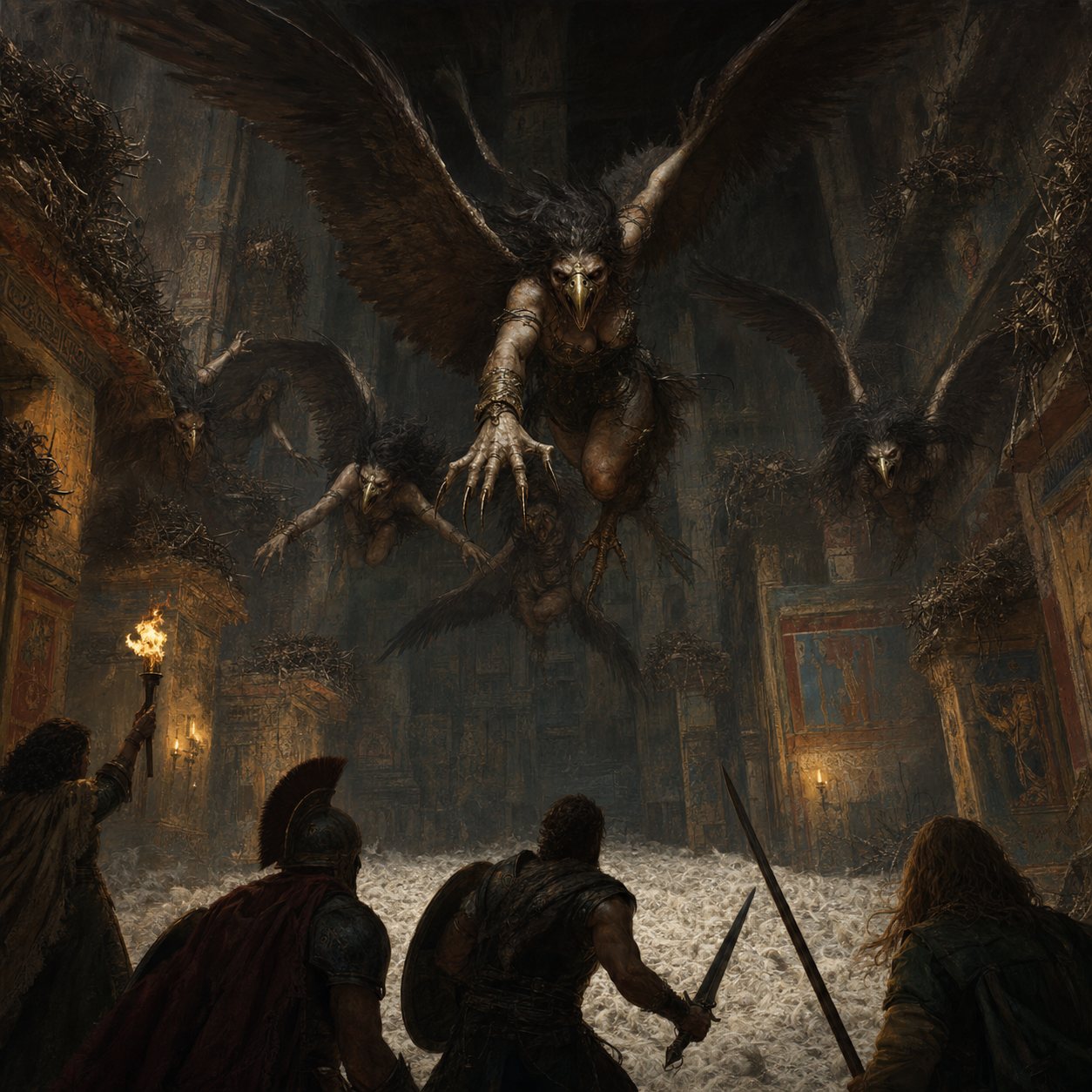
The floor is white. Not stone-white — bird-white, a foot deep of it, and it stinks. Above you the walls go up further than your light reaches and every ledge and broken cornice on them is packed with nests, and the nests are made of wire and bronze scrap and somebody's spear shafts.
Something up there shifts its weight. Then two hundred somethings shift their weight, and a single feather comes down through the light, and it is metal, and it hits the guano point first and stands there quivering.
DM summary. A Stymphalian rookery in a shaft. Four birds and a harpy come down at anything that walks in, and the entire flock can be driven off with noise — which every party has, and which nobody thinks of until they are told.
Terrain & Features
Battle map: custom map. A 40 × 40 ft floor under a 60-ft shaft, and the floor plan is almost irrelevant — chalk the footprint and track the nest shelves at 15/25/40 ft beside it. Browse the book if a page half fits your table better.
- Dimensions. 40 ft × 40 ft of floor, and the shaft goes up 60 ft to a crown of broken vaulting. This is a Z-axis room; the floor plan is almost irrelevant.
- Light. Dim to 20 ft from the party's own light, dark above that. The birds are not bothered by dark and the harpy prefers it.
- The nest shelves. Cornices and broken galleries at 15 ft, 25 ft, and 40 ft, each a strip 3–5 ft deep running around two or three sides. A creature on a shelf has three-quarters cover from the floor.
- The guano. A foot of it, everywhere. It is difficult terrain, it is flammable (any fire damage in the room ignites a 10-ft square for 2 rounds, 1d6 fire per turn), and the ammonia in the air means a creature that ends its turn prone in it makes a Constitution save DC 12 or is poisoned until the end of its next turn.
- The nest wire. Nests are woven of bronze scrap and spear shafts. Pulling one apart takes an action and yields something useful about half the time — see Loot, and note that the birds mind very much.
- The climb. The walls are rough and shelved: Athletics DC 13 to climb, 10 ft per success. Falls from the shelves are 15, 25, or 40 ft; do the dice honestly.
Encounter
Four bronze-feathered birds working as a squall, and one harpy who is worth all four.
| Count | Creature | XP each |
|---|---|---|
| 4 | Storm-Crow | 450 |
| 1 | Bronze-Beak Harpy | 1,800 |
Base 3,600 XP; ×2 for five bodies = 7,200 adjusted, against the APL 9 Medium budget of 6,600 — six hundred over, which is deliberate, because the scatter rule below usually ends this fight in three rounds rather than six.
Round 1. The storm-crows come off the 40-ft shelf together and pass through the party's space without landing — a diving harass, dropping bronze scrap and one nest-stone apiece: everyone under the flight path makes a Dexterity save DC 13 or takes 1d10 bludgeoning. The harpy does not come down at all on round 1. She sings from the 25-ft shelf, and her song pulls one target toward the nearest edge or drop, which in this room means toward the wall she is going to be at on round 2.
Tactics. The storm-crows never land and never stay in reach: they dive, pass, and climb, which makes them miserable for melee characters and a gift for anyone with a bow. The harpy is the fight. She snatches and drops — a grappled target carried 20 ft up and released is 2d6 falling damage and a lot of shouting — and she will not engage a target standing under an overhang. There are three overhangs, and a party that finds them fights a much easier room.
Traps / Puzzles / Checks
The scatter rule, which is the whole encounter. Stymphalian birds are driven off by noise; Herakles used rattles, and a shield-boss and a dagger-pommel work just as well.
| Element | Value |
|---|---|
| Making a scatter-noise | One action: banging metal on metal, a thunderclap or similar spell, a Performance DC 12 with anything percussive, or simply six people shouting on a coordinated count (no check, but everyone must spend the action) |
| Effect | Every Storm-Crow within 30 ft makes a Wisdom save DC 13 or is frightened and flies to the crown of the shaft for 1 round |
| The scatter clock | Three scatter-noises — cumulative across the fight, not consecutive — and the flock abandons the rookery entirely, up and out through the crown. They do not come back this session |
| The harpy | Immune to the scatter. She is not a bird, she is furious about the noise, and once the crows are gone she is alone against six people and she knows the arithmetic |
| Diminishing returns | None, deliberately. This is a trick the deck wants the party to find and use, and taxing it would teach them not to |
Reading the nests (Investigation DC 13, from a shelf): the wire is Daedalan scrap, the spear shafts are Knossian issue, and one nest is built around a bronze mechanism that the bird did not make.
Exits
None. The nests are wire, bones, spear shafts, and bronze scrap that is scrap and not treasure, and the party will be very sure it is all worth something because it is shiny. Let them spend one action per nest finding out.
The bronze mechanism built into the third nest is not loot either. It is a clue object (see DM Notes) and it goes on the sheet, not on the table.
Scaling — APL 6 / 12 / 15
| APL | Adjustment |
|---|---|
| 6 | Three storm-crows, no harpy. Scatter save DC 11, and two scatter-noises empty the shaft. All DCs −2 |
| 9 | As written |
| 12 | Eight storm-crows and two harpies, and the crows return one round after each scatter unless the clock has run out. DCs +1 |
| 15 | Twelve storm-crows, two harpies, and the shaft has a wind in it: everything airborne has advantage on attacks against anything on the floor, and any climb check made while the wind is up is at disadvantage. Scatter clock is five noises. DCs +3 |
- Pacing: eight minutes. This is the deck's tagged quick-room in this batch and it should feel like a squall — sudden, loud, over. Behind schedule? Skip the harpy, run one round of diving crows, let the first scatter-noise clear the shaft, and move on. Three minutes.
- Hint the noise trick early and cheaply. A crow flinches when a pot lid falls off somebody's pack in round 1. That is all the hint any table needs, and it turns a Medium fight into a moment where the players feel clever.
- Do not let a party with no ranged attacks feel useless. The overhangs and the climb are the melee characters' room; put a storm-crow on the 15-ft shelf within reach of a running jump and let someone drag it out of the air.
- If the party is fresh and the session is long, run the harpy as written and let her snatch somebody. A 20-ft drop is memorable and almost never lethal at APL 9.
- Table safety. Nothing heavy here beyond falling and filth. The guano is played for disgust rather than horror; if that is unwelcome, make the floor deep dry chaff and keep every mechanic.
- Clue drip. Two objects: the bronze mechanism woven into the third nest, a geared hub with a feather-clamp on it that no bird made and no soldier carried (X20, and X17 if your table has already seen a wing-frame), and the moving air at the crown of the shaft, which is the plainest X17 signpost in this batch — sixty feet up, in a maze, there is a draught coming down.
- Callback. The Harpy Squall (W05) is always vertical and always about snatch-and-drop. A party that has fought them in an aviary shaft already should arrive here looking for the overhangs, and finding three of them is their reward for paying attention.
Creature Cards
Both belong to the Harpy Squall (W05) and recur across the deck, so the numbers live in the bestiary. The scatter clock, the shelves, and the guano are this room's.
Shared across rooms, so the full cards live in the bestiary: Storm-Crow, Bronze-Beak Harpy. Every mention above opens the numbers here on this page.