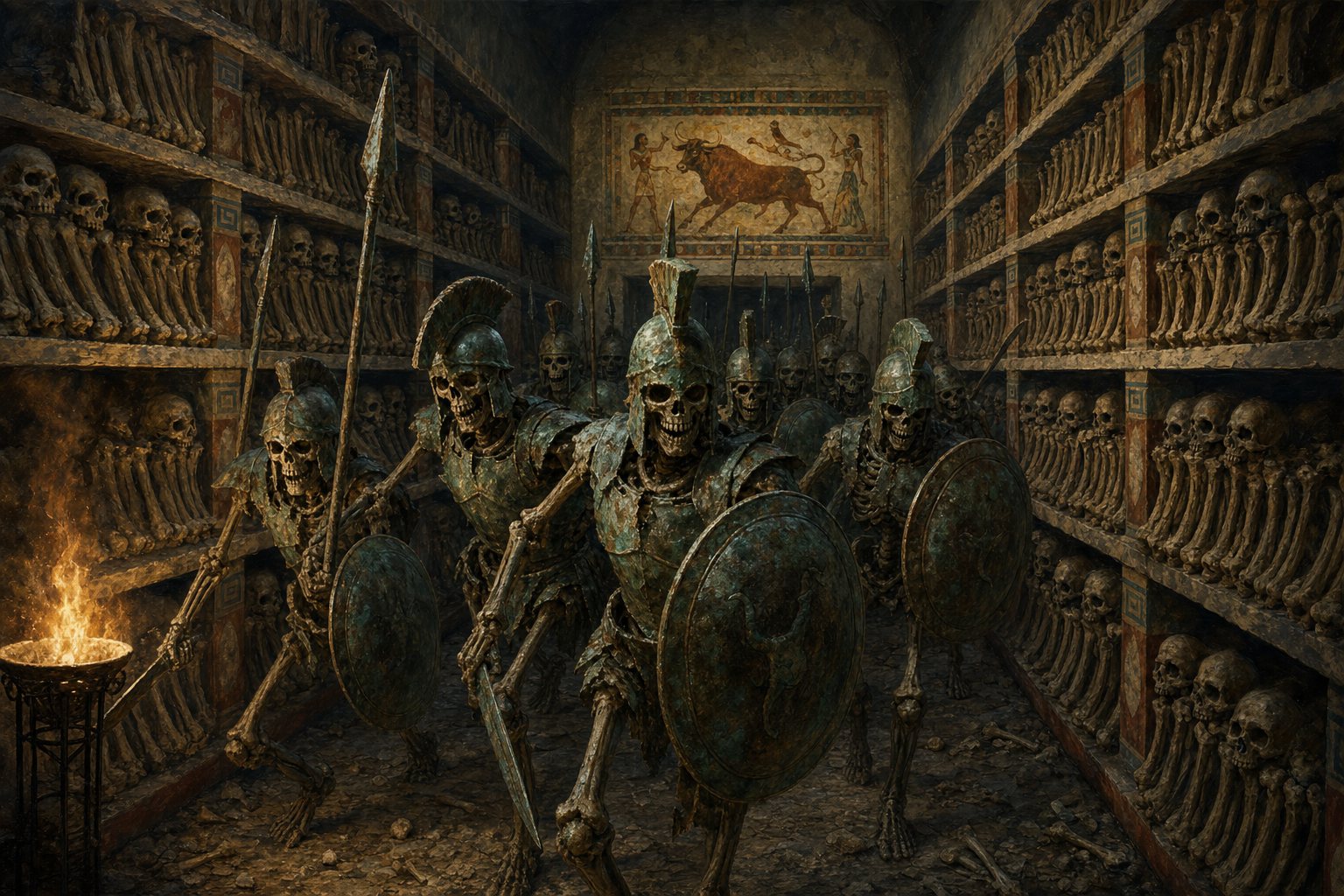
A long aisle, and both walls are shelves — three tiers of them, floor to ceiling, stacked with the sorted bones of a great many people. Shins with shins. Skulls with skulls. Someone did this on purpose and took years over it.
Sixty feet down the aisle the shelves stop and a wall of bronze begins: eight round shields, edge to edge, filling the passage from one side to the other, and above them a hedge of spear-points at exactly the same height.
None of it moves. All of it is facing you.
DM summary. A shield wall in a corridor too narrow to go around — except that the shelves are climbable, the wall is guarding a door rather than the corridor, and both of those facts are findable before anyone throws a spear.
Terrain & Features
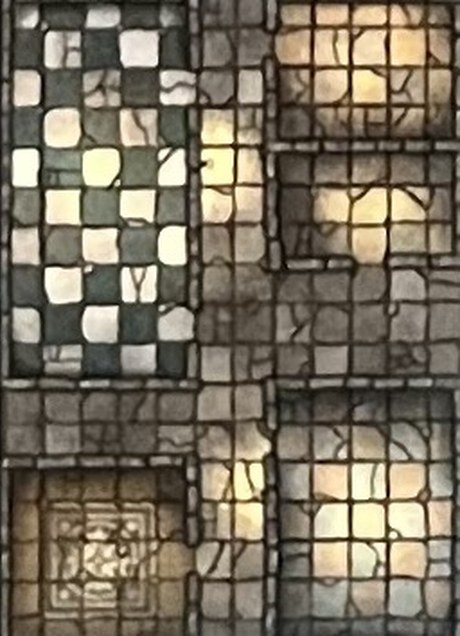
Battle map: The Service Rooms — page 24, 55 × 75 ft (one half of The Tiled Halls)
Use the longest of the plain chambers as the 60 × 20 ft gallery: hatch both long walls as three-tier bone shelves, leaving the 15-ft aisle, and draw the four spent grooves down the floor.
- Dimensions. 60 ft × 20 ft, ceiling 10 ft. A gallery, not a hall. The fighting frontage is 15 ft of open floor between the shelf faces, which is three men abreast and no more.
- Light. Two tallow lamps in wall brackets at the aisle's mid-point, guttering low. Beyond them the aisle is dark and the shield wall is a shape rather than a fact.
- The shelves. Both walls, three tiers, each tier 3 ft deep and 30 inches high. Climbable at Athletics DC 12. A person can lie in a tier and crawl. A tier that takes a hard hit collapses: 2d10 bludgeoning in a 10-ft length, the floor there becomes difficult terrain, and anything under it is restrained for one round while it digs out — which works on skeletons just as well as it works on people.
- The spent grooves. Four shallow bronze-lipped channels run the length of the aisle floor, cracked and empty, the bronze gone green. Nothing grows in them any more. They are the reason this place exists.
- The doorway. Behind the shield wall, 5 ft wide, closed with a bronze-bound door. The wall stands across it, not across the corridor.
- The lamp posts. Two shelf-posts at the mid-point, oak, load-bearing for the middle tier. Pulling one is a way to bring a shelf down deliberately.
Encounter
A wall of six, and it does not want the corridor. It wants the door.
| Count | Creature | XP each |
|---|---|---|
| 4 | Bronze-Tooth Hoplite | 700 |
| 2 | Bone Archer of the Sown Field | 450 |
Base 3,700 XP; ×2 for six bodies = 7,400 adjusted, against the APL 9 Hard budget of 9,600. This room is 23% under budget and it is still Hard, because of frontage: three PCs can reach the wall, two hoplites can reach them, and the archers shoot over the top from a rank the party cannot get at. A twenty-foot corridor is worth two extra bodies.
Round 1. Nothing charges. The wall takes one step forward — all four hoplites, together, one pace — and then stops, and the spear-points come down level. The archers nock. They will hold this position for as long as the party wants to stand there, which is the room's entire personality.
Tactics.
- The wall only works in contact. A hoplite more than 5 ft from another hoplite loses its shield-wall benefit. Anything that pulls one out of line — a shove, a grapple, a shelf collapsing on it — degrades the whole rank.
- They will not advance past the last shelf-posts, 15 ft in front of the door. Nothing will make them. A party that stops 20 ft away is in no danger at all and should be told, in narration, that the wall has stopped.
- The archers never leave the rank. They are useless in melee and they know it. Anything that gets behind the wall makes them worthless, and they will still not move.
- Nothing pursues out of the aisle.
Bypass Options
The dead do not look up. The shelves run the full length of both walls and the second tier clears a spear-point by four inches.
- Getting up: Athletics DC 12, one tier at a time.
- Traversing: group Stealth DC 13 for a party moving along the tiers. The hoplites face the aisle and the archers watch the aisle; nothing in the room has looked at the ceiling in four hundred years.
- One failure: a skull rolls off a shelf. An archer turns and shoots at the climber — one attack, and the wall does not move.
- Two failures: a tier gives way under someone. 2d10, prone in the aisle, 10 ft from a spear hedge.
- Success: the party arrives behind the wall at the door, where the archers are, and the wall now has to turn around. A hoplite that turns breaks the wall for both its neighbours. This is the whole fight, won in one move.
Free information, and the party has to think to get it.
- The check: Investigation DC 13 on the wall's position, or History DC 14 on the formation. Both give the same answer: this is a door guard in a corridor, not a corridor guard. They are not here to stop passage; they are here to stop entry.
- Success: the party may walk up the aisle to within 20 ft, take the north shelf-crawl (exit C), and leave without a single attack roll. The wall watches them do it and does nothing.
- Failure: nothing happens, but nothing is learned, and the party's next move is a guess. A guess that walks to 10 ft is a guess that gets a spear.
- Cost: whatever is behind that door stays behind it, which includes this room's loot roll.
Walk back out. They will not follow. It costs the loot and the clue and nothing else.
Traps / Puzzles / Checks
The spent grooves are the room's lore payload and they cost one check.
| Element | Value |
|---|---|
| Reading them | Religion DC 12 or History DC 13, or free for anyone who has seen a live sowing floor |
| What they say | These four channels grew the men in the shield wall. They are exhausted — the earth in them is spent and the bronze lips are cracked, so nothing more will come up here. A groove with teeth still in it is a different proposition entirely |
| Why it matters | It is the difference between a room that spawns and a room that does not, and a party that can tell the two apart at a glance has been given a real tool for the rest of the maze |
Exits
One roll on the loot table — the grave-goods stacked behind the door the wall is guarding: a hoplite's full kit, laid out the way a man is buried, and it has not been touched.
- Through the door: no check, once the party is behind the wall.
- Without the door: Athletics DC 14 to squeeze through the cleared shelf in the north tier and reach around. Roll on the same table.
Taking the kit does not animate anything. This is not that kind of room, and a DM who springs a wight here has broken the promise the spent grooves made.
Scaling — APL 6 / 12 / 15
| APL | Adjustment |
|---|---|
| 6 | Three hoplites and one archer, and the middle shelf tier is already collapsed on the west side — the flank is open from the start. All DCs −2 |
| 9 | As written |
| 12 | Six hoplites in two ranks of three and three archers, and the front rank has planted spear-butts: any creature that charges the wall takes 2d8 piercing before it arrives. DCs +1 |
| 15 | Eight hoplites, three archers, and a Dragon-Tooth Serjeant in the second rank who sows — one of the four grooves is not spent after all, and it produces a fresh hoplite at the end of every third round while the Serjeant stands over it. DCs +3 |
- Pacing: 15–20 minutes fought, 5 bypassed. The shelf-crawl should be findable in the first two minutes; if nobody looks up, have a rat knock a skull off a tier.
- If you are behind schedule, the wall is four hoplites and no archers and the north tier is already collapsed. Eight minutes.
- If the party is grinding, remember the wall never advances. A stalled melee in this room is a stalemate the party can simply walk away from, and you should say so: "They have not moved. They are not going to."
- The lesson this room teaches is frontage, and it is worth teaching explicitly. Put the 15-ft aisle on the mat and let the fighters discover that the wizard's position matters more than their own.
- Table safety. Sorted human remains, stacked by bone type, is a real ossuary and a genuinely unsettling image for some tables. It is also just Sedlec. If it lands badly, the shelves are votive terracotta limbs left by pilgrims, which is equally Greek and entirely bloodless.
- Clue drip. Two hooks: the grave-goods behind the door, which include a sealed writing tablet nobody opened (X08's writ, X14's survey), and the spent grooves themselves, which tell a party what the tooth-sowing floors of this maze do and where the men in them come from (X03 — the threshold is held by these, and knowing the grooves is knowing how to break the door guard).
- Callback. Sown Bones hold, step into a dead comrade's place, and never chase. If your table met them at the threshold, this room should confirm the pattern — and the exhausted grooves should tell them that a sowing floor is a resource that can run out.
Creature Cards
Both belong to Sown Bones (W01) and recur across the deck, so the numbers live in the bestiary. The tactics above are this room's and stay here.
Shared across rooms, so the full cards live in the bestiary: Bronze-Tooth Hoplite, Bone Archer of the Sown Field. Every mention above opens the numbers here on this page.