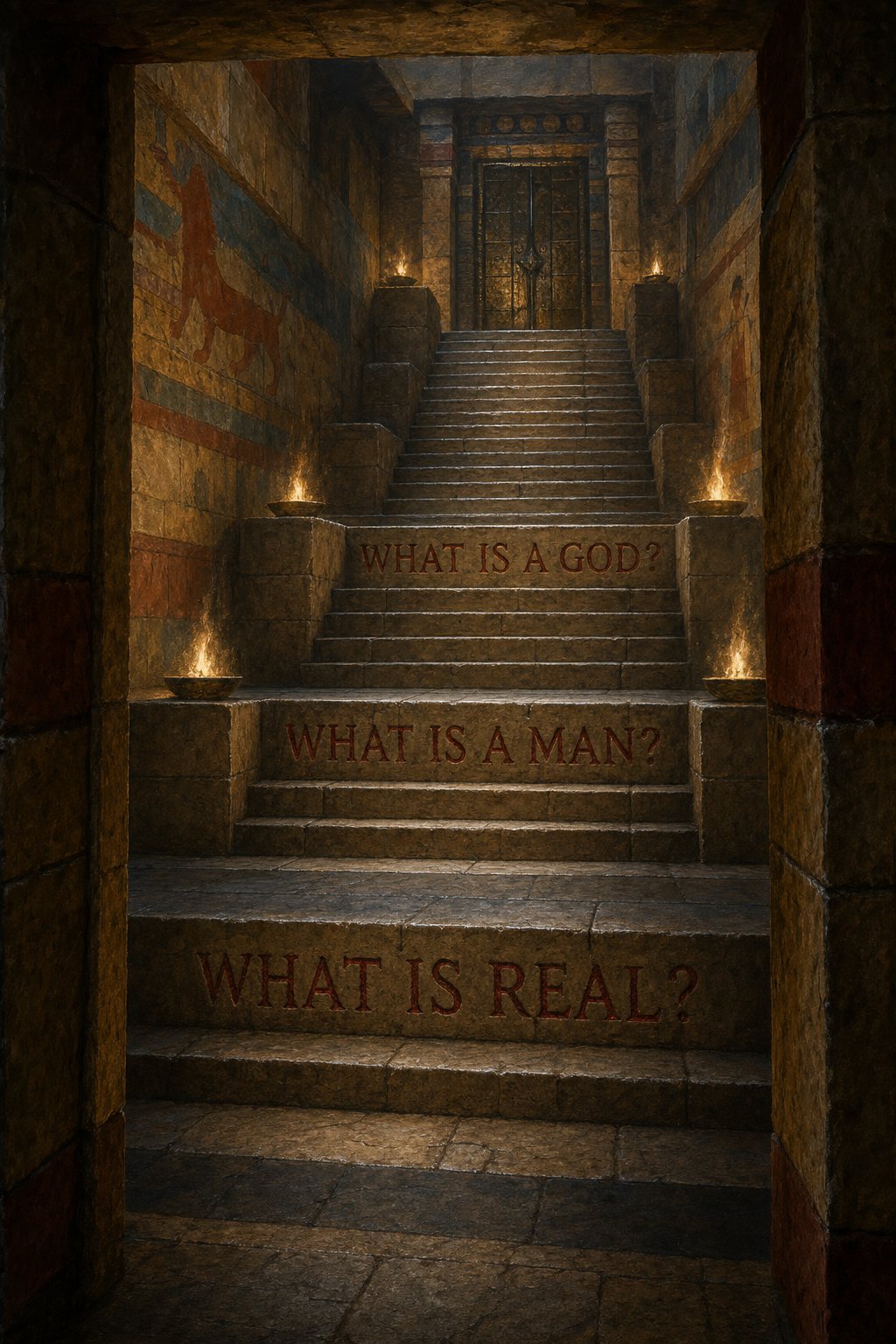
Thirty steps up to a bronze gate, and the stair has three landings in it. On the face of each landing a question is cut into the stone, deep, by someone who took their time, and the letters are packed with dried red wool so they can be read in the dark.
At the bottom of the stair, folded over on his side as though he had been walking down and simply stopped, is a man in grey with a bone needle still in his hand.
DM summary. A Cult initiation stair that opens for honesty and tips liars back down it. No creature, no damage worth the name, and thirty minutes of character that most tables will remember longer than the fight before it.
Terrain & Features
Battle map: The Stairhead — page 54, 55 × 75 ft (one half of The Buried Stair)
The stairhead is the judging stair: the printed twin staircases are the flights (treat the sand as worn stone), the four pillars frame the landings — chalk the three 10-ft pivot platforms — and the central stairwell is the barred gate at the top.
- Dimensions. 60 ft × 20 ft — a stair hall, rising 30 ft in thirty steps, with three landings at the tenth, twentieth, and thirtieth step. Ceiling 15 ft above the stair throughout.
- Light. Three bronze lamp-cups, one per landing, unlit. Answering a landing's question honestly lights its cup, by itself, with a small blue flame. Nothing else lights them; the party can try.
- The three landings. Each is a 10-ft square platform on a hidden pivot. The first two tilt. The third does not.
- The gate. Bronze, double-leafed, at the head of the stair. Barred from the far side by three tumblers, one per lit lamp.
- The dead cultist. Grey robe, bone needle, a purse, no wounds. He is at the bottom of the stair with his feet toward it, which is worth describing precisely: he was on his way down. Investigation DC 12: he broke his neck on the fall, and he has been dead a month, and he was a grown man who knew this stair and lied on it anyway.
- The side door at the foot of the stair, on the west wall, standing open — the way the Cult's initiates leave when they fail, and the reason this room can never trap anybody.
Traps / Puzzles / Checks
The rule, stated plainly for the DM. The stair does not judge whether an answer is true in the world. It judges whether the speaker believes it. That makes this a player-facing question and a character-facing one at the same time, and you resolve it by asking the player: is your character telling the truth? Take the answer at face value. This works, at every table, as long as you never argue with it.
| The three questions, in order | Cut on |
|---|---|
| "What did you take that was not given?" | Landing one, step ten |
| "Who do you expect to come for you?" | Landing two, step twenty |
| "What will you do when you are out?" | Landing three, step thirty |
How to run each landing.
- Every character who intends to pass must answer. Not one spokesperson — each of them, out loud, and it takes about a minute each. That is the room's whole pacing budget and it is worth it.
- An honest answer — including "I do not know", "nothing", and "I will not say" — lights nothing on its own, but counts. When every character on the landing has answered honestly, the cup lights and the tumbler behind the gate drops.
- A lie tilts the landing to 40 degrees at the end of that character's answer. The liar makes Dexterity save DC 12 or slides to the foot of the stair: 1d6 bludgeoning, prone, and the landing resets. Everyone else on that landing makes the same save at DC 10 to grab the rail. Nothing here is lethal and nothing here escalates.
- A refusal to answer at all — silence, walking back down — is treated as honest and does not light the cup. That character cannot pass the gate, and the rest can. Say so kindly; a player who does not want to improvise personal disclosure has an in-fiction way out that costs the party nothing but one member's route.
- Calling a lie. Another character may spend their turn saying so: Insight DC 13 against the liar. On a success the stair believes the accuser and tilts immediately. On a failure the accuser has just publicly called a friend a liar on a stair that knows better, and the accuser's own next answer is at disadvantage — the stair has become interested in them.
Three ways past that are not honesty. Every puzzle in this deck has a mechanical fallback, and this one has three, all of them costly.
- Shim the tumblers. The gate's three tumblers are reachable through the gap under the leaves: Thieves' Tools DC 16, ten minutes, and it must be done from the top landing — which means standing on the one platform that does not tilt while the other two are unlit. Failure by 5 or more snaps a pick.
- Force the gate. Athletics DC 17, two characters, and the bar shears with a noise you should describe as a bell. Ten minutes of work, and the noise carries: roll the wandering-threat die once, and whatever the party meets is waiting for them beyond the gate rather than behind it.
- Speak the rite. Religion DC 15, or free for anyone who has learned the Cult's initiation from another room: the questions are a catechism and the Cult's own answer to all three is the same phrase — "the thread was given, the thread will take me back, and I will re-tie it behind me." Delivered convincingly (Deception DC 15 for a non-believer), it lights all three cups at once, and it is a lie the stair accepts because the Cult built the stair and wrote themselves an exemption. Let a player who works that out feel enormous.
Solved state. Three lamps lit, three tumblers dropped, the gate swings inward under its own weight. It stays open.
Exits
None. The dead cultist's purse holds four drachma, a bone needle, and a knotted cord — pocket money and a keepsake, not a loot roll. The lamp-cups are bronze and fixed. The stair pays in a rider and in whatever the players learn about each other, which at a good table is quite a lot.
Scaling — APL 6 / 12 / 15
| APL | Adjustment |
|---|---|
| 6 | Two questions instead of three; the second landing's is skipped. Tilt save DC 10, Insight DC 11, all fallback DCs −2 |
| 9 | As written |
| 12 | Three questions, and the third landing tilts as well — a lie on the top step is a 30-ft slide, 2d6 and prone. DCs +1. The rite is known to have been changed recently, so Religion DC 16 and a wrong phrase counts as a lie |
| 15 | Three questions, all landings tilt, and the stair asks a fourth question of any character who answered all three honestly: "and what did you leave behind?" — the honest answer to that one costs something the party has to name off a sheet. DCs +3 |
- Pacing: fifteen minutes and it is nearly all roleplay. This is the room to roll when the table has had two fights in a row. Behind schedule? One question, asked of the party as a group, and the gate opens. Four minutes — but ask it properly and give them the silence to answer in.
- Ask the question and then stop talking. The single most common way to ruin this room is filling the pause. Count to ten in your head.
- Never adjudicate honesty yourself. Ask the player: "is that true?" Believe them. The stair is a mechanism for getting players to say things about their characters, not a lie detector for you to wield.
- The refusal option is a table-safety feature and should be named early. Before the first question, say aloud that "I will not answer" is a legitimate and non-punished response. Some players will not want to improvise a confession in front of five friends, and the room must not make that a failure.
- The dead man at the bottom is your demonstration. Let someone examine him before anybody climbs. A month dead, no wounds, walking down: he answered the third question, did not like his own answer, and turned round.
- Clue drip. Two objects: the knotted cord in his purse, which is a Cult route-record in knots rather than ink and pairs with anything the party has learned about splices (X10), and the red wool packed into the carved letters, which is the same dyed wool as the thread and was cut from a length of it to fill a carving — somebody had a great deal of it and no particular reverence (X14 for a party building their own map of who marks what).
- Callback. The Cult of the Thread (W18) argue, negotiate, and believe. This is the room where the party meets their theology without meeting any of them, and if the table later has to talk a priest down, everything they need is carved into these three landings.