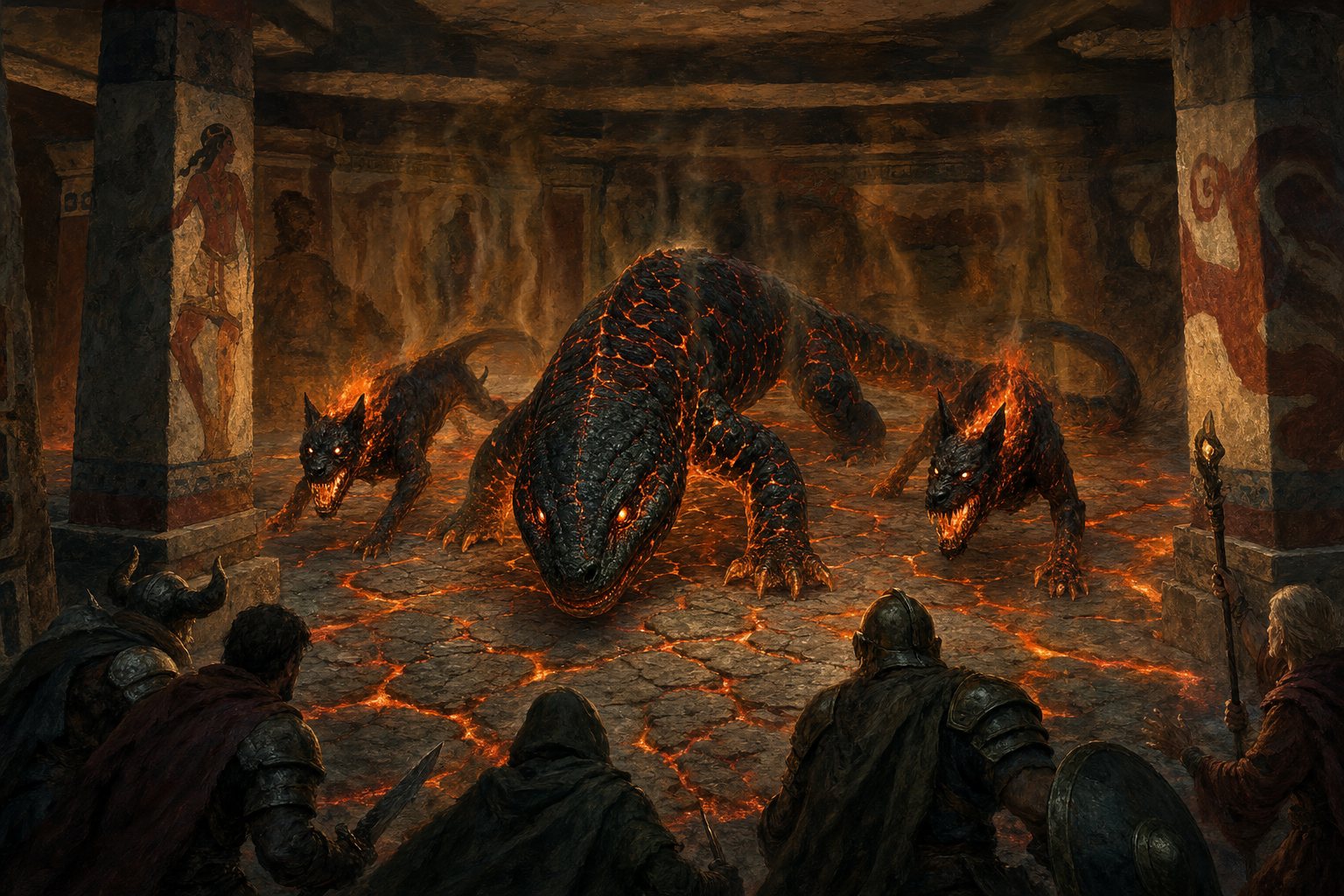
The floor here is grey crust, and the crust is cracked, and the cracks are orange. Heat comes off it in sheets that bend the far wall out of shape. A path of trodden ash winds between the seams — narrow, deliberate, walked often.
Three dogs made of embers are standing on it, facing you, and behind them something taller straightens up from the seam it was feeding and lifts a bar of molten iron out of the ground like a man lifting a rake.
DM summary. A crossing, not a clearing. Fire-hounds herd the party off the safe ash path and onto the crust, and cold damage — any cold damage at all — freezes a seam into a bridge nobody made. The party's job is to reach the far door, not to win.
Terrain & Features
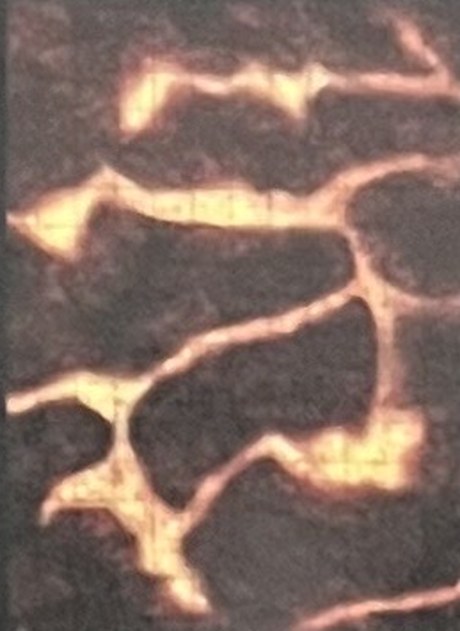
Battle map: The Branching Flows — page 49, 55 × 75 ft (one half of The Fire Floes)
The branching flows are the seams, printed: run the room 70 × 40 ft along the page's length, chalk the 5-ft ash trod winding between the flows in four legs, and mark the slumped roof at the west end.
- Dimensions. 70 ft × 40 ft, ceiling 15 ft and lower at the west end where the roof has slumped. The party enters at the east.
- Light. Bright throughout, orange, from the floor. Nobody needs a torch and nothing here can hide.
- The trod. A winding path of packed ash, 5 ft wide, running east to west across the room in four legs with three switchbacks. It is safe ground. It is also exactly wide enough for one person, which is the trap: a party on the trod is a single file line with no flanks.
- The seams. Seven lava cracks, each 5–10 ft wide, cutting the room into islands of crust. Entering or starting a turn in a seam: 4d10 fire damage, half on a Dexterity save DC 15. Crossing a seam is a 10-ft jump (Athletics DC 13) or a bridge.
- The crust. The grey ground between the seams holds a person's weight and complains about it. A creature that dashes across crust rolls a Dexterity save DC 12 or breaks through into ankle-deep heat: 2d10 fire and its movement ends.
- The quench pit. A stone-lined pit of black water at the room's north-west corner, 8 ft across, left over from whatever forge this was. Full immersion ends any burning and is the only water in the room.
- The slump. The collapsed roof at the west end leaves a 5-ft crawl over rubble to the far door — a bottleneck the hounds will not follow into, because they cannot turn round in it.
Encounter
Three hounds working as a herd, and a salamander who is in no hurry at all.
| Count | Creature | XP each |
|---|---|---|
| 3 | Pyre-Hound | 700 |
| 1 | Forge Salamander | 2,300 |
Base 4,400 XP; ×2 for four bodies = 8,800 adjusted, against the APL 9 Hard budget of 9,600. It sits 800 under, and the seams make up the difference and more: a party that fights standing on the trod is fine, and a party that gets herded is taking 4d10 a round from the floor. The room, not the roster, is what makes this Hard. Say that to yourself before you run it, and then run the hounds like sheepdogs rather than like wolves.
Round 1. The hounds do not close. They split — one left, one right, one holding the trod — and the two on the flanks run the crust to get behind the party's line, which puts the party between three hounds and the door they came in by. The salamander walks the trod toward them at half speed, dragging the molten bar so the ash smokes behind it, and does not reach anyone until round 3.
Tactics. Pyre-Hounds herd: they bite and shove toward heat, never away from it, and they will break off a target entirely to cut off a route. They ignite when they die — anything within 5 ft takes fire damage — so a party that kills one in a doorway has closed their own doorway for a round. The salamander holds the trod's middle switchback and will not leave it; that is its job and it has been doing it for a long time. Nothing here pursues past the slump.
Bypass Options
The room's real answer, and it is the only place in this batch where a cantrip solves a Hard encounter. Any cold damage dealt to a seam — a ray of frost, a cone of cold, a flask of brine off a corpse, a cleric's chill touch — skins it over: a 10-ft crust bridge forms across that seam and lasts 3 rounds, or until it takes 10 fire damage.
- Success: the party crosses seam to seam in a straight line to the west door instead of walking the trod's four legs, which is 40 ft of travel instead of
- The hounds will not step on frozen crust — it hurts them and they know it — so a party moving bridge to bridge is untouchable by the herd.
- Cadence, stated: a bridge laid on round 1 is gone at the end of round 3. Count it aloud. A party strung out across two bridges when the first one goes has someone standing in a seam.
- No cold on any sheet? Water works at half measure: a full waterskin or a flask of oil-free liquid buys a 1-round crust, and the quench pit can be bucketed if someone carries a helmet. Say this at the table the first time somebody looks at the pit.
- Failure: a bridge that takes fire damage while someone is on it drops them into the seam — 4d10, Dexterity save DC 15 for half, and they end their turn on the near side of where they were going.
The salamander's molten bar is the thing that makes it frightening. Get it into the quench pit: Athletics DC 16 to shove the salamander in (it weighs what a horse weighs), a grapple and a 10-ft drag, or a hit on the bar itself with any cold effect.
- Success: the bar goes solid and black and useless. The salamander is not beaten, but it stops advancing and spends two rounds re-heating it at the nearest seam, which is two free rounds of crossing for everybody.
- Failure: you are adjacent to a salamander in a room made of fire. Take the consequence honestly and let the party's healer earn their evening.
- Withdrawing instead: the east door is behind the party the entire fight and nothing in this room follows them through it. They lose nothing but the crossing — this room has no loot and its clue is on the far wall, which is the only reason to be here at all.
Traps / Puzzles / Checks
Reading the trod. Survival DC 12 or Investigation DC 13: the ash path is maintained. Somebody sweeps it. The switchbacks avoid the seams that vent and cross the ones that do not, which means the path is safe and the shortcuts are a gamble — and it means something in this maze walks here on a routine.
The vents. Two of the seven seams vent rather than pool: at the end of every third round, both throw a 10-ft column of flame to the ceiling. Anything in the column takes 4d10 fire, Dexterity save DC 15 for half. They are marked by lighter ash and a smell, and Perception DC 13 picks them out from the doorway — before anyone commits to a route, which is the point of telling them.
Exits
None. Everything that could burn in here has burned, and everything that could melt is part of the floor. The salamander carries nothing; the bar is a lump of iron the party cannot hold. Tell them straight — this room charges resources and pays in distance covered.
Scaling — APL 6 / 12 / 15
| APL | Adjustment |
|---|---|
| 6 | Two hounds, no salamander. Seams do 2d10, the vents fire every fourth round. All DCs −2, and the cold bridge lasts four rounds |
| 9 | As written |
| 12 | Four hounds and two salamanders working the two middle switchbacks. Seams 10d10. DCs +1, and a frozen bridge lasts two rounds |
| 15 | Five hounds, two salamanders, and the room breathes: at the end of every second round one seam closes and a new one opens somewhere else, rolled or chosen, so no route stays good. Seams 10d10, DCs +3 |
- Pacing: fifteen minutes, and it should feel like eight. Run it fast, keep the party moving west, and resist the urge to make them clear the room. Behind schedule? Two hounds, no salamander, one seam, and the crossing is three rounds. Five minutes.
- Announce the exit at the start. The party must be able to see the west door from the east door. A chase room where the finish line is a surprise is just a fight in a bad room.
- Count the bridges out loud. "That one goes at the end of this round." The entire tension of this room is a timer on a piece of ground, and the timer only exists if you say it.
- If the party has no cold damage on any sheet, that is fine and it is why the quench pit and the waterskins are written down. Do not let a party with no wizard feel locked out; the trod itself is a legitimate, slower route and the hounds can be fought on it.
- Table safety. Burning. The hounds ignite when killed and the imagery is vivid; if fire is on your table's veil list, run the seams as scalding steam vents — same damage type or swap to bludgeoning-and-scald, same DCs, no other change.
- Clue drip. Two objects: the wax that has run out of a crack in the west wall and puddled where the heat reaches it, which nobody would store here unless they were storing it somewhere above (X17), and the plumb bob melted into the ash at the second switchback, dropped by somebody who was measuring the seams rather than avoiding them (X14).
- Callback. The Salamander Forge (W13) always answers to cold and water. If your table has met them before and someone has been holding a cold spell in reserve for four rooms, this is the room where they get to be right about it.
Creature Cards
Both belong to the Salamander Forge (W13) and recur across the deck, so the numbers live in the bestiary. The trod, the seams, and the bridges are this room's.
Shared across rooms, so the full cards live in the bestiary: Pyre-Hound, Forge Salamander. Every mention above opens the numbers here on this page.