The Oracle's Bargain
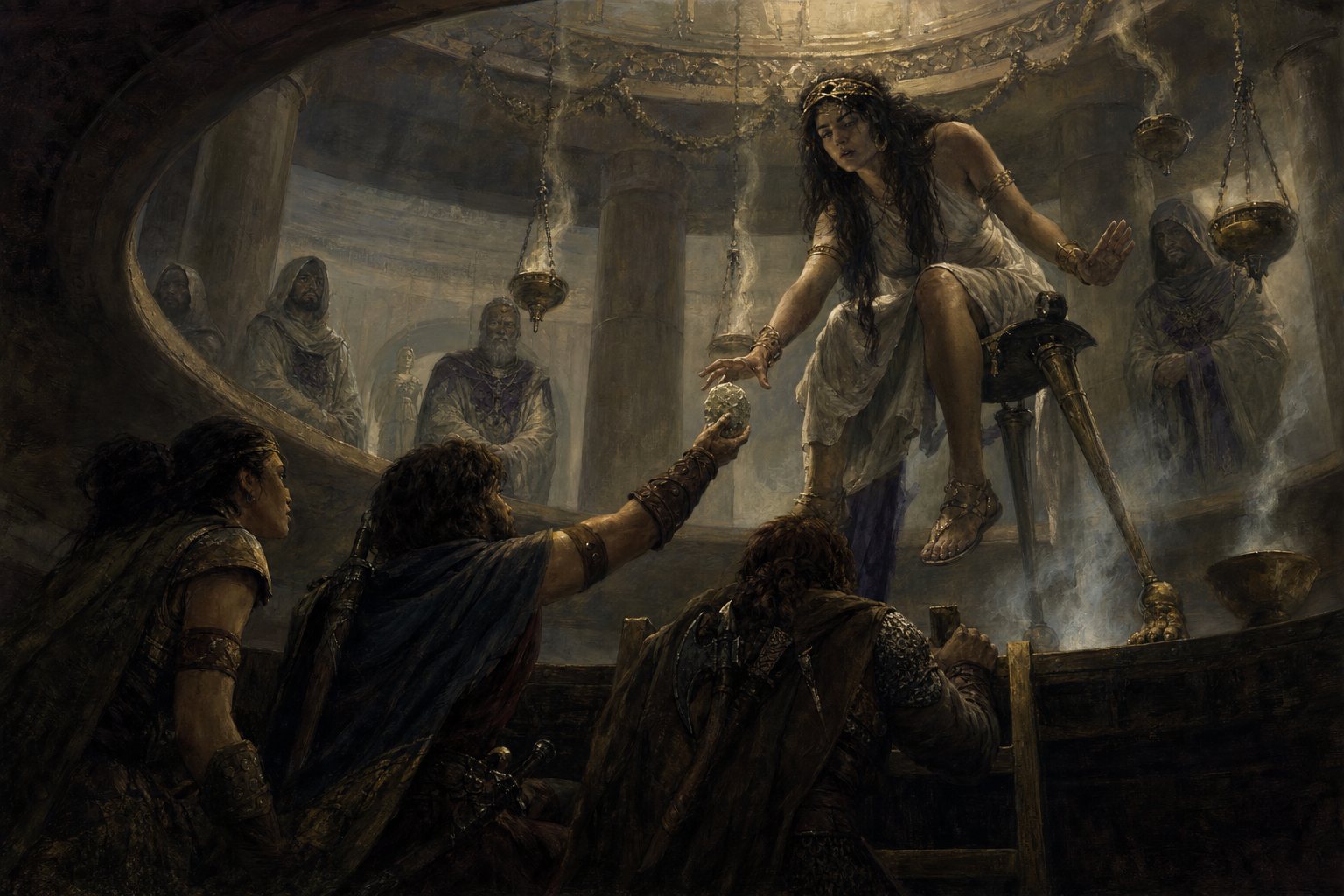
The chamber has weather. Not damp, not draught — weather, a slow cold turning of the air, as though the room were much larger than it is and had a sky.
Water falls from one stalactite at the centre, one drop about every four seconds, into a basin that has been worn a foot deep by the doing of it. When the drop lands, the sound is a syllable. Not a word. A syllable, and always a different one.
Nobody has been in here for a long time and it has been waiting the whole while.
The Way Out
There is a power in the Labyrinth older than the Labyrinth — a spring-oracle, a riddling voice, a thing with three mouths and one opinion, whatever the DM prefers. It predates Minos, it predates the maze built on top of it, and it can put a person anywhere the water goes, which includes outside.
It will do this. It says so, immediately, without haggling and without threat. It asks one thing in return, and the thing it asks is never money, never blood, and never a service — it is always something the party did not know they were carrying.
This Resolution is a negotiation with somebody who cannot be beaten and does not want to fight. It is the only ending on the list where the entire scene is a conversation about price.
Requirements
| Requirement | Where it comes from |
|---|---|
| Finding it | R044 Oracle of Dripping Stone is the seat; R094 Hall of the Hollow Chorus and R009 The Riddle Bridge are its outer voices and both will direct a polite party inward. R032 Sanctum of Quiet Hours and R091 Cell of the Chained Prophet both name it |
| Something it wants | It names the price itself, and the price is always something the party owns rather than something they can fetch. See the table below. The party always has at least one thing it will take — that is a design guarantee, not a coincidence |
| Understanding the terms | Insight DC 14, Religion DC 13, or Arcana DC 15 tells the party what a price actually costs. Without a check the oracle is still honest — it simply answers the question asked, and a party who asks nothing learns nothing |
| Willingness | One character has to say yes, out loud, in the first person. It will not accept a price paid on someone else's behalf, and it will not accept a group decision. Somebody has to volunteer |
Clues
| Tier | Line to deliver |
|---|---|
| Whisper | Water dripping in the dark, and one drop in nine sounds almost like a syllable of a language you half know. |
| Trace | A votive left on a ledge — a barley cake, gone hard, and a coin of a design nobody has struck in two hundred years. |
| Sign | A queue. Or the fossil of one: worn kneeling-hollows in the stone floor, forty of them, all facing the same doorway. |
| Proof | A supplicant's tablet, unfinished: I asked and it answered and the price was — and then nothing, because the writer could not spell what they had given up. |
| Path | Water leaving the chamber by a channel too small for a person, and a carved line above it: what the water may go, the water may carry. |
| Door | The basin, the drop, the syllable — and the voice, which says your name before you say anything at all. |
Resolution Scene
Fifteen to twenty minutes, and it is all one conversation.
The oracle opens by granting the request before the party makes it. Yes. All of you. Outside the wall, dry, in the afternoon. Then it names its price, and the price is where this scene lives.
Roll or choose. Six prices, and the party may counter-offer.
| d6 | The price | What it actually costs |
|---|---|---|
| 1 | A name | The character gives up their own name. They keep every memory of being called it; nobody else can hold it in their head. Reintroductions, forever. Mechanically nil; socially enormous |
| 2 | A memory | One specific happy memory, chosen by the player, gone. They know it existed. They cannot get it back, and the oracle will not tell them what it was |
| 3 | Nine years | Off the far end, not the near. The character ages nine years on the spot, or agrees to die nine years sooner. Player's choice which |
| 4 | A thing carried in | The oracle names one item the party is carrying, and it is always the one somebody cares about — not the most valuable. It never asks for a maguffin another Resolution needs |
| 5 | A promise | One future act, unspecified, to be named later. The oracle is not malicious and will not ask for atrocity, but it will ask at the worst possible time |
| 6 | A truth said aloud | The character says the truest thing they have never said, in front of the party, and means it. That is the whole price. It is the most expensive one on the list |
Counter-offers are the point of the scene. The oracle will trade down if offered something it finds more interesting: a story it has not heard, the name of what is at the maze's heart, news of the world above, or a genuinely better idea. Persuasion DC 16, or automatic if the party offers something specific and strange. A party who gives it the Cult's heresy, or a description of the sea, or the mason's confession, gets their price reduced or waived and the oracle is delighted.
The bad play to watch for: a party volunteering their least-loved NPC or arguing about whose turn it is. Let one round of that happen, then have the oracle say it will take the price from whoever speaks next, and mean it.
When paid, the water rises to ankle height, moves against the slope, and goes out by its channel. The party goes with it, in a way that is not swimming, and arrives dry on a hillside above Knossos with the taste of cold stone in their mouths.
Fallback
The party will not pay, or has nothing it wants, or the volunteer backs out. It does not refuse and it does not bargain harder.
- Credit. Then go, and owe me. Passage now, price later, and a mark to say so — a thumbprint-sized cold spot at the base of the throat that never warms.
- Cost: an unspecified debt to an old power, collected at a time of its choosing. The DM writes it down and does not use it in this session. It is a hook for a later story, not a penalty for this one.
- The party still gets out, all of them, dry, in the afternoon, exactly as promised. The oracle keeps its word perfectly. It always has.
Resolution-owned, never on the loot table.
- The oracle's coin. The two-hundred-year-old votive from the ledge, returned to whoever paid. Once, anywhere, the holder may ask one question of still water and get a true answer of ten words or fewer.
- One honest answer, asked and answered before the party leaves. It will not tell the future. It will tell them anything about the past, including who built the maze and why, and what happened to the twelve.
- What was not taken. A party who counter-offered well keeps the price, and the oracle's regard, and the standing invitation implied by come back when you have another story.
Scaling — APL 6 / 12 / 15
| APL | Adjustment |
|---|---|
| 6 | The oracle asks for price 4 or 6 only — an object or a truth. No years, no names. DCs −2 |
| 9 | As written |
| 12 | It names two prices, from two different characters, and will not take both from one. DCs +2 |
| 15 | It names three prices and is interested in the party rather than merely willing — it has heard of them. Counter-offers must be genuinely novel; DCs +3. It also knows what they did to get here and will mention it |
- The oracle never lies, never haggles up, and never cheats. That is the entire reason this Resolution is frightening. A power that keeps its word exactly is far worse than a trickster, because the party's problem is not the wording — it is that they have to decide what they are willing to lose.
- Price 6 — the truth said aloud — is the best one, and only for the right table. Read the room. If the players are the kind who will run with it, this is the scene they remember for a year. If they are not, roll again and never mention it.
- Do not put a mechanical penalty on any price. No ability score loss, no levels, no attunement slots. The prices cost story, and story is enough. A player who gave up a memory will play it harder than any −1 could make them.
- B09 parties came in as penance, which is the entire joke: they were sent to pay for something, and the way out is to pay for something else. Let the oracle notice the irony out loud.
- Never let a party arrive with nothing. If they somehow have no object, no memory worth having, and no willingness, the fallback is right there and it costs the DM nothing to hand it to them.
- If the party is out of time, name price 4, take the object, and put them on the hillside. Five minutes. The scene works fine as a short one.