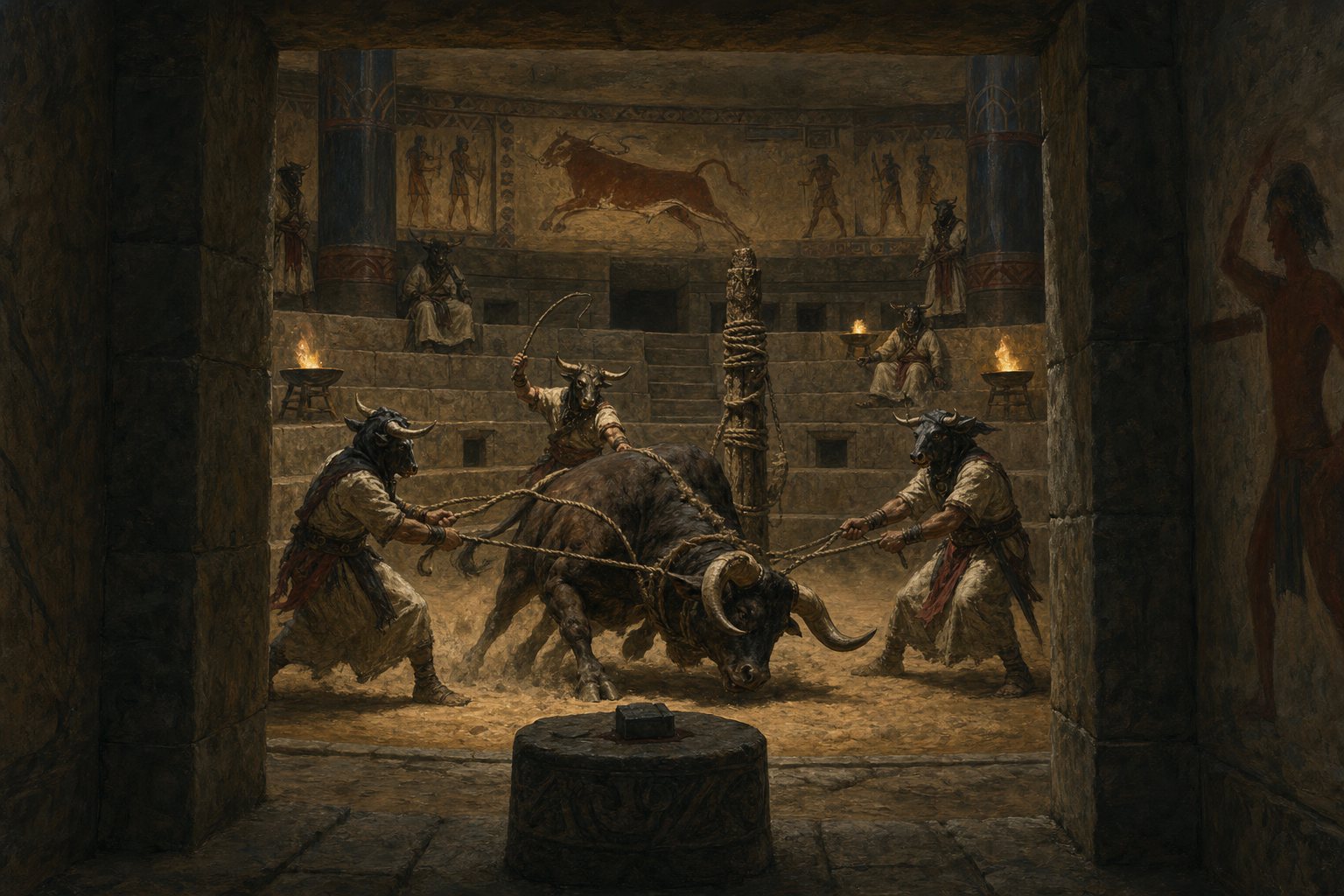
Someone has built a colosseum down here. Not a big one — the sand floor would fit a house — but it has tiers, and a timekeeper's stone, and a post at the centre with old rope on it. Eleven people in bull masks are sitting in the tiers with their feet on the seat in front, and when you walk in they do not run and they do not shout. They start drumming.
Two gates open under the tiers. What comes out of them was a man's shape once and is now mostly shoulders.
DM summary. A fight the audience is enjoying. Three cultists in the stands drive two bull-brutes with drums and goads from ten feet up where the party cannot easily reach them, and the room is won by taking the drums away — or by giving the crowd a better show than the one they came for.
Terrain & Features
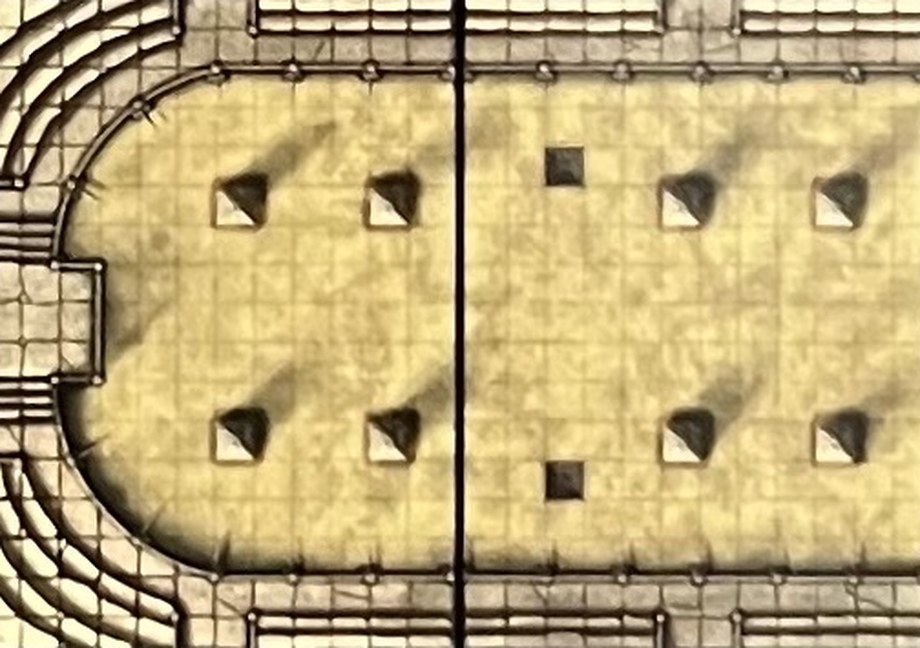
Battle map: The Hippodrome — pages 31 & 32, 110 × 75 ft
The hippodrome is the arena: the 60 × 60 ft sand is printed, the continuous rail on the curve is the first tier's edge (chalk the two upper tiers behind it), and the floor-level gates are the north tunnel and the gate. Draw the bull-post at centre.
- Dimensions. 60 ft × 60 ft of sand, ceiling 30 ft, ringed by three tiers of stone seating rising 10 ft. The party enters through the north tunnel at floor level, which is the worst possible place to enter and is the whole point.
- Light. Bright. Eight torches in wall-brackets above the top tier, and the cultists keep them lit because they want to see.
- The sand. Ankle-deep and raked. It is not difficult terrain, but a creature that is shoved prone in it takes an extra 5 ft of movement to stand, and any creature that Dashes in a straight line for 20 ft or more raises a cloud that gives half cover for one round.
- The tiers. 10 ft of stepped stone from sand to walkway. Climbing them is Athletics DC 12 and costs the climber their movement; the cultists are on the top walkway and can shove a climber back down (Athletics contest, or a flat DC 13 Dexterity save to hang on).
- The post. A bull-post at the centre with 20 ft of old rope on it, the sand around it darker than the rest. A creature can be tied to it, and a brute can be roped to it (see below), and it is the single best piece of terrain in the room.
- The two gates. Counterweighted beast-gates under the east and west tiers, each held by a pin. Beyond them, stock pens with a smell coming off them that a brute can find blindfolded.
- The timekeeper's stone. A flat slab by the north tunnel with a bronze bowl on it, a water-clock, and the wagered purse underneath. The cultists hold the fight to the clock and will complain if the party ignores it, which is the funniest thing about them.
Encounter
Two brutes on the sand, three cultists in the seats, and eight more who are only an audience.
| Count | Creature | XP each |
|---|---|---|
| 2 | Taurine Brute | 1,800 |
| 3 | Bull-Masked Cultist | 450 |
Base 4,950 XP; ×2 for five bodies = 9,900 adjusted, against the APL 9 Hard budget of 9,600 — three hundred over, and honest. The other eight masked figures in the tiers are not combatants. They have no weapons, they do not descend, and they will not be given stat blocks; they are the noise. If the party attacks them, they run, and the room becomes a chase the party will lose the point of.
Round 1. The drum starts before initiative. Both brutes come out of their gates in a straight line at whoever is nearest the centre — this is a charge lane the party can see coming and step out of (Dexterity save DC 14 to sidestep and let a brute pass, ending prone). The three cultists on the walkway throw goads and shout in rhythm and never come down.
Tactics. The brutes fight the way the drum tells them: while a drum is beating, a brute Dashes and shoves every round and will not stop to finish a downed target. Silence the drums and they slow, look around, and start choosing their own targets — which is more dangerous per hit and far less dangerous overall, because they stop lane-charging and start milling.
The crowd's rule. The cultists respect the arena's own rules, absurdly and sincerely: one fighter against one brute, inside the sand, no missiles from the tunnels. Break the rules and they boo. Follow them and they will honour the outcome, which is the room's real exit.
Bypass Options
The crowd wants a show. Give them one. Any character who steps to the post and calls a single combat — Performance DC 15, or Intimidation DC 15 with a weapon planted in the sand — gets the crowd's assent. The cultists chain the second brute at its gate and drum for the duel.
- Success: one PC fights one Taurine Brute alone, on sand, with everyone else out of it. That is 1,800 XP against one character — dangerous, survivable, and the best solo spotlight in this batch. The crowd honours the result either way: win and they open the south gate and let the party walk; lose and they drag the loser out alive, because a dead champion ends the day's sport early.
- Failure: they laugh. No fight starts, but the party has lost the option and the drum starts for real. Roll initiative with both brutes loose.
- Interfering in the duel — a spell, an arrow, a friend stepping in — ends the bypass instantly and puts all five enemies on the sand at once.
The brutes are penned animals with a better idea available. The gate pins are on the sand side, reachable at a run: Athletics DC 15 to haul a counterweighted gate up, or Thieves' Tools DC 13 to drop the pin and let it swing.
- Success: one gate open and the smell of the stock pen reaches the sand. Both brutes break for it at the top of the next round and are gone. The cultists scream. The fight is over and the party has beaten a Hard encounter by opening a door.
- Failure: the gate sticks half-up. It is now a 10-ft square of cover either side, which is not nothing, and the pin can be tried again next round by anyone standing there — with a brute bearing down.
- Cost: the noise carries. Two open gates, eleven screaming cultists, and a stock pen full of alarmed animals is the loudest thing in three rooms.
- Withdrawing instead: the north tunnel is at the party's back all fight and neither the brutes nor the crowd will follow into it — the brutes will not leave the sand and the cultists will not leave the brutes. The party loses the purse and the clue and nothing else.
Traps / Puzzles / Checks
The drums. Three of them, on the top walkway, one per cultist: hide over a clay body, AC 12, 8 HP, and a single hit destroys one. Track them.
| Drums beating | What the brutes do |
|---|---|
| 3 | Charge lanes every round, shove on every hit, no target selection |
| 2 | As above, but one brute may choose its own target each round |
| 1 | Both mill; charges only when a lane is already clear |
| 0 | The brutes stop. They look at the tiers, then at the party, and one of them goes for the nearest cultist. Give the party that round for free — they earned it |
The rope and the post. A character who gets a brute's charge to pass the post can throw the loop: Sleight of Hand DC 15 or Athletics DC 16. A roped brute is anchored to a 20-ft radius until it breaks the rope (Athletics DC 15 on its turn, one attempt per round). This is the trick the arena was built for and the cultists will cheer for it even though it is their brute.
Exits
One roll on the loot table: the wagered purse under the timekeeper's stone — coin, a knucklebone set, and somebody's pledged bracelet. Take it after the fight (no check), or lift it on the way past during the fight (Sleight of Hand DC 14, and the cultists will not intervene because it is not their money).
The bronze victory-wreaths on the south gate hooks are hammered thin and worth less than they look. Let a player weigh one in their hand and find out.
Scaling — APL 6 / 12 / 15
| APL | Adjustment |
|---|---|
| 6 | One brute, two cultists, two drums. All DCs −2, and the crowd's single-combat rule is offered by them, unprompted, before initiative |
| 9 | As written |
| 12 | Three brutes, four cultists, four drums, and the timekeeper drops a third brute in from the west gate at the end of round 4 if the crowd is still entertained. DCs +1 |
| 15 | Two brutes and a Minotaur Champion as the day's main event, chained at the south gate and released at the end of round 3 unless the party has taken the drums by then. Five cultists. DCs +3 |
- Pacing: eighteen minutes. It is a big, loud, straightforward set-piece and it is allowed to be. Behind schedule? One brute, two drums, no single-combat offer, and the beast-gate pin already half-dropped. Eight minutes.
- Do the drumming at the table. Tap the table edge. Stop when a drum dies. The players will hear the encounter's difficulty changing, which is a better feedback loop than any number you could give them.
- The eight non-combatants are load-bearing. They make the room a crowd, and a crowd is what makes the single-combat offer land. Hold the line that they are scenery — the moment you give them stat blocks the room becomes a slog.
- If one player is dominating the session, this is their room. Offer the duel directly, by name, through the mouth of the loudest cultist, and let the rest of the table watch someone be a hero for four rounds.
- If the party is nearly dead, the crowd's rule is a genuine out and they should be told so plainly: one person, one brute, and everyone else lives.
- Clue drip. Two objects: the victory-wreaths on the south hooks, each with a name scratched into the band and the last one recent (X03 — somebody won their way out of here in living memory), and the timekeeper's water-clock, which is fed by a pipe from somewhere above and drips salt (X16).
- Callback. Bull-Kin (W02) are charge lanes and shoving, every time. A party that has been shoved into something once already will spend this whole fight watching the floor, and they will be right to.
Creature Cards
Both belong to Bull-Kin (W02) and recur across the deck, so the numbers live in the bestiary. The drums, the crowd's rule, and the post are this room's.
Shared across rooms, so the full cards live in the bestiary: Taurine Brute, Bull-Masked Cultist. Every mention above opens the numbers here on this page.