The Counting Room
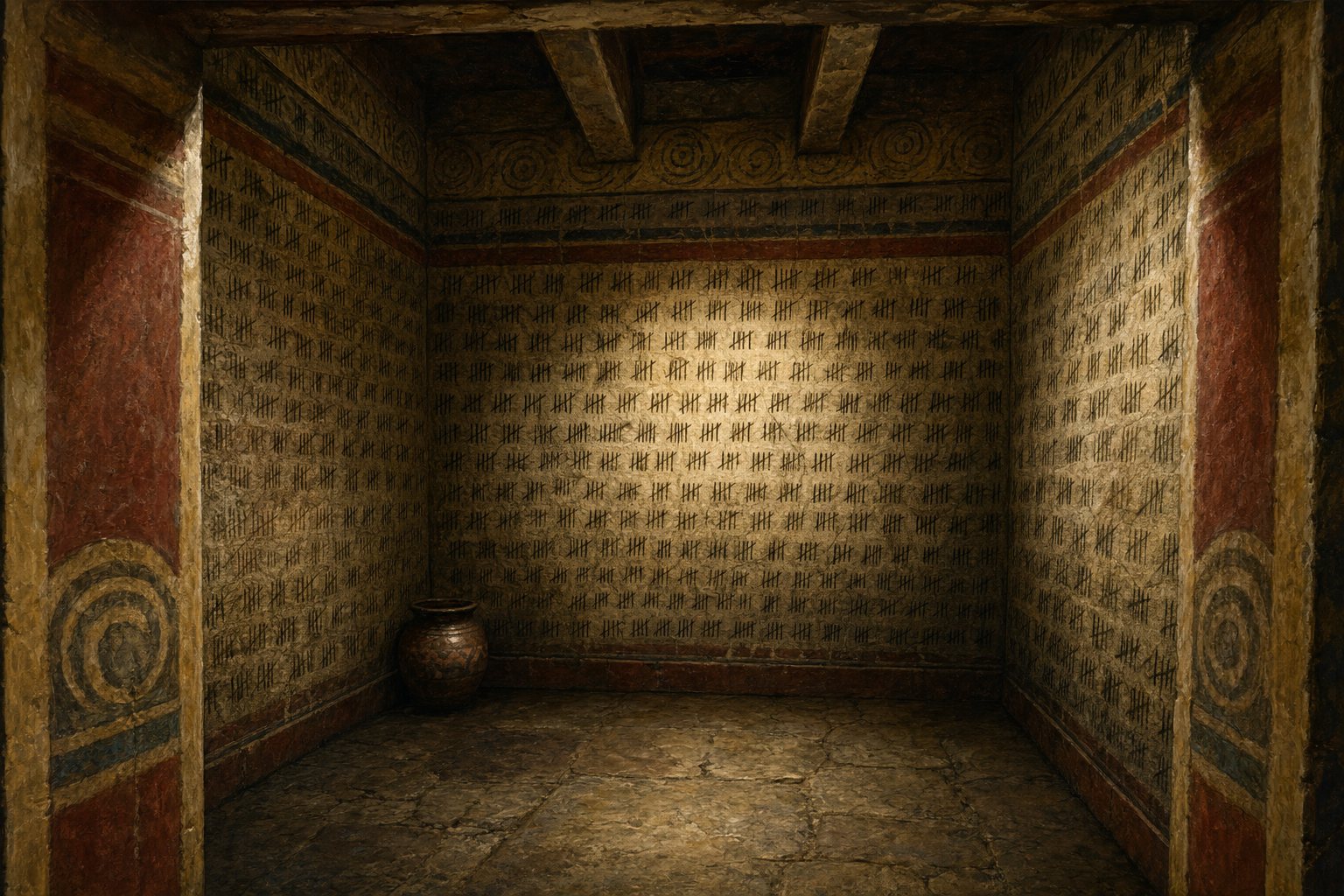
A small square room, and every inch of every wall is scratched with tally marks. Not decoration — accounting. Groups of five, in bands, in courses, tens of thousands of them, made by many different hands over a very long time and all of them counting the same thing, whatever it is.
In the middle of the floor stands a waist-high stone board with a hundred shallow sockets in it and a bowl of white pebbles beside it. In the north wall, behind the board, is a bronze door with no handle and a toothed wheel set into it, and around the wheel are numbers: one to a hundred.
DM summary. A surveyor's depth-lock that opens for a party willing to say honestly how far into the maze they have come. It is the only room in the deck that asks the players a question about their own session.
Terrain & Features
Battle map: custom map. A 20 × 20 ft counting closet — sketch it; the walls' tally marks are handouts, not terrain. Browse the book if a page half fits your table better.
- Dimensions. 20 ft × 20 ft, ceiling 8 ft — the smallest room in this stretch of the deck, and
crampedon purpose. Six people and a counting board is a crowd. - Light. None. Bring your own, and hold it close: the tally marks are shallow and a torch held at arm's length shows nothing but grey wall.
- The tally walls. Four walls, floor to ceiling, marked in bands. The topmost band is the oldest and the lowest band is the freshest, and the freshest marks are not old at all.
- The counting board. Limestone, waist high, with a hundred sockets in ten rows of ten and a bowl of forty-odd white pebbles. It is an abacus for people who count rooms rather than money.
- The wheel. Bronze, toothed, numbered 1 to 100, set into the door at chest height. It turns stiffly and it clicks.
- The plumb shaft. A 4-inch hole in the floor's south-west corner with a bronze eyelet above it. A plumb-line dropped down it runs out two hundred and ten feet and finds no bottom — which tells a party something about where they are that no other room in the deck will tell them.
- The inscription. Cut above the door, in careful Knossian, and the party can read it for free: "Set the number of chambers you have entered, this one among them, and the way opens. Set a number you have not earned and you will be counted with those who did the same."
Traps / Puzzles / Checks
The lock wants a number, and the number is real. It is the count of rooms the party has entered this session, including this one — the DM's scratch list of rolled results, plus the Beginning if the party wants to argue for it, plus this room.
- Setting it: place that many pebbles in the board's sockets, or turn the wheel to that number. Either works; the board and the wheel are linked.
- If your table has not been counting: they have. Somebody at that table has a list of rooms, and if nobody does, the DM does — the session procedure requires a scratch list of rolled numbers so duplicates can be rerolled. Tell the players to count their own adventure. It takes thirty seconds and it is the best moment in the room.
- Does the Beginning count? The inscription says chambers entered. The lock accepts either the strict room count or the room count plus one for the Beginning — both are correct, because the surveyors argued about this too. Do not make your table guess a technicality; say yes to a reasoned answer.
- A wrong number: the wheel clicks, resists, and locks for ten minutes. Then — and describe this slowly — a new tally mark appears in the freshest band on the east wall. No damage, no alarm, no monster. The room simply notes it.
- A second wrong number: as above, and the party may notice (Perception DC 12) that the count of marks in the lowest band on the east wall is now exactly two higher than it was when they came in.
- The fallback (every puzzle has one): Thieves' Tools DC 16 on the wheel's ratchet, ten minutes, opens it without the count. Or Athletics DC 17 with a bar to lever the door, which works, takes fifteen minutes, and cracks the counting board — the door opens and the room's reward is lost. State that cost before the roll.
- Solved state: the wheel turns freely, the bronze door swings inward on a narrow stair, and the board's sockets stay filled. The room has been told the truth and it has no further business with the party.
The reward for a correct count. In the niche behind the door, on a shelf: a surveyor's tally-board — a hinged wooden diptych, ruled in columns, filled in by somebody methodical for thirty-one chambers and then stopped. Hand the party the following, out of character, honestly, in these words:
- How deep they are. Two hundred and ten feet of plumb-line and no bottom, and the tally-board's own depths in cubits for every chamber its owner recorded.
- How far they have come, and how far is left. The DM states plainly how many rooms remain before the finale is declared at the session's planned length. This is meta-information, deliberately, and it is the single most useful thing a party can be given at the two-thirds mark of a run — it lets the players decide whether to push, rest, or start looking for their way out.
That is the whole reward. There is no treasure in here.
Exits
None. A counting room has nothing in it worth carrying but the tally-board, and the tally-board is knowledge rather than treasure: it consumes no d100 slot and it is worth more than most rolls.
The forty white pebbles are worth nothing. Players will take them anyway. Let them; a handful of counting stones is a fine thing to have in a maze, and at least one party in the world will use them to solve a room you have not written yet.
Scaling — APL 6 / 12 / 15
| APL | Adjustment |
|---|---|
| 6 | Fallback DCs −2 (Thieves' Tools 14, Athletics 15), and the inscription is bluntly worded: "how many rooms have you entered?" The count itself does not scale — it is whatever the party's run has been |
| 9 | As written |
| 12 | Fallback DCs +1. The wheel wants the count and the depth in cubits, which the plumb shaft and the tally-board give between them — two numbers, and the second one requires actually dropping the line |
| 15 | Fallback DCs +3, and the room lies once: the freshest band on the east wall has been pre-marked with two extra tallies, so a party that tries to count the wall instead of counting their own session gets it wrong. The honest answer is still the honest answer |
- Pacing: eight to twelve minutes. When you are behind schedule, this is the cheapest room in the batch to run: read the inscription, ask the table how many rooms they have been in, open the door. Four minutes, and the reward still lands.
- Ask the players, not the characters. The joke and the pleasure of this room is that the puzzle is answered from the session's own history — an hour of play turned into a key. Let them argue about whether the corridor with the pit counted.
- Accept a reasoned answer. Strict count, count plus the Beginning, count plus a room they passed through twice: if a player can justify a number in one sentence, the wheel turns. This room is not a trick lock and it must never be the reason a party is stuck in a 20-ft box.
- The tally marks are the horror and you should underplay them. Do not explain who made the freshest band. Do not have anything come out of the wall. The image of a room that has been quietly counting people for centuries is worth more than any monster, and it costs one sentence.
- Use the meta-reward honestly. When the party earns it, actually tell them how many rooms are left in your planned session. It changes how the table plays the last third of the run — usually for the better, because parties that know the clock start making decisions instead of wandering.
- Clue drip. Two hooks, and this is one of the strongest clue rooms in the deck: the surveyor's tally-board itself, which is thirty-one chambers of somebody's own mapping and stops mid-line (X14, and it is the closest thing to that Resolution's Proof tier outside its own page), and the plumb shaft, whose two hundred and ten feet of line ends in moving air rather than stone (X11, X12).
- Callback. If your table came in as the surveyor's crew (B11), this room is their predecessor's office and the handwriting on the tally-board should be one they have seen before. Say so. It costs nothing and it will land.