Atelier of Living Bronze

A working atelier, and it has been left tidy: benches down both long walls, tools in racks by size, a half-assembled bronze hound on a trestle with its ribs open and its jaw laid out in labelled pieces. There is a smell of oil and hot metal from a forge banked at the far end.
Between you and everything else in the room stands a bronze man twelve feet tall, and it has been standing there long enough to be part of the architecture. It lowers its head to your level with a sound like a gate settling and says, in excellent Knossian, and quite pleasantly:
"The atelier is closed. I will hear your business, and then I will decide. Do not touch the benches while I am listening."
DM summary. A bronze bailiff that recites its master's rules and enforces them literally. The argument is the encounter. The fight is what happens when the argument is lost, and the argument is genuinely winnable.
Terrain & Features
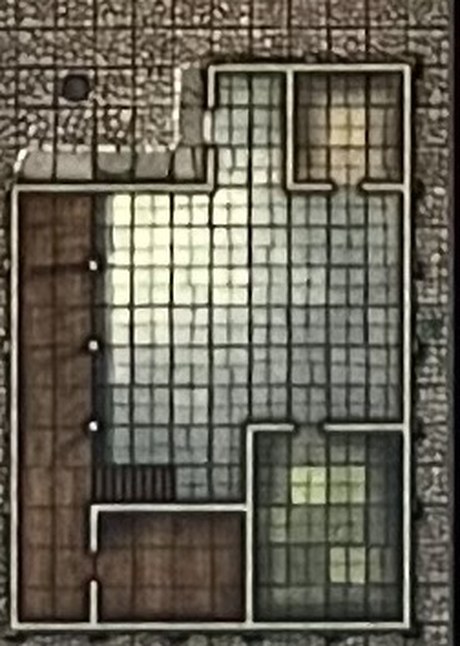
Battle map: The Guildhall Floor — page 35, 55 × 75 ft (one half of The Hall and the Sanctum)
The guildhall floor is the atelier: the printed benches are the eight work-benches (mark which four hold live work), the stair corner is the ledger stand, and the hall gives the Warden its 20-ft headroom. Wall to 60 × 40 ft.
- Dimensions. 60 ft × 40 ft, ceiling 20 ft — high enough for the Warden to stand, and it never sits.
- Light. Good: four sealed lamps and the banked forge. Everything in this room can be seen clearly, which matters, because most of what the party needs is written down somewhere in it.
- The benches. Eight, four to a side, each with work on it in some state of finish. Touching one during the parley is a refusal (see below), and the Warden says so before the party has a chance to do it.
- The trestle hound. A bronze hound, half built, ribs open, jaw in fourteen labelled pieces on a cloth. It is the room's lever: it is unfinished, and the first of the master's rules is about unfinished things.
- The ledger. A hinged wooden tablet on a stand by the door, ruled in columns: date, item, out, in, signature. The last entry is nine years old and in a different hand from all the others. Nothing has left this room unrecorded since it was built.
- The shift roster. Chalked on the wall behind the forge: eleven names, days of the week, and duties. Nine of the names have been rubbed out with a thumb.
- The forge. Banked, live, and the only heat source. A bellows, a quench trough full of black water, and a rack of tongs.
- The Sentinel. A Clockwork Sentinel stands in the north-east corner on its charge plate, dormant. It comes on only if the Warden calls it, and the Warden calls it only when the argument is over.
Bypass Options
This is the room. The Warden states three rules in its first minute, in this order, and it means all three:
- "Nothing leaves the atelier unfinished."
- "No hand but the master's touches the master's work."
- "The atelier is closed to strangers until the master returns."
Its position, if a player asks it why — and they should ask, and it will answer: in nine years, eleven parties have come through this maze and every one of them tried to strip this room. It has put out four fires. It has recovered two hundred and six tools. It is the only thing standing between a lifetime of work and a heap of scrap metal, and it is aware, in whatever way bronze is aware, that the master is very late. It will not be the reason his work is scattered. It would rather be wrong and still standing here than right and empty.
What it wants, in order: the inventory to balance; somebody to sign for anything that moves; the work finished.
Run it as three exchanges. Each exchange, the party makes one argument. Track concessions and refusals; three concessions and the party has the run of the room and its passage, two refusals and the Warden rules against them and calls the Sentinel.
| The party argues | The Warden's answer | Result |
|---|---|---|
| "We are not the master's work, so rule 2 does not cover us, and rule 1 covers objects, not people." | It considers this for a full four seconds. "You are not work. You are traffic." | Concession, no check. This is the clean loophole and it is meant to be found |
| "Then let us finish the hound. Rule 1 says nothing unfinished may leave — so nothing unfinished may stay unfinished either." | "That is not what it says." Then, slower: "That is what it meant." | Concession on Persuasion DC 14, or free if the party actually does the work — see Traps / Puzzles / Checks |
| "Your own hands are the master's make. When you take up his tools, his hand is on his work." | A long pause. It looks at its own hand. "…I had not been permitted to conclude that." | Concession on Persuasion or Arcana DC 15. This is the argument that changes it, and you should let the table feel that |
| "The master is dead. There is no master. You are guarding rubbish." | "That is not established." It does not raise its voice. It never raises its voice | Refusal. True or not, this is the one line of attack that cannot succeed. Say the refusal flatly and let the player try something else |
| "Get out of the way or we will put you down." | "You may attempt it. I would prefer the ledger." | Refusal |
| Touching a bench, pocketing a tool, or lying about either (Insight +6, and it is watching) | "Put that back, please." Once | Refusal on the second occurrence |
- Three concessions: the Warden steps aside, opens exit C itself, countersigns the ledger, and gives the party the countersign token (see Loot). It will also answer three factual questions about the workshops and their machines, truthfully and pedantically.
- Two refusals: it rules against them. One warning — "You will leave by the door you entered" — and then initiative at the top of the next round.
- A clever fourth argument: accept anything that engages the text of the three rules rather than the Warden's feelings. It cannot be flattered, frightened, or charmed, and it can absolutely be out-read. If a player finds a loophole you had not thought of, give it to them; that is what a room built on rules-lawyering is for.
The Warden's deepest need is an inventory that balances. It will accept a surety against passage, and it will accept it from strangers, because the ledger has a column for exactly that.
- What it takes: a genuine tool, a weapon of real quality, fifty drachmas' worth of anything, or a named promise written into the column. No check if the item is genuinely valuable; Insight is its own and it knows the price of everything in this room.
- Success: the party may cross, and may borrow — take one thing from a bench, provided it is written down and the bond covers it. The Warden hands it over itself, which satisfies rule 2 on a technicality that visibly pleases it.
- Cost: stated in items. The bond stays here. A party may come back for it and, if they do, the Warden will have kept it clean and oiled.
- Failure (offering something worthless, or lying about the value): one refusal, and a correction. "Nine drachmas. Please do not do that again."
The roster on the wall has eleven names, nine rubbed out. The Warden has not seen a colleague in nine years and it would very much like to.
- Doing it: Investigation DC 14 to read the roster and pick a plausible name and duty, then Deception or Performance DC 15 to present as workshop staff. Wearing an apron off the hook, carrying the right tool, and going straight to a bench gives advantage on the check. Announcing your own name gives disadvantage: it knows the eleven names and yours is not one of them.
- Success: it accepts the party as relief labour, asks after two of the rubbed-out names by name, and tells them where the work stands. Complete passage, and it will not reconsider later.
- One failure: "That name is discharged." No violence — one refusal, and the parley or the bond is still open.
- Two failures: initiative.
- Withdrawing instead: the party may withdraw through their own entrance at any point, including mid-fight and including after two refusals, and the Warden will let them go — it prefers ejection to breakage. The cost is a wandering-threat roll, this room's token, and the only friendly conversation with an automaton in the deck.
Encounter
Contingent, and the failure branch of a conversation. Two bodies and one of them is CR 12.
| Count | Creature | XP each |
|---|---|---|
| 1 | Bronze Warden, Atelier-Pattern | 8,400 |
| 1 | Clockwork Sentinel | 1,800 |
Base 10,200 XP; ×1.5 for two bodies = 15,300 adjusted, against the APL 9 Deadly budget of 14,400 — 900 over, in a room full of benches that break line of sight and a forge that will set fire to whoever gets shoved into it.
Why it is not already attacking. Because it is not a guard. It is a bailiff, and its instructions require it to state the rule, hear the answer, and rule on it before it may act. That is not mercy and it is not stupidity: it is the last functioning procedure of a workshop whose master walked out mid-project nine years ago and did not come back. Procedure is the only thing this thing has left.
If the party fights anyway. Say it plainly before initiative: twelve feet of bronze, in a room it was built for, and a second one waking up behind you. Round 1 the Warden closes the door it is standing beside — the party's own entrance — with one hand, and calls the Sentinel with the other. Round 2 it starts working through the party in the order they touched things. This encounter can kill the party. It is CR 12 with support at APL 9 and it does not tire. That is the honest cost of poking it, and it will offer the argument again at any point, mid-fight, if anybody says the word ledger.
Tactics. The Warden fights to eject and detain, not to kill: it grapples, carries, and puts people out of the door it came in by, and it will stop entirely the moment nobody in the room is touching the master's work. It will not damage a bench, throw anything valuable, or fight in a way that risks the trestle hound — and a party that works this out can use the benches as genuine cover it will not smash. The Sentinel holds the exit and follows its patrol pattern even in combat, which makes it predictable and beatable. Neither will pursue past the atelier's threshold: outside is not their inventory.
Traps / Puzzles / Checks
Finishing the hound is the optional piece of work that turns rule 1 from an obstacle into a handshake. The jaw is in fourteen labelled pieces on a cloth and the labels are in the master's shorthand.
| Element | Value |
|---|---|
| Understanding the labels | Investigation DC 13, or Arcana DC 12, or free for anyone with a smith's or tinker's tools proficiency |
| Doing the work | Twenty minutes and one check: Tinker's/Smith's Tools DC 14, Sleight of Hand DC 15, or Arcana DC 15 |
| On a failure | The jaw is wrong, and it takes another twenty minutes to undo. No damage, no refusal — the Warden watches and says nothing, which is worse |
| On a success | The hound's jaw closes. It does not come alive. The Warden looks at it for a long moment and then makes a mark in the ledger, and that mark is one concession |
| Solved state | One bench in this atelier is finished for the first time in nine years, and the room's whole posture toward the party changes |
There are no traps in this room. The forge is hot, the quench water is filthy, and the tools are sharp. That is all. A workshop this well kept does not need a trap; it has the Warden.
Exits
Room-specific: the Atelier Countersign.
A bronze wrist-token the size of a coin on a leather thong, stamped with the workshop mark and a shift number. The Warden gives one to anybody it has accepted as staff, bonded, or out-argued — it is what it has instead of a handshake.
- What it does: show it, and any Daedalan Automata (W03) creature treats the bearer as authorised staff for one minute. It will not attack, will step aside, and will answer a direct question about its own function. Once per session.
- What it does not do: open doors, operate mechanisms, stop a machine already in motion, or work on anything that is not an automaton. It is not a Resolution requirement and it does not substitute for one — no way out of this maze is unlocked by a shift token, and the bronze bird in the deep workshops will still need building by hand.
- It is off the loot table and consumes no d100 slot. A party that fights instead of talking does not get one, because the Warden will not sign for the dead.
Scaling — APL 6 / 12 / 15
| APL | Adjustment |
|---|---|
| 6 | The Warden is a Clockwork Sentinel in the Warden's role, at −25% hit points, with the same three rules and the same arguments. No second automaton. Parley DCs −2 |
| 9 | As written |
| 12 | The Warden gains +25% hit points and one legendary action — Recite the Rule, forcing one creature to make a Wisdom save DC 16 or lose its reaction. Two Sentinels, and it takes three refusals to lose the argument, because it has more patience than usual for a party this competent. DCs +1 |
| 15 | As APL 12 with +50% hit points, plus the hive-case above the forge: as a lair action on initiative count 20 the Warden opens it, and every creature that is not an automaton within 20 ft of the forge makes a Dexterity save DC 17 or takes 2d8 piercing and 2d8 poison damage from bronze bees and is blinded until the end of its next turn. Second phase: at half health it stops trying to eject the party and starts trying to finish the hound mid-fight, which is both harder and unbearably sad. DCs +3 |
- Pacing: twenty-five minutes talked, forty-five fought. When you are behind schedule, state the three rules, let the party make one argument instead of three, and take any of the table's accepted lines as a full win. Ten minutes.
- This is a Deadly room where the intended play is a conversation, so give the conversation the same care you would give a combat round. Do not resolve it with a single Persuasion check. Ask the players what they actually say. Let the Warden answer in complete sentences. It speaks excellent Knossian, it is unfailingly polite, and it is the most reasonable thing in this dungeon.
- Read its lines slowly and never let it shout. The register is a court official, not a monster: "Put that back, please." Nothing about this thing should be menacing until the moment it closes the door.
- The master is a singular icon and cannot be resolved here. Daedalus does not appear, is not dead on the page, and the Warden's rules must not be settled by the party proving anything about him. If a player tries, the answer is "That is not established," forever.
- What to do if the party rolls badly. Every bypass here has a no-check path: the first argument in the table needs no roll, and the bond needs only something valuable. A party with no talkers can still pay, still work the bench, and still leave with the token.
- Clue drip. Two hooks: the ledger's last entry, nine years old and in the wrong hand, recording two wing-frames out and none returned (X17, X20) — and the shift roster's nine rubbed-out names, one of which is still faintly legible and is a name the party may have seen on a votive or a tally elsewhere (X05, X14).
- Callback. Daedalan Automata (W03) reward observation over damage everywhere in this deck, and this room is the argument's version of that: the Warden's pattern is procedural rather than physical. A party that has beaten a Sentinel by watching its patrol should recognise that they are being asked to do the same thing to a rulebook.
Creature Cards
Both belong to Daedalan Automata (W03) and both recur, so the numbers live in the bestiary. The Atelier-Pattern Warden is this room's centrepiece, and R006 fields it again when scaled up. The tactics and the three rules above are this room's and stay here.
Shared across rooms, so the full cards live in the bestiary: Bronze Warden, Atelier-Pattern, Clockwork Sentinel. Every mention above opens the numbers here on this page.