The Marriage Feast
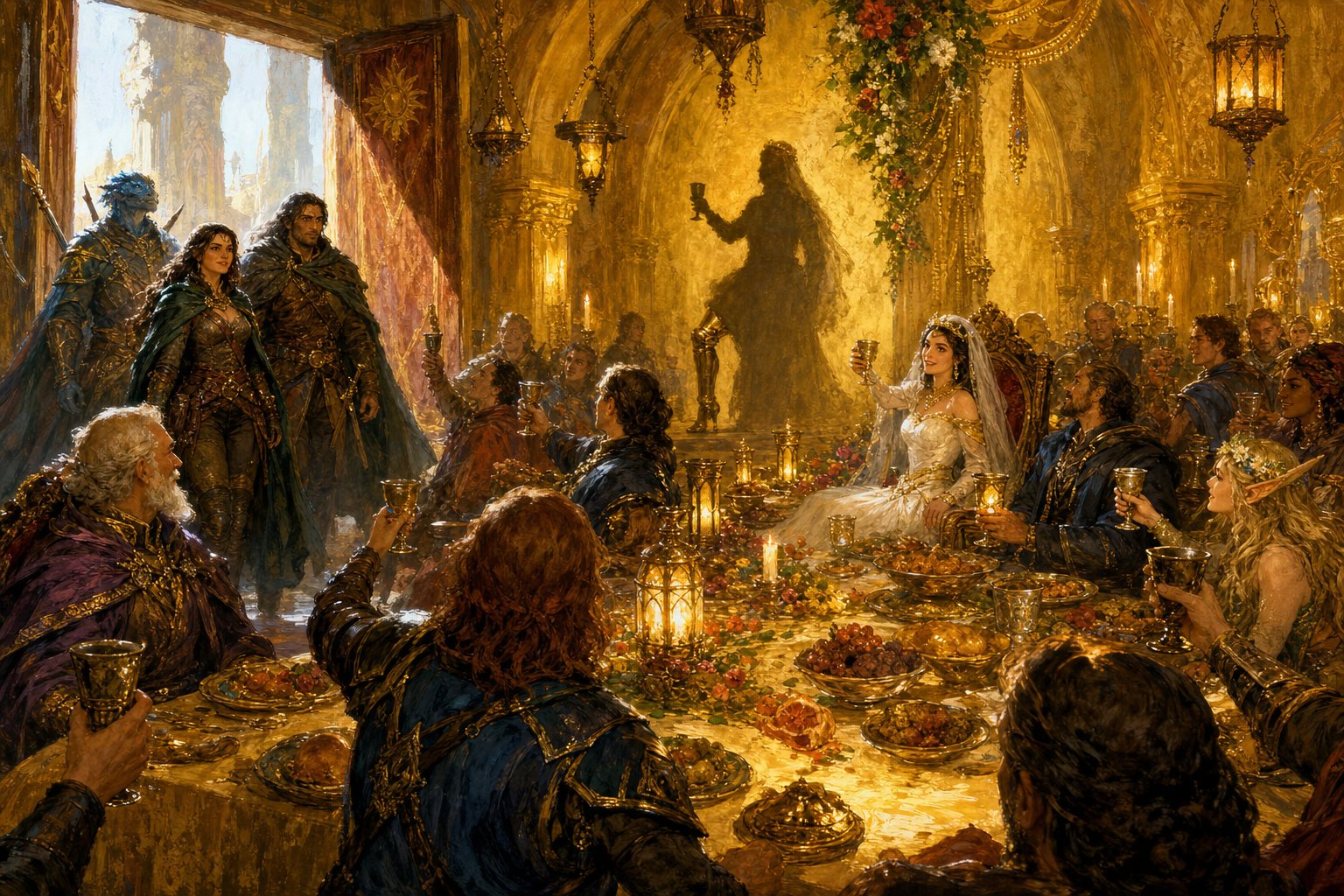
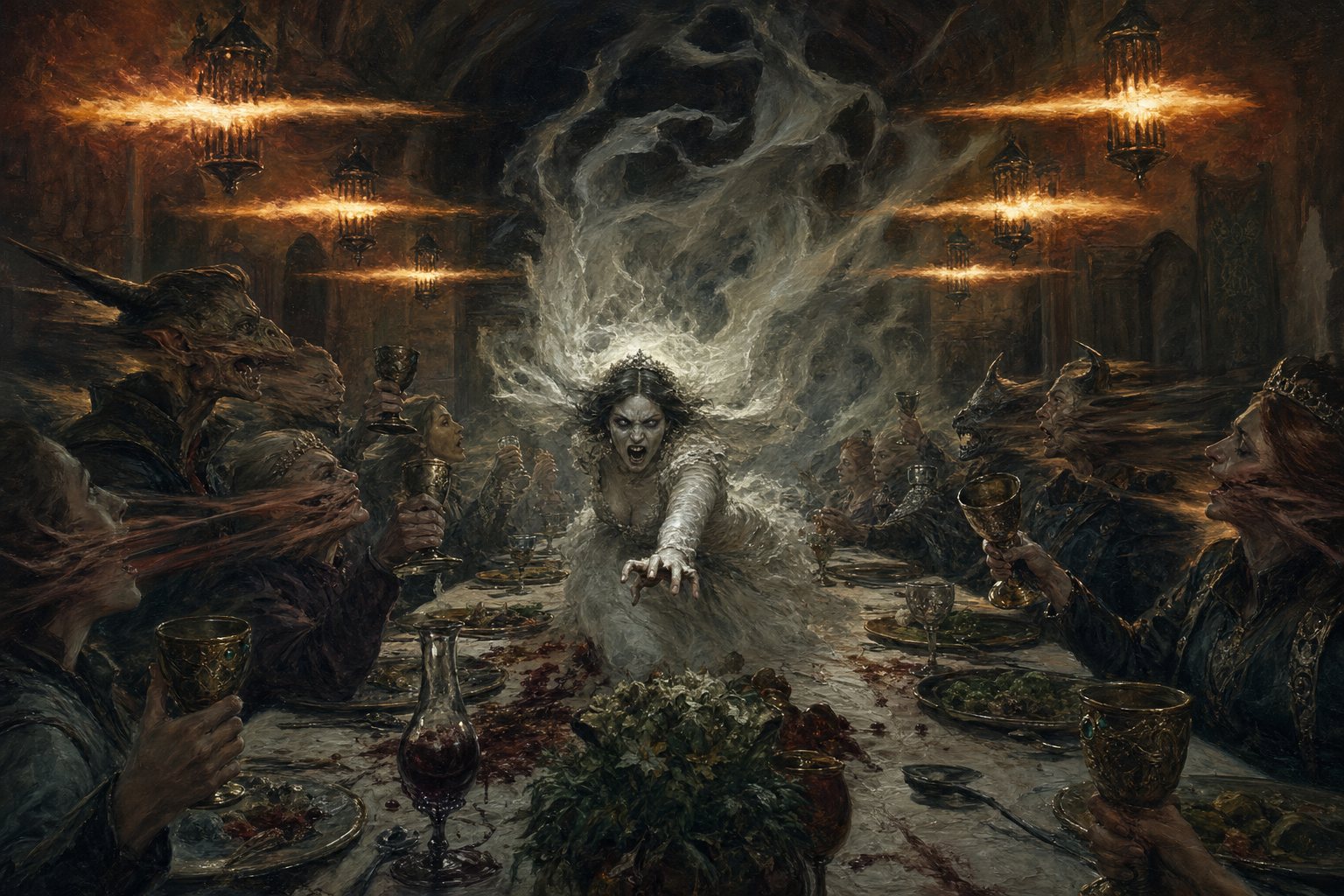
The doors are already open and the hall beyond them is warm. A table forty feet long, laid for eight. Lamps on chains, a floor swept and strewn with bay, a woman at the head of the table in saffron and gold who rises when she sees you with an expression of pure, uncomplicated relief.
"You came," she says. "I told them you would come."
Three attendants are already pulling out chairs. Seven of the eight places are yours. The eighth is at her right hand, garlanded, and the card set against the cup has a name written on it in a careful hand.
It is one of yours.
DM summary. An empusa's wedding, and the party are the guests. Hospitality binds her as tightly as it binds them: nobody in this hall can raise a hand until somebody is rude. Seven courses, one vow, and the whole fight is what happens if the party fumbles the manners.
The Boon
The Hearth-WordsOptional knowledge
Three lines of household verse that refuse one dish politely, and settle one course
What it is. Three lines of household verse, in the sing-song a child learns them in: how a Cretan refuses a dish in another family's hall without insulting the hand that cooked it. The Hearth-Words work only if said in order, aloud, to a host who is listening. "Your hall is generous and my hands are already full. Let the dish go to one who has less than I do. I will carry the name of this house out with me."
Where it comes from. Early, in the first three rooms: a tutor's wax tablet on a loot roll, listed between the rope and the lamp oil. Better, an NPC at a rest point feeds the party, expects the courtesy back, and corrects their grammar, so they have practised on somebody harmless. Late: the same lines are cut into the lintel of these doors, above the salt — Perception DC 12 for anyone who looks up. Write them on a card, hand the card to a player, and say nothing.
What it does here. One course, the party's choice. Courses 3, 4 and 5 are the three that ask for a refusal, and the Hearth-Words settle any one of them with no roll: no Religion DC 13 for the libation, no Religion DC 14 for the roast, no Insight DC 15 and Persuasion DC 14 for the bride's own dish. Kalliste matters more: nobody has given her the guest's half in nine feasts, and she answers with the host's half before she thinks, and for one course she is at a real wedding in a real house.
What it doesn't do. One course, once, and never all seven. Nothing at the toast, which wants a voice rather than a formula, and nothing at the vow, which wants an answer. Not a protection either: once the salt is scuffed or two courses are fumbled, Phase 3 runs. A party who never learned it plays all seven courses exactly as written.
Card and numbers or jump to the card ↓
Arena
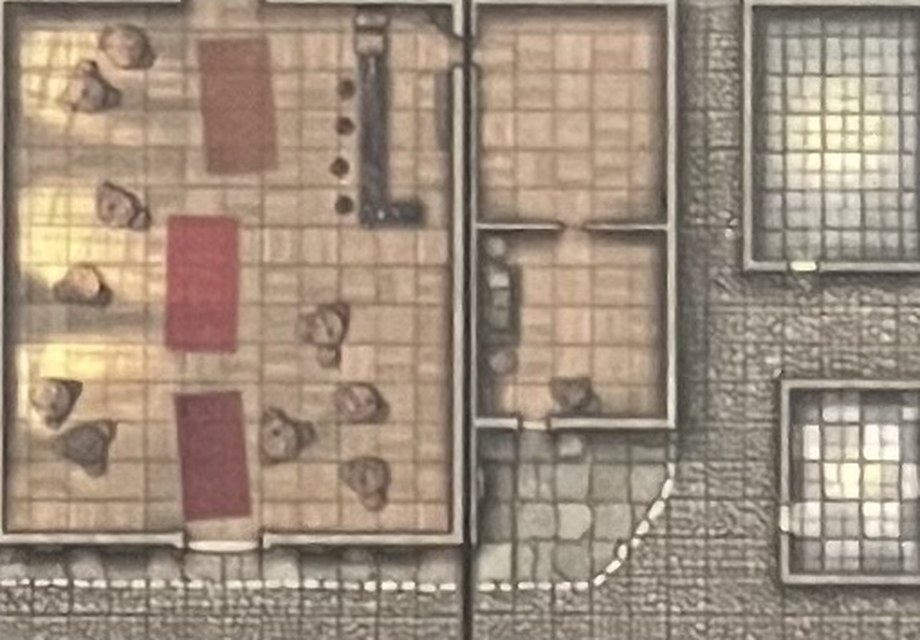
Battle map: The Roadhouse — pages 37 & 38, 110 × 75 ft
The roadhouse full is the wedding hall: line the printed tables into the 40 × 6 ft feast table down the middle, draw the bridal dais at the north end, the four myrtle braziers at the table's corners, and the salt line across the threshold. The back rooms are the kitchens the servers vanish into.
- Dimensions. 80 ft × 60 ft, ceiling 25 ft, one long table down the middle (40 ft × 6 ft, waist high, and it can be climbed on, upended, or fought across).
- Light. Warm and generous: sixteen lamps on two long chains running the length of the hall, plus four braziers. The lamp chains can be cut (one action, AC 12), which drops burning oil in a 5-ft-wide, 40-ft-long line — 16 (3d10) fire damage, DC 14 Dexterity for half — and plunges the hall into dim light.
- The salt line. A finger-thick line of salt poured across the threshold at the doors. It is the hospitality boundary and everyone in the room knows it. Crossing it outward ends your guest-right; crossing it inward accepts it. Scuffing it out is an action and is the single rudest thing available.
- The bridal dais. A step at the north end with the marriage contract on it: a wax tablet, two hands' span, with the terms cut in and one name-space left blank. Whoever holds the tablet dictates the terms — she will not tear it, because she has never broken a contract in her life and does not intend to start at her own wedding.
- The braziers. Four, at the corners of the table, burning myrtle. She keeps one hand near a brazier whenever she can. Watch her card and you will see why.
- The kitchen door. East wall, curtained, with a hot smell coming through it that is not lamb. Anyone who looks (Perception DC 14, or just opening it) finds the eight previous feasts' worth of table linen, laundered, folded, and labelled with names.
- Scorched hoofprints. In the bay leaves, going in and out of the kitchen. One of the two prints is a hoof and one is not, and they are burnt into the floor. Nobody in the room mentions them.
Roster & Budget
Four at the table, and none of them may lift a hand while the manners hold.
| Count | Creature | XP each |
|---|---|---|
| 1 | Kalliste, Bride of the Ninth Feast (boss) | 5,900 |
| 3 | Empusa Attendant | 1,800 |
Base 11,300 XP; ×2 for four bodies = 22,600 adjusted, against the APL 9 Deadly budget of 14,400 — 1.6× over.
The honest number for most tables is zero. While guest-right holds, the active encounter is a dinner party. The 22,600 is what the party buys with a broken course, and the whole design intent is that they can see the price on the table the entire time: three attendants standing behind their chairs, pouring.
Phases / Clock
The feast runs on courses, not rounds. Each course is three to five minutes of table talk and one decision.
| Phase | Trigger | What visibly changes |
|---|---|---|
| 1 — The Feast | On arrival | Seven courses. She is delighted, attentive, and asks real questions about the party's lives. The attendants serve. Nobody may attack anyone |
| 2 — The Vow | The seventh course, or any moment the party is rude | She produces the ring and the contract, and she asks. This is the pivot. What she asks for is not blood — it is a yes |
| 3 — The Ninth Feast | Guest-right broken, or the vow refused badly | The lamps swing. Her left leg is bronze and always was. The attendants stop pouring and step onto the table, and everything on it that was warm is suddenly on fire |
Round one, before anything else. Use the name card. Pick the PC with the strongest player and set the garland chair for them, by name, out loud, and have her be pleased to see them. Then let the table work out that she is not joking and never was.
Combat Resolution
Only after somebody is rude, and rudeness is a decision, not a die roll.
- Opening. She does not strike first even now. She says "You have broken the salt" — always, every time, in a voice that has gone flat — and takes one round to remove her earrings and set them down on the dais, during which she does nothing. That round is a gift and it is the last one.
- Tactics. She fights across the table, never around it, and she uses Charming Toast on whoever is closest to the doors, because a charmed guest is still a guest and she would rather not have to break the rules further. The attendants fight from the tabletop with fire-hot bites and try to grapple PCs into the braziers.
- The table is the terrain. Upending it (Athletics DC 15, two PCs) makes a 40-ft length of three-quarters cover and scatters the braziers: three 5-ft squares of open fire, 7 (2d6) on entry. Cutting a lamp chain does the damage above and takes the room to dim light, which suits her and disadvantages everyone without darkvision.
- The weakness. She cannot break the contract herself. If a PC holds the wax tablet, she will not use Charming Toast on that PC and cannot attack them with more than one attack per round, because assaulting the holder of the contract is a breach and she is not a hypocrite. A party that grabs the tablet first has effectively taken a hostage that cannot be harmed.
- What winning looks like. She is a lamia-court fiend and killing her is permitted. At a quarter hit points she does not surrender; she asks, once, whether they will reconsider, and means it. Five to seven rounds, 30 minutes.
- What losing looks like. Nobody at this table is eaten in front of the party. A PC at 0 hit points is carried to the kitchen. They can be recovered — alive, marked, and extremely quiet about it — in the Resolution, and that is worth far more to the campaign than a corpse.
Alternate Resolution
Refuse every course correctly. A skill path with seven beats, and getting it right is a performance rather than a die roll.
Guest-right is a contract with obligations on both sides. She cannot harm a guest who has not been rude. A guest is not obliged to eat — only to be courteous about not eating. Two clumsy refusals break the contract; seven correct ones win the finale outright.
| Course | What is served | The correct refusal |
|---|---|---|
| 1. Water for the hands | A bowl and a cloth | Accept it. Refusing the washing is the rudest opening available. No check; a party that refuses this takes its first strike immediately |
| 2. Bread and salt | Barley bread, coarse salt | Accept and eat. It is genuinely bread and genuinely salt, and eating it binds her as much as them. Insight DC 13 to be sure, if someone insists on being sure |
| 3. The mixed wine | Dark, well watered, and something under it | Take the cup, pour the first measure as a libation, and set it down. Religion DC 13, or any character who has made an offering earlier in the run does it free. Drinking it costs a DC 15 Constitution save or poisoned for the rest of the feast |
| 4. The roast | Not lamb | Decline on a vow. Religion DC 14 to name a plausible abstinence, or Nature or Medicine DC 15 to identify the meat and then say nothing about it, which she respects enormously |
| 5. The bride's own dish | Offered from her hand | Take it, and offer her the first bite back. Insight DC 15 to see the trap, then Persuasion DC 14 for the courtesy. She cannot eat it, and having to refuse in her own hall costs her a strike instead of the party |
| 6. The toast to the groom | The named PC is toasted by name | Answer it. That PC speaks — Performance DC 15, waived entirely for any player who actually makes a toast at the table. Silence here is a strike |
| 7. The ring and the vow | The contract, the ring, the question | Return the ring with a courtesy and a better gift. Persuasion DC 17, with advantage if the party has passed all six previous courses, or automatic success if they can offer something she wants more than a husband — the name of the man who left her at the eighth feast is the answer, and it is written inside the ring |
If a player says the Hearth-Words, they settle any one of courses 3, 4 or 5 with no check — the party chooses which, at the moment they say it, and only once. Take any honest attempt — a paraphrase, a fluffed line, a player reading straight off the card. Kalliste answers with the host's half, "Then take the salt, and think of us," and is visibly, disproportionately pleased to have been given the chance.
- Seven correct: she stands, sees the party to the door herself, and has the attendants pack food for the road. She is not angry. She has done this nine times and this is the first time anyone has been polite about it, and that is the beat the players will talk about afterwards.
- Two strikes: the salt is broken and Phase 3 begins. Say which two.
- Saying yes. A player may accept the vow. Do not stop them. The marriage is binding, the party leaves unharmed with an empusa bride in the group, and that is a campaign, not a mistake. If you want a mechanical hook: the married PC can never be attacked by W10 again, and can never refuse an invitation from one.
Scaling — APL 6 / 12 / 15
| APL | Adjustment |
|---|---|
| 6 | Kalliste at −25% HP (114) and no Charming Toast. Two attendants. Five courses instead of seven — cut the roast and the bride's dish. All DCs −2 |
| 9 | As written |
| 12 | Kalliste at +25% HP (190) and a third legendary action. Four attendants and an Empusa Bath-Mistress at the foot of the table who says nothing all feast and is the first to move. DCs +1 |
| 15 | Kalliste at +50% HP (228) with a second phase: at half HP she takes a brazier in her bare hand and the hall's fires answer her — a lair action on initiative 20 sets a 10-ft square alight, 11 (2d10) fire on entry. Five attendants, the Bath-Mistress, and the previous eight grooms come out of the kitchen as an audience who do not fight and do not leave. DCs +3 |
Exit to the Resolution
- Pacing. 35–45 minutes as a feast, 25 as a fight. Behind schedule: run courses 2, 5, and 7 only, and tell the players the shape — "there will be three courses and then she will ask you something."
- Play her sincere. She is not toying with them. She is nervous, she has cooked all day, and the eighth feast ended badly for her in a way she will describe if anyone asks a kind question. The horror is that all of that is true and she is a fiend who eats grooms.
- Do not describe the meat. Let a player identify it and then let the table sit with it. A DM who narrates it has taken the scene away from them.
- The named PC is a real decision, so name them before the session, and choose the player who enjoys being the centre of a scene. If your table has someone for whom a forced marriage plot is not fun, name nobody and set the garland chair for "the one who ate first" instead.
- Table safety. Coerced marriage, consumption of people, and a monster with a human face and a bronze leg. The softer framing: she is contracting for a household member rather than a spouse, the kitchen holds linen and not remains, and the leg stays under the skirt. Offer this before the doors open.
- Clue drip. This finale delivers the Door tier. Two objects: the folded linen with names on it, which is the strongest late clue in the deck for anybody hunting a person (X05 Carry Them Out, X10 Ariadne's Thread — one label says Ariadne, laundered and never collected), and the marriage contract itself, which is a legal instrument a court would honour (X06 The Oracle's Bargain, X08 The King's Writ).
- Callback. A party that took the bath at the empusae's bathhouse (R034) or traded a memory in the perfumery (R017) has already learned that this warband's hospitality is real and load-bearing. If they behaved well there, Kalliste has heard about it, and she will say so by name.
Boon Card
The Hearth-Words
Knowledge — three lines of Cretan household verse · no weight, no attunement, and it works only spoken aloud
Uses: one course, once per feast · Learned by: anyone who hears them twice, or reads them off a wall · Best given to a player on a card, to be read out at the table
The Words. In order, and the order is the whole of it: "Your hall is generous and my hands are already full. Let the dish go to one who has less than I do. I will carry the name of this house out with me." Praise the house, pass the dish on rather than push it away, and leave something behind that is worth more than the dish.
One Course, No Roll. Spoken to a host who is standing on hospitality, the formula refuses one offered dish with no ability check and no strike against the guest. At the Ninth Feast that is any one of courses 3, 4 or 5, chosen when the words are said.
Said Badly Is Still Said. Any honest attempt counts in full: a paraphrase, a fluffed line, a player reading it off a card. A DM never charges a player for their own diction. Said sarcastically it does not work at all, and the host will say which of the two it was.
The Host's Half. A host raised at the same kind of table answers "Then take the salt, and think of us." Kalliste has not heard the guest's half in nine feasts and will answer it before she thinks, which is the finest moment available in this hall.
What It Is Not. Not a charm, not a compulsion, not a protection. It buys nothing from a host who is not offering hospitality, nothing once guest-right has been broken, and nothing at a toast or a vow, both of which ask a guest for something the guest has to find themselves.
Saying It Costs Nothing. A guest with a dish in front of it simply speaks the three lines. There is no action to spend, because while the words still work nothing in this hall is being measured in rounds — and the moment it is, they have stopped working.
Creature Cards
Kalliste is unique to this hall. Her household is the Lamia Court (W10) and recurs across the deck, so those numbers live in the bestiary.
Shared across rooms, so the full cards live in the bestiary: Empusa Attendant. Every mention above opens the numbers here on this page.
Kalliste, Bride of the Ninth Feast
Medium fiend, neutral evil · CR 10 (5,900 XP)
AC 15 (saffron silk, unhurried) | HP 152 (16d8 + 80) | Speed 40 ft.
Saves Dex +8, Wis +7, Cha +10 · Details Deception +10, Insight +7, Performance +10, Persuasion +10 · Resistant to fire · Immune to charmed · Darkvision 120 ft.
Guest-Right Binds Us Both. She cannot attack, charm, or order harm against any creature that has crossed the salt as a guest and has not been rude. Two clumsy refusals, an attack, a theft, or scuffing the salt line ends this for the whole party at once. She states the breach aloud before she acts on it, every single time.
The Brazen Leg. One leg is bronze and always has been. She ignores difficult terrain from fire, heat, and burning oil, leaves scorched prints on wood and cloth, and can stand in an open brazier as though it were a footstool.
She Cannot Eat Bread. She cannot consume mortal food or drink, and refusing an offered dish in her own hall costs her guest-right standing exactly as it would a guest. A party that works this out can make her break her own contract first.
The Contract. While another creature holds the marriage tablet, she will not target it with Charming Toast and may make only one attack per round against it.
Legendary Bearing. She takes two legendary actions per round, spent at the end of another creature's turn, and regains them at the start of hers.
Multiattack. Two bites, or one bite and one use of Bridal Grasp.
Fire-Hot Bite. Melee, +8 to hit, reach 5 ft, one target. Hit: 13 (2d6 + 4) piercing damage plus 10 (3d6) fire damage. If the target is charmed by her, the fire damage is 17 (5d6) and she looks genuinely sorry about it.
Bridal Grasp. Melee, +8 to hit, reach 5 ft, one target. Hit: the target is grappled (escape DC 16) and moved 10 ft with her, and she may pull it into a brazier or a burning square as part of the same movement.
Charming Toast (recharge 5–6). She raises a cup and speaks a name. Each creature of her choice within 30 ft that can hear her makes a DC 18 Wisdom saving throw or is charmed for 1 minute. A charmed creature treats her as a beloved host, cannot attack her, and will step in front of blows aimed at her. It repeats the save at the end of each of its turns and whenever it takes damage from anyone other than her.
A Guest Does Not. When a creature within 30 ft attacks one of her attendants, she may impose disadvantage on that attack roll by naming the discourtesy aloud.
Another Course. An attendant within 30 ft moves up to its speed and makes one bite attack, or clears a section of table and creates one square of open fire.
Turn the Lamps. The hanging chains swing. Each creature under them makes a DC 15 Dexterity saving throw or takes 7 (2d6) fire damage from falling oil, and the light in a 20-ft radius drops to dim until the end of her next turn.
The Ring. Costs 2 actions. She offers the ring to one creature within 30 ft that can see and hear her. That creature makes a DC 18 Charisma saving throw. On a failure it must spend its next action either taking the ring or refusing it with a courtesy, and it can do nothing else on that turn.