Stalls of the Bronze Herd
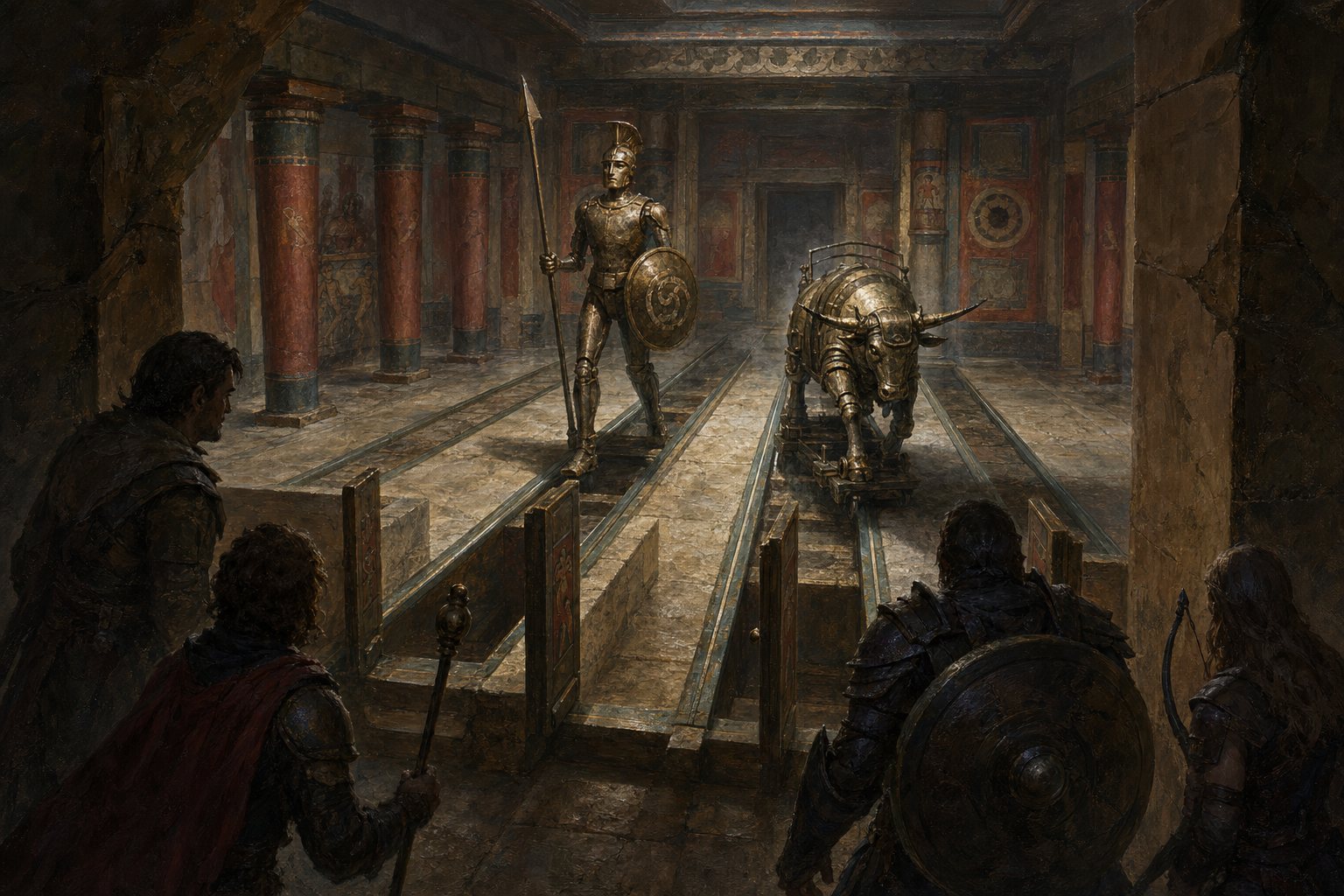
Four grooves run the length of this hall, cut into the floor and lined with bronze, and each groove has a stall at the near end with a gate on it. Three of the gates are open. In the third stall something stands with its head down and its flanks ticking as it cools, and it is a bull the size of a cart, and it is made of hammered bronze plate over a frame you can see through the gaps.
There is a turntable in the middle of the floor and a lever-frame at each end of the hall. Somebody has chalked numbers beside the levers, and somebody else has chalked over them.
DM summary. Three mechanical bulls that run on rails and cannot leave them. The fight is not the bulls, it is the switches: the party wins by putting them into each other, and the room is 30 seconds of confusion followed by a very satisfying two rounds.
Terrain & Features
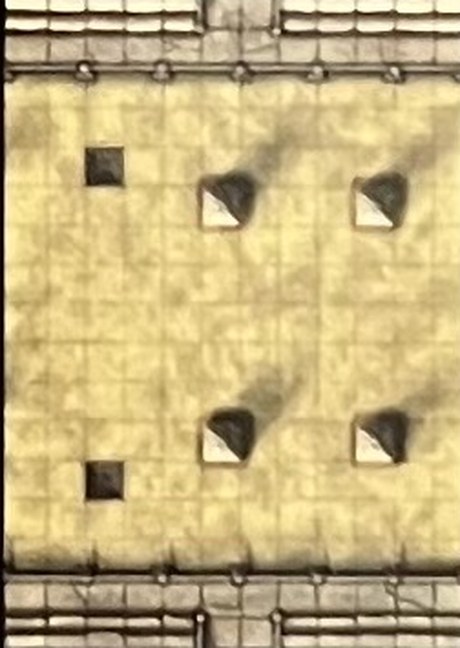
Battle map: The Straight — page 32, 55 × 75 ft (one half of The Hippodrome)
The hippodrome straight is the ox hall: run its lanes east–west as the four charge rails 10 ft apart, draw the 15-ft turntable flush at centre, and box the four stalls at the west end. Its grates read as the maintenance pits.
- Dimensions. 70 ft × 40 ft, ceiling 16 ft. Long axis east–west; the stalls are at the west end and the rails run east.
- Light. Four bronze reflector lamps still burning on brackets, one per lane. Bright throughout. This is a working shop floor and it is lit like one — nothing in this room is hiding.
- Four rails. Grooves 4 inches wide, bronze-lined, running the length of the hall, 10 ft apart. A Bronze Ox cannot leave its rail — it can run either direction along it at 40 ft, and that is the entire extent of its freedom.
- The gaps. The 5 ft either side of each rail is the ox's charge lane. The 5 ft between lanes is not. A character standing between the rails is untouchable, and the party will work this out on round 2 and feel clever, which is correct — this is the room where Daedalan Automata teach that observation beats damage.
- The turntable. A 15-ft bronze disc set flush in the floor at the hall's centre, where all four rails cross. It rotates a quarter-turn per pull on the centre lever and switches any ox standing on it onto a different rail.
- The lever-frames. Two, one at each end of the hall, four levers each — one per rail. Throwing a lever reverses that rail's ox at the end of its next movement. A lever is one action and the frames are on the rail ends, so a character working a lever is standing in a charge lane.
- The chalk. Numbers by each lever in a shop hand, and a second set chalked over them by somebody who did not agree. The overwritten numbers are correct; Investigation DC 12 to notice which set is fresher.
Encounter
Three bronze oxen, four rails, and a room where the terrain is the whole fight.
| Count | Creature | XP each |
|---|---|---|
| 3 | Bronze Ox | 1,100 |
Base 3,300 XP; ×2 for three bodies = 6,600 adjusted, which is exactly the APL 9 Medium budget. It plays lighter than that against a party who reads the rails, and harder against a party who stands in a lane and trades blows — which is the point of printing the number.
Round 1. The oxen do not start moving until something crosses a rail. When one does, all three start: they run the full length of their rail, turn at the end, and run back, indefinitely, and they gore whatever is in the lane on the way past. There is no cunning in it. The first pass should catch somebody, and the second pass should catch nobody.
Tactics. They are predictable on purpose. An ox always finishes its movement — it does not stop to fight, it runs through and comes back. It cannot be flanked because it does not care, and it cannot be baited off the rail because it physically cannot leave. The only ways to stop one are the levers, the turntable, and 60 ft of sustained damage on something with plate over a visible frame.
The collision rule, which is what the room is for. Two oxen put on the same rail facing each other collide at the end of their movement: both take 4d10 bludgeoning and are stunned for one round, and the second collision on the same pair cripples both — a wheel out of its groove, and the ox is a stationary hazard that can still gore anything within 5 ft. Setting this up takes the turntable and one lever, or two levers, and it should take the party two rounds to arrange and one round to enjoy.
Traps / Puzzles / Checks
Working the machinery.
| Element | Value |
|---|---|
| Throwing an end lever | One action. The character must be standing at the rail end — in the charge lane — and takes the next pass unless they step out immediately |
| Reading which lever is which | Investigation DC 12 on the chalk, or one round of watching. On a failure, the character throws the wrong rail's lever and reverses an ox they did not mean to |
| The turntable | The centre lever is between the lanes and is therefore safe to work. One action per quarter-turn. An ox on the disc when it turns is switched to whichever rail the disc now presents |
| Timing the disc | Perception DC 13 or one round of counting to know when an ox will be crossing the centre. On a failure, the disc turns with nothing on it |
| Stopping a rail outright | Jam the groove: a spear, a crowbar, or a broken lever, Athletics DC 14. The ox derails at the jam, takes 4d10, and is stationary and still dangerous within 5 ft |
| Solved state | All three oxen crippled, derailed, or stationary. The rails keep running whether or not the oxen do, and the grooves are still difficult terrain for the rest of the session |
Prying a horn. Every ox has two cast bronze horns, hollow, with three filed flats at the base. Athletics DC 15, and it is very loud — the sound carries and the DM should charge for it in the next room's reaction. This is the object X19 names, and it is not loot: see below.
Prying a pinion gear. The visible frame carries a pinion at the shoulder, the same pitch as the one X20 is missing. Athletics DC 15 on a crippled or destroyed ox, ten minutes, and equally loud.
Exits
One roll on the loot table, from the stall-keeper's tool chest in the crib behind the west lever-frame. No check once the room is safe; Sleight of Hand DC 13 to open it while an ox is still running past.
The horns are not loot and neither are the gears. A hollow bronze bull's horn with three filed flats is the key-object X19 is built around, and the shoulder pinion is what X20's flying machine is missing. Both are Resolution-owned: hand them over as the thing the Resolution needs, point the party at the Resolution, and do not consume a d100 slot for either. A party who pries a horn here has done something important and should be told so obliquely — the horn is heavier than it looks and the flats are cut, not cast.
Scaling — APL 6 / 12 / 15
| APL | Adjustment |
|---|---|
| 6 | Two Bronze Oxen on two rails, and the chalk is legible without a check. Collision damage 2d10, all DCs −2 |
| 9 | As written |
| 12 | Four Bronze Oxen and a Clockwork Sentinel at the east lever-frame that resets any lever the party throws, once per round, and does not otherwise attack. Collision 10d10, DCs +1 |
| 15 | Four Bronze Oxen, two Clockwork Sentinels on the lever-frames, and the turntable turns on its own every third round to a pattern the party can read (Investigation DC 18) or suffer. Collision 10d10, DCs +3 |
- Pacing. Twelve minutes, and the shape is: one round of getting hit, one round of realising the rails are lanes, two rounds of gleeful engineering. Do not stretch it — once the party has crashed two oxen, let the third derail on the wreck and move on.
- If you are behind schedule, two oxen, both already running when the party arrives, and the chalk read for free. Six minutes, and it is still a good room.
- Say "it cannot leave the groove" out loud the first time an ox passes somebody. This entire warband is built on rewarding observation, and observation the players never get told about is just a secret. One clear sentence, then let them use it.
- Make the levers cost something. A lever in a charge lane means the party's clever plan requires somebody to stand where a bronze bull is going to be. That trade is the room's only real tension and it evaporates if you let them work the levers from safety.
- If the party solves it in one round, give them the applause and the loot roll and do not add a fourth ox. A Medium room that ends early is a gift to the session clock, and this deck has plenty of rooms that will take their time back.
- Table safety. Nothing here. Bronze machinery and no blood; this is one of the rooms to reach for after something upsetting.
- Clue drip. Two objects: an ox's horn (X19, Proof or Path tier — this is one of two rooms in the deck that can supply the horn-key, and X19 says exactly what to do with it), and the shoulder pinion (X20, Proof — the bird's missing gear, at the same pitch, and this is the loudest of the three places to get one).
- Warband callback. Daedalan Automata (W03) have patterns, and the pattern is always visible before it is dangerous. A party who has met the Clockwork Sentinels should walk in here counting passes rather than swinging. Reward that: an ox is genuinely trivial to a party who has understood one, and this room is where they get to prove it.
Creature Cards
Both belong to Daedalan Automata (W03) and recur across the deck, so the numbers live in the bestiary. The rails, the collision rule, and the levers are this room's and stay here. The Sentinel appears only in the APL 12 and 15 rows, where it works the levers against the party, and is listed so a DM scaling up has the card to hand.
Shared across rooms, so the full cards live in the bestiary: Bronze Ox, Clockwork Sentinel. Every mention above opens the numbers here on this page.