Oracle of Dripping Stone
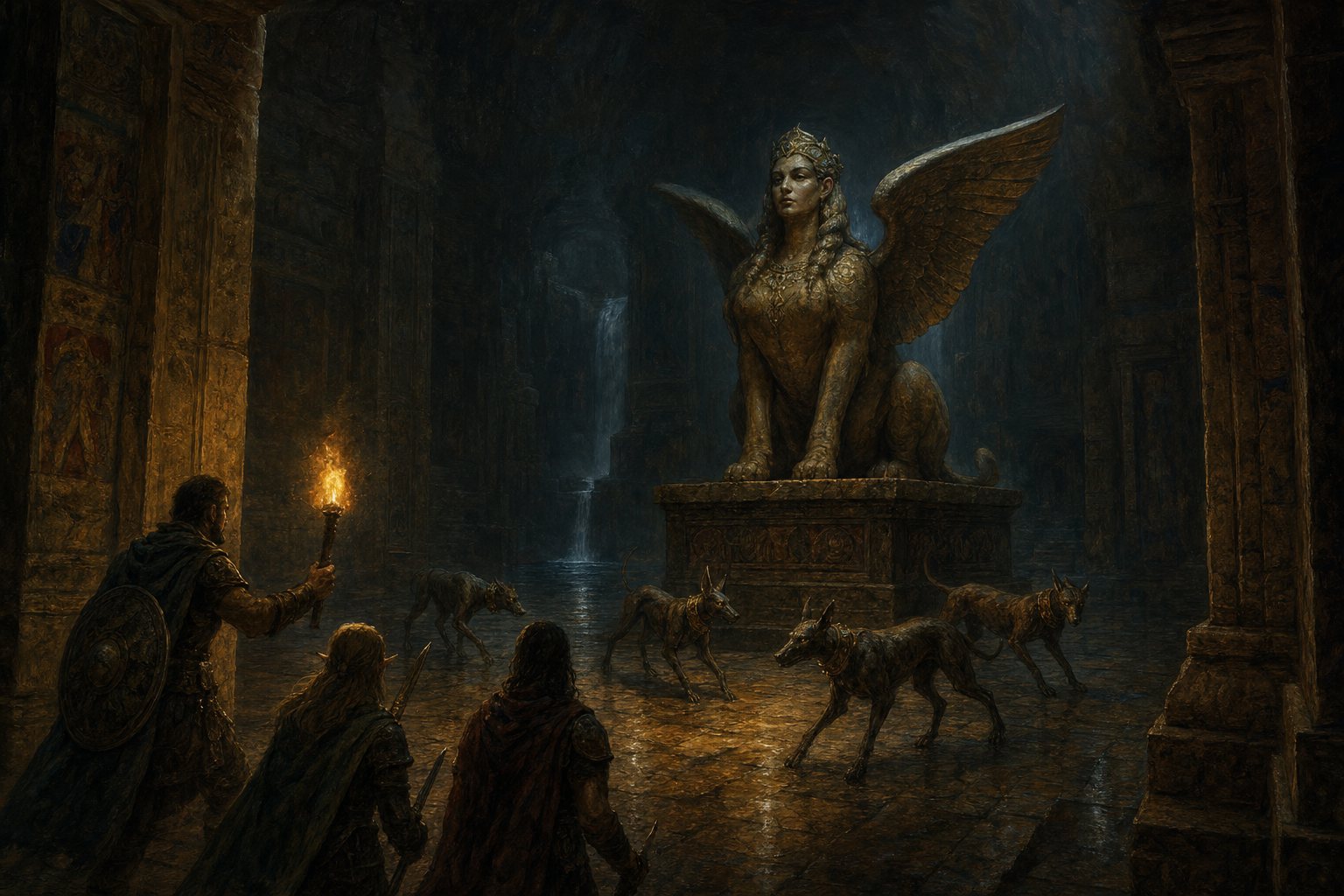
Your light will not hold in here. It reaches maybe fifteen feet and then gives up, and past that there is only sound: water falling into water, slowly, from a long way up.
When you step closer the drops resolve into a rhythm, and the rhythm resolves into something worse. Each drop lands with a syllable in it. The syllables are Greek, they are in order, and they are saying a name none of you has spoken aloud since you came down here.
DM summary. A stalactite that answers exactly one question, honestly, at the speed of dripping water — and a warband that lets anyone through who is still mid-conversation. The room's difficulty is deciding what to ask.
Terrain & Features
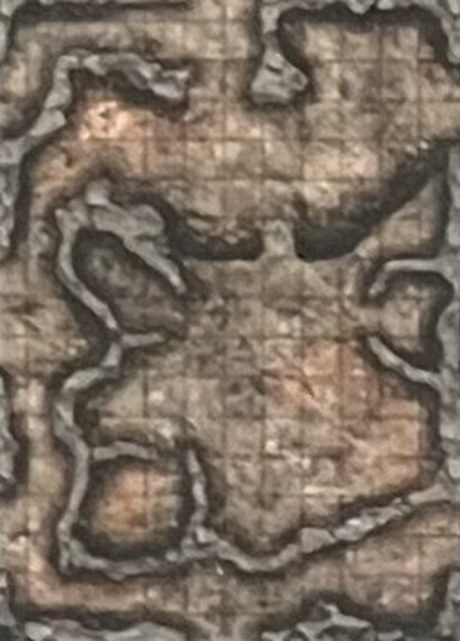
Battle map: The Wide Chambers — page 15, 55 × 75 ft (one half of The Broken Galleries)
The wide cave chambers are the oracle's cavern: shade the 25-ft black pool in the larger chamber, keep a 5-ft dry margin, and mark the party's entry shelf at the east. Star the spot beneath the hanging stalactite.
- Dimensions. 40 ft × 40 ft, ceiling 45 ft — a natural chamber, not a built one, cut through by the maze at its edges. The party enters on a shelf at the east.
- Light.
darkness-heavy, and this is mechanical, not mood: all light sources in this chamber are reduced by half (a torch lights 10 ft bright / 10 ft dim). The limestone dust in the air eats it. Darkvision works normally, which makes this the room where the party's darkvision-havers should be leading. - The pool. Black, 25 ft across, 3 ft deep, fed by the drip. Wading it is quiet and cold; anything that runs through it can be heard anywhere in the room.
- The oracle. One stalactite, four feet long, hanging 20 ft above the pool's centre — wet, ribbed, faintly warm to a hand held near it, and the thing that is speaking. It has no face and does not want one.
- The dry margin. A ring of dry stone 5 ft wide around the pool, littered with the leavings of previous petitioners: guttered lamps, a folding stool, and four chalked questions on the wall in four different hands.
- The hound shelves. Two ledges at 8 ft, north and south, worn smooth. The Riddle-Hounds lie on them and are extremely hard to see (passive Perception 16 in this light, or Perception DC 15 to pick them out).
Encounter
Contingent. This fight happens only if the party breaks the room's rule, and the room states its rule out loud before anything happens.
| Count | Creature | XP each |
|---|---|---|
| 3 | Riddle-Hound | 1,100 |
| 1 | Whispering Laurel | 1,800 |
Base 5,100 XP; ×2 for four bodies = 10,200 adjusted, against the APL 9 Hard budget of 9,600. It runs 600 hot, and the halved light is why it plays hotter still. If the party arrives already worn down, remove one hound — they were never counted aloud, so nobody at the table will know.
Why nothing is attacking. The Riddle-Hounds will not attack a creature that is answering a question. That is not a mood; it is the rule they are built around, and the Whispering Laurel enforces it by supplying questions. As long as somebody in the party is engaged in the exchange, the hounds stay on their shelves and watch with their heads on their paws.
What breaks it. Three things, and only these three: touching the stalactite without leave; asking the oracle a second question; and walking to an exit while the Laurel is mid-sentence. Announce all three, in the Laurel's own words, in the first minute of the room.
Round 1, if it breaks. The Laurel stops speaking — the silence is the initiative cue — and the hounds come off both shelves at once, into the pool, which does not slow them. The Laurel does not fight; its voice withdraws to the ceiling and keeps asking questions, and any character who answers one is ignored by the hounds until the end of their next turn. That is not a bug and you should not fix it: even the failure branch of this room rewards a party that keeps talking.
Tactics. The hounds flank and do not pursue past the chamber's mouth. The Laurel lies exactly once per encounter, and the lie is always about the pool. If the party withdraws to the entry shelf and stops moving, the hounds are back on their ledges within three rounds.
Bypass Options
The rule is exploitable and the room knows it. A party that keeps a conversation running can walk the dry margin from the east shelf to either far exit without a fight and without ever petitioning the oracle.
- The check: one character maintains the exchange — Persuasion, Performance, or Deception DC 13, one check per two rounds of crossing, three checks total. Any character may spell another mid-crossing; that is a free action and the hounds do not mind who is talking.
- Success: the party crosses. No fight, no question spent, no clue given.
- One failure: the talker dries up. The nearest hound stands, and the party has one round to say literally anything — any player at your table saying any sentence in character counts — before it steps down.
- Two failures: initiative, and the Laurel sounds almost apologetic about it.
- The cost: you get through this room having learned nothing, and the oracle is one of only a handful of places in the deck that will hand a party a Resolution clue. Say what they are giving up as they reach the exit.
The Laurel asks one riddle of anyone who wants the oracle. Answer it and the petition is granted; the hounds sleep through the whole exchange.
- The riddle, verbatim: "I am carried into the dark by everyone who enters and by no one who leaves. I weigh nothing. Cut me and you are lost, and cutting me is the only way anyone has ever got out. What am I?"
- Three accepted answers: thread; the way back / the route you came; hope. Any of the three opens the oracle, no check.
- A clever fourth: accept anything a player can argue for in one sentence — a name, a promise, your own footprints — and let them roll Persuasion DC 12 to make the Laurel concede. It concedes gracefully. It has heard better and it has heard far worse.
- Failure: two wrong answers and the Laurel withdraws the offer. The hounds do not attack — nothing has been broken — but the oracle stays silent and the party must cross on the bypass above or withdraw the way they came, which costs only time and a wandering-threat roll.
- The lie. Remember that the Laurel lies exactly once. Spend the lie here, on the pool: "the water is only water." The water is only water. It is a true statement delivered as its one lie, and a table that catches the paradox has earned the laugh.
Traps / Puzzles / Checks
The oracle's rule, as it states it. One question, from one voice. It answers honestly. It answers what was asked. It knows the maze as the maze is now — every room, every occupant, every door — and it knows nothing whatsoever about what will happen next.
The cadence. It answers at one word per round — a drop, a syllable, a pause. A twelve-word answer is twelve rounds of table time in which nothing else happens, and that is the room's real cost. Say the words one at a time. Make the players wait. It is the best thing in this room and it takes ninety seconds.
Three questions, and what it says. Use these as your calibration:
| The party asks | The stone answers |
|---|---|
| "How do we get out of the Labyrinth?" | "Up. Or through. As everyone does. Eventually." — honest, useless, and the lesson |
| "What is behind the north door?" | A flat inventory: "Nine feet of stair. Then a room with four sleepers in it. Then a choice." Answer for the room the party will actually roll, in terms of shape rather than statistics |
| "What does the thread lead to?" | The Sign- or Proof-tier clue for whichever Resolution you rolled, spoken plainly, in ten words or fewer |
The DM's obligation. If a player asks a sharp, narrow question, answer it straight and give up the information. A room built on an honest oracle that weasels is a room that teaches your table never to talk to anything again. Reward precision; it is the whole design.
What it will not do. Answer twice, answer about the future, or answer two people talking at once — if the table talks over itself the stone waits, and it will wait all session.
Exits
None. The leavings on the dry margin are four guttered lamps, a stool, and a century of other people's questions chalked on the wall. The room's gift is information, and it will not also pay you.
If a player insists on taking something, let them take the stool. It is a good stool.
Scaling — APL 6 / 12 / 15
| APL | Adjustment |
|---|---|
| 6 | Two hounds, no Laurel — the oracle sets its own riddle and accepts the same three answers. DCs −2. Light is reduced by a quarter rather than a half |
| 9 | As written |
| 12 | Four hounds; the Laurel lies twice and one lie is about an exit. DCs +1, and the answer comes at one word every other round |
| 15 | Four hounds and a Lesser Sphinx on the ceiling shelf, which does not fight unless the stalactite is touched — and then it is the encounter and the hounds are the retinue. DCs +3 |
- Pacing: eighteen minutes, most of it silence. The question is the room. When you are behind schedule, cut the riddle, have the Laurel grant the petition on entry, and run the room as: one question, one honest answer, three exits. Six minutes, and it will still be the room the table remembers.
- Prepare one honest answer before the session. Whatever Resolution you rolled, write its Sign-tier clue on an index card in ten words. This room is the deck's designated pressure valve for a table that has ignored three clues in a row.
- Let them argue about the wording. Five minutes of players drafting a question is five minutes of the best play a dungeon can produce. Do not hurry it and do not help them. Then take the phrasing literally and answer generously.
- Clue drip. Two physical hooks besides the answer itself: the four chalked questions on the wall — one of them in a woman's hand, asking how long the thread is (X10) — and the folding stool, which is Knossian palace furniture and has a steward's inventory mark burnt into its leg (X08).
- Table safety. The read-aloud has the stone speaking a name a character has not said aloud. Ask before you use a real detail from a player's backstory; if you would rather not, the name it speaks is Asterion, and everyone in the room can hear it.
- Callback. Sphinx & Riddlers (W15) always talk first and always tell you the rule before they enforce it. If your table has met them at the Riddle Bridge or in the Hollow Chorus, the recognisable thing is the fairness: this warband never ambushes, and a party that has learned that should be visibly more relaxed here than they were the first time.
Creature Cards
All three belong to Sphinx & Riddlers (W15) and recur across the deck, so the numbers live in the bestiary. The tactics above are this room's and stay here. The Lesser Sphinx appears only in the APL 15 row and is listed so a DM scaling up has the card to hand.
Shared across rooms, so the full cards live in the bestiary: Riddle-Hound, Whispering Laurel, Lesser Sphinx. Every mention above opens the numbers here on this page.