The Chimera Yard
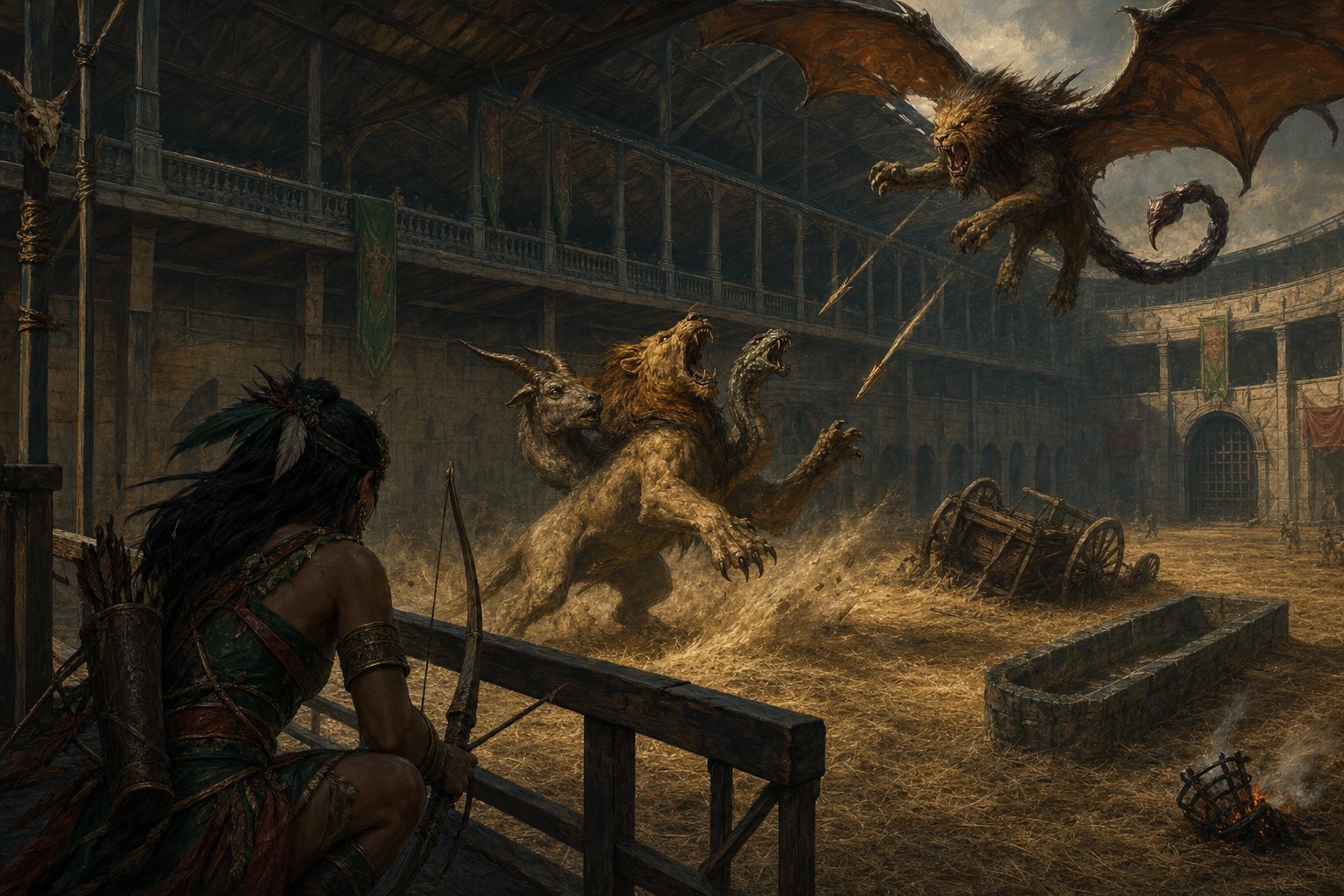
You hear it two corridors out: a sound like a barn falling over, again and again, with screaming in it.
The yard beyond is enormous — old stock pens, a stone trough down the middle, a wagon on its side with the axle snapped. In the middle of it a three-headed thing the size of a cart-horse is turning in place, snapping upward, its goat's head shrieking and its lion's head bleeding from the ear. Forty feet above it something with bronze quills is circling, and every few seconds it fires one down.
Neither of them has looked at the doorway you are standing in.
DM summary. A chimera and a manticore have been trying to kill each other for an hour and will keep at it for another. The room is eighty feet of open ground and a covered colonnade at fifteen feet, and the party's only real job is to not become the third party in a two-party war.
Terrain & Features
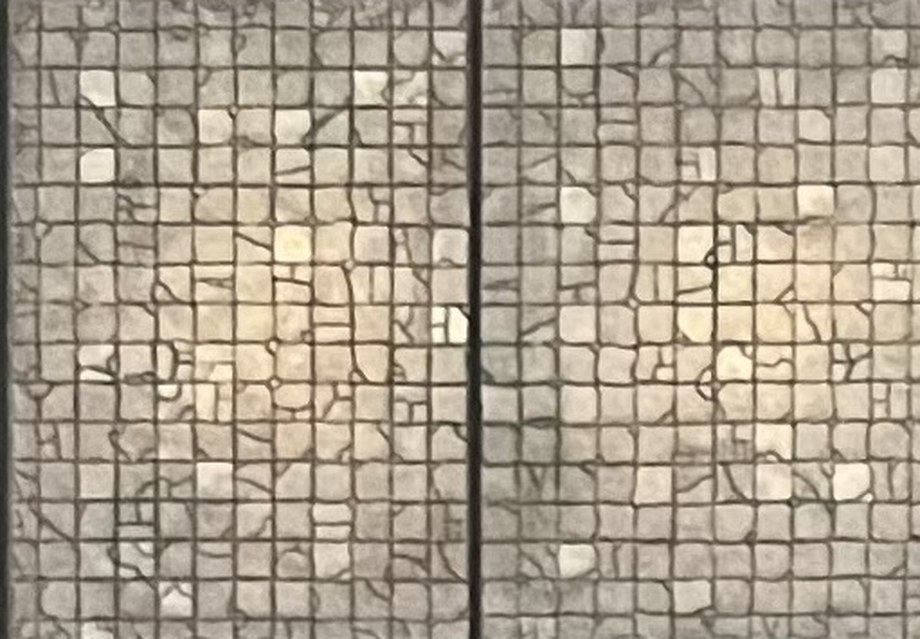
Battle map: The Grey Flags — pages 1 & 2, 110 × 75 ft
The blank full spread carries the 100 × 75 ft stockyard: draw the colonnade line along the north wall, the six hurdle pens along the south, the 20-ft trough down the centre, and the overturned wagon at the south-west.
- Dimensions. 100 ft × 75 ft, ceiling 50 ft. A stockyard, roofed, the largest open floor in the deck and the only room that goes near the cap — a manticore and a chimera both need somewhere to be, and fifty feet of air over an open yard is what makes them dangerous. The party arrives on a ramp at the east end, 3 ft above the yard floor.
- Light. Four hanging braziers on chains at 20 ft, three still lit. The manticore has knocked one down and it is smouldering in the straw, which is the room's other clock if you want one.
- The colonnade. Along the north wall, a covered walk at 15 ft: eight columns carrying an intact stone architrave 3 ft wide, with a low roof above it. This is the crossing. It runs the full 100 ft of the north wall, from the entry ramp to a loft door at the west end, and the roof over it means nothing flying can get at anyone on it. A hundred feet at 15 ft up is four rounds of walking a 3-ft ledge while two apex predators fight underneath, which is the price of the safe route.
- The trough and the wagon. Stone trough 20 ft long down the yard's centre; overturned wagon at the south-west. Both are total cover from the ground and neither is cover from the air.
- The pens. Six empty stalls along the south wall, hurdle-walled, each with a gate. Cover, and a very bad place to be cornered.
- The carcass. A mule, mostly eaten, in the middle of the yard, with its pack still lashed on. This is what started the fight.
- The manticore's ledge. A stone shelf at 40 ft on the west wall with a hole behind it. It goes up there when it runs out of spikes.
Bypass Options
Eighty feet of three-foot stone at fifteen feet, under a roof, from the entry ramp to the loft door. It is the room's intended answer and it is not a formality.
- Getting up: Athletics DC 13 at the ramp end, where a fallen column leans against the first pillar. Anyone with a climb speed or a rope goes free.
- Crossing: group Stealth DC 15, taken with advantage — there is a chimera screaming forty feet below you and nothing up there can hear anything.
- One failure: a tail-spike goes wide and takes a foot of masonry out from under someone. Dexterity save DC 14 or fall 15 ft into the yard: 2d6, prone, and in the worst square in the Labyrinth.
- Two failures: the manticore breaks off and comes for the colonnade, and the chimera follows it because it will not be denied. The party is now on a 3-ft ledge in a fight it did not want.
- Cost: the architrave passes directly over the carcass. Nobody on it can reach the mule's pack.
Keep them at each other. It is cynical, it is effective, and it is exactly what a Labyrinth party should think of.
- Doing it: hurt one of them in a way that reads as the other's work. A thrown spear at the chimera from the manticore's arc — one ranged attack against AC 15, made from a position in the manticore's line — or a Deception or Sleight of Hand DC 15 to make the shot look like a spike.
- Success: they go two more rounds, hard, and the party crosses the open floor at ground level without a check. The chimera's goat head screams for the duration and nothing in the yard is listening for footsteps.
- Failure: you have thrown a spear at a chimera. It has an excellent nose and it now knows there are three parties in this yard.
- Cost: if it works, it works. If it does not, it is the worst outcome available in the room, and the party should be told the odds before they roll.
The patient option, and it is a real one.
- What happens: the manticore carries twelve tail-spikes and fires two or three a round. On the sixth round of any given exchange it is out, breaks off, and goes up to its ledge at 40 ft to regrow them. The chimera returns to the carcass and eats, head down, for about four minutes.
- The window: four rounds of eating. Crossing the yard floor in that window is Stealth DC 13 with advantage — the lion head is eating, the dragon head is watching the ledge, and only the goat head is looking at the doors, out of habit.
- Cost: ten minutes of watching from the ramp, which is ten minutes of session time and one wandering-threat roll (d6; on 1–2 something arrives behind the party, and now there are four parties in this yard).
- Failure: if the Stealth check fails, the eating stops. The party is halfway across an eighty-foot floor and both heads that matter are up.
Encounter
Two things above the party's weight class, fully occupied with each other.
| Count | Creature | XP each |
|---|---|---|
| 1 | Chimera of the Yard | 7,200 |
| 1 | Bronze-Barbed Manticore | 3,900 |
Base 11,100 XP; ×1.5 for two bodies = 16,650 adjusted, against the APL 9 Deadly budget of 14,400. That is 2,250 over the Deadly line, in a room with no chokepoint and one of the two combatants in the air.
Why they are not attacking the party. They are attacking each other, and have been for an hour, over a dead mule and about six hundred square feet of territory. Neither can finish it: the chimera cannot reach the air and the manticore cannot survive the ground. It is a stalemate that has become a habit. Every round the party spends unnoticed is a round these two spend on each other, and that is the entire economy of this room.
What happens if the party fights anyway. Say it plainly at the table: sixteen and a half thousand adjusted XP, in the open, one of them flying, against six PCs at ninth level. Worse: after two rounds of taking damage from a third party, they stop fighting each other. The fastest way to turn a chimera and a manticore into allies is to shoot at both of them. This can kill characters, and if the party chooses it with those numbers in front of them, that is the honest cost of poking it and you should run it straight.
If they engage, in order. The manticore breaks off first and goes for whoever is at range — it prefers artillery duels and it has been losing this one. The chimera goes for whatever is closest and does not change targets. Round 3, both of them are on the party and neither is on the other. Round 5, the chimera tries to drag someone into a pen.
Withdrawal. The entry ramp is 40 ft of open ground behind the party and neither creature has looked at it. A party can withdraw the way they came at any point before either creature has taken damage from them, at no cost but ten minutes, this room's clue, and the pack on the mule. State that option out loud the first time somebody reaches for a bow.
Exits
Conditional — one roll on the loot table, and the condition is nerve.
The mule in the middle of the yard still has its pack lashed on: somebody's supplies, somebody's coin, and somebody's very bad afternoon.
- In the open: Sleight of Hand or Athletics DC 14 to cut the strap and go, performed within thirty feet of a feeding chimera. Failure is not damage — it is noise, and noise ends the eating window.
- Patiently: the chimera eventually drags the carcass to the south-west corner and abandons the pack where it lay. A party that waits out the second exchange can pick it up with no check at all.
Nothing else in the yard is worth having. The braziers are chained down and the wagon has a snapped axle.
Scaling — APL 6 / 12 / 15
| APL | Adjustment |
|---|---|
| 6 | A Bronze-Barbed Manticore and two Cage-Broken Hybrids fighting each other — still far above the party, still the point, and the hybrids are unpredictable enough that the stalemate is noisier. All DCs −2, and the eating window is six rounds |
| 9 | As written |
| 12 | Add two Cage-Broken Hybrids skulking in the pens, taking bites out of whichever combatant is losing. Three-way, and the party is the fourth. DCs +1, and the manticore carries eighteen spikes |
| 15 | Two Chimeras of the Yard against the manticore and its mate. Four bodies at 22,200 base and ×2 = 44,400 adjusted, which is not an encounter, it is weather. DCs +3, and the architrave has a 10-ft gap in it at the halfway point — Athletics DC 15 to jump, in silence, with that going on below |
- Pacing: 15–20 minutes, and most of it should be watching. Run the first ninety seconds as pure description with no dice: the exchange, the spikes, the goat head screaming. Let the players work out that this is a thing happening to somebody else.
- If you are behind schedule, open at the top of the eating window. The manticore is already on its ledge, the chimera has its head in the mule, and the party has four rounds. Six minutes, one Stealth check, out.
- If the party is over-resourced and spoiling, do not add monsters. Take the colonnade instead: a section of the architrave is already down, so the crossing needs a 10-ft jump in silence.
- Nobody has to be a hero here. If one player is determined to fight and the table plainly is not, stop and ask out of character. This is a room whose whole design is an offer to walk past two things that would each be a finale somewhere else.
- Interfactional, per content spec §4.5. Both creatures are Chimeric Menagerie (W07), so this is one warband at war with itself rather than a two-warband exception, and it needs no special labelling beyond the
interfactionaltag. - Table safety. Two animals mauling each other for an hour, and a half-eaten mule. It is animal violence rather than body horror, but it is sustained, and the goat head's screaming is genuinely upsetting by design. If that is not wanted, describe the exchange in wide shots and keep the mule offstage behind the trough.
- Clue drip. Two hooks: the mule's pack, which belonged to somebody who got this far and had a plan written down (X14, X08 — a route sketch, a writ, a contract), and the ruts through the cart-gate, which are wheel tracks, which means a cart, which means a cart got in here somehow (X19, X12). If your Resolution is X03, the yard is exactly the sort of ground the party will have to fight back across, and letting them see it now pays later.
- Callback. Chimeric Menagerie fight each other as readily as they fight you. If your table meets them again, the first question a smart player should ask is "what else is in here with it?"
Creature Cards
Both belong to Chimeric Menagerie (W07) and both recur, so the numbers live in the bestiary. The Chimera is this room's centrepiece, and R049 fields her again in its upper scaling row. The tactics above are this room's and stay here.
Shared across rooms, so the full cards live in the bestiary: Chimera of the Yard, Bronze-Barbed Manticore. Every mention above opens the numbers here on this page.