Anvil of the Lame God
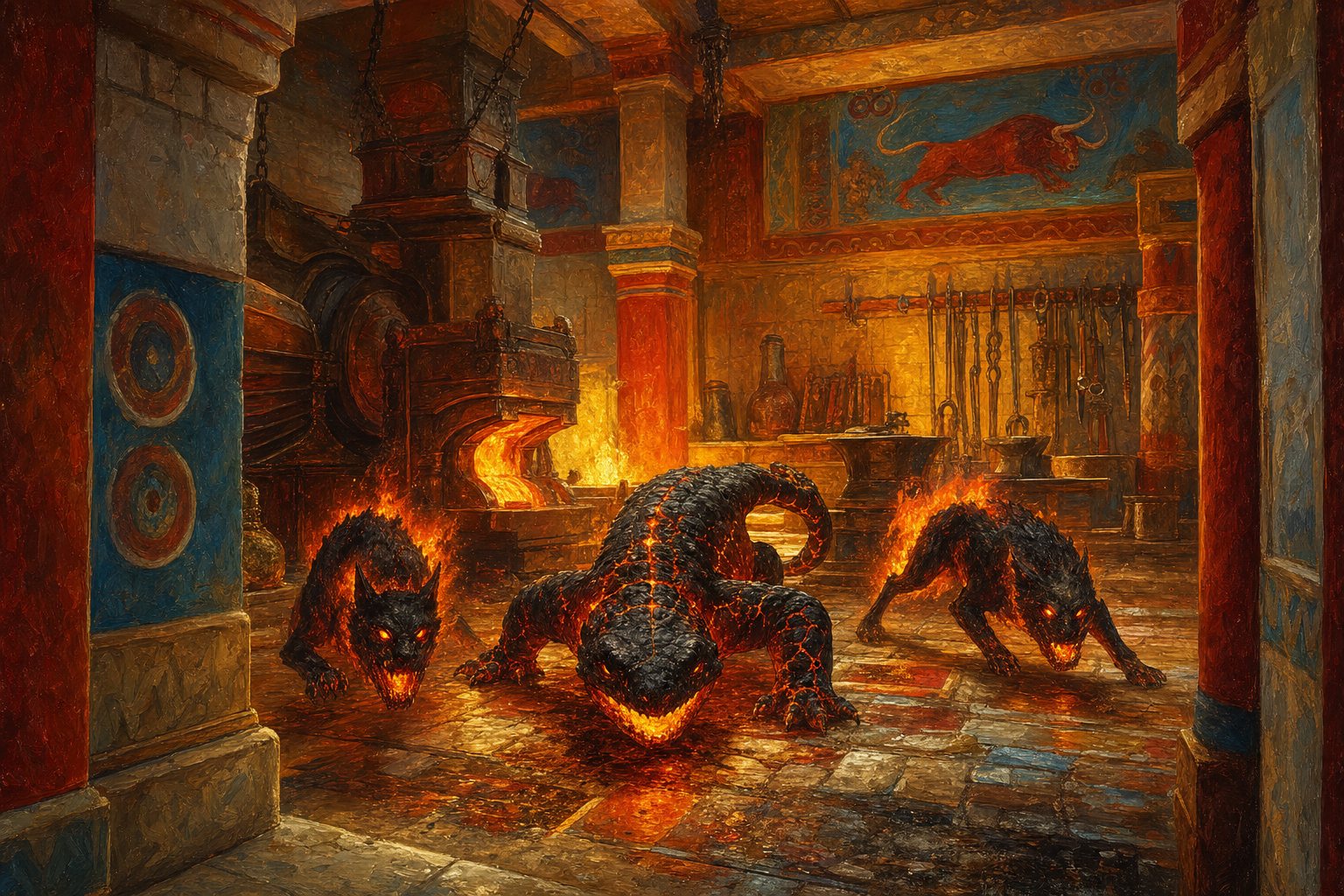
The heat arrives before the room does. Then the room: a forge, working, with nobody in it. Bellows breathing on their own. A fire banked orange-white in a hearth built into the living rock. Tongs, hammers, a wire brush, all of them hung where a right-handed man would want them.
On the anvil lies a spearhead, finished, still glowing at the socket.
The coals shift, and something in them says, in the flat considering voice of a craftsman who has been interrupted: "Whose is that, then?"
DM summary. A forge-spirit that will improve exactly one weapon, at a price paid in labour, metal, and pain. It is not a monster and it does not want a fight, but it keeps salamanders and it will set them on anyone who insults the work.
Terrain & Features
Battle map: custom map. A 40 × 30 ft forge where the hearth eats the north end — sketch hearth, anvil, and trough; everything is within reach of the anvil anyway. Browse the book if a page half fits your table better.
- Dimensions. 40 ft × 30 ft, ceiling 14 ft, and the hearth takes up the whole north end. There is no wasted space in here; it is a workspace and everything in it is within reach of the anvil.
- Light. Bright, orange, and moving. The room is the only light source the party needs and the shadows swing when the bellows breathe.
- Heat. The whole room is hot: a creature that ends its turn within 15 ft of the hearth takes 1d10 fire damage unless it has resistance, and metal armour worn for more than ten minutes here means a Constitution save DC 12 or one level of exhaustion. Say the number when they walk in.
- The anvil. Bronze-faced, waist-high, bedded on an oak stump that should have burnt through a century ago. It is where the spirit is. Nothing in the room can be taken while touching it and nothing said over it can be a lie — the spirit hears an untruth spoken across the anvil the way you hear a cracked bell.
- The quench-trough. A stone trough of black water, 8 ft long, beside the hearth. Two hundred gallons. It can be tipped (see Bypass).
- The shelf. Ichor jars, tin ingots, a coil of bronze wire, a bundle of files. Three of the jars hold automaton ichor, thick and gold and still liquid, and the spirit will trade one for a straight answer.
- Two salamanders and a hound. Not in the room. In the flue — a 4-ft crawlway behind the hearth, glowing, from which the party can hear something large turn over. They come out if the spirit calls them and not otherwise.
The Bargain
The spirit will improve one weapon, once, for this party, ever. It says so at once and without haggling, and the price is fixed:
- An hour at the bellows. One character, working, in the heat. One level of exhaustion, no save. The spirit will not accept a hireling, a spell, a construct, or an animated object at the handles; it wants somebody's hour.
- Twenty-five pounds of bronze or iron, fed into the fire. A shield, a spare weapon, a helm, a cook-pot, greaves — real inventory, gone. Coin does not count and the spirit is contemptuous about being offered it.
- The wielder holds the tang while it cools. 2d10 fire damage, no save, no resistance applied, freely chosen. A character who lets go early gets a weapon that is merely a weapon.
What it wants to talk about while it works is the weapon's history: where it was made, who has died on it, whether the wielder has ever used it on somebody who was running away. It asks the last question of everyone and it can tell an honest answer over the anvil. An honest ugly answer is worth more to it than a flattering one — a wielder who tells the truth and is not proud of it gets one of the ichor jars thrown in.
Three ways to insult it, each of which starts the fight: taking anything off the shelf without asking, striking the anvil with a weapon, or claiming work as your own that is not. It gives one warning — the bellows stop — and then it calls the flue.
Encounter
Only if the parley fails. Two salamanders and a hound out of the flue, in a room that is already burning.
| Count | Creature | XP each |
|---|---|---|
| 2 | Forge Salamander | 2,300 |
| 1 | Pyre-Hound | 700 |
Base 5,300 XP; ×2 for three bodies = 10,600 adjusted, over the APL 9 Hard budget of 9,600. That overage is deliberate: the failure branch of a parley should feel like a mistake, and this one is a room-wide fire hazard with two heat-aura brutes in it.
Round 1. The bellows stop — that is the warning, and it costs the party nothing but a round of nerve to apologise in. If they do not, the hearth flares and the salamanders come out of the flue on the second count, one at each end of the room, to put the party between them. The Pyre-Hound goes for the quench-trough and stands in front of it, because the spirit knows what the trough is for.
Tactics. They herd. Every shove, every push, every bit of positioning is aimed at getting a character within 15 ft of the hearth and keeping them there. The salamanders do not pursue past the door — the spirit calls them back the moment the party is out of the room, and it will not be pursued, ambushed, or followed up on. It has work to finish.
Cold and water end this fight. The salamanders are vulnerable to cold and the trough is right there. A party that opens with a ray of frost and a tipped trough should win in three rounds, and that is a correct outcome.
Bypass Options
The spirit has no interest in passers-by. It asked whose the spearhead was; it did not ask the party to stay.
- The check: Persuasion DC 12 or Insight DC 12 to get out of the conversation without giving offence — decline the offer, compliment the work specifically (the socket, the weld, the wire brush hung where a right hand wants it), and walk. A player who does that in character needs no roll.
- Failure: it takes the refusal as a judgement on the work and names a toll instead: one metal object, chosen by the spirit, from whoever spoke. Refuse the toll and the bellows stop.
- Cost: the party walks past the single best weapon upgrade in the deck. Some parties should. Let them.
Two hundred gallons of black water into a banked forge.
- The check: Athletics DC 14 to lever the trough over, one character, one action, and it must be done from the hearth side, which means taking the 1d10.
- Success: the room fills with steam. Everything in it is blinded for 2 rounds including the party; the hearth is out; the heat damage stops; the salamanders are at half speed and take 2d10 as the steam hits them; and the party can walk out through the north flue or either exit unopposed.
- Failure: the trough rocks and does not go. The spirit knows exactly what was attempted. Bellows stop, no second warning.
- Cost, and it is a real one: the forge is dead and the bargain is gone forever. The spirit does not relight for this party, in this session or any other, and if the party later needs a forge for a Resolution they have burnt it — say so out loud before the roll, because it deserves to be an informed decision.
- Withdrawing instead: the party can simply leave the way they came at any point, including mid-fight. Nothing here follows. Cost: the time, and the spirit remembers being walked out on, which is worth a colder greeting if the DM ever brings this forge back.
Exits
Room-specific: the anvil's mark. Off the loot table, and it never consumes a d100 slot.
- The God-Marked weapon. One weapon, chosen and paid for as above. It gains +1 to attack and damage rolls, and on a critical hit it flares for an extra 1d6 fire damage.
- It cannot be improved again — by this spirit or any other — and it will not take an enchantment on top. The mark is the whole of it.
- It goes cold if it changes hands. Sold, gifted, or looted from its wielder's body, it loses the +1 and the flare permanently. It is not a party item; it is somebody's.
The ichor jar is not loot. If the wielder answered the last question honestly the spirit throws in one jar off the shelf — thick gold oil that does nothing whatever on its own. It is what a seized Daedalan mechanism needs, it is Resolution-owned, and X20 names this forge as one of its three sources. Hand it over as the thing the Resolution needs and do not spend a d100 slot on it.
Scaling — APL 6 / 12 / 15
| APL | Adjustment |
|---|---|
| 6 | One Forge Salamander, one Pyre-Hound. Hearth damage 1d6, the tang is 1d10, and the bellows hour costs no exhaustion. All DCs −2 |
| 9 | As written |
| 12 | Three Forge Salamanders, and the flue disgorges one more every third round while the hearth burns. Hearth damage 2d10; the tang is 4d10. DCs +1 |
| 15 | Four Forge Salamanders and two Pyre-Hounds, the hearth flares on a two-round cycle for 4d10 in a 20-ft radius, and the anvil itself acts once a round: it calls one metal object worn or carried within 30 ft, which its bearer must succeed on a Strength save DC 18 to hold on to. DCs +3 |
- Pacing. Twenty-five minutes if they take the bargain, mostly conversation and entirely worth it. Eight minutes if they decline politely. Thirty if it goes wrong.
- If you are behind schedule, the spirit is brusque: it names the price in three sentences, the hour at the bellows happens in one line of narration, and the party is out in nine minutes with a marked weapon. Do not cut the question. "Have you ever used it on somebody who was running away" is the room.
- Play it as a tradesman, not a god. It is not grand, it is not cryptic, and it does not speak in riddles. It is competent, it is bored, and it is deeply interested in whether the party knows anything about metal. If a player is a smith, let them talk shop for two minutes and hand them the ichor jar for it.
- Make the price hurt in inventory, not in dice. Twenty-five pounds of real bronze off a real character sheet is the memorable part. Ask which shield.
- If one player is dominating the table, this is the room to hand a quiet player: the bellows hour, the honest answer, and the tang. Let the loud one watch somebody else earn the only magic weapon in the run.
- Table safety. A character voluntarily taking 2d10 fire damage by holding hot metal, and a room that is about pain as a price. Keep it brief and physical rather than lingering; if the table would rather not, the tang can be held through leather and the price paid in the hour and the bronze alone, with no change to the item.
- Clue drip. Two objects: the ichor jars on the shelf (X20, Proof tier — the bird's joints are seized and this is what they need), and the spirit itself, which is a power in the maze that keeps its bargains exactly (X06, Sign or Proof — if the Oracle's Bargain is live, this is the party's evidence that such a trade is real and survivable).
- Warband callback. Salamander Forge (W13) always fights by moving you toward the heat. A party who has met them should recognise the herding immediately and should be looking for the water before the second round. The trough is right there, in plain sight, from the doorway.
Creature Cards
Both belong to Salamander Forge (W13) and recur across the deck, so the numbers live in the bestiary. The forge-spirit has no card on purpose: it is a voice in the coals and an anvil, it cannot be attacked, and printing hit points for it would invite a fight this room is built to avoid.
Shared across rooms, so the full cards live in the bestiary: Forge Salamander, Pyre-Hound. Every mention above opens the numbers here on this page.