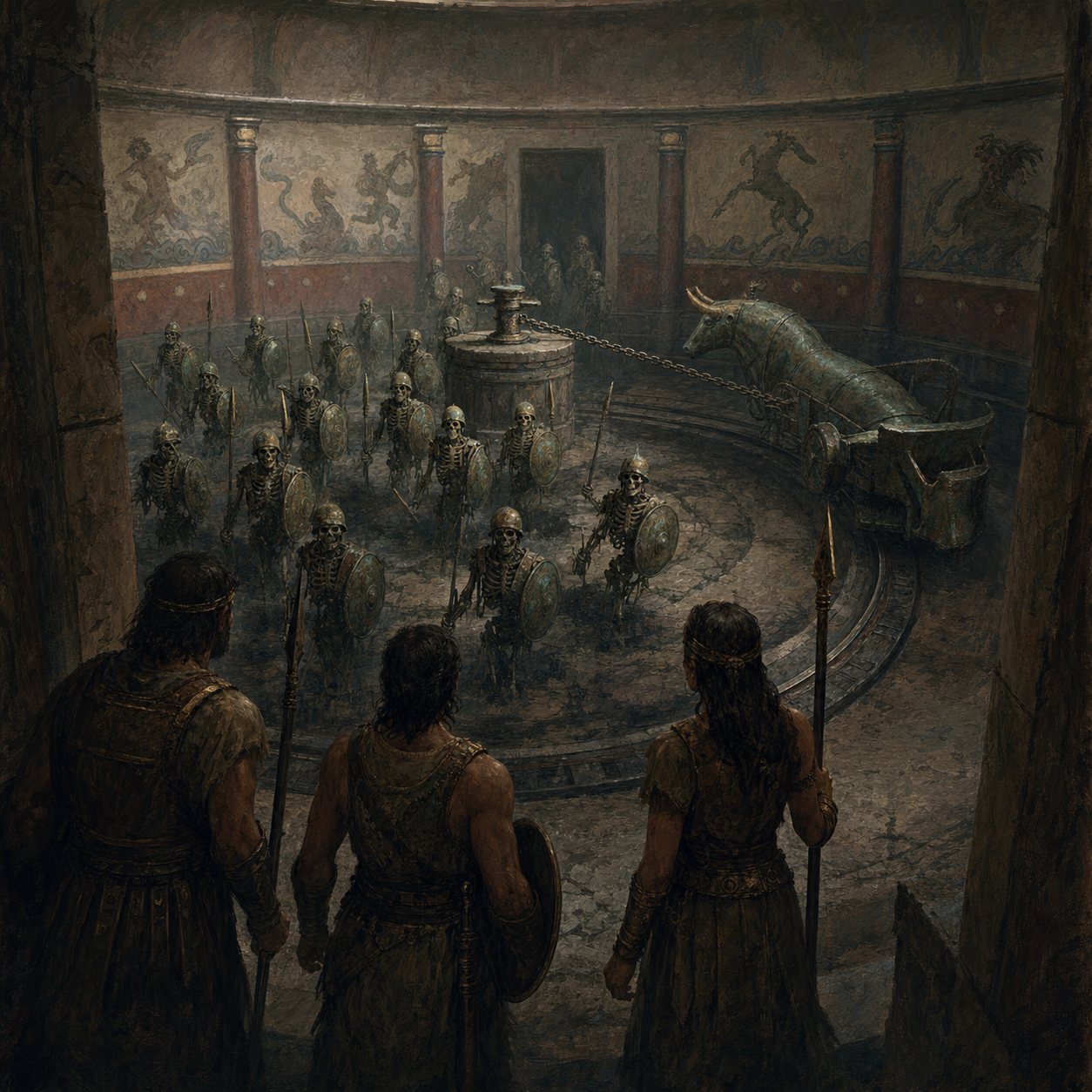
The room is round, and something is ploughing it. A bronze plough the size of a cart is dragging itself around the outside of the chamber on an iron rail, hauled by a chain that runs to a capstan on a raised mound in the middle, and the capstan is turning on its own. Behind the plough the floor opens in a furrow. Ahead of it, a hopper shakes teeth down into the cut.
Standing on the plough's beam, riding it around like a man on a barge, is a skeleton in a serjeant's harness. It is watching the furrow behind it. So are four archers, waist-deep in the ring, holding bows that are already drawn.
Something in the last furrow is getting its elbows under it.
DM summary. A sowing machine on a two-round lap, four archers already up, and a serjeant riding the plough. The room keeps producing bodies until the plough is stopped, and the plough will not hold still to be stopped.
Terrain & Features
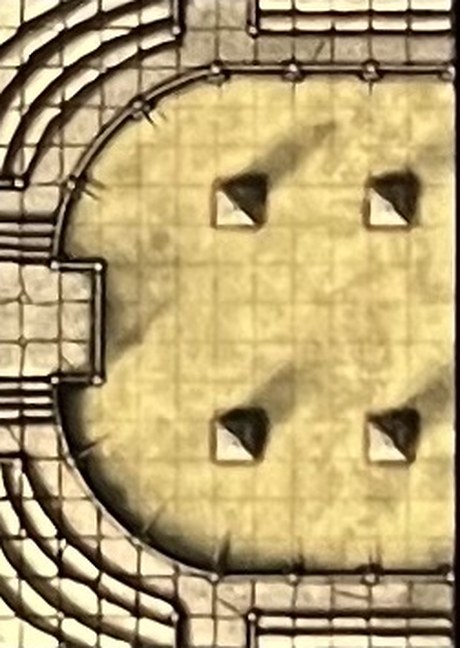
Battle map: The Turn — page 31, 55 × 75 ft (one half of The Hippodrome)
The hippodrome's curve is the plough's rail: close the printed rail into a 50-ft circle with a drawn arc, shade the ploughed ring inside it, and chalk the 20-ft mound at the centre. The page edge stands in for the round wall.
- Dimensions. 60 ft × 60 ft, round, ceiling 16 ft.
mechanism: the room is a machine and every feature is part of it. - Light. Four oil cressets on the mound, bright in the middle and dim at the wall — which means the ring is the dark part and the party will be lit while the archers are not.
- The rail and the plough. An iron rail runs a 50-ft-diameter circle 5 ft in from the wall. The plough runs it anticlockwise, completing one lap every two rounds — 25 ft of travel per round. Anything standing in the rail's path is shoved: Strength save DC 14 or be knocked prone and pushed 10 ft; the plough does not stop for bodies.
- The ring. The 15-ft band between the rail and the mound is ploughed ground: furrows, loose earth, and teeth. Difficult terrain, and it is where everything rises.
- The mound. A raised stone island 20 ft across in the middle of the chamber, 3 ft up, with the capstan on it. Nothing rises on the mound and the plough cannot reach it. It is a safe island in a room that is otherwise a mill, and it is the key to everything.
- The capstan and chain. A bronze drum on the mound, turning steadily, with the chain running from it to the plough's yoke. Chain: AC 17, 25 damage to sever. Capstan drum: AC 15, 30 damage, or jam it — see below.
- The hopper. A bin on the plough's beam, half full of teeth, with the Serjeant beside it feeding the cut by hand.
Encounter
Six bodies up, and more coming every second lap until the plough stops.
| Count | Creature | XP each |
|---|---|---|
| 4 | Bone Archer of the Sown Field | 450 |
| 1 | Dragon-Tooth Serjeant | 1,800 |
| 1 | Bronze-Tooth Hoplite | 700 |
Base 4,300 XP; ×2 for six bodies = 8,600 adjusted, against the APL 9 Hard budget of 9,600. The spawn clock is not in that number — it is the room's pressure, not its budget, and a party that ignores the plough for four rounds is fighting a Deadly encounter with archery support.
The spawn clock. At the end of every second round — that is, each time the plough completes a lap — one Bronze-Tooth Hoplite rises in the freshest furrow. Maximum four extra. A newly risen hoplite spends its first round half-formed: it is prone, has half its hit points, cannot take reactions, and can be put back down cheaply by anybody who is paying attention. That window is the room's mercy and its tactical invitation.
Round 1. The four archers loose from the ring at whoever came through the door — they are waist-deep in loose earth, they cannot move, and they will not stop. The Serjeant rides the plough and does not dismount unless the plough stops or somebody boards it. The single standing hoplite walks the ring to intercept the first party member who steps off the entry apron.
Tactics. The archers are rooted and useless within 5 ft: closing on one is always correct and always costs a crossing of difficult terrain under three other bows. The Serjeant sows from the hopper — every round it rides, it hand-scatters an extra measure, and if it is ever given three uninterrupted rounds it seeds a second furrow and the clock runs every round instead of every second one. It fights to protect the plough. Nothing here leaves the chamber; the ring is the field and the field is the point.
Bypass Options
The plough is enormously loud and it takes half the room with it. Everything in this chamber is oriented to the furrow behind it.
- The beat: the plough passes any given point once every two rounds, and it takes a full round to travel the quarter-circle in front of the party. Perception DC 10 or one round of watching gives the cadence.
- Crossing: wait for the plough to pass, then cross the ring behind it, in its wake, where the earth is freshly turned and the archers' line of sight is broken by the machine itself. Athletics DC 13 for the furrows and group Stealth DC 14 in the plough's noise. Two rounds to reach the far door.
- One failure: an archer picks somebody out of the dark. One volley — three arrows — and the party may keep going.
- Two failures: the Serjeant sees them from the beam and blows the horn. Full initiative, and the party is strung out across the ring, which is the worst formation available here.
- Cost: crossing means passing within 10 ft of at least one rooted archer, who gets an opportunity attack as they go by. Nobody crosses this room free.
The mound is the one place in this chamber where nothing can reach the party, and the chain that runs across it is the room's off switch.
- Reaching it: 15 ft of ring from the entry apron and a 3-ft step up: Athletics DC 12 while the plough is on the far side of its lap, or DC 15 if it is coming.
- Stopping the machine, three ways:
- Sever the chain: AC 17, 25 damage. The plough coasts to a halt within one round and the Serjeant steps off, furious.
- Jam the capstan: a spear, a bar, or a crowbar in the drum's teeth — Athletics DC 15 or Thieves' Tools DC 14. The drum locks, the chain goes taut, and the chain whips: everyone within 10 ft makes a Dexterity save DC 14 or takes 2d10 bludgeoning.
- Reverse it: Investigation DC 15 to find the pawl and Athletics DC 14 to throw it, which drags the plough backwards over its own furrows and buries the two most recent risings, killing them outright. This is the best outcome in the room and it should be findable by anyone who looks at the drum for a round.
- Success: the spawn clock stops. The fight is whatever is standing, and the party is holding a raised island that nothing rooted can reach.
- Failure: a botched jam costs the tool. A botched swing at the chain is a miss and the plough keeps coming.
- Withdrawing instead: the entry apron is a 10-ft stone shelf inside the door, off the ring, and nothing in this room can follow the party onto it or out of it. The party may withdraw at any point for a wandering-threat roll and this room's loot, and if they have already taken three volleys of arrows they should.
Traps / Puzzles / Checks
The plough is the room's mechanism and it is not hidden. Everything about it can be learned by looking:
| Element | Value |
|---|---|
| Reading the lap time | Perception DC 10, or one round of watching |
| Understanding the spawn link | Investigation DC 12 — the risings follow the freshest furrow — or free after the first one comes up |
| Boarding the plough | Athletics DC 14 from the ring as it passes, or DC 11 from the mound as the chain hauls it by. A boarder is on a moving platform with the Serjeant, and that is a very good fight |
| Stopping it | Chain AC 17 / 25 damage · capstan jam Athletics DC 15 or Thieves' Tools DC 14 · reverse the pawl Investigation DC 15 then Athletics DC 14 |
| Solved state | The plough stops or reverses. No further risings, and the room is suddenly, enormously quiet |
Exits
One roll on the loot table, earned either way:
- After the fight: the Serjeant's harness and the hopper's fittings, no check.
- Without the fight: the tool-box bolted to the capstan's base on the mound — a bar, a hammer, and whatever the last maintenance crew left in it. Investigation DC 12 to open it, and it can be done while the party is holding the island.
The teeth are not loot. They are a problem in a pouch, and exit B says so explicitly.
Scaling — APL 6 / 12 / 15
| APL | Adjustment |
|---|---|
| 6 | Three archers, no Serjeant — the plough runs unattended. Lap time three rounds, two extra risings maximum. DCs −2 |
| 9 | As written |
| 12 | Six archers, the Serjeant, two hoplites up at the start, and the lap is one round — the plough runs the ring at 50 ft per round. Six extra risings maximum. DCs +1 |
| 15 | As APL 12 with two ploughs on concentric rails running in opposite directions, which removes the safe wake entirely, and the capstan repairs a jam after two rounds unless the chain is severed outright. DCs +3 |
- Pacing: twenty-five minutes. When you are behind schedule, run the plough as already stopped — the chain severed by whoever came through before them, the Serjeant standing over it — and play the room as a straight six-body fight with rooted archers. Ten minutes.
- This is the deck's second sowing room and it must not feel like the first. In the Threshold of Bronze Teeth the mechanism is a hopper in a wall and the enemy is a shield wall; here the mechanism moves, the enemy cannot, and the safe ground is in the middle rather than above. If your table has run R001, name the resemblance out loud in the read-aloud — someone has built a bigger version of a thing you have seen — and then let the differences do the work.
- The half-formed round is the tactical gift. Say it plainly the first time a body comes up: it is on its hands and knees and it is not finished. A party that learns to spend one attack a round on the furrow instead of the archers has solved the pacing of this fight themselves.
- Reversing the plough is the best answer and should be discoverable. If the table is grinding, have the Serjeant glance nervously at the pawl. That is a free clue and it looks like characterisation.
- Clue drip. Two hooks: the capstan's maintenance plate, stamped with a workshop mark and a service interval, which means somebody is still servicing it (X20, X19), and the hopper's teeth, which are not all a beast's — one of them is a boar's tusk with a bronze ear-tag wired to it, and somebody is farming the things that go into this machine (X08, X06).
- Table safety. Bodies assembling themselves out of a furrow is the image, and it is the same low-intensity register as the rest of Sown Bones. If it lands badly, the risings are bronze castings sprouting from cast teeth and there are no remains in the room at all.
- Callback. Sown Bones (W01) always has a mechanism behind it, and the warband's lesson across the whole deck is the machine is the enemy, not the skeletons. This room is the graduate version: the machine is mobile, it is defended, and stopping it is a boarding action.
Creature Cards
All three belong to Sown Bones (W01) and recur across the deck, so the numbers live in the bestiary. The tactics above are this room's and stay here.
Shared across rooms, so the full cards live in the bestiary: Bone Archer of the Sown Field, Dragon-Tooth Serjeant, Bronze-Tooth Hoplite. Every mention above opens the numbers here on this page.