The Maze Itself
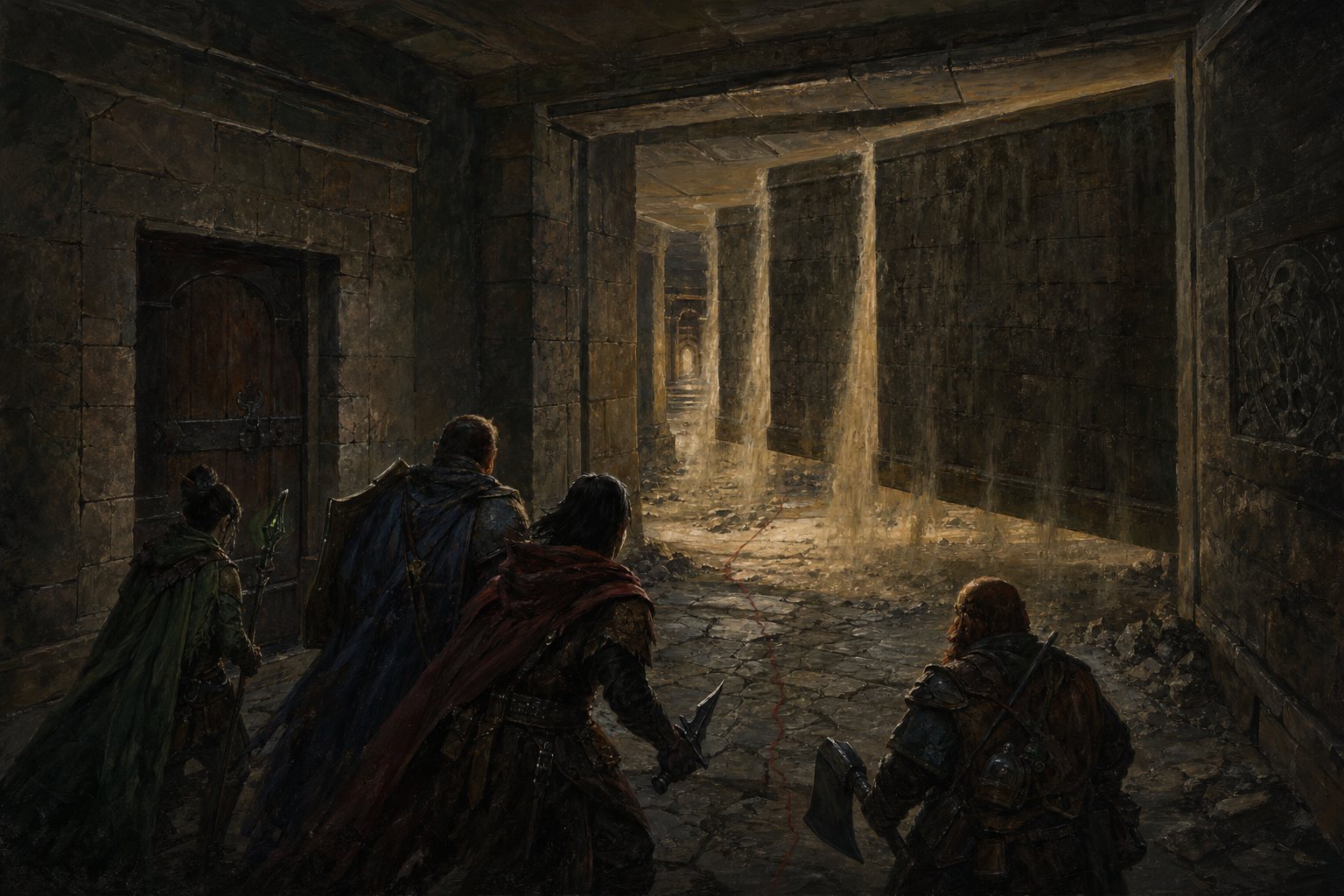
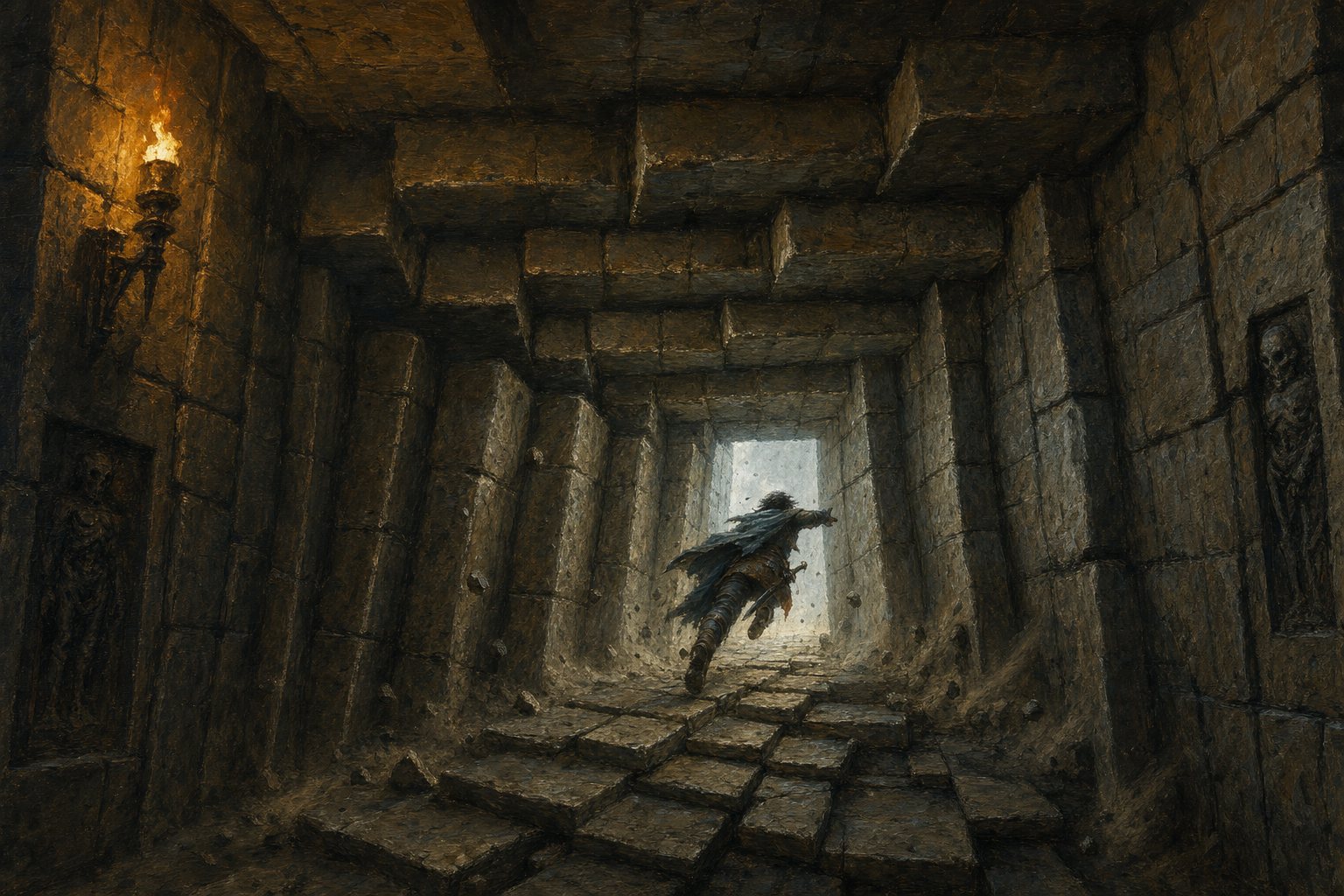
The door you came through closes behind you, unhurried, on a counterweight you can hear paying out somewhere in the wall.
Then a bronze plumb bob comes down from the ceiling on a long line, and swings once, slowly, over the head of each of you in turn — the way a mason checks a course — and goes back up.
Somewhere above you, a great many things begin to move at once.
DM summary. There is no monster. The chamber is a lock built to be worked from the inside by someone who knows the maze's numbers, and it is now cycling. The party has twelve beats to work out what it wants, get under something, or break its teeth.
The Boon
The Vent-FinchOptional companion
She lands on the spindle that wants turning next, and leaves a beat before the vents blow
What it is. A grey finch the size of a fist, living in the maze's vents on grain-dust and moths, entirely unafraid of people and entirely uninterested in them until somebody produces crumbs. The Vent-Finch has been in this machine her whole life and she has never once been caught in it, which is a skill.
Where it comes from. Any room with air moving through it: she comes down to a resupply room's grain sacks, she sits in the roof of a rest point, she follows a party that feeds her once and keeps following as long as they keep having food. Plant her the first time the party opens a ration pack, and do not make it a scene. Late plant: she comes out of a grit vent on beat 1 of this room, shakes the dust off, and looks at the party — which is unsettling in exactly the right way, because the only thing in here that is not trying to kill them is a bird.
What it does here. Two things, and neither of them solves the lock. She will not sit on a spindle that is wrong: set one correctly and she hops to the next one in the sequence, so a party that watches her knows the order without deciphering IN THIS ORDER YOU FOOL. And she leaves the floor a beat before the vents blow, every time, so a table that is paying attention to the bird gets one round's warning on the grit and on the ceiling's turn of speed at beat 9. What she mostly does is make the room feel survivable, and then make the players want to save something. Somebody will have to cup her in both hands during a grit blow, which costs that character their action.
What it doesn't do. She does not know the numbers, cannot turn a spindle, cannot carry anything, and will not fight — she has 3 hit points and no attack at all. She never opens the iris and never jams the ceiling. A party who never met her runs the finale exactly as written; a party who did has one more thing in the room they would be sorry to lose, and that is most of the point.
Card and numbers or jump to the card ↓
Arena
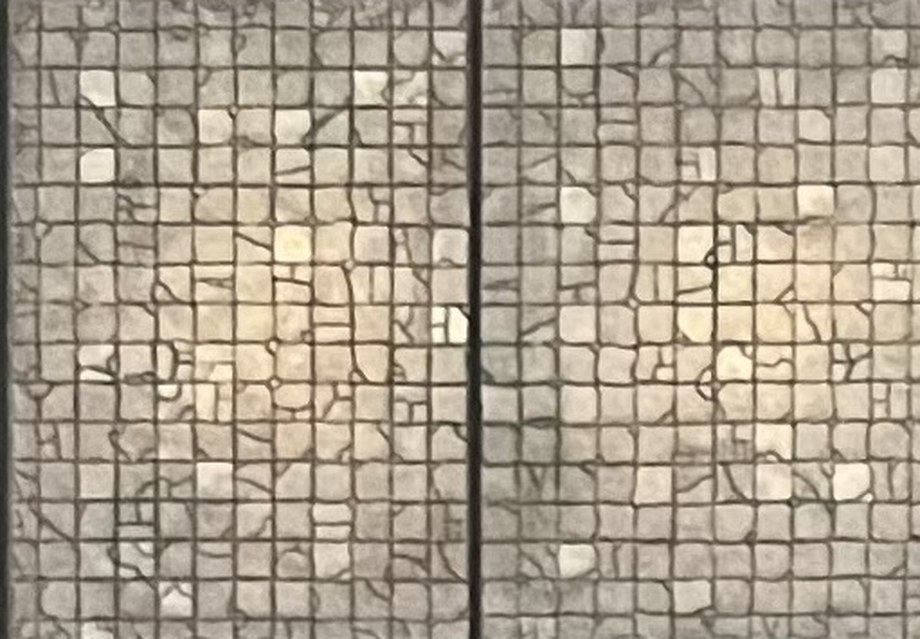
Battle map: The Grey Flags — pages 1 & 2, 110 × 75 ft
The blank full spread and a dry-erase marker are this room's whole apparatus: draw the 80 × 75 ft starting walls, chalk the beat-12 footprint (40 × 35 ft) as the room text instructs, then erase and redraw the walls inward on every beat. Mark the three drains — they don't move.
- Dimensions. 80 ft × 75 ft at the start of the cycle, ceiling 30 ft, and every one of those numbers is going to change. By the twelfth beat the room is 40 ft × 35 ft with a 4-ft ceiling. Chalk the beat-12 footprint on the mat on the first beat and let the party watch it come to meet them.
- Light. None of its own. Whatever the party brought, and the grit is going to be hard on open flame — an unshielded torch or lamp goes out on any beat when the vents blow (see below).
- The moving walls. Four wall segments, each 40 ft long, ride on tracks in the floor: north and south close inward, east and west slide past each other. They move on the beat, 5 ft each, in silence except for the tracks. The shear line — the 5-ft strip a wall passes through — deals 22 (4d10) bludgeoning to anything caught in it, DC 15 Dexterity save for half and to be shoved clear.
- The ceiling. Drops 2 ft on every third beat, and does not stop. See the Clock for what happens when it arrives.
- The three drains. Three round sinks in the floor, 3 ft deep and 5 ft across, spaced along the diagonal of the beat-12 footprint — all three inside the 40 ft × 35 ft the room ends as, because a drain the walls take away is a drain that was never a survival option. Two Medium creatures fit in each, lying down. Six PCs fit in three drains exactly, and this is not a coincidence — the masons who built this worked in shifts of six.
- The grit vents. Eight bronze grilles at knee height. On every fourth beat they blow a lungful of pulverised limestone across the room: the area is lightly obscured for one beat, and every creature not in a drain or behind a wall takes 11 (2d10) bludgeoning and slashing from the blast and makes a DC 13 Constitution save or is blinded until the end of its next turn.
- The three spindles. Waist-high bronze posts on the room's centreline, each with a pointer over a ring of twelve marks. They are the lock. They are described properly under Alternate Resolution and they are the point of the room.
- The mason's tally. Cut into the east wall at shoulder height, half filled with dust: three depths in Knossian numerals — ninety, forty, seventy — and under them, in a different hand and a different century, IN THIS ORDER YOU FOOL.
- The gearing. Behind three grilles in the west wall: three bronze gear-trains, oiled and turning. They are the only part of this room a weapon can meaningfully touch.
Roster & Budget
No creatures. No XP. Say that out loud when you turn the page.
A Deadly encounter for six PCs at APL 9 is 14,400 XP of monsters. This finale spends nothing on bodies and pays for its rating in damage on a clock:
| Source | Per beat | Over twelve beats |
|---|---|---|
| Shear line | 22 (4d10), one to three PCs | ~130 damage, spread |
| Grit vents (every 4th beat) | 11 (2d10) to everyone exposed | ~100 damage, party-wide |
| The closing ceiling | — | 55 (10d10) to anything not in a drain at beat 12 |
That is roughly 250–300 points of damage distributed across the party, two resource taxes (light and mobility), and a hard failure state at the end of the count. It is Deadly by arithmetic, not by monster, and the pressure is entirely in the clock. Nothing in here has an initiative, nothing in here can be frightened, and nothing in here will negotiate.
Phases / Clock
Twelve beats. One beat is one round in initiative — roll it anyway; the party needs the turn structure. Announce the beat number every time, out loud.
| Beats | What the room does |
|---|---|
| 1–3 — Measuring | Walls close 5 ft per beat, north and south. Grit vents on beat 4. Ceiling drops to 28 ft on beat 3. The plumb bob comes down again on beat 3 and measures the tallest PC |
| 4–8 — Working | East and west segments begin sliding past each other, opening and closing 5-ft gaps along both walls. Shear lines are live every beat now. Ceiling 24 ft, then 22, then 20 |
| 9–11 — Warning | The ceiling drops 4 ft per beat instead of 2, the vents blow every beat, and every bronze surface in the room begins to ring on one note. Tell the players on beat 9 that they have three beats. A room that can kill outright telegraphs, always |
| 12 — Home | The ceiling arrives at 4 ft. Everything in the room that is not lying in a drain, not behind the west grilles, and not already through the north iris takes 55 (10d10) bludgeoning, DC 17 Dexterity save for half, and is restrained until the cycle resets on beat 13 |
| 13 — The Iris | The cycle completes. The north iris opens, the walls run back to their marks over about a minute, and the room begins again empty. It opens whether or not anybody solved anything. That is what a lock does |
Round one. The plumb bob. Do not explain it. A player will work out what a mason measures for, and the moment when somebody at the table says "it's measuring how tall we are" is worth more than any trap description you could write.
Combat Resolution
Required on all twenty finales, and this one has to be honest: you cannot kill a room. You can break its teeth, and it costs you the exit.
- What weapons do to the walls. Nothing. Limestone dressed and set by Daedalan masons: slashing and piercing do 0 damage, bludgeoning does half, and a PC who spends a beat attacking a wall has spent a beat. Say this the first time somebody swings, plainly and without sarcasm, and let them choose again.
- What actually works. The three gear-trains behind the west grilles. Each grille is AC 15, 10 damage to tear off. Each train is AC 17, 40 hit points, immune to poison and psychic, resistant to slashing and piercing, and takes full damage from bludgeoning, force, and thunder. A jammed crowbar, a shatter, or a warhammer are the right tools; a rapier is not.
- Breaking one train stops the wall segment it drives: that segment freezes and its shear line goes dead for the rest of the cycle.
- Breaking all three stops the room. The ceiling halts wherever it is, the vents die, the count stops, and the party is standing in a broken machine. This is the combat win and it is a real one — about 120 points of damage into three specific targets while the clock runs, which is four or five beats of a party's whole output. Expect eight to ten beats and 30 minutes.
- What it costs. A stopped room cannot open its own iris. A party that breaks the machine leaves by the maintenance crawl behind the housings (Exit B), which is narrow, filthy, and one at a time.
- Two things that look like answers and are not. Dimension door and similar work fine, and are the correct use of a spell slot — do not punish them; the party still owes the Resolution a way onward and has to come back through the iris or the crawl either way. Stone shape removes one wall segment's ability to seal, which is worth exactly one spindle's worth of progress and no more.
- If someone is reduced to 0 hit points by the room, they are pinned rather than crushed: unconscious, held by a wall or a fallen slab, stable at the start of the next beat, and recoverable by anyone who spends an action and a DC 14 Athletics check. This room's job is fear, not corpses.
Alternate Resolution
Work the lock. It was built to be opened from in here.
The three spindles stand on the centreline, and each is engraved with what it governs, in Knossian: WAY IN, WAY ON, WAY DOWN. Each has a pointer over twelve marks. Turning one spindle is an action and no check.
The answer is on the east wall. The mason's tally gives three depths in cubits — ninety, forty, seventy — and the marks on the spindles are in tens. Set WAY IN to 9, WAY ON to 4, WAY DOWN to 7, in that order, and the lock opens. Setting the right numbers in the wrong order does nothing; the second hand on the wall was warning about exactly that.
| The information is all in the room | Where |
|---|---|
| The three numbers | The tally, Investigation DC 12 to clear the dust, or free for anyone who looks at a wall instead of a spindle |
| The units are tens | Any of the three lintels, each carved with its depth beside a spindle-mark, Perception DC 13 |
| Order matters | IN THIS ORDER YOU FOOL, same tally, same check |
| Which spindle is which | The words are cut into the bronze. Any character who reads Knossian, or History DC 13, or ten seconds with a lamp |
Each wrong setting costs one beat and shifts the walls out of sequence — a shear line opens somewhere unexpected, and every creature standing on the centreline makes a DC 15 Dexterity save or takes 22 (4d10) bludgeoning.
Mechanical fallbacks, because a puzzle without one is a trap:
| Fallback | Cost |
|---|---|
| Force a spindle to its mark | Athletics DC 18 or Thieves' Tools DC 17 per spindle. On a failure the spindle jams and must be freed (DC 15 Strength, one beat). Success on all three opens the lock without knowing the numbers, at three or four beats' cost |
| Jam the ceiling | A spear, an iron bar, or a ten-foot pole braced in a drain buys two extra beats before the ceiling arrives, and the object is destroyed. This can be done three times |
| Get in the drains | Not a solution, a survival. Three drains, two PCs each, lying flat. Everyone in a drain takes nothing on beat 12, and the room opens on beat 13 anyway. A party that simply lies down and lets the maze finish its cycle has passed this finale, and you should let them, and you should describe the ceiling arriving four inches above their faces |
| Break the gearing | See Combat Resolution |
If the party brought the Vent-Finch, the order comes free — she hops to whichever spindle is next in the sequence and will not perch on a wrong one — and the numbers do not. She is worth about one wrong setting, which is one beat and one shear line, and she is worth considerably more than that to the table.
Solved state. The spindles seat with three heavy clicks, the count stops wherever it is, the walls run back out to their marks, and the north iris opens on a passage with cold air in it.
Scaling — APL 6 / 12 / 15
| APL | Adjustment |
|---|---|
| 6 | Sixteen beats instead of twelve, ceiling arrives at 5 ft, shear line 22 (4d10) unchanged but the vents blow every fifth beat. Two spindles, not three (WAY DOWN is already seated). All DCs −2 |
| 9 | As written |
| 12 | Ten beats. Shear line 55 (10d10), vents 22 (4d10), final crush 99 (18d10). Four spindles, and the fourth is unlabelled. Gear-trains have 60 hit points. DCs +1 |
| 15 | Eight beats, all damage as APL 12, and the room re-seats one correct spindle at random on beat 5 — the maze is working the lock against them. Only two drains. The gearing repairs 10 hit points per beat unless the train is destroyed outright. DCs +3 |
Exit to the Resolution
- Pacing. 25–35 minutes, which is short for a finale, and it should be. This is the one that ends on a held breath rather than a kill. Behind schedule: run eight beats, drop the vents, and keep the plumb bob.
- Count out loud. "Beat four. The walls come in five feet. The vents blow." The entire tension of this finale is a number going up while the room gets smaller, and it evaporates the moment you stop saying the number.
- Do not make the puzzle a gotcha. Every piece of the answer is on a wall and every piece has a DC of 12 or 13. If the party has not looked at the tally by beat 5, have the grit blow the dust off it and read them the numbers.
- The best possible outcome is not the puzzle. It is six people lying in three holes in the floor holding hands while a ceiling comes down. If a player proposes that, drop everything and run it.
- Table safety. Crushing and confinement, which is the sharpest content flag in this batch. The softer framing: the ceiling stops at 4 ft rather than the floor, nothing is described as crushed, and a PC who goes to 0 is pinned and recoverable. Offer this before the door closes, because the door closing is the moment somebody with claustrophobia will feel it.
- Clue drip. This finale delivers the Door tier and it does it in cold air. Two objects: the mason's numbers, which are depths — the party now knows exactly how deep they are and can count their way up (X14 A Thread of Your Own Making, X12 Bring It Down Behind You), and the cold draught through the north iris, which is coming from somewhere with weather (X17 The Wings of Icarus, X16 The Salt Door).
- If the finch dies, and she can — a grit blow catches her, or a player forgets her on beat 12 — say it once, plainly, and do not linger. Then let her be the thing the party talks about on the way to the Resolution. Do not have her miraculously reappear.
- Callback. This room is the maze admitting what it is. A party that survived the tightening walls (R033), the whispering trapfloor (R080), or the cartwheel rotunda (R099) has met three of its fingers. This is the hand.
Boon Card
The Vent-Finch
Tiny beast, unaligned · CR 0 (10 XP) · a companion, and not a combatant
AC 13 | HP 3 (1d4 + 1) | Speed 10 ft., fly 50 ft.
Skills Perception +4 · Passive Perception 14 · she navigates by draught rather than by light, and is not troubled by darkness
Will Not Fight. She has no attack. She flees any creature that swings at her, and she cannot be commanded into danger by anyone, including a friend.
Knows the Beat. She leaves the floor one round before any mechanism in a room she lives in cycles — a vent blowing, a wall stepping, a ceiling changing speed. A DM should describe her going up, and nothing else.
Won't Sit on a Wrong Answer. She will not perch on a lever, spindle, dial, or plate that is set incorrectly for the mechanism she lives in. She will perch on the next one that wants moving.
Three Hit Points. Any area effect that catches her kills her. A creature within 5 ft can spend its action to cup her in both hands, which protects her completely and costs that character the action.
Go and Look. On a command she understands — a whistle, a pointed finger, a held-out crumb — she flies up to 100 ft, through any gap a fist would fit through, and comes back. Her report is behaviour, not speech: she returns calm, she returns agitated, or she does not return.