Pit of Peeled Shields
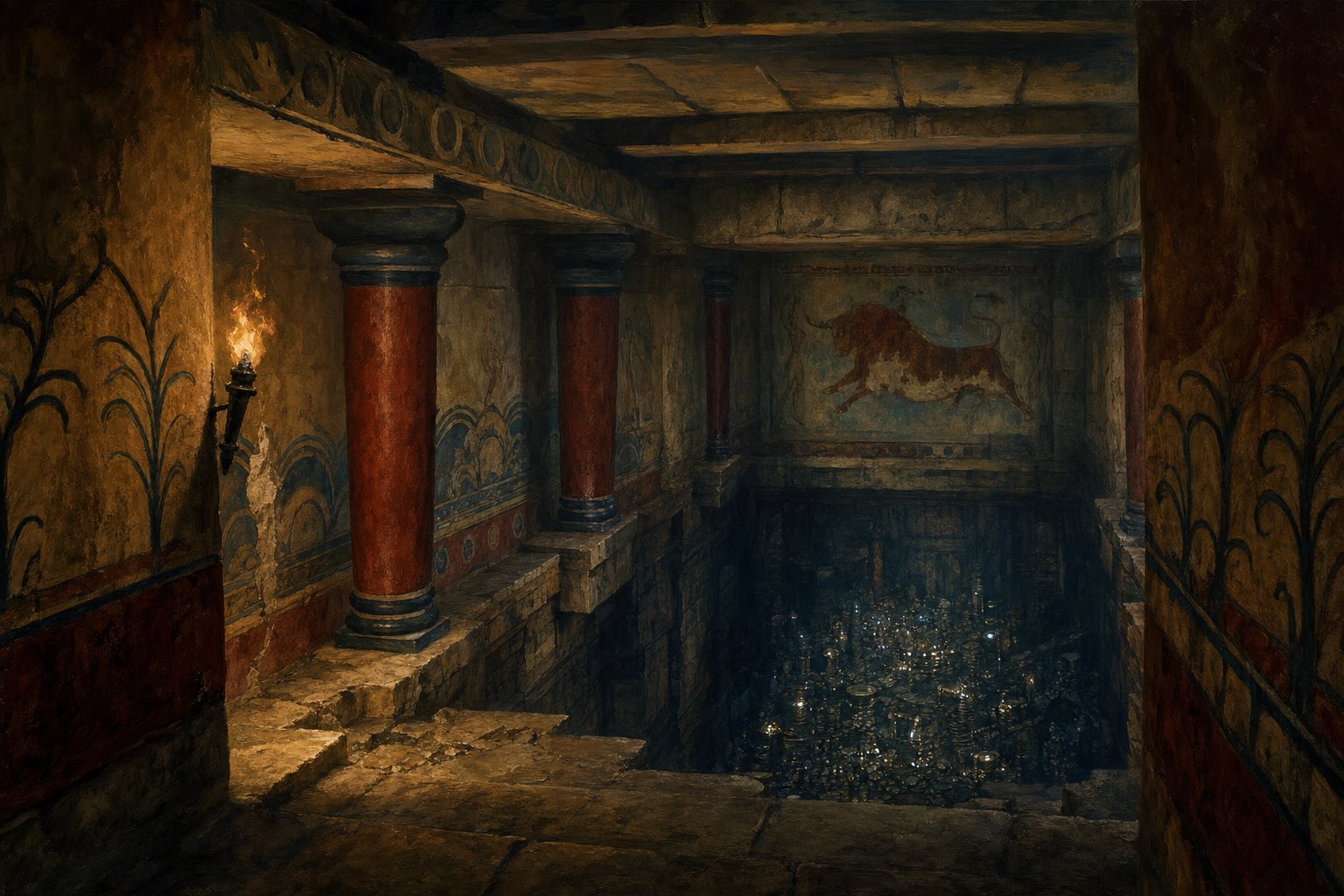
The corridor opens into a low room and then stops being a floor. Twenty feet of it has fallen away, or was never there, and at the bottom — fifteen feet down — the dark is full of pale points catching your light.
They are spikes. Between them, nailed flat to the floor in a rough mosaic, are shields. Dozens of them. Hoplons, bucklers, a Corinthian face-guard, all peeled of their leather and hammered down as though someone were tiling a room with the last effort of everybody who came this way.
DM summary. A spike pit whose floor is a treasury, and the treasury is the bait. Crossing costs nothing but nerve; going down is where the room bills you.
Terrain & Features
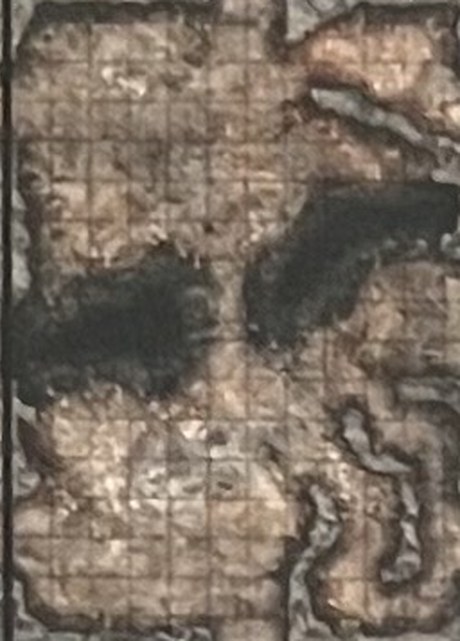
Battle map: The Bridged Pit — page 16, 55 × 75 ft (one half of The Broken Galleries)
The printed pit is the spike pit: wipe the bridge (or leave it drawn and rusted-through as bait), extend the pit north–south across the 40 × 30 ft room, chalk the 4-ft ledge along the north wall, and dot the thirty-one shields on its floor.
- Dimensions. 40 ft × 30 ft, ceiling 12 ft. The party enters at the east end.
- Light. None of its own. Whatever the party carries, and the pit swallows the bottom half of it.
- The pit. 20 ft across, spanning the room north to south, 15 ft deep, floored with 60-odd iron spikes set 18 inches apart and rusted the colour of old blood.
- The east lip. A 4-ft ledge of intact floor runs along the north wall past the pit — the room's honest crossing. Acrobatics DC 12 to walk it, or no check at all with a rope, a spear used as a handrail, or anyone spotting.
- The shield mosaic. Thirty-one shields nailed to the pit floor between the spikes, face up. They are the only reason to descend. Six are worth carrying.
- The false span. Two flagstones bridge the pit's narrowest point at the south wall, held on a pivot. They look like the shortest way across. They are the trap, and they are why there are shields down there.
Traps / Puzzles / Checks
The false span.
| Element | Value |
|---|---|
| Trigger | Weight on either pivot stone — about 80 lb, so a thrown pack sets it off |
| Detect | Passive Perception 14, or Investigation DC 13 on the flagstones (the mortar lines do not match, and the dust on them is thinner) |
| Telegraph | The stone drops half an inch and grinds before it goes. Anyone on it gets a Dexterity save DC 14 to fall back to the lip instead of in |
| Effect | 15-ft fall (1d6 bludgeoning) plus 2d10 piercing from the spikes. On any spike hit, Constitution save DC 12 or contract a rust-fever: −1d4 to Constitution saves until a long rest |
| Disarm | Thieves' Tools DC 15 to pin the pivot, which makes the span a real bridge. Athletics DC 16 to lever a spike out of the floor and wedge it under, same result, and the spike is then a serviceable improvised weapon |
| Solved state | The span is pinned and the room is a corridor. Say so plainly and let them walk it |
Climbing out of the pit is Athletics DC 13 with the spikes for handholds, or nothing at all with a rope. Nobody is ever trapped down there. What they lose is time, and time in this maze is a wandering-threat roll.
Exits
Two rolls on the loot table, both earned the same way: go down, and pry.
- Descending and working the mosaic takes ten minutes and one Athletics DC 12 or Thieves' Tools DC 12 per roll. The nails were driven by something strong and unhurried.
- A party that crosses and never descends gets nothing, and should be told exactly what they walked past — thirty-one shields, and six of them still good — as they leave. That is the room's whole argument.
Do not let the shields become a plot. Nobody down there is coming back. If a player asks whose they are, the honest answer is everyone's.
Scaling — APL 6 / 12 / 15
| APL | Adjustment |
|---|---|
| 6 | Detect DC 11, disarm DC 13, Dexterity save DC 12. Spikes 2d10 and no rust-fever save — a bad afternoon, not a lasting one |
| 9 | As written |
| 12 | DCs +1. Spikes 4d10, and four of the spikes are barbed: a creature that falls is restrained until it or an ally spends an action (Athletics DC 14) |
| 15 | DCs +3. Spikes 4d10, the whole southern third of the floor is false rather than two stones, and the pit is 25 ft deep. Telegraph it anyway |
- Pacing: eight minutes, and ten more if they go down. This is a
quick-roomon purpose — run it when the session is behind schedule and you want a beat between two heavy rooms. When you are late: skip the false span entirely, describe the pit, charge the crossing an Acrobatics DC 12, and offer the shields as a single roll instead of two. - The trap only works if you describe the shields before the flagstones. Greed sets this trap off, not bad luck. Let the party look down, want something, and then choose the fast way to it.
- Clue drip. Two objects here carry a Resolution clue cleanly: a surveyor's chalk mark on the pit wall at exactly 10 ft — a depth measurement in a maze nobody has mapped (X14, X12) — and a shield in the mosaic painted with the Knossian double axe, upside down, which is how a man signals he was on the King's business when he died (X08, X03).
- Table safety. There are bodies under the shields; the mosaic is what was left after the pit finished with them. If your table would rather not, the shields were stripped and stacked by scavengers and the dead are long gone. Nothing mechanical changes.
- Callback. A party that came in as the surveyor's crew (B11) or that has met another of the maze's peeled rooms should notice the housekeeping: somebody in here tidies. Nobody in here helps.