The King's Writ
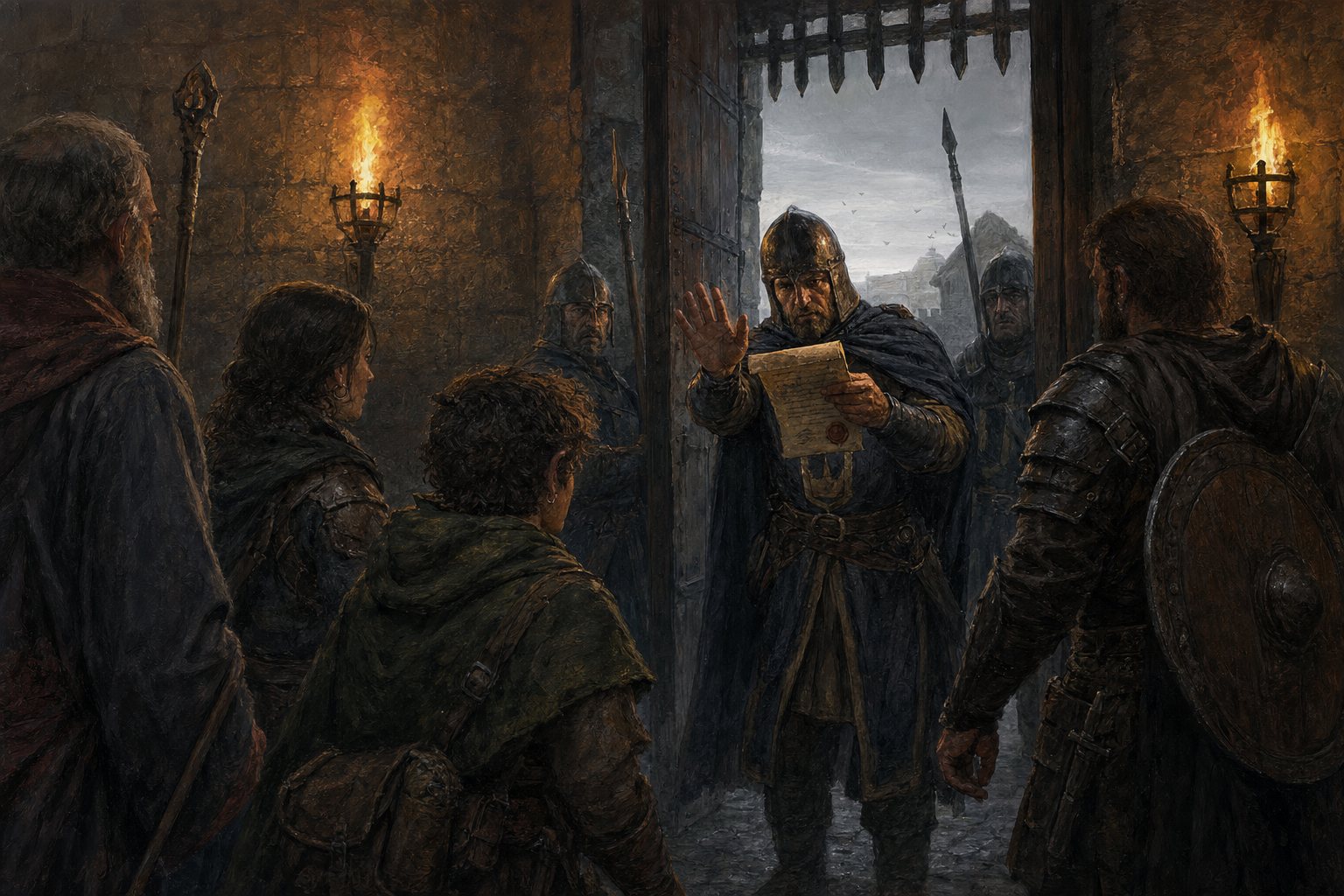
The corridor gives up being a corridor and becomes an office.
There is a desk. There is a shelf of ledgers gone furry with damp. There is a bronze stamp on a chain, worn shiny at the handle, and a wooden rack of blank tablets, and a stool with a cushion on it that somebody has been sitting on recently enough that the dent has not risen.
Beyond the desk, forty feet of empty floor, and then the gate. It is the size of a ship's sail and it is not barred. It simply will not open for you.
The Way Out
The bronze gate of the Labyrinth is a counterweighted door that any six people can work — from outside. From inside, the mechanism is behind a grille in the gatehouse, and the gatehouse is staffed, and its staff answer to Minos.
This Resolution is not a lock. It is a bureaucracy. The gate opens for a sealed instrument and a recorded name, and it has opened that way for thirty years, for inspectors and masons and tribute-wardens and the occasional man who came to look at the beast and had the paperwork to prove it.
The party's problem is not force. It is standing, and the fact that whatever they have been doing for the last two days has almost certainly voided it.
Requirements
| Requirement | Where it comes from |
|---|---|
| The writ | B02 The King's Commission starts the party holding it. Otherwise: R052 Throne of the Absent King keeps the steward's fair copy, R087 Ruin of the Old Temple has a thirty-year-old expired one, and blank tablets plus the stamp on the gatehouse desk make a forgery possible at Deception or Forgery DC 16 |
| The seal, or a stand-in | The bronze stamp is on the desk, on a chain. Taking it is trivially easy and catastrophically noticed. A countersignature from the steward in R052 is the legitimate route and costs a favour |
| Finding the gatehouse | It adjoins the entrance hall, not the depths. R003 Hall of Nine Doors and R026 Court of the Thread-Wardens both point at it; so does any map. R062 The Mason's Unfinished Wall names it in the confession |
| The form of words | R039 The Judging Steps and R052 both teach it: the gate is asked, not commanded, and the asker gives their name, their business, and the name of who sent them. History or Religion DC 13, or simply listening in either room |
Clues
| Tier | Line to deliver |
|---|---|
| Whisper | Somebody, somewhere ahead, is doing sums out loud. Badly, and with pauses. |
| Trace | A wax tablet in a corridor niche, half-erased, with a column of names on it and a date in the current year. |
| Sign | A notice cut into stone at a junction, in careful official lettering: all persons entering or departing to present at the gate-house. By order. |
| Proof | The ledger. Thirty years of entries in four different hands, and the last one is nine days old and reads tribute, twelve, received. |
| Path | A clerk's route — swept floor, a lamp bracket refilled, a worn line in the stone where the same man has walked the same path daily for years. Follow the tidiness. |
| Door | The desk, the stamp, the rack of blanks, and the gate beyond it, waiting to be asked properly. |
Resolution Scene
Twenty minutes, and the decision is which lie to tell, or whether to tell one.
The staff. One gatehouse steward — call him Phorbas — sixty, arthritic, unarmed, and entirely unafraid of the party, because in thirty years nothing has come up out of the maze that wanted anything from him except to be let out, and he is the man who lets people out. He has two wardens (W18) who will fight if he says so, and he would rather they did not, because then there would be a report.
Phorbas wants three things: a name, a business, and an instrument he can file. He will accept remarkably little. He will not accept nothing.
The four ways through.
- Present the true writ. Clean, fast, and expensive: Phorbas stamps it, files it, and the party's names go in the ledger as having been in the Labyrinth on the king's business — which means Minos will want the proof he asked for, and will send for them. This is the "cost" of the easy route and it should be stated aloud.
- Forge one. Deception DC 16, or DC 13 if the party watched him work first, or automatic with a real forger and ten minutes. Phorbas is not stupid, he is procedural: he checks the stamp, the phrasing, and the date, in that order. Get any two right and he does not check the third.
- Argue standing. Persuasion DC 17 with an actual argument — that the party is evidence, that the tribute count is wrong, that somebody has to tell the king what is down there. Phorbas has been filing a maze's worth of grievances for three decades and a party who lets him complain gets an extraordinary amount of help.
- Take the stamp and work the grille. Sleight of Hand DC 15 and Investigation DC 14 on the counterweight grille. Fast, silent, and it makes the party thieves in Minos's own gatehouse — the wardens are on them in three rounds and the ledger has their descriptions in it forever.
The real decision is not how to get out. It is whether to be recorded getting out. Make sure the players understand that the ledger is permanent before they choose.
Fallback
The party has no writ, no forgery, and blows the roll. Nobody is turned back.
- Phorbas's discretion. He has it, he almost never uses it, and he will use it here — for a party that gives him something to write. A statement. A count of the dead. The name of what is down there. He will let them out under his own hand.
- Cost: the party owes him, and he is a man who collects in writing. Their names, their descriptions, and their business go in the ledger under at the gate-keeper's discretion, which is the phrase Minos's inspectors circle. Expect a summons.
- The party still gets out. Through the front door, in daylight, legally, and entirely on the record.
Resolution-owned, never on the loot table.
- The countersigned writ. A wax-and-bronze instrument with the party's names on it, stamped, certifying they entered and left the Labyrinth on the king's business. It is not magic. It opens doors in Knossos that no spell will.
- Phorbas's goodwill, if earned — which is worth one favour from a man who knows every entrance to the maze and who is on the roster on any given day.
- The ledger, if the party takes it. Thirty years of who went in and who came out, including several names that are supposed to be dead. Deeply dangerous to own.
Scaling — APL 6 / 12 / 15
| APL | Adjustment |
|---|---|
| 6 | Phorbas is alone, all DCs −2, and he is frankly delighted to have visitors |
| 9 | As written |
| 12 | Two wardens become four and an inspector is present — a second, sharper official who checks what Phorbas waves through. DCs +2 |
| 15 | The inspector is a Cult of the Thread officer (W18) who knows the party's names already, and Phorbas is being watched. Social DCs +3; the theft route triggers the full gate watch |
- This is the Resolution where the party talks their way out of a dungeon, and it lives or dies on Phorbas. Play him as tired, precise, and entirely reasonable. Do not play him as an obstacle. He is a man doing a job in a building that frightens him, and he has been doing it a very long time.
- Never let paperwork become a dead end. Every route through this scene works, including the bad ones. The variable is what goes in the ledger.
- The stamp on the desk is a trap for clever players, and a fair one. It is right there, on a chain, unguarded. Let them take it. Let the consequence be social rather than mechanical.
- The ledger's last entry — tribute, twelve, received — should land hard on a B04 party, who were part of that twelve, and on any party who has been finding bodies. Read it flat and move on.
- If the party is out of time, put Phorbas at the desk, have him ask for a name, and take whatever they give him. Five minutes, one stamp, and the gate grinds open.