The Bull-Gate Mechanism
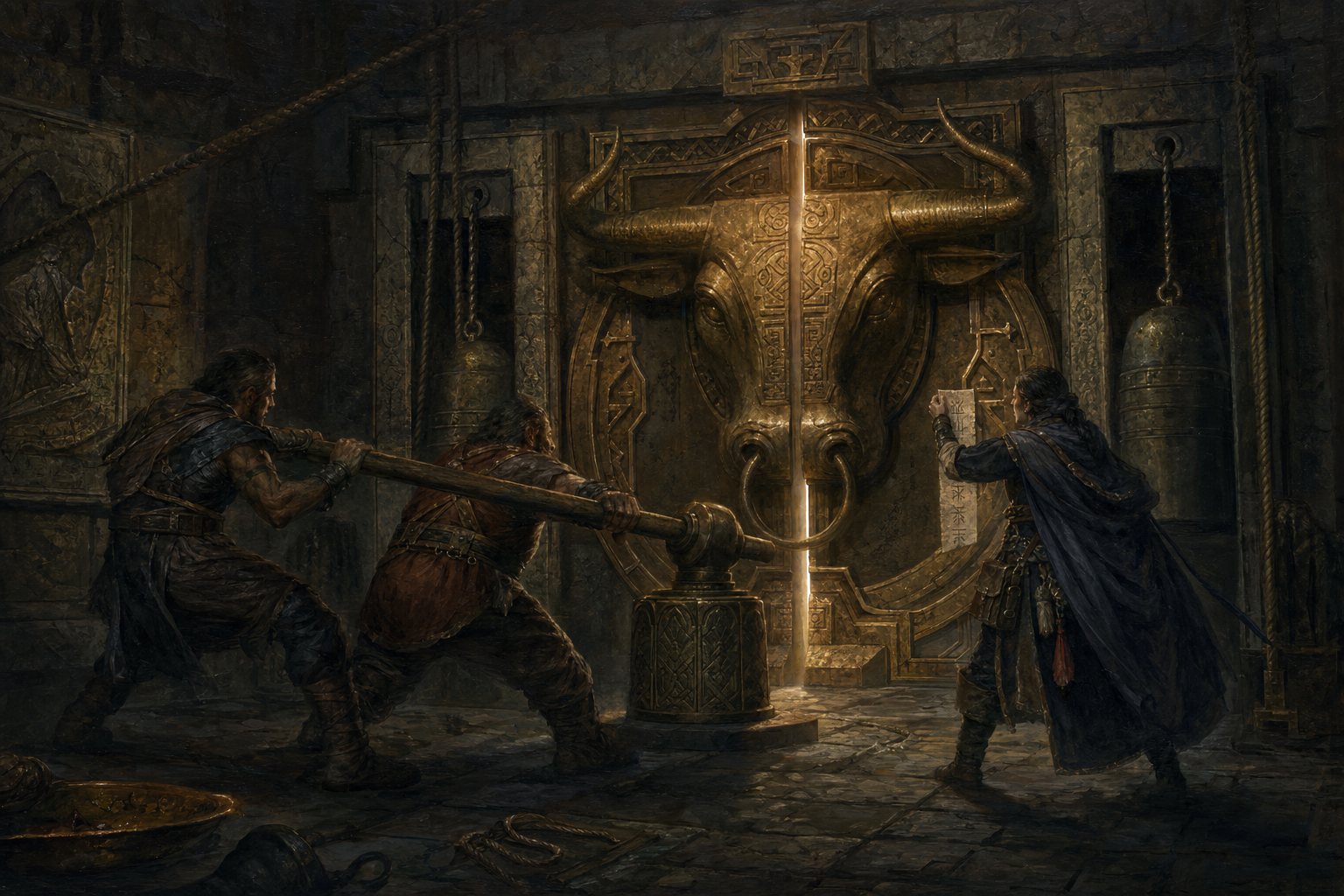
The chamber is a diagram of itself. Everything in it is doing something.
A chain as thick as your thigh comes out of the ceiling, turns twice around a bronze drum, and goes into the floor. Two counterweight cages hang at different heights, both of them full of quarried stone. A capstan with four arms. A socket in a plinth, bull-headed, worn bright at the lip.
And, faintly, through the wall, the sound of the sea and the gulls and the outside world going about its afternoon eight feet away.
The Way Out
The great bronze gate is counterweighted, and the counterweights are in here. Wind the drum, drop the weight, and the gate rises — that is all. Daedalus did not hide it and did not lock it. He did something better: he made it require three things at once, so that no one person and no cornered animal could ever work it.
- The horn-key turned in the plinth socket, which releases the drum pawl.
- The capstan wound, four arms, which takes six hundred pounds of pull.
- The counterweight cage loaded and dropped at the right moment.
Get all three and the gate opens smoothly in ninety seconds. Get two and the machine groans and stops. The Resolution is the coordination problem, and the party will solve it by working out who stands where — which is exactly the scene a thief's crew in B06 came here to run.
Requirements
| Requirement | Where it comes from |
|---|---|
| The horn-key | A bronze bull's horn, cast hollow, with three flats filed on it. R065 Gate of the Two Bulls has the pair it was cast from — one true, one false. R074 Stalls of the Bronze Herd has one on every mechanical bull, and prying one off is Athletics DC 15 and very loud. B06's client sketch is a drawing of this object |
| Raising the counterweight | 600 lb of pull. R085 Chamber of the Weighing Chain teaches the trick — it is the same gearing, built for a minotaur, and the pulley advantage is written on the wall. With the trick, one strong character and a rope; without it, four characters at Athletics DC 15 as a group check |
| Three stations at once | Six PCs makes this comfortable and four makes it a real problem. The capstan can be pinned with a crowbar, a spear shaft, or the horn-key itself, at Investigation DC 14 — the party's own cleverness is the intended answer |
| Understanding it first | R045 The Bellows Gallery and R021 The Weighing Floor both drill the party in reading a Daedalan mechanism before touching it. Investigation DC 13 here maps the whole machine and turns every subsequent check into a straight success |
Clues
| Tier | Line to deliver |
|---|---|
| Whisper | A deep, slow tick through the stone, at about the rate of a resting heartbeat. It has been there since you arrived and you only just noticed it. |
| Trace | Bronze filings in a floor seam, and a smear of tallow grease on the wall at the exact height of a chain. |
| Sign | A maintenance schedule cut into a pillar: a drum, a weight, and a hand — three symbols, three columns, and a tally of how many times each has been serviced. |
| Proof | A bull's horn of cast bronze, hollow, with three flats filed along it, lying in a rack of tools that are all much too big for a man. |
| Path | A chalk diagram on a corridor wall, drawn by somebody who was working it out as they went: a drum, two cages, a capstan with four arms, and an arrow. |
| Door | The chamber itself, the chain coming out of the ceiling — and daylight in the seam at the bottom of the wall, eight feet away, with gulls on the other side of it. |
Resolution Scene
Fifteen to twenty minutes, and the decision is who does not get to help.
The party has the horn-key and the chamber. The machine needs three roles filled simultaneously, and something is coming.
The three stations.
| Station | What it needs | If unmanned |
|---|---|---|
| Plinth | The key turned and held for the full ninety seconds | The pawl re-seats and the drum locks after one turn |
| Capstan | 600 lb of pull, sustained. Athletics DC 15, or DC 10 with the R085 pulley trick, or free with a pinning bar | The gate rises four inches and settles back |
| Cage | Someone to knock the chocks out at the right moment — Dexterity or a called action on round 3 | The gate opens halfway and stops, which is enough to crawl under at the cost of one round each and a Dexterity save |
The interruption. On round 4 of the 9-round sequence, something arrives — the Cult of the Thread (W18) if the party has been noisy, mechanical bulls off the rails of R074 if they stole a horn, or the finale's own retinue if the finale is behind them. One wave, three to four bodies, and they go for the stations, not the party. This is the fight this Resolution exists to have: a defence of three points by a party that cannot spare anybody.
The pinning solution is the good ending. A party who jams the capstan with a crowbar and frees two people to fight has solved Daedalus's machine, and should be told so — by the machine working, and by the gate coming up smooth.
Fallback
No key, no strength, or the sequence collapses. The chain is the fallback and it is a bad one, which is the point.
- Break the chain. Two rounds of concentrated work on the drum's weakest link (AC 19, 40 HP, resistant to everything but bludgeoning and force), or drop a counterweight cage onto it from height.
- What happens: the free weight falls, the gate slams up eighteen inches, and the whole mechanism tears itself off the wall. Everyone in the chamber makes a Dexterity save (DC 15) against 3d10 bludgeoning from flying bronze.
- The party crawls out under a door eighteen inches high, on their bellies, one at a time, in the open, having made the loudest noise in the history of Knossos.
- And the gate never closes again. The Labyrinth is open at the front. Whatever the party has met down there now has an afternoon and a road. Say this out loud as they crawl.
Resolution-owned, never on the loot table.
- The bronze horn-key. Hollow cast bronze, three filed flats. It works this gate and it works R065 and R085, and any Daedalan socket the DM cares to put in front of the party later. A key to the front door of the Labyrinth of Knossos.
- The pulley trick, written down. A page of gearing that gives its holder advantage on any check to move something enormously heavy with rope and time.
- B06's contract fulfilled, if the horn was the sketched object all along — and it should be, unless the DM has a better idea. The client did not want the beast. They wanted the key to the door.
Scaling — APL 6 / 12 / 15
| APL | Adjustment |
|---|---|
| 6 | Two stations instead of three: the cage is already chocked. DCs −2, and the interruption is two bodies |
| 9 | As written |
| 12 | Four stations — a second pawl on the far side of the drum — and DCs +2. Two waves of interruption, on rounds 3 and 6 |
| 15 | As APL 12, and the chain is rigged: the Cult wedged the drum eight days ago, which must be found (Investigation DC 17) and cleared before anything turns. Three waves |
- Draw the machine. Genuinely draw it, on a scrap of paper, in front of the players — drum, two cages, capstan, plinth. A coordination puzzle they can see is a ten-minute delight; the same puzzle described aloud is a twenty-minute argument.
- Six PCs is exactly the wrong number, deliberately: three stations, three defenders, and nobody spare. If the table is four players, hand them the pinning bar earlier and let them feel clever rather than short-handed.
- The daylight in the wall seam is the whole emotional payload. Eight feet of bronze between the party and the afternoon, and the only way through it is to make a machine work. Mention the gulls twice.
- The broken-chain fallback should feel like vandalism, because it is. A party who takes it wins and leaves the front door of the maze open behind them, and that is a hook, not a punishment. Write down that it happened.
- If the party is out of time, hand them the key, let one Athletics check stand for the capstan, and run the interruption as a single round of pressure. Eight minutes and the gate is up.