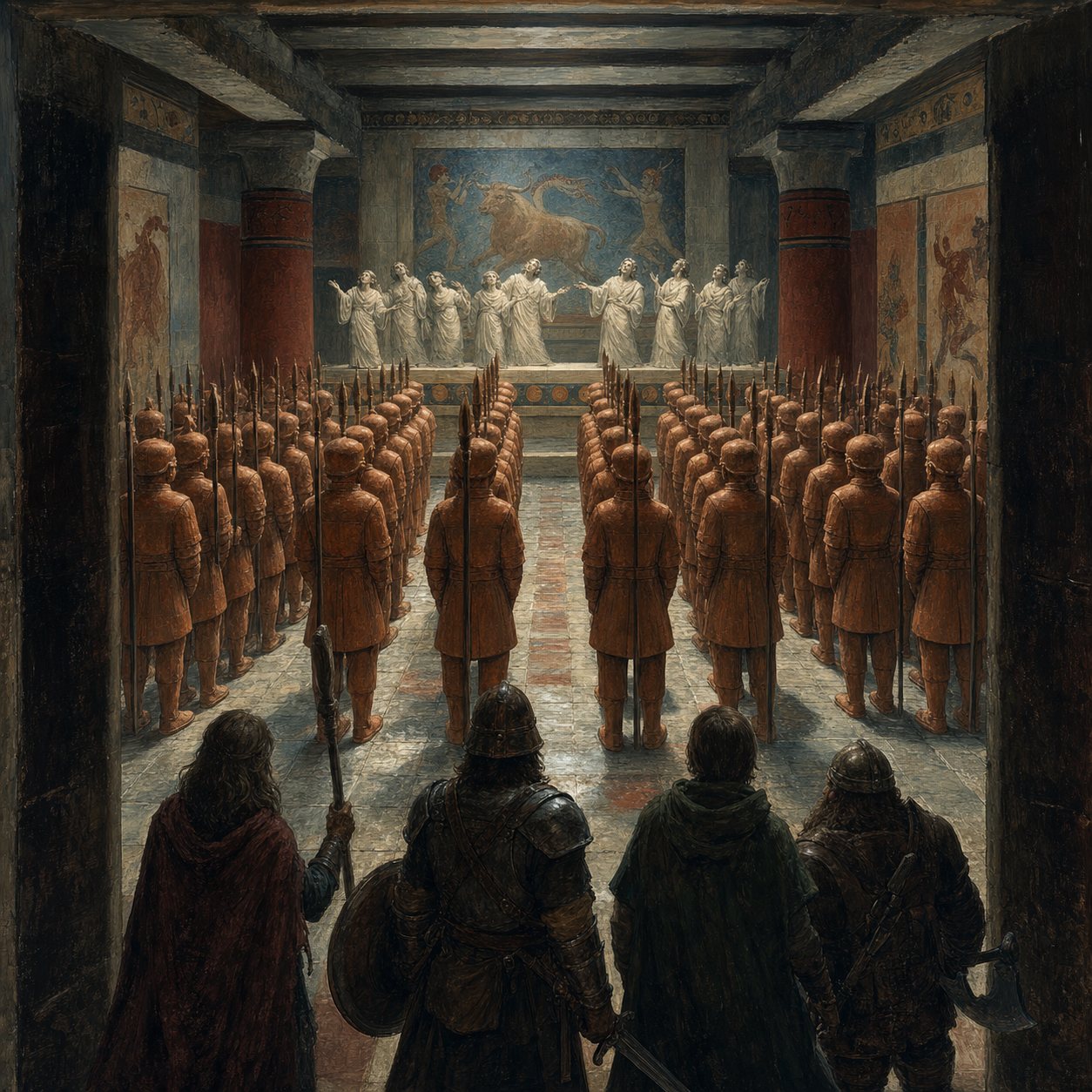
Sixty clay soldiers stand in four ranks of fifteen, facing the far wall, spears at rest. They are the height of men and the colour of flowerpots, and their faces are all the same face. The room smells of a kiln that went out a long time ago.
At the far end, on a low plinth, one of them is turned around. It is facing you, and it has a bronze rod in its hand instead of a spear, and while you are looking at it, it does not move at all.
DM summary. Sixty statues, two of them awake, and the drill-master on the plinth can wake more with a bronze baton if the party gives it time. The fight is small; the room is about which sixty-fourth of it is going to move.
Terrain & Features
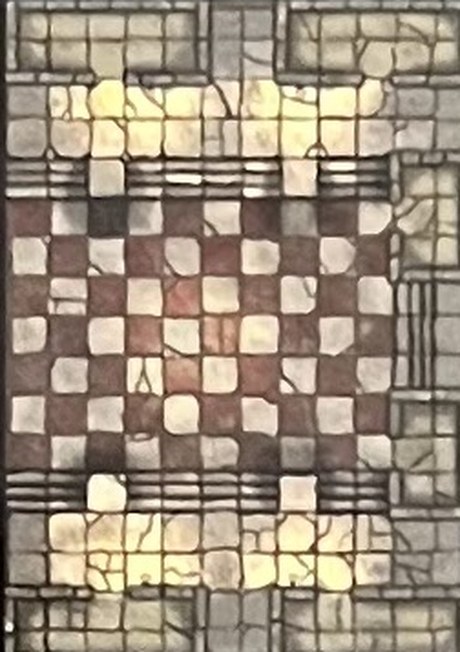
Battle map: The Hall, East End — page 30, 55 × 75 ft (one half of The Great Hall)
The chequerboard drills the ranks for you: stand the sixty terracotta soldiers on its squares, four ranks of fifteen, 5 ft apart. Draw the 10-ft plinth at the north end and mark the kiln-vents' red glow along the west wall.
- Dimensions. 60 ft × 40 ft, ceiling 18 ft. The party enters at the short south wall, behind the ranks.
- Light. Dim, from a bank of kiln-vents in the west wall that still hold a little heat and a red glow. Nothing here casts a shadow you can trust.
- The ranks. Four ranks of fifteen, 5 ft apart in both directions. The ranks are difficult terrain for anything Medium or larger — moving through them means turning sideways between clay shoulders — and they give half cover in every direction, to the party as much as to anything else.
- They shatter. A destroyed terracotta soldier — animate or not — leaves a 5-ft square of sherds that is difficult terrain for the rest of the scene. A party that smashes its way through the ranks is building a wall behind itself, and will regret it if they need to leave in a hurry.
- The plinth. 10 ft × 10 ft and 2 ft high at the north end, with the drill-master on it. It is hollow and it is not fixed to the floor.
- The kiln-vents. Six brick openings in the west wall, each 3 ft square, still warm, going somewhere. A person fits.
- The armoury rack. Behind the plinth, a rack of real bronze — spears, two hoplons, a helmet — issued to whoever was supposed to drill these and never collected.
Encounter
Two awake out of sixty, and a baton that can change the arithmetic.
| Count | Creature | XP each |
|---|---|---|
| 1 | Terracotta Soldier | 700 |
| 1 | Choirmaster of the Plinth | 3,900 |
Base 4,600 XP; ×1.5 for two bodies = 6,900 adjusted, against the APL 9 Medium budget of 6,600 — three hundred over. The wake clock below is deliberately outside that number, exactly as R001's spawn clock is: it is the room's pressure, not its budget, and a party that leaves the drill-master conducting for six rounds is fighting a Hard encounter it built itself.
The wake clock. At the end of every second round, the Choirmaster beats the bronze rod once against the plinth and one more Terracotta Soldier in the ranks animates, acting from the next round. Maximum four extra. The clock stops the moment the rod is taken, broken, or the plinth is toppled.
Round 1, and the surprise. The one awake soldier is standing in the third rank, indistinguishable from its neighbours, and it attacks the nearest character from inside the formation. Unless the party has checked the ranks (see below), it and the Choirmaster get a surprise round. The Choirmaster spends that round beating the rod, not attacking; it is a conductor and it conducts.
Tactics. Terracotta Soldiers are slow, keep their rank spacing, and never pursue past the ranks they belong to. The Choirmaster does not leave the plinth while it has bodies to conduct; strip its ranks and it comes down and fights badly, alone, and it knows it. Nothing here follows the party out of the room.
Traps / Puzzles / Checks
Telling the awake from the fired. This is the room's actual game and it is free to anyone who looks.
| Element | Value |
|---|---|
| Check one rank | One action, Investigation DC 14, from within 10 ft of it |
| The tells | Fresh clay dust at the feet (it has shifted its weight), no kiln crack along the shoulder seam, and warmth — an animate soldier is faintly warm and the rest are cold to the touch |
| Success | You know which figure in that rank is awake, or that none is. Mark it |
| Effect on the ambush | Checking the rank that holds the awake soldier cancels the surprise round entirely. Checking any other rank narrows it and gives the party's own scout advantage on the next rank |
| Passive | A character with passive Perception 16 or better notices the dust at the third rank's feet as they walk in, no action, no roll. Give it to them; the room is better when somebody spots it |
| Hiding among them | The party can play the same trick: Stealth DC 15 to stand in a gap in the ranks. An animate soldier walks straight past a hidden character, and the Choirmaster does not count its own ranks |
The bronze rod. The wake clock's whole mechanism, and there are four ways to take it away.
| Approach | Number | Cost of failure |
|---|---|---|
| Grapple the rod-arm | Athletics DC 14 contested by the Choirmaster | You are adjacent to it, on its plinth, alone |
| Snatch it | Sleight of Hand DC 16 | It beats the rod on the same turn: one extra wake |
| Break it | AC 15, 10 HP, and a bronze rod resists piercing | Nothing extra; it is just a wasted attack |
| Tip the plinth | Athletics DC 15, two characters, from behind | The plinth rocks and settles. Second attempt allowed at the same DC |
Solved state: rod gone or plinth over. No further soldiers wake, and the ones already awake keep going until they are down.
Exits
One roll on the loot table: the armoury rack behind the plinth — real bronze, issued and never drawn. Reaching it means getting to the north end, by fighting, by the outside aisle, or by hiding in the ranks and walking past everything.
Sixty clay spears are sixty clay spears. Let somebody take one and let it snap on the first parry, and do not warn them, because that is the sort of room this is.
Scaling — APL 6 / 12 / 15
| APL | Adjustment |
|---|---|
| 6 | No Choirmaster: three Terracotta Soldiers scattered through the ranks and no wake clock. All DCs −2 |
| 9 | As written |
| 12 | Two awake soldiers to start, the wake clock runs every round to a maximum of six, and a Marble Chorister stands at the plinth's foot singing the ranks into step. DCs +1 |
| 15 | Three awake to start, wake clock every round with no maximum, and the Choirmaster reassembles a shattered soldier from its own sherds once per round as a bonus action — the sherd terrain works against the party twice over. DCs +3 |
- Pacing: twelve minutes. It is a Medium fight with a search mini-game bolted to the front. Behind schedule? Skip the wake clock, have the awake soldier already stepping out of rank as the party enters, and run it as two bodies in a cluttered room. Six minutes.
- Make them look before they walk. Describe the sixty faces and then wait. If nobody investigates, the surprise round is earned and the table learns the lesson in one round of damage rather than a lecture.
- Count the wake clock out loud on even rounds. "The rod goes down. Second rank, fourth from the left, turns its head." Naming the position each time makes the room feel like a machine filling up.
- Do not let the party clear all sixty. If someone starts methodically smashing statues, let them do two, then point out — through the sherds underfoot — that they are filling the room with rubble. The fight ends at the plinth, not at the ranks.
- Table safety. None needed. This is the least intense room in this batch and it is a good one to roll after something that was not.
- Clue drip. Two objects: the armoury rack's issue-tally, a bronze plate listing what was drawn and by whom, ending nine years ago with a name and the word gate (X08), and the Choirmaster's rod itself, which is a Daedalan tuning bar with the same maker's mark as every bronze thing in the maze — and which, struck against the right metal, is a key of a sort (X20).
- Callback. Clay & Marble (W16) are slow, many, and hard to move, and their elites conduct rather than fight. A party that has met a marble choir already should look for the plinth before they look for the enemy, and this room rewards that instinct in the first thirty seconds.
Creature Cards
Both belong to Clay & Marble (W16) and recur across the deck, so the numbers live in the bestiary. The wake clock, the rank-checking, and the rod are this room's.
Shared across rooms, so the full cards live in the bestiary: Terracotta Soldier, Choirmaster of the Plinth. Every mention above opens the numbers here on this page.