Vault of the Salt Wind
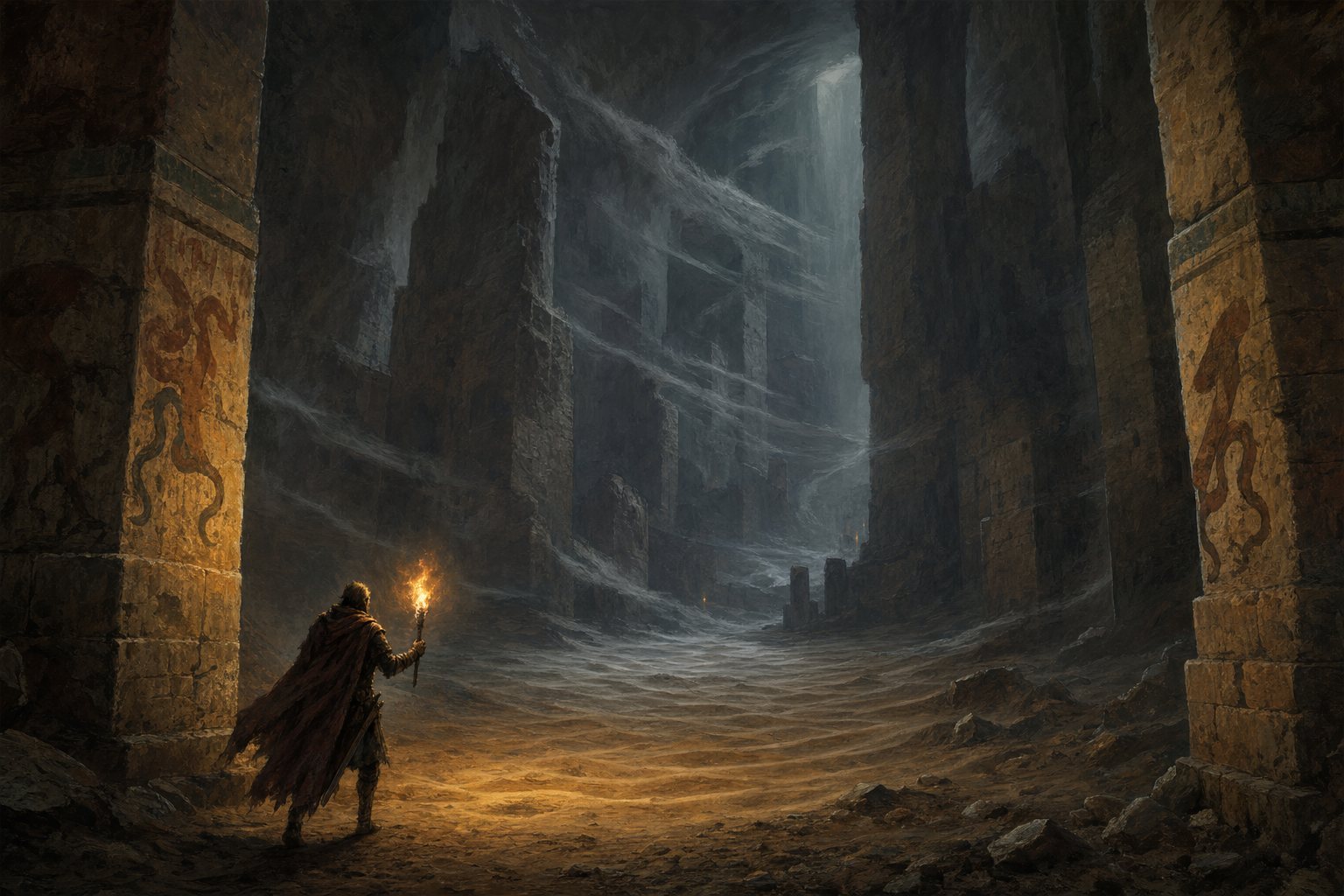
This is not a room anyone built. The walls go out and up past what your light can hold, the floor is dry rippled sand over rock, and the air moving through it is cold and moving fast.
It tastes of salt. Not the salt of old stone — the other one. Somewhere out past the north-west wall there is weather.
Under the crack where the wind comes in there is a low white drift, and when you get close enough it turns out to be birds. Hundreds of them. Gulls, small bones and hollow, layered like snowfall, going back years.
DM summary. The room where the party learns which way the sea is. No threat, no puzzle, one bearing — and the bearing is worth more than most of the loot in this deck.
Terrain & Features
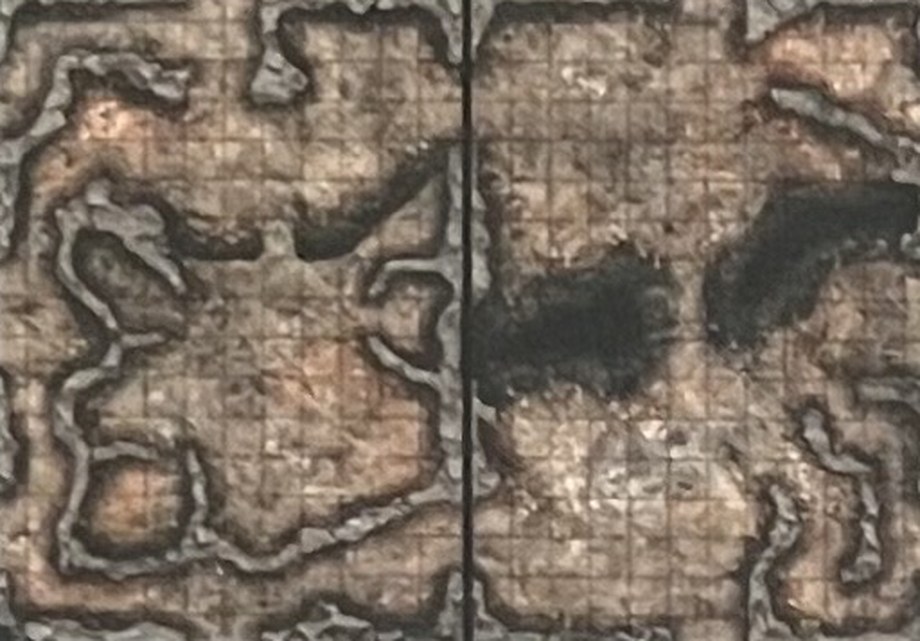
Battle map: The Broken Galleries — pages 15 & 16, 110 × 75 ft
The full cave spread at 100 × 60 ft is the sea-cave. Treat the printed pit as the old collapse — its floor is the gull-bone drift — and wipe the bridge. Chalk the fissure high on the north-west wall and the salt line beneath it.
- Dimensions. 100 ft × 60 ft, ceiling 40 ft, natural. A collapsed sea-cave the maze ran into and stopped digging.
- Light. None, and it swallows what you bring — a torch lights 20 ft of a hundred-foot room, which is the point of the tag on this entry.
- The crack. North-west wall, 25 ft up, a fissure nine inches at the narrowest and forty feet long. It is where the wind comes from and it is the only honest thing in the Labyrinth. Reaching it is a scramble up broken rock: Athletics DC 12.
- The gull drift. Sixty feet of white bone under the crack, knee-deep at the centre. Gulls come in on the draft, cannot find the way out, and die here. It has been happening for a long time.
- The salt line. A crust on the north-west wall, thick at the bottom, thin at head height, banded like tree rings.
- The ship's strake. A curve of oak with three bronze nails in it, wedged in the fissure eight feet up. It came in through the crack. Whatever it was part of is on the other side.
- The sand. Rippled the way beach sand ripples, which is the tell: water has been in here, and water that ripples sand is water that moves.
Traps / Puzzles / Checks
Nothing here is dangerous. Four things here are readable, and one of them changes how the party plays the rest of the session.
| Element | Value |
|---|---|
| The bearing | Stand under the crack; the draft is unambiguous. Survival DC 12, or free with navigator's tools, a lodestone, or any character who has been to sea. Fixes the direction of open water relative to this room |
| What the bearing buys | Once per session the party may declare they are heading seaward. On their next d100 room roll they roll twice and take either result. Then it is spent — a direction is not a map |
| The salt line | Survival DC 14 or Nature DC 14: nine bands, and the bands are days. The water that made them comes and goes on a cycle, which means tide, which means the sea is at this level, not above it |
| Surf | Perception DC 13 in total silence with everyone holding still: a six-count boom under the wind. Something big is breathing out there |
| The strake | Investigation DC 12: oak, bronze-nailed, Knossian work, and the break is fresh — under a year. History DC 14 dates the nail pattern to the royal yards |
| The gull with the ring | Investigation DC 15 in the drift, or free if anyone spends ten minutes turning bones over: one leg bone carries a fisherman's bronze tally-ring, stamped with a boat's mark. Someone alive, recently, on the water, close enough that their bird got lost in here |
Exits
None, and it is worth saying why out loud. This is a hundred-foot room and there is nothing in it. The gulls took what was shiny and dropped it out at sea, and the sea took the rest.
The fisherman's tally-ring is worth two drachmae and it is worth a great deal more as an argument, so let a player keep it and do not make them roll for it.
Scaling — APL 6 / 12 / 15
| APL | Adjustment |
|---|---|
| 6 | The crack is already a squeeze — no widening needed. All DCs −2, and the bearing is free to anyone who stands under the draft |
| 9 | As written |
| 12 | The draft is intermittent: it reverses every few minutes and half the readings are wrong. DCs +1, and the bearing requires two successful Survival checks taken ten minutes apart |
| 15 | As APL 12, and the gull drift is not only gulls. Something has been coming in through the crack to eat, and its leavings are in the bone. DCs +3; if you want a threat here, a lone Storm-Crow watching from the fissure is enough, and it should not fight — it should leave, loudly, to tell something |
- Pacing: 8–10 minutes. It is a quiet room and it should be quiet. Put it after something loud.
- If you are behind schedule, give the bearing in the read-aloud — "the wind is coming from over there and it tastes of the sea" — and let the party leave in three minutes with the thing that matters.
- Run the silence. Ask the players to stop talking and tell them what they hear over about ten seconds of actual table quiet. It works every time and it costs you nothing.
- Do not put a monster in here. This is one of ten rooms in a hundred whose job is to be safe, informative, and slightly awe-inspiring. If the party is bored, that is a scheduling problem, not a room problem.
- Table safety. None needed. If anything, this is the room to run after an intense one, deliberately.
- Clue drip. This room is built for the seaward Resolutions and carries the strongest early hooks for three of them: the salt line is X16's tide table in raw form, the runnel with the draft going down it is a Trace-tier clue for X11, and the bearing itself is X14's datum — a known direction from a known point, which is exactly what a party mapping its own way out needs. If your Resolution is none of those, the ship's strake is still a fine Whisper: somebody's boat came apart within a year, close enough to hear.
- The one line to land. When a character puts their hand in the draft, tell them their fingers are cold in a way nothing underground has been cold. Then let the table sit with it for a beat before somebody says "which way is that".