Gymnasium of Dead Champions
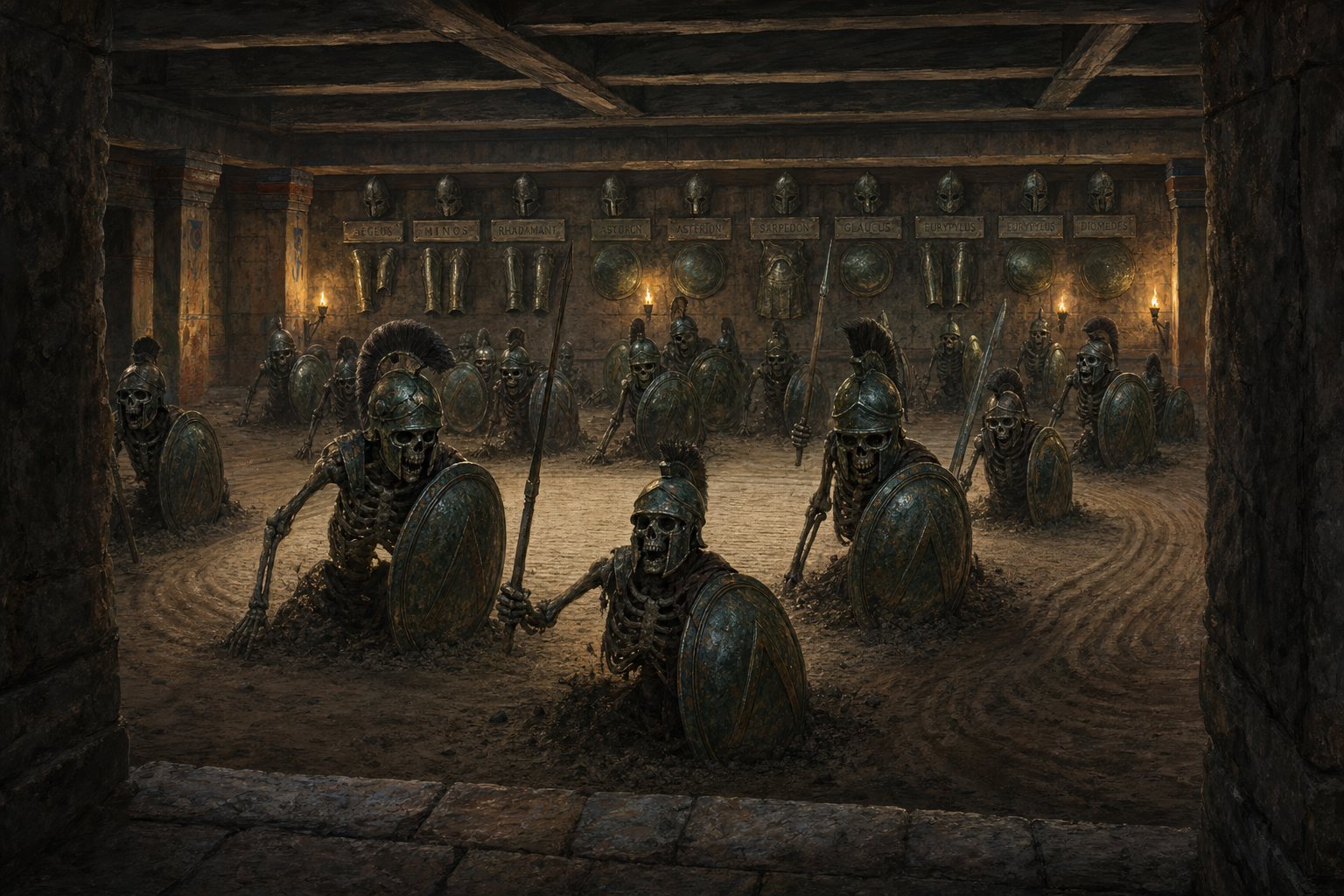
Somebody dug a stadium down here. There is a square of raked sand in the middle of the floor, a packed running track worn in a long oval around it, and along the far wall a rack of bronze — helms, greaves, shields, prizes, hung on pegs with names punched into them.
Four skeletons stand at the four corners of the sand. They are not wearing armour. They are oiled, and dusted with sand over the oil, the way a man does before a bout, and each one is holding the tool of a different event. None of them moves. All four of them are facing the sand, not you.
DM summary. Four dead champions who do not care that the party exists until the party steps onto the sand or touches the prizes. The east door opens for anyone holding a victor's token, and there are three honest ways to get one — only one of which involves fighting anybody.
Terrain & Features
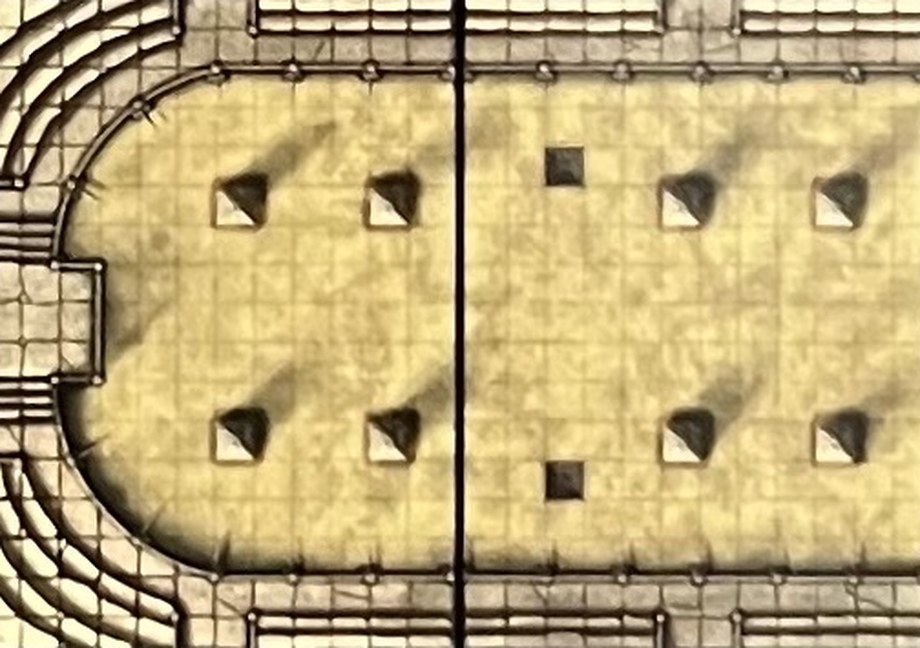
Battle map: The Hippodrome — pages 31 & 32, 110 × 75 ft
The hippodrome is the gymnasium: its sand is the 40 × 40 ft skamma (chalk the bronze channel as its edge) and the printed track is the dromos circling past all three exits. Hatch the trophy pegs along the east wall.
- Dimensions. 90 ft × 60 ft, ceiling 30 ft — a real hall, and one of the few rooms in the deck where a longbow is worth having.
- Light. Four bronze cressets on the long walls, lit, burning something that smells of olive oil and old sweat. They have been burning for a very long time.
- The skamma. A 40 ft × 40 ft square of raked sand, edged in a shallow bronze channel. The channel is the rule. Everything in this room turns on which side of it you are standing on.
- The dromos. A packed-earth running track, 10 ft wide, circling the sand and passing all three exits. It is bare, level, and safe.
- The trophy rack. Sixty pegs along the east wall; forty-one still hold something. Every piece is punched with a name and an event. Nine of the pegs hold small bronze discs the size of a palm — victor's tokens — and the door beside the rack has a matching disc-shaped socket beside the handle.
- The bone drift. Under the rack and along the base of the walls, the losers: a knee-deep bank of bone, undisturbed, swept there tidily. Difficult terrain, and the only place in the room the champions will not step.
Bypass Options
The champions want a bout, not a battle. A PC who steps into the channel with an implement in hand rather than a weapon is offered one event, and the other three step back to watch.
- Choosing: the party picks the event, which is the whole tactical decision. Stadion (sprint, one length): Athletics DC 16. Halma (jump with the stone weights): Athletics DC 17, or DC 14 for anyone with a jump bonus. Diskos (throw for distance): Athletics DC 15. Pale (wrestling, two falls): contested Athletics against +10, twice.
- Success: the champion hands over its own token, unhurt and apparently pleased. That token opens exit B. One token is enough for the whole party.
- Failure: the PC takes 2d10 bludgeoning from the fall or the throw and is out of the sand. The party may enter one more event with a different PC.
- Second failure: the champions consider the account settled and stop offering. The sand is now closed, the door stays shut, and the party takes another exit or dedicates instead.
- Cheating: magic, flight, and enhancement are all fine — these are dead men, not a rules committee — but a PC who attacks mid-bout has struck a champion, and you know what that means.
The old practice: when you stop competing, you hang your kit on the rack and say who you were.
- What it costs: a real, used weapon, shield, or piece of armour belonging to a PC. Not rope, not a spare dagger, not a rock. The champions know the difference and you should adjudicate meanly here.
- The check: Religion DC 13 to say the dedication correctly, free for any PC with a background that ever competed, and free for anyone who simply says something true about themselves out loud at the rack.
- Success: a token is taken off a peg and put in the dedicator's hand. Exit B opens. Nobody fights.
- Failure: the dedication is refused, the item stays on the rack anyway, and the party can try once more with a better item or a better speech.
The pure avoidance, and the fastest route through this room.
- The check: none. Stay on the packed earth, keep hands empty, do not enter the channel. Exits A and C are both reachable from the track without a roll.
- The only risk is a party member who wants a souvenir. Sleight of Hand DC 18 to lift something off the rack unseen; four skeletons with passive Perception 13 are all facing the sand and none of them is facing the rack, which is why the DC is achievable at all. Failure is the encounter above.
- Cost of withdrawing instead: the party can leave the way they came at no cost but time, and this room's clue drip does not happen.
Encounter
Four champions, one card, four completely different fighters.
| Count | Creature | XP each |
|---|---|---|
| 4 | Champion of the Gymnasium | 2,300 |
Base 9,200 XP; ×2 for four bodies = 18,400 adjusted, against the APL 9 Deadly budget of 14,400. Nearly a third over, and the four of them fight as four specialists rather than a block, which is worse than the number looks.
Why they are not attacking. They are competitors, not sentries. The rule they kept in life is the only thing they kept: you contest a man who comes onto the sand, and you do not touch a man who does not. A party can walk the whole length of this room on the track, in the open, in torchlight, and be entirely ignored.
What starts it. Exactly three things: stepping into the bronze channel; taking anything off the rack that you did not put there; and striking one of them. Nothing else. Not talking, not looting the bone drift, not opening doors.
Round 1, if it starts. All four step onto the sand and none of them steps off it — the fight comes to them, and a party that stays on the track is fighting four things that will not close. Expect that stalemate and enjoy it; then have Straton break the rule (see below), because one of them always does.
Tactics, by name. They share a stat block and no two of them play alike.
- Oinomaos of the Discus stays at the far corner and throws. He targets whoever is casting, at 60 ft with no cover between them, all day. He is the reason the room is 90 ft long.
- Antilochos of the Long Jump carries stone halteres and uses Set the Feet to cross the sand in one bound. He lands next to whoever moved last and makes that a mistake.
- Pheidon the Wrestler does not strike; he grapples, drags to the middle of the sand, and pins. A PC pinned by Pheidon is out of the fight and being watched by three others. He is also the one the party can actually kill for good, because a champion put down while prone does not stand back up.
- Straton the Pankratiast has no event and no rules. He steps off the sand on round 3 and goes after whichever PC has hurt his brothers most. When he does, say so out loud — it is the moment the room stops being fair.
If the party fights anyway. Four CR 6 specialists on open ground can kill a level 9 party, and the party will have started it by stepping over a line they were shown. That is the honest cost. Two mercies exist and both are real: the three rule-keepers never leave the sand, and a party that puts its weapons down and steps back over the channel ends the contest — the champions return to their corners, insulted but finished. They may also simply withdraw out any door; nothing but Straton follows, and Straton stops at the doorway.
Traps / Puzzles / Checks
The trophy door (exit B).
| Element | Value |
|---|---|
| Trigger | A victor's token pressed into the socket beside the handle |
| Understood by | Investigation DC 12 — the socket, the discs, and the punched names read together |
| Forced by | Athletics DC 20 against bronze-faced oak, or 40 damage to the panel (AC 17), either of which is loud and counts as touching the rack |
| Solved state | The door stands open permanently and the token stays with the party as a keepsake with no further use |
Reading the names on the rack: History DC 14. They are the names of athletes who competed at Knossos across roughly two hundred years, which is not possible, and the most recent one was punched in a script nobody used before last century. Somebody is still adding to this rack.
Exits
Room-specific: the Alabastron of the Unbeaten. A palm-sized flask of ribbed alabaster in the oil-store, still stoppered, still full. Found automatically by anyone who takes exit C, or with Investigation DC 14 at the rack, where a second one hangs on a peg beside a helm.
- Three doses. Anointing yourself is an action.
- For 10 minutes after anointing, you have advantage on checks and saves to escape or avoid being grappled or restrained, and creatures have disadvantage on attempts to grapple you.
- It smells of crushed olives and iron and it does not wash off; while anointed, you have disadvantage on Stealth against anything that hunts by scent.
Nothing else in the room is loot. The rack is dedications, and taking dedications is theft, which the room has strong opinions about.
Scaling — APL 6 / 12 / 15
| APL | Adjustment |
|---|---|
| 6 | Three champions, and Straton keeps the rule like the others. Event DCs −2, and the door's forcing DC drops to 17 |
| 9 | As written |
| 12 | Five champions — a fifth, Kleitos the Boxer, waits on the rack side and defends the trophies specifically. Event DCs +1, and Pheidon pins on a success by 3 rather than a success by 5 |
| 15 | Six champions, all of whom leave the sand on round 3, and the sand itself is sown — a champion killed on the sand and left there stands up in two rounds as a Bronze-Tooth Hoplite. Event DCs +3 |
- Pacing. Fifteen to twenty minutes if the party competes, which they should. Four if they walk the track. Behind schedule: skip the events, put a loose token in the bone drift (Investigation DC 13), and let the room be a ninety-second held breath and a door. It still works.
- Run the events like a scene, not a roll. Describe the champion going first — Oinomaos throws sixty feet with no wind-up, Antilochos lands and does not stumble — then ask the player how their character is going to beat that. A good answer is worth advantage. This is the deck's one sports room and it should feel like one.
- One card, four fighters. The stat block below is printed once and used four times deliberately. Their names and habits are in the tactics above and doing the work; do not give them different numbers, give them different verbs.
- Clue drip. Two objects here take a clue well: the most recent name on the rack, punched in a modern hand, which tells the party somebody living still comes here and suits X14 (A Thread of Your Own Making) or X05 (Carry Them Out); and the feathered helm-crest on peg forty-one, grey quills wired into bronze, which suits X17 (The Wings of Icarus).
- Table safety. Low intensity — this room is bones being sporting. The one place it turns is Pheidon's pin, which is a held-down, cannot-move beat. If that is a bad note for your table, he throws instead of pinning.
- Warband callback. Sown Bones fight in ranks everywhere else in the deck. These four are the exception and the party should feel the difference immediately: no shield wall, no line, no formation — four individuals who were somebody, which is precisely why they are harder.
Creature Cards
The champions are unique to this room and share one card. Their names, and the differences that matter, are in the Encounter above.
Champion of the Gymnasium
Medium undead, unaligned · CR 6 (2,300 XP)
AC 16 (unarmoured, oil and sand) | HP 90 (12d8 + 36) | Speed 40 ft.
Saves Str +7, Dex +6 · Skills Athletics +10, Acrobatics +6 · Immune to poison damage, exhaustion, poisoned · Darkvision 60 ft.
The Rule of the Sand. It will not attack a creature standing outside the bronze channel, and it will not pursue past the channel. Straton the Pankratiast ignores this trait from round 3 onward.
Fell Fair. The first time it drops to 0 hit points it stands with 15 hit points at the start of its next turn, unless it was prone, grappled, or restrained when the blow landed.
Multiattack. Two bronze-bound fist attacks, or one fist and one grapple.
Bronze-Bound Fist. Melee, +7 to hit, reach 5 ft. Hit: 11 (2d6 + 4) bludgeoning damage.
Cast the Implement. Ranged, +7 to hit, range 60/180 ft. Hit: 13 (2d8 + 4) bludgeoning damage, and a Medium or smaller target makes a DC 15 Strength save or is knocked prone.
Set the Feet. It jumps up to 20 ft in any direction without provoking opportunity attacks and without needing a running start.
Trip the Runner. When a creature within 5 ft moves more than half its speed, the champion makes a DC 15 Dexterity save contest against it; on a win the creature is prone and its movement ends.