The Cartwheel Rotunda
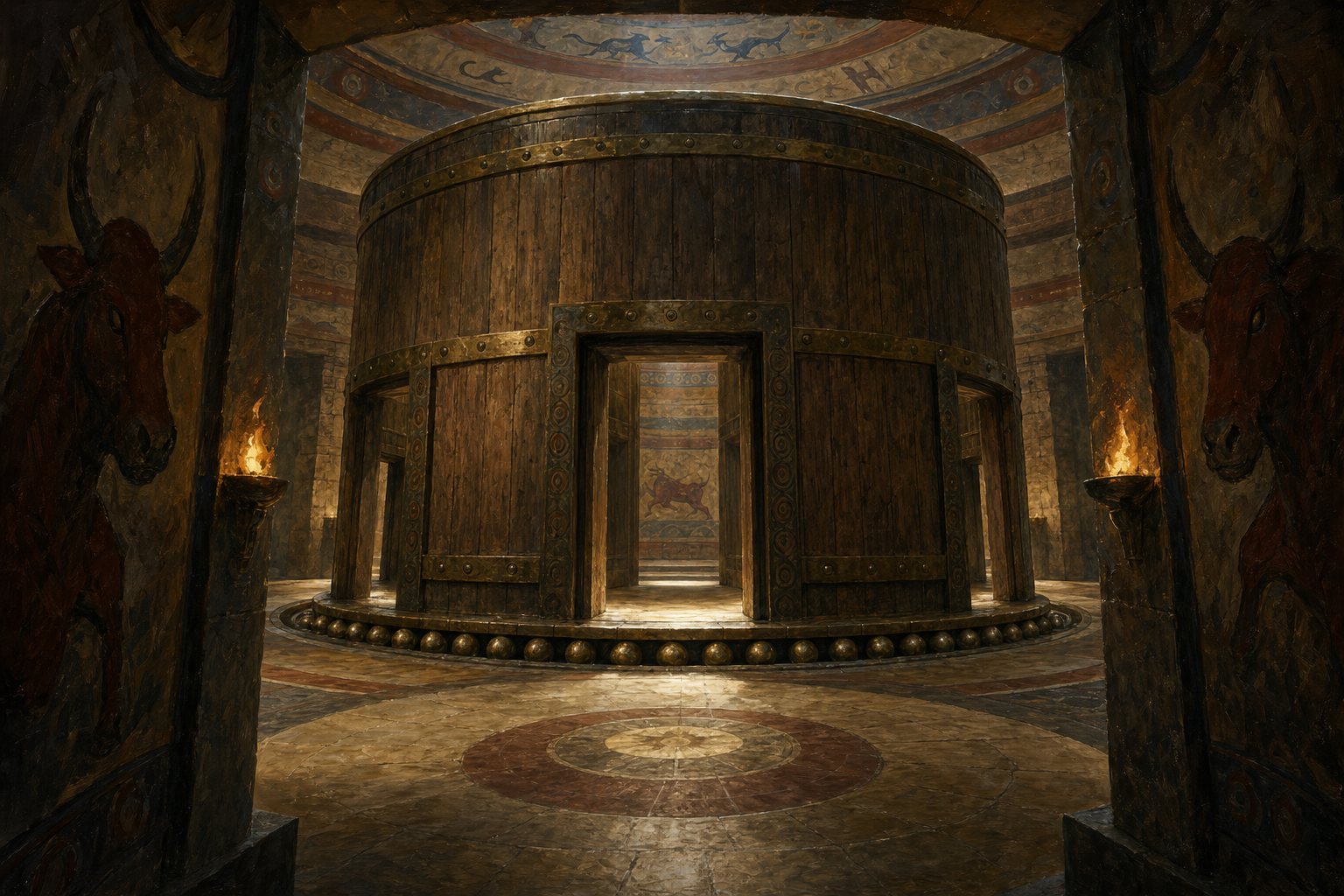
A round room inside a round room. The inner wall is a drum of bronze-banded timber forty feet across with five doorways cut through it, and it does not quite touch the floor — it stands on a groove full of bronze balls the size of apples, and when the last of you steps through, the whole thing moves. Not fast. A hand's width, with a sound like a millstone settling.
Behind you, where the doorway was, there is now wall.
DM summary. A turntable with five doors in it and four corridors outside it, and it indexes one notch every time somebody walks through a doorway. Nothing here is hostile. The party is not trapped and never can be — at every position at least one way out is open — but they cannot get to the particular way out until they work out that the room is a dial and they are the hand turning it.
Terrain & Features
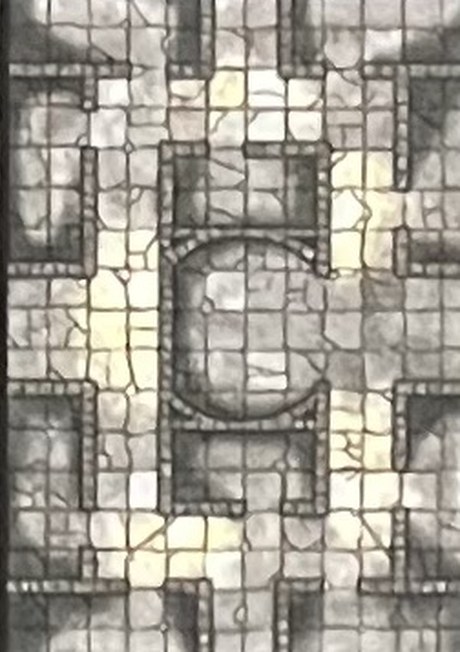
Battle map: The Silo Warren — page 28, 55 × 75 ft (one half of The Grey Warrens)
The silo is the drum, the corridors around it are the ambulatory — the page is this room's diagram. Mark the drum's five doorways at their uneven spacings, the four outer mouths at the compass points, and turn a paper overlay when the drum turns.
- Dimensions. Outer chamber 56 ft across; the drum inside it is 40 ft across and 15 ft high, leaving an 8-ft ambulatory between drum and outer wall. Ceiling 20 ft.
- Light. None fixed anywhere, and that is the room's real difficulty. Any light the party carries turns with them, which means it tells them nothing. A lamp set down in an outer corridor mouth does not turn, and is the single most useful thing anyone can do in here.
- The drum. Timber banded in bronze, with five doorways through it at fixed, uneven spacings. Inside is a bare round floor, swept, with the index plate at its centre.
- The outer mouths. Four corridors open off the outer wall at the compass points. Only whichever of them a drum doorway currently lines up with can be used; the rest are blank drum wall from the inside and blank drum wall from the outside.
- The ball race. A groove around the drum's foot packed with bronze spheres, greased. Investigation DC 12 shows the drum rides on them and rides easily.
- The index plate. A bronze disc set in the drum's inner floor, punched with twelve dots around its edge and one deeper dot beside a fixed pointer. Investigation DC 13 to find it under the dust; once found, it reads out the drum's position at a glance and the puzzle becomes a table lookup instead of a guessing game.
- The attendant. A life-size bronze figure is cast into the drum's inner wall, one arm out, finger extended at the index plate. It is part of the machine and it has never moved. Investigation DC 14: it is a Daedalan casting, hollow, unpowered, and its finger is a pointer, not a threat. If your table needs a fight here, that is a substitution you are choosing to make, not something this room contains.
Traps / Puzzles / Checks
The rule. The drum indexes one notch clockwise every time any creature passes through one of its five doorways. In or out; it makes no difference. Six PCs filing in is six notches.
Tell the players nothing. Show them: index once when the first person steps in and describe the grind, and let them work out the trigger. Investigation DC 13 watching one crossing, or DC 10 after anybody says the words "wait, does it move when we walk through?" — reward the thought, not the roll.
The lookup table. Track a single number, 1 to 12. Add one per doorway crossing; after 12 it wraps to 1. Start at 1.
| Index | Outer mouths open |
|---|---|
| 1 | North |
| 2 | East, South |
| 3 | North, West |
| 4 | East |
| 5 | South, West |
| 6 | North, East |
| 7 | South |
| 8 | North, West |
| 9 | East, South |
| 10 | West |
| 11 | North, East |
| 12 | South, West |
The solution. One PC steps in and out of the same doorway repeatedly, and each pass moves the dial one notch. The party can reach any mouth they like within eleven crossings and usually within four. Once a player says it out loud, give it to them completely — no check — and let them count.
Keeping track in the dark. Without a fixed reference, a party loses which mouth is which after two notches. Three answers, all of them findable:
- Leave a light in a mouth. Free, obvious, and it works.
- Chalk the outer wall, which is what a surveyor does. Free.
- Read the index plate. Investigation DC 13 to find it, then no further checks at all.
A party with none of the three navigates by Survival DC 15 each time they want a specific mouth, and on a failure they get a different one and do not know it until they are twenty feet down the corridor.
Mechanical fallbacks, per the puzzle rules, for a party that will not or cannot dial it.
| Fallback | Cost |
|---|---|
| Jam the race. A crowbar, spear, or shield rim into the ball groove: Athletics DC 15 | The implement is destroyed, the jam takes a full minute of grinding and hammering, and the drum freezes at its current index permanently. Jam it on the wrong notch and the party has locked themselves out of three mouths, though never out of all four |
| Trip the pawl. Thieves' Tools DC 16 at the index plate | Frees the drum to be pushed by hand to any notch, one at a time, and it no longer indexes on crossings. Failure means the pawl skips: roll d4 and advance that many notches |
| Shoulder it round. Four or more PCs pushing: group Athletics DC 16 | One notch per attempt. On a failure the drum slips backward d4 notches and someone takes 1d6 from a hand caught in the race |
| Any spell that stops, locks, or shapes a mechanism | No check. Hold it where they want it |
Solved state. The drum stands still at a chosen index, the corresponding mouths are open, and the room is a round chamber with doors in it. Nothing resets. If the party comes back through later, it is where they left it.
Exits
All four mouths lead onward and none of them is closer to anything than any other — this room's cost is entirely in the counting.
None. The drum is swept, the ambulatory is swept, and the only portable things here are the bronze balls in the race — which are worth something to a scrap dealer four hundred feet above and weigh nine pounds each, and taking one makes the drum grind and stick at every third notch for the rest of the session. Let a player do it. Charge them the grinding.
Scaling — APL 6 / 12 / 15
| APL | Adjustment |
|---|---|
| 6 | Four drum doorways instead of five and the index plate is in plain sight — no check. A lamp burns in one outer mouth already. All DCs −2 |
| 9 | As written |
| 12 | The drum indexes two notches per crossing, which breaks the intuition the party just built, and the index plate's pointer has been bent by somebody so it reads one notch out. Investigation DC 16 to notice the bend. DCs +1 |
| 15 | As APL 12, plus the drum indexes on its own every minute regardless of crossings, so the party is working against a clock as well as a count, and the jam fallback rises to Athletics DC 18 because the race has been re-greased recently. DCs +3 |
- Pacing. Ten to fifteen minutes, and it is the good kind of table argument. Behind schedule: put the index plate in the open, say the rule out loud after the second crossing, and let them dial it in five minutes.
- Run this with a physical prop. Two circles on paper — the outer with four marks, the inner with five — and rotate the top one. Or a plate on a napkin. It turns twenty minutes of confusion into five minutes of delight, and a party who can see the mechanism will solve it themselves, which is the whole point of a Daedalan room.
- Never let them be stuck. At every index at least one mouth is open. Say that out loud early if anyone starts to panic — this is a puzzle about getting the door you want, not about escaping.
- The bronze attendant will worry them and it should. Let them poke it, prise at it, and eventually work out it is a signpost. A Daedalan room that turns out not to contain a guardian is a good use of a party's caution and a fine joke to play once in a hundred rooms.
- Clue drip. Two objects here take a clue well: the index plate, a readout built by somebody who expected to be read, which suits X14 (A Thread of Your Own Making) or X19 (The Bull-Gate Mechanism); and the maker's mark stamped inside the ball race — Investigation DC 15, and it is the same mark that is on every winch and iris in this maze — which suits X20 (The Bronze Bird) or X17 (The Wings of Icarus).
- Table safety. None needed, unless somebody at the table is unhappy in the dark, in which case light one outer mouth from the start and lose nothing.
- Warband callback. Daedalan Automata rooms all reward watching before touching, and all of them can be beaten by somebody who counts. This one has no creature in it at all, which should make a party that has met the bronze elsewhere more nervous rather than less.