The Skeleton Kings of Five Wars
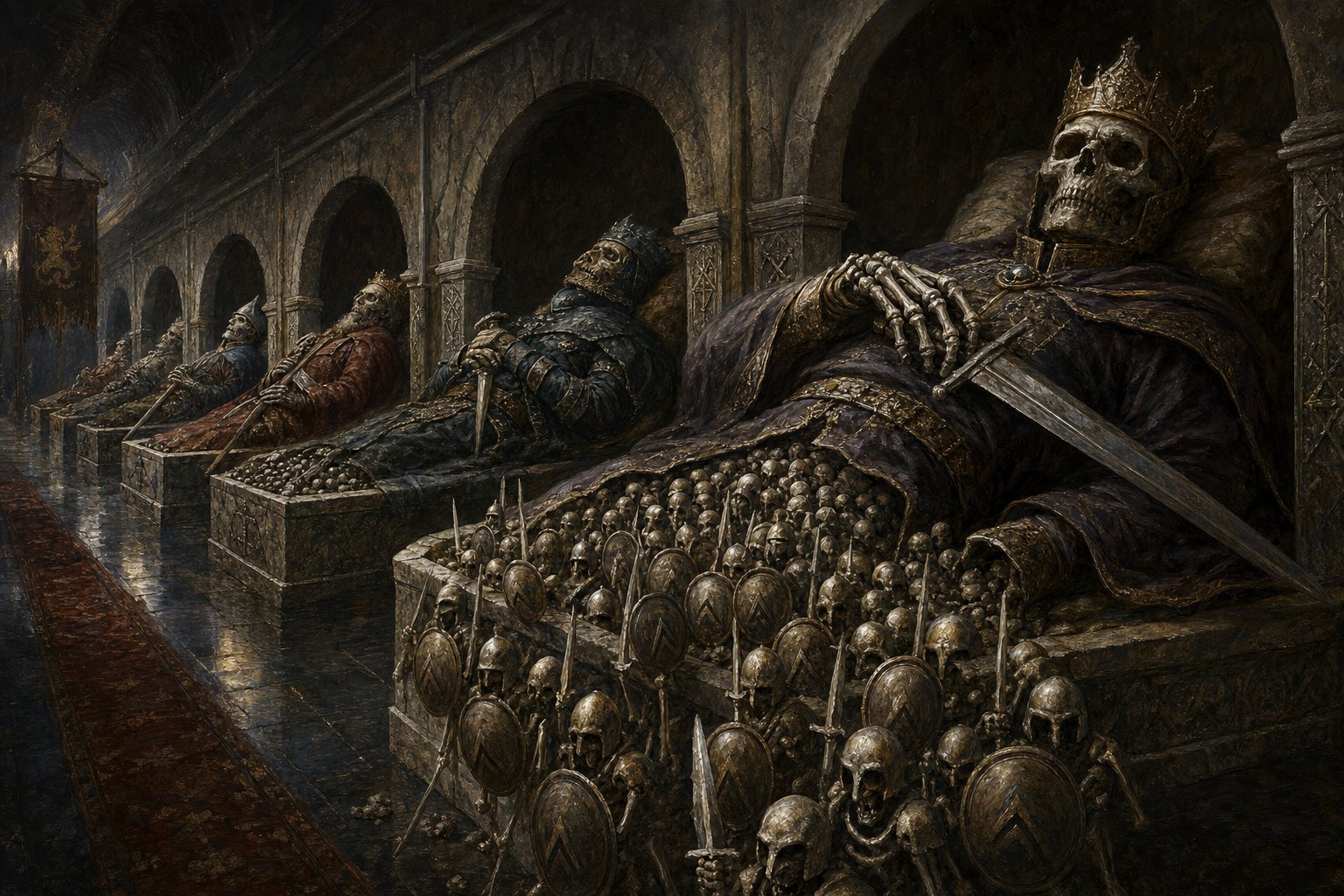
Five alcoves down the long wall, and a dead king laid out in each with the spoils of his war stacked around him: salt-eaten cuirasses, a mound of bronze arrowheads, a chariot wheel, a stack of shields with the paint still on them, and in the fifth, nothing at all but a spear and a jar.
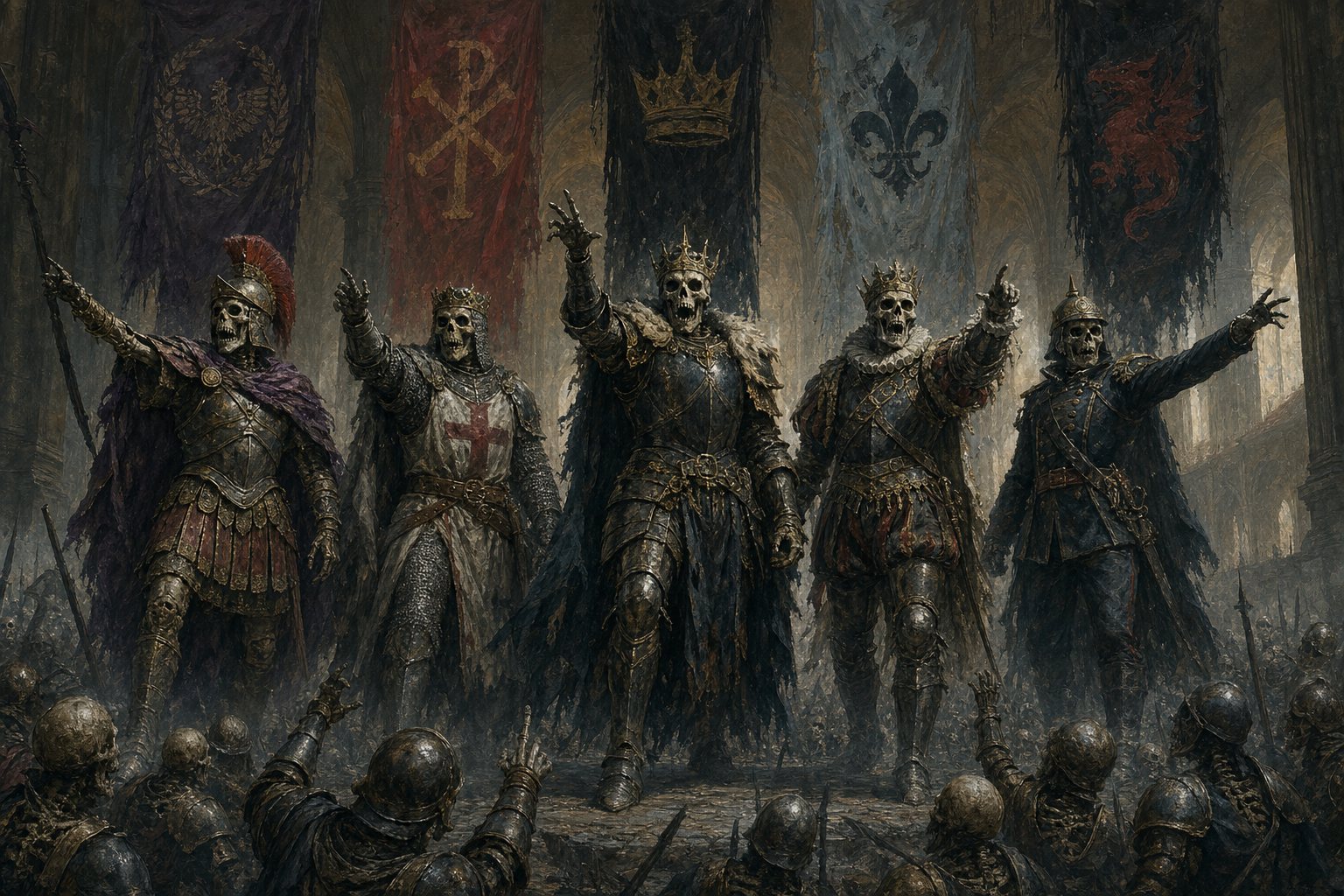
None of them is lying down. They are standing in the middle of the floor in a loose ring, five skeletons in full panoply, and they are arguing. You can hear the argument from the door and it is about which of them had the worst of it.
Behind them, a sixth figure holds a standard upright: a bronze-shod pole, five campaign discs nailed down its length, a horsehair crest gone the colour of dust. It has not moved and it is not arguing. It is waiting for them to finish.
DM summary. Five champions who cannot stay dead while their standard stands, and who spend the entire fight getting in each other's way over precedence. The standard is carried, not planted — so the way to win is a chase across a hall full of kings.
The Boon
The Herald's RollOptional knowledge
Names the five wars and their years, so choosing who is winning costs no check
What it is. A herald's muster-roll on a wax-and-boxwood diptych, recopied twice by hands that got smaller each time. The Herald's Roll gives five campaigns, the year each king mustered, and — because it runs oldest first, and the fifth king is the oldest muster in the hall — a name at the head of its first entry for the war this hall believes was never named.
Where it comes from. Plant it in the first three rooms: the second thing on a loot roll in any room with writing, or the whole of it recited by an old man in a rest point who used to cry the muster at festivals and cannot be stopped once he starts. Late plant: the fourth alcove of this hall, under the eighty stacked shields, where a herald set his kit down and never came back. Hand it over as a curiosity and say nothing about what it is for.
What it does here. Precedence, by the herald's rule, runs from the year a king mustered, and the roll has the years — the Tylissos Water in the ninth, the Sown War in the twenty-sixth, and three between. So the fifth king outranks all four of the others, and the Sown King, who is winning when the party walks in, is the junior man in the hall. Reading an entry aloud changes who is winning with no check, in place of the DC 15 Persuasion or History that Winning the Argument asks for, and it still spends that character's check for the round. It also names the fifth war, which is what the Insight DC 13 row was for.
What it doesn't do. The Serjeant cannot be argued with; his orders are older than every war on it, and no document blunts the Sowing Horn or the pole's AC 15 and 40 hit points. It does not lift Precedence's disadvantage or keep a king from rising with 25 hit points. A party who never found it makes the DC 15 as written and fights exactly the finale below.
Card and numbers or jump to the card ↓
Arena

Battle map: The Ashfield — pages 11 & 12, 110 × 75 ft
The ashfield is the barrow hall at 80 × 60 ft: the burnt seam down its length is the coal trench (dim red, 3 ft wide), the char reads as four centuries of pyre floor. Chalk the five war-alcoves along the north wall, the sown furrow strip along the south, and the empty plinth at the west end.
- Dimensions. 80 ft × 60 ft, ceiling 30 ft, entered at the short east end by a stepped barrow door.
- Light. A trench of banked coals runs down the centre of the hall, 40 ft long and 3 ft wide — dim red light, and 7 (2d6) fire damage to anything that ends its turn in it. It divides the room lengthwise and everybody has to choose a side.
- The five alcoves. 15 ft deep, north wall, one per war. Each is three-quarters cover and each holds one usable thing: (1) a stack of forty javelins, (2) a jar of lamp oil, (3) an intact chariot wheel that can be rolled down the hall, (4) eighty shields, stacked, which collapse into difficult terrain when disturbed, (5) one spear and one sealed jar of water, which is the whole of the fifth king's spoil and is the room's saddest object.
- The sowing strip. A 10-ft band of dry earth along the south wall, planted in furrows. It is sown ground and the Serjeant knows it. Nothing rises from it unless the horn is blown.
- The plinth. Empty, at the far west end. The standard used to stand here. Somebody picked it up, which is the entire reason this room is a problem.
- The doorway width. The barrow door the party enters by is 5 ft. Five kings cannot come through it at once, and neither can they be flanked in it. The room is a fair fight only if the party leaves the doorway.
Roster & Budget
Five kings and the man who carries the flag.
| Count | Creature | XP each |
|---|---|---|
| 5 | King of the Five Wars | 1,800 |
| 1 | Dragon-Tooth Serjeant | 1,800 |
Base 10,800 XP; ×2 for six bodies = 21,600 adjusted, against the APL 9 Deadly budget of 14,400. That is fifty per cent over and it is a true statement of what the room is while the standard stands: the kings do not stay down, so the arithmetic describes a fight the party cannot win by grinding.
Break the standard and the number stops mattering. Five CR 5 skeletons that stay dead is 9,000 base, ×2 = 18,000, and six ninth-level characters close that out in three or four rounds because the kings are already damaged and are now spending half their attacks at disadvantage arguing with each other. The room is budgeted to be solved, not out-damaged, and you should let the party feel the difference the instant the pole goes.
Phases / Clock
Phase one — While the Standard Stands. No king can be reduced below 1 hit point. At the end of any round in which a king is at 1, he stands up with 25 hit points and says something about it. This is not a trick to be discovered late: the first time it happens, describe the standard dipping toward him as he rises. Two rounds of this and any table has the idea.
Phase two — The Pole Goes Down. Triggered when the standard is destroyed or taken out of the hall. Visibly: the horsehair crest goes up like a torch, the five campaign discs fall off the pole one after another and ring on the floor, and every king in the room stops mid-sentence. From here they stay dead, they no longer argue, and they fight with a competence they were too busy to show earlier — each one gains one extra spear attack.
The argument clock. Track which king is currently winning the argument (start with the second, the Sown War). Each round, the winner gets advantage on his first attack and the other four have disadvantage while within 10 ft of each other. Any character who intervenes in the argument can change who is winning. This is not decoration; it is a lever, and the players should be told it exists by round two.
Combat Resolution
Five to eight rounds. The party is fighting a bodyguard problem, not five monsters.
- Round 1. They do not all charge. Two of them keep arguing, one walks to the coal trench and stands on the far side of it so nobody can flank him, one goes for whoever is standing in the doorway, and one turns to the Serjeant and tells him to plant the standard where everyone can see it, which the Serjeant does not do, because his orders are older than any of them.
- Tactics. The kings will not leave the hall and will not step into another king's alcove — precedence again. They bunch, and bunched kings fight at disadvantage, so the party's best play is to keep them together and their worst is to peel them off one at a time into clean single combats.
- The Serjeant holds the west end, keeps the standard between himself and the wall, and blows the Sowing Horn at the sown strip on round two: two Bronze-Tooth Hoplites rise there, and two more each time the horn recharges. That spawn is outside the budget and it is the pressure that makes ignoring the standard a losing plan.
- Reaching the standard. He is 60 ft from the door with five kings in between. Wresting it: contested Strength (Athletics) DC 17. Destroying it: AC 15, 40 hit points, or 15 fire damage to the crest ends it outright — the horsehair is dry as tinder and the coal trench is right there.
- The weakness, discoverable. Investigation DC 13 on a king who has just risen shows the campaign disc on the standard glowing faintly as he comes up. History DC 14 names the practice: a bearer holds the dead of five wars until the last of them is honoured, and none of them ever was.
- When the last king falls, he goes down on his own alcove's threshold and the argument stops, and the hall is very large and very quiet. The fifth king's spoil is still one spear and one jar of water.
Alternate Resolution
Skill — break the standard, or settle the argument. A skill challenge, four successes before three failures, and the party may mix the two lanes freely. One check per character per round.
Lane one — get to the pole.
| Approach | Check | On a success |
|---|---|---|
| Cross the coal trench under fire | Acrobatics DC 14 or Athletics DC 15 | You are on the Serjeant's side of the hall |
| Roll the chariot wheel down the aisle | Athletics DC 13, one action | Two kings must save (Dex DC 14) or be knocked prone; the wheel is spent |
| Topple the shield stack across the aisle | Athletics DC 12 | 20 ft of difficult terrain between the kings and the pole |
| Take it off him | Contested Athletics DC 17, in melee | The standard is in your hands. Now run |
| Burn the crest | Any 15 fire damage, or a flask of the alcove oil and a light | The standard is destroyed. This is the fastest route in the room |
Lane two — judge the wars. They want a verdict. They have wanted one for three hundred years and there has been nobody to give it.
| Approach | Check | On a success |
|---|---|---|
| Name the wars from the spoils | History DC 15 or Investigation DC 14 on the alcoves | You can address a king by his war, which he was not expecting |
| Argue a case | Persuasion DC 15, or any argument the table finds genuinely persuasive, with no roll | One king of your choice steps out of the fight for three rounds to hear you out |
| Concede to one of them | Insight DC 13 to spot which one has stopped believing his own case — it is the fifth, whose war nobody named | The fifth king lowers his spear for good and will not raise it again against anyone who says the name of his war aloud |
If the party carries the Herald's Roll, the first row of this lane needs no roll: the wars have their years, and reading one out is the success. That is the one success the Roll hands over. The third row still costs what it always cost — the Insight is only how a party without the Roll works out which king has stopped believing himself, and knowing it in advance does not concede to him. Somebody still has to stand in front of the fifth king, grant him his war, and say its name aloud. The other three successes have to be earned in a hall with five kings in it, and the pole is still sixty feet away.
Four successes: the standard is down or the argument is settled, and in either case the surviving kings put their spears in the earth of the sowing strip and lie back down in their alcoves in order of precedence — which they finally agree on. Three failures: the party is in Combat Resolution with the Serjeant now behind the coal trench and a round of spawn on the board.
Scaling — APL 6 / 12 / 15
| APL | Adjustment |
|---|---|
| 6 | Three kings, no Serjeant — the standard is planted on the plinth and does not move. Kings at 72 hit points. DCs −2 |
| 9 | As written |
| 12 | Five kings at 121 hit points, the Serjeant plus two Bone Archers of the Sown Field on the sowing strip from round one, and the standard repairs itself one round after being taken unless it is burned. DCs +1 |
| 15 | Five kings at 145 hit points and each one an elite: give every king the Roar the War recharge on 4–6 and one legendary action per round (a spear attack). Two Serjeants, and a second phase when the pole goes in which the five discs animate as five more standards, each holding one king. DCs +3 |
Exit to the Resolution
Boon Card
The Herald's Roll
Knowledge · a herald's wax diptych, five musters with their years · optional, and never on the loot table
Appearance: two boxwood leaves hinged in bronze, wax gone black, one bead of it broken off the first entry and thumbed back into place · Reading one entry aloud takes a sentence · Usable by anyone who reads Knossian, or who has ever heard a herald cry a muster
The Years, In Order. The roll dates five musters, oldest first: the Tylissos Water in the ninth year, the Salt War in the eleventh, the Long Siege in the fourteenth, the Bronze War in the nineteenth, the Sown War in the twenty-sixth. The herald's rule is that precedence runs from the year a king went out, so the fifth king outranks all four of the others and the Sown King is the junior man in any hall he stands in.
The Fifth War Has a Name. The roll's first entry is the fifth king's, because his was the oldest muster, and it names the war nobody named: thirty days, sixty men, one spring above Tylissos, and the sealed jar he was buried holding. A creature that says it aloud satisfies anything that asks for the name of the fifth king's war, with no Wisdom (Insight) check first.
Lines to Say Out Loud. Hand the players the five entries and let them read them. "Ninth year, the water above Tylissos. Thirty days, sixty men, and he brought back fifty-one." "Eleventh year, the Salt War." "Fourteenth year, the Long Siege, nine years in the field." "Nineteenth year, the Bronze War." "Twenty-sixth year, the Sown War — and you, sir, are the last man mustered in this room."
It Can Be Lost. Wax burns and boxwood is kindling. A diptych dropped in the coal trench is gone in a round, and there is nothing else in this hall that can read it back to you.
What It Is Not. It carries no authority over the Dragon-Tooth Serjeant, whose orders are older than every war on it, and it does nothing whatever to the standard, the Sowing Horn, or a king who has just risen with 25 hit points.
Read the Entry. The bearer reads one king's entry aloud, war and year. This is the intervention Winning the Argument asks for and it needs no ability check: choose which King of the Five Wars is winning at the start of the next round. Once per round, and in a skill challenge it spends that character's one check for the round.
Creature Cards
The kings share one card and one chassis — the differences between them are the war each carried and the argument each is losing, and those are above. The Serjeant and the hoplites he sows belong to Sown Bones (W01) and live in the bestiary.
Shared across rooms, so the full cards live in the bestiary: Dragon-Tooth Serjeant, Bronze-Tooth Hoplite, Bone Archer of the Sown Field. Every mention above opens the numbers here on this page.
King of the Five Wars
Medium undead, lawful neutral · CR 5 (1,800 XP)
AC 18 (bronze panoply, hoplon) | HP 97 (13d8 + 39) | Speed 30 ft.
Saves Str +7, Cha +6 · Details Athletics +7, History +4, Intimidation +6 · Immune to poison damage, exhaustion, poisoned · Darkvision 60 ft. · Speaks a Greek two hundred years out of date
While the Standard Stands. He cannot be reduced below 1 hit point while the five-disc standard is intact and in this hall. At the end of any round in which he is at 1 hit point he rises with 25 hit points, and the campaign disc bearing his war glows as he does it.
Precedence. He will not be seen to yield ground to another king. While two or more Kings of the Five Wars are within 10 ft of each other, each of them has disadvantage on attack rolls, and none of them will enter another king's alcove for any reason, including pursuit.
Winning the Argument. One king at a time is winning. That one has advantage on his first attack roll each round and is immune to the disadvantage from Precedence. A creature that intervenes with a Charisma (Persuasion) or Intelligence (History) check against DC 15 chooses which king is winning at the start of the next round.
Answers a Judgment. A creature that names his war aloud and argues, honestly, that it was the worst of the five gets his attention: he steps out of the fight for 3 rounds to listen, taking no hostile action and interposing his shield against anything aimed at the speaker. This works once per king and he knows flattery when he hears it.
The War He Carried. Roll 1d5 or choose when each king first acts, once per king and never twice: 1 the Salt War, and his weapon deals cold damage; 2 the Sown War, necrotic; 3 the Bronze War, and his attacks ignore resistance to nonmagical weapons; 4 the Long Siege, and his attacks deal double damage to objects and structures; 5 the war nobody named, psychic.
Multiattack. Two attacks with the kingly spear, or one spear and one shield rush. In the encounter's second phase he makes three attacks instead of two.
Kingly Spear. Melee or thrown, +7 to hit, reach 10 ft or range 20/60 ft, one target. Hit: 11 (2d6 + 4) piercing damage plus 5 (2d4) damage of his war's type.
Shield Rush. Melee, +7 to hit, reach 5 ft, one target. Hit: 9 (1d10 + 4) bludgeoning damage, and a Medium or smaller target makes a DC 15 Strength saving throw or is pushed 10 ft, which he will always aim at the coal trench.
Roar the War (recharge 5–6). He shouts the name of his war and what it cost. Each hostile creature within 20 ft that can hear him makes a DC 14 Wisdom saving throw or is frightened of him until the end of its next turn, and he regains 10 hit points whether they fail or not.
Claim the Ground. He plants the spear and does not move for a round. Until the start of his next turn he has +2 AC and cannot be moved against his will by anything smaller than Huge.
Not Before Me. When another King of the Five Wars within 30 ft is reduced to 1 hit point, he moves up to 10 ft toward the creature that did it and makes one kingly spear attack. He is not avenging anyone; he is objecting to the order of things.