The Long Silence
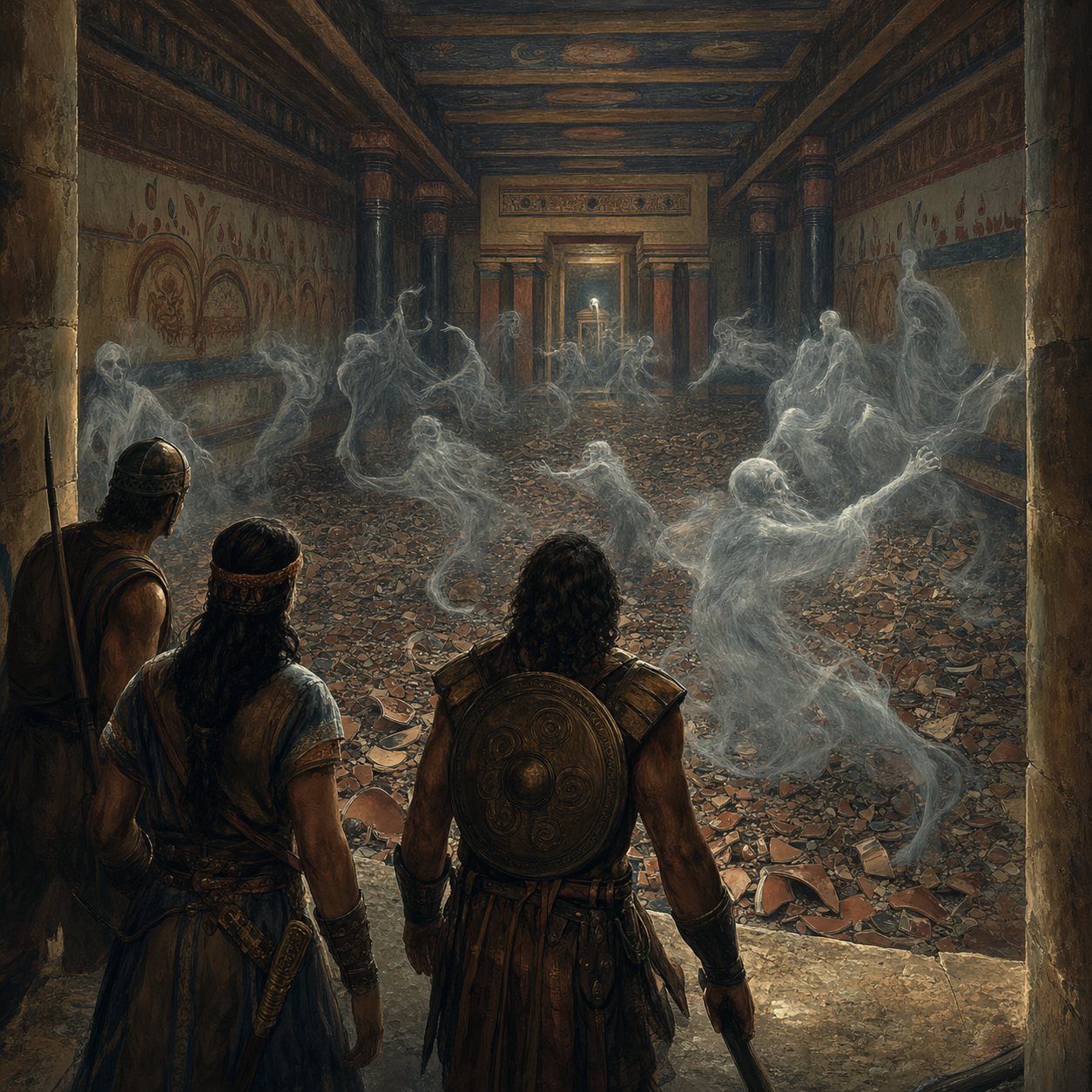
The corridor opens into a gallery a hundred and twenty feet long, and the floor of it is covered ankle-deep in broken pottery. Sherds, thousands of them, edge to edge, wall to wall. Somebody emptied a storeroom down here and never swept.
Three grey shapes stand in the gallery, thirty feet apart, facing three different walls. They do not move. At the far end, where your light stops, something taller is standing with its head tilted, the way a man stands when he is listening for a sound he heard once and is not sure about.
Nobody in your party has said anything for four seconds and nobody wants to be first.
DM summary. A blind wraith that hunts by sound, three shades that ignore anyone who makes none, and a hundred and twenty feet of broken pottery. This is the deck's pure stealth room: there is no fight in it worth having and the party's dice are mostly irrelevant — what matters is the choices they make about noise, one at a time, out loud, at the table.
Terrain & Features
Battle map: custom map. A 110 × 25 ft dead-straight gallery of sherds — draw the line, dot the three columns at 30/60/90 ft, and mark the cistern mouth at 80 ft. Browse the book if a page half fits your table better.
- Dimensions. 110 ft × 25 ft, ceiling 12 ft. A straight gallery, and it must stay straight: a corner would give the party somewhere to be unseen, and in a room where nothing is looking that would be a mercy rather than a mechanic. Enter at the west end, and everything that matters is between the party and the east end.
- Light. None, and light is free here — the wraith is blind and the shades do not care. Bring all the light you want. But an open flame crackles, and a crackle is noise: see the noise table. A shuttered lamp is silent. This is the room's first real decision and the party makes it before they take a step.
- The sherd floor. Ankle-deep broken pottery over the whole gallery. Moving across it makes noise on a scale, below, and there is no way to clear a path quietly — pushing sherds aside with a boot is noise 1 per 5 ft.
- Three columns. At 30, 60, and 90 ft, each 4 ft thick. Total cover from nothing, because nothing here is looking. They are useful only as places to stand still.
- The cistern. A dry brick cistern mouth in the north wall at the 80-ft mark, 4 ft across, open, and 20 ft deep. Anything thrown into it makes a great deal of noise a long way from the party, which is the room's best trick.
- The far door's hinge. The east door is shut and its hinge is dry. Opening it is noise 4 unless it is oiled first — one flask, one round, and it is silent. A party that walks the whole gallery perfectly and then opens that door is a party that has learned the room's real lesson too late.
The Noise Count
This is the room's mechanism and it replaces initiative, Stealth contests, and Perception checks. Keep a single running count on a scrap of paper where the players can see it. Start at 0.
| What somebody does | Noise |
|---|---|
| Standing still; whispering; casting with no verbal or material component | 0 |
| Walking at half speed across the sherds (15 ft) | 0 |
| Walking at full speed (30 ft) | 1 |
| Dashing | 2 |
| Wearing medium or heavy armour, per round of any movement | +1 |
| Speaking at a normal volume | 2 |
| An open flame carried, per round | 1 |
| Casting a spell with a verbal component | 3 |
| Dropping anything, or a failed climb, or a weapon drawn in haste | 3 |
| Opening the east door un-oiled | 4 |
| Any attack, hit or miss | 4 |
The thresholds, and they never change:
- At 3: the three Sighing Shades turn toward the count's loudest source and drift toward it at 20 ft per round. They do nothing else. A party that goes silent now loses nothing.
- At 6: the Wraith of the Long Silence moves. It goes to the exact point the noise was made — not to the party, to the point — at 60 ft per round, and it arrives with its head tilted.
- At 9: it stops guessing. It has the party located and it attacks the nearest living thing at the start of the next round.
The decay, and state the cadence out loud: the count drops by 1 at the end of every round in which the total added is 0. Complete silence for three rounds takes a party from 3 to 0. This is what makes the room playable: it is always possible to stop, stand still in the dark, and get quieter.
Muffling, before they start. Wrapping buckles, scabbards, and mail in cloth is Sleight of Hand DC 12 and five minutes, and it takes heavy armour's +1 per round down to 0 for the length of this gallery. Bare feet do the same for the sherds. A party that prepares in the doorway has done the room properly and should be rewarded for it exactly this much and no more.
Bypass Options
Half speed, shuttered lamp, muffled gear, and nobody says a word.
- The arithmetic, not a check: 110 ft at half speed is eight rounds. At noise 0 per round the count never rises and nothing in the gallery ever knows the party was there.
- What it costs: eight rounds of table time in which no player may speak in character, which is the best eight rounds this room has. Ask for pointing, notes, and hand signals. Let them enjoy it.
- The one check: a character in heavy armour who has not been muffled must make Stealth DC 15 each round to keep their contribution at 0; each failure is +1. That is the whole dice content of the intended path, deliberately.
- If the count reaches 3: stop, stand still, and let it decay. Three rounds of nothing and they are back to 0. Say this to the players once, plainly, because a table that does not know decay exists will panic and run.
The cistern at 80 ft is a 20-ft brick drop with an echo, and it is not where the party is standing.
- The check: Athletics DC 12 to put something heavy through the cistern mouth from up to 40 ft away — a helm, a stone, a broken lever. It lands as noise 6 at the cistern, not at the party.
- Success: the wraith and all three shades go to the cistern and stand around it listening. Four rounds in which the gallery's east half is empty and the party can walk it at full speed if they want to.
- Failure: the throw falls short and lands on the sherds — noise 6 wherever it landed, which is probably between the party and where they wanted to go.
- Cost: whatever was thrown, and the wraith is now at the room's east end, which is where the party wants to be next. Time the run.
- The elegant version: any silence effect, a thaumaturgy-style sound cast at distance, or a familiar sent 60 ft away to knock something over. All of these work exactly as well as the throw and cost a spell slot instead of a helm. Say yes.
The gallery is 110 ft of nothing anybody needs.
- The condition: none, at any count below 9. The party may leave the way they came at half speed, silently, and the count decays behind them. Above 9, withdrawing costs one round of movement while the wraith is closing, and it does not leave the gallery — it has never left the gallery and it will not start now.
- Cost: the time, this room's clue, the satchel at the midpoint, and the crossing — which means going back to the previous room and finding a different door.
- Say this out loud when the count first hits 6. A party that knows withdrawal is free will make better decisions, and a party that dies here should have chosen to.
Encounter
Printed so a DM knows the size of the mistake. This is not a fight; it is a consequence.
| Count | Creature | XP each |
|---|---|---|
| 1 | Wraith of the Long Silence | 8,400 |
| 3 | Sighing Shade | 1,800 |
Base 13,800 XP; ×2 for four bodies = 27,600 adjusted, against the APL 9 Deadly budget of 14,400. Nearly double. That number is in this room to be read by the DM and never balanced.
Why it is not already attacking. It is blind and it has been alone in a silent gallery for a very long time. It does not know the party is there. The shades do not either, and by the rule on their card they ignore anyone who makes no sound — an absolutely silent party can walk within five feet of one and it will not turn its head.
What happens if the party fights anyway. The wraith is incorporeal, ignores the sherds entirely, drains resolve rather than blood, and can pass through the columns and the walls. The three shades arrive from three directions. This can kill the whole party, and if they insist on it you should let it, because the room gives them four separate ways not to and a running count that tells them how close they are. Warn once, mechanically, by showing them the number.
Round 1, if it comes to that. The wraith goes for whoever spoke, not whoever is nearest. The shades come down the gallery in the dark at 20 ft, and the party's light does not help.
Traps / Puzzles / Checks
There is nothing to disarm and nothing to solve. The only checks in this room are the heavy-armour Stealth DC 15, the muffling Sleight of Hand DC 12, the cistern throw Athletics DC 12, and Investigation DC 13 to notice that the east door's hinge is dry before somebody hauls on it.
The sherds are worth one line of information. Anyone who looks: they are all one kind of pot, all one glaze, and all broken the same way — dropped from a height, at once, deliberately. Somebody made this floor on purpose, to make this gallery loud. That means somebody wanted the thing at the far end to stay fed, and a party who works that out has learned something true about who runs this maze.
Exits
Conditional — one roll on the loot table. A satchel lies on the sherds at the gallery's midpoint, 60 ft in, exactly where somebody set it down to go faster.
Picking it up is noise 2 (a buckle against a sherd), and there is no check that avoids it. That is the room's cleanest small decision: two points of noise for one roll on the table, taken with the count already at 1 or 2 and 60 ft still to walk. Offer it flatly and let them choose.
Scaling — APL 6 / 12 / 15
| APL | Adjustment |
|---|---|
| 6 | Two Sighing Shades, no wraith — the thing at the far end is a Lost Wanderer repeating its last hour, and at count 9 it walks into the party rather than attacking. Thresholds at 4 / 8 / 12, and heavy-armour Stealth DC 13 |
| 9 | As written |
| 12 | Five Sighing Shades, and the wraith moves at count 5 instead of 6. Add a second sherd field in the last 30 ft where the pottery is glazed and slick: half speed there is noise 1, not 0. DCs +1 |
| 15 | Five Sighing Shades, two wraiths at opposite ends of the gallery, and the count does not decay below 3 — the gallery holds sound now. The east door's hinge cannot be oiled; it has been welded, and opening it is noise 6. DCs +3 |
- Pacing. Fifteen minutes, and hold the table to the silence for all of it. This room is the deck's best argument that a dungeon does not need a fight, and it lives or dies on whether the DM has the nerve to run eight quiet rounds.
- Put the count where the players can see it. Write 0 on a card in the middle of the table and change the number by hand every round. Nothing else in this deck generates the same tension for the same effort, and it turns every individual player's decision into a visible cost.
- If you are behind schedule, shorten the gallery to 60 ft (four rounds), drop the shades to one, and keep the count and the wraith. Seven minutes and it still works.
- Refuse to give this room a conventional fight. If the party opens with an attack, do not run a balanced encounter — run the honest one, print the 27,600 in your head, and put the wraith on whoever spoke. Then, at the end of the second round, remind them the west arch is 40 ft behind them and that nothing here leaves the gallery.
- Let players enforce the silence on each other. The best moment this room produces is one player quietly telling another to shut up, in character, in a whisper. Give them room for it and do not fill the pauses.
- Table safety. Held breath, enforced silence, and a table where speaking has a cost can be genuinely stressful for some players — and one that is unable or unwilling to stay quiet must not be punished for it. If anyone would rather not, drop the speaking penalty entirely and keep the movement and armour rules; the room still works and nobody is policed at the table.
- Clue drip. Two objects: the satchel at the midpoint, whose contents the DM chooses to suit the live Resolution (a surveyor's chain and chalk for X14, a sealed wax packet for X17), and the sherd floor itself, which was made deliberately to keep something fed — evidence that the maze is managed (X10 or X03, Sign tier).
- Warband callback. Shades of the Maze (W09) are all sound and reenactment, and this is the room where that becomes an entire ruleset. A party who has met the shades before should walk in already whispering. If they do, tell them their instinct is right and then show them the count.
Creature Cards
Both belong to Shades of the Maze (W09) and recur across the deck, so the numbers live in the bestiary. The noise count, the thresholds, and the decay are this room's and stay here — and they matter more than either stat block, because a well-played R075 never opens one. The Lost Wanderer appears only in the APL 6 row, where it stands in for the wraith, and is listed so a DM scaling down has the card to hand.
Shared across rooms, so the full cards live in the bestiary: Wraith of the Long Silence, Sighing Shade, Lost Wanderer. Every mention above opens the numbers here on this page.