Vent of Sulfur Song
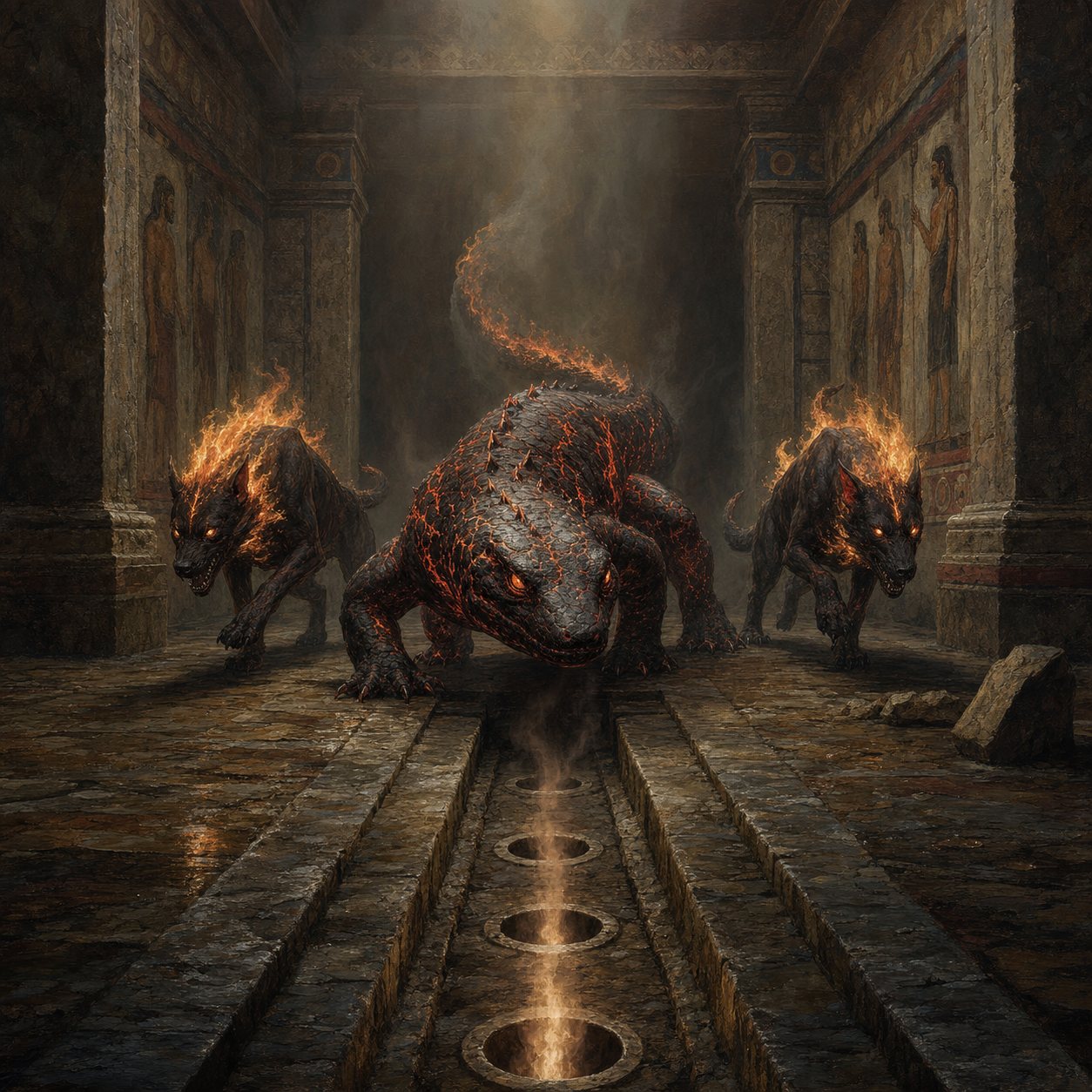
The room is singing. Three notes, low and breathy, out of three holes in the floor at the bottom of a stone trench that runs the length of the chamber — and as you listen, one of the notes climbs, sharpens, and lets go with a hiss you feel in your back teeth. The air over the trench shivers.
It smells of struck matches and rotten eggs. At the far end, on the dry step above the trench, four dogs are lying in a heap, and they are on fire. They have been on fire for a while. They do not seem to mind.
DM summary. Four fire-hounds in a room full of sulfur gas, where the hounds' own deaths are the hazard. The fight is Medium; the gas is what makes it interesting, and the party's own torches are the biggest threat in the room.
Terrain & Features
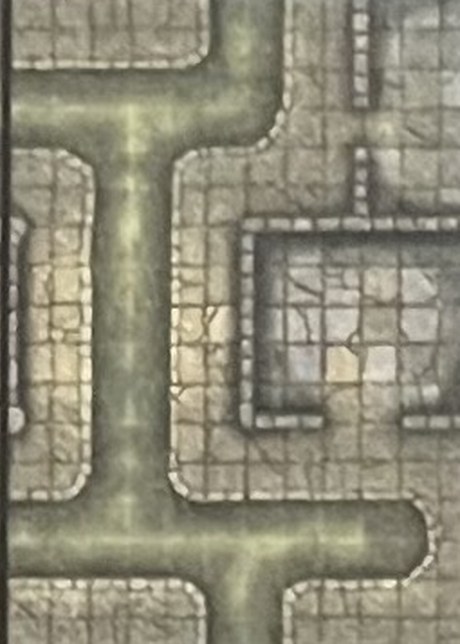
Battle map: The Sluice Room — page 40, 55 × 75 ft (one half of The Sewers)
The sluice room fits the vent trench: its straight canal is the 8-ft gas trench (chalk the three vents in its floor), the walkway along the wall is the dry step, and the intact walled room bounds the 45 × 35 ft chamber.
- Dimensions. 45 ft × 35 ft, ceiling 12 ft, with a trench 8 ft wide and 4 ft deep running east to west down the middle. The party enters on the north side at floor level.
- Light. The hounds. That is all, and it is enough — they light the room in a moving orange that throws no useful shadows. Nobody in this room needs a torch, and the room means to punish anyone who lights one anyway.
- The three vents. In the trench floor at 10 ft, 22 ft, and 34 ft along.
airless: they push out a heavy sour gas that pools in the trench and does not climb above its lip except when a vent lets go. - The trench. Gas-filled to the brim at all times. Standing in it means breathing it: Constitution save DC 13 at the end of the second consecutive round in the trench and every round after, and a failure means poisoned until a minute after leaving. Three failures in a row is one level of exhaustion.
- The dry step. A raised stone shelf, 12 ft wide, along the whole south wall, a foot above the trench lip. No gas. This is where the hounds live and where the party wants to be.
- The pinch. One stone slab bridges the trench at the 28-ft mark — 3 ft wide, no rail. It is the only way across that does not involve climbing down into the gas.
- The scorch marks. On the ceiling above each vent: a black flower of soot, and the newest of them is still flaking. Somebody has already learned this room's lesson and did not get to keep the knowledge.
Encounter
Four hounds that die explosively, in a room that is asking them to.
| Count | Creature | XP each |
|---|---|---|
| 4 | Pyre-Hound | 700 |
Base 2,800 XP; ×2 for four bodies = 5,600 adjusted, against the APL 9 Medium budget of 6,600. It is deliberately 1,000 light: the gas is the rest of the encounter, and a party that fights carelessly will do more damage to itself in this room than the hounds manage all fight.
Round 1. The hounds are asleep in a heap and wake on the party's second round in the room, or immediately if anything makes light or noise. They come off the dry step along the south wall — not through the trench; they are not stupid — and they herd: their whole tactic is to drive prey into heat, and in this room the heat they want is the trench. Expect shoves and flanking that always pushes north-to-south toward the gas.
Tactics. A Pyre-Hound ignites when it dies, and that is the room's central fact. A hound killed on the dry step is a 10-ft burst of fire and a scorched cloak. A hound killed in the trench, or in a vent-cloud, is 4d10 to everything within 20 ft, including the rest of the party. Cold damage kills them without the burst — they are vulnerable to it — and a party with any cold at all should be allowed to work that out and feel excellent about it.
They will not leave the room; the vents are their hearth. Nothing pursues.
Traps / Puzzles / Checks
The song, and what it tells you. Each vent runs a three-round cycle: two rounds of a low steady note, then one round where the note climbs and the vent lets go, throwing a 10-ft-radius cloud of gas up out of the trench to head height. The three vents are out of phase — one lets go every round, in order, west to east, and then again.
- Reading it: Perception DC 12 or one round of listening tells the party the note climbs before the vent blows. Investigation DC 14 or Nature DC 13 names the gas and confirms the one thing that matters: it burns.
- Ignition. Any open flame, any fire damage, or any burning creature entering gas — in the trench, or in a cloud a vent has just thrown — ignites it. 4d10 fire in a 20-ft radius from the ignition point, Dexterity save DC 15 for half. The trench then burns clear and that vent is safe for three rounds before the gas rebuilds.
- Telegraph, always. The climbing note is the warning and it comes a full round ahead. A character standing in the trench who hears their vent begin to climb may spend their movement to get out, and they should be told so the first time.
- Capping a vent: a shield, a breastplate, a flagstone, or the room's own slab laid over the hole and weighted — Athletics DC 13, or Thieves' Tools DC 14 to do it neatly with wedges. A capped vent is dead for the rest of the session and the trench above it clears in two rounds. Capping all three turns the room into a plain corridor with four dogs in it.
- Solved state: vents capped, or the trench burned off and crossed on the beat. Either way the party's problem becomes four fire-hounds on a dry stone step, which is a fight they can win.
Exits
None. This is a vent, not a room anybody kept anything in. The soot on the ceiling is the closest thing to a legacy in here.
If a player insists on searching the trench, the gas is the answer and the find is a melted bronze buckle. Let them make the Constitution saves for it. Some tables need to be told no by a room rather than by a DM.
Scaling — APL 6 / 12 / 15
| APL | Adjustment |
|---|---|
| 6 | Three hounds. Two vents rather than three, and the ignition is 2d10 in a 15-ft radius. All DCs −2 |
| 9 | As written |
| 12 | Six hounds and one Forge Salamander on the dry step, whose heat aura ignites the trench on its own initiative if it steps into a vent-cloud. Ignition 10d10, save DC 16. DCs +1 |
| 15 | As APL 12 with two salamanders, and the vents let go two at a time, which removes the safe beat entirely — the party has to cap or leave. Ignition 10d10, DCs +3 |
- Pacing: fifteen minutes. When you are behind schedule, skip the cycle: the trench is gas, the gas burns, the hounds explode, the north edge is safe. Run the hounds as a straight four-body fight on the dry step and be out in eight minutes.
- Hum the vents. Low note, low note, rising note — say it at the top of every round like the bell in the tidal chapel. The players should be able to hear which vent is about to go, and once they can, they will start planning around it, which is the entire room.
- The party's torch is the trap. Ask who is carrying an open flame as they enter, and ask it neutrally. Do not warn them; the smell, the singing, and the soot flowers on the ceiling are three warnings already on the page.
- Let the wizard have this one. A single ray of frost changes this fight completely — no bursts, no chain ignition. The room is built so that the answer is the least fiery thing you own, which is a funny and memorable inversion for a party used to solving fire-hounds with more fire.
- Clue drip. Two hooks: the newest scorch flower on the ceiling, under which there is a melted iron lantern of a specific and unusual pattern — a surveyor's lantern (X14, X17) — and the vent shafts themselves, which go up and out and are therefore evidence that this level has air coming down from somewhere (X17, X12).
- Table safety.
airlesshere is a poison and suffocation register rather than a crushing one, and nobody drowns in gas in this room: the worst the trench does is poison, exhaustion, and a bad memory. Keep the Constitution saves visible so the table can see they are on a slow clock, not a sudden one. - Callback. The Salamander Forge (W13) always fights in terrain that is itself hot, and the answer to the warband is always water or cold. A party that has crossed the Ash Trod knows this. What is new here is that the terrain can be turned against them and their own light is the fuse.
Creature Cards
The Pyre-Hounds belong to the Salamander Forge (W13) and recur across the deck, so the numbers live in the bestiary. The tactics above are this room's and stay here.
Shared across rooms, so the full cards live in the bestiary: Pyre-Hound. Every mention above opens the numbers here on this page.