Loom of Ten Thousand Legs
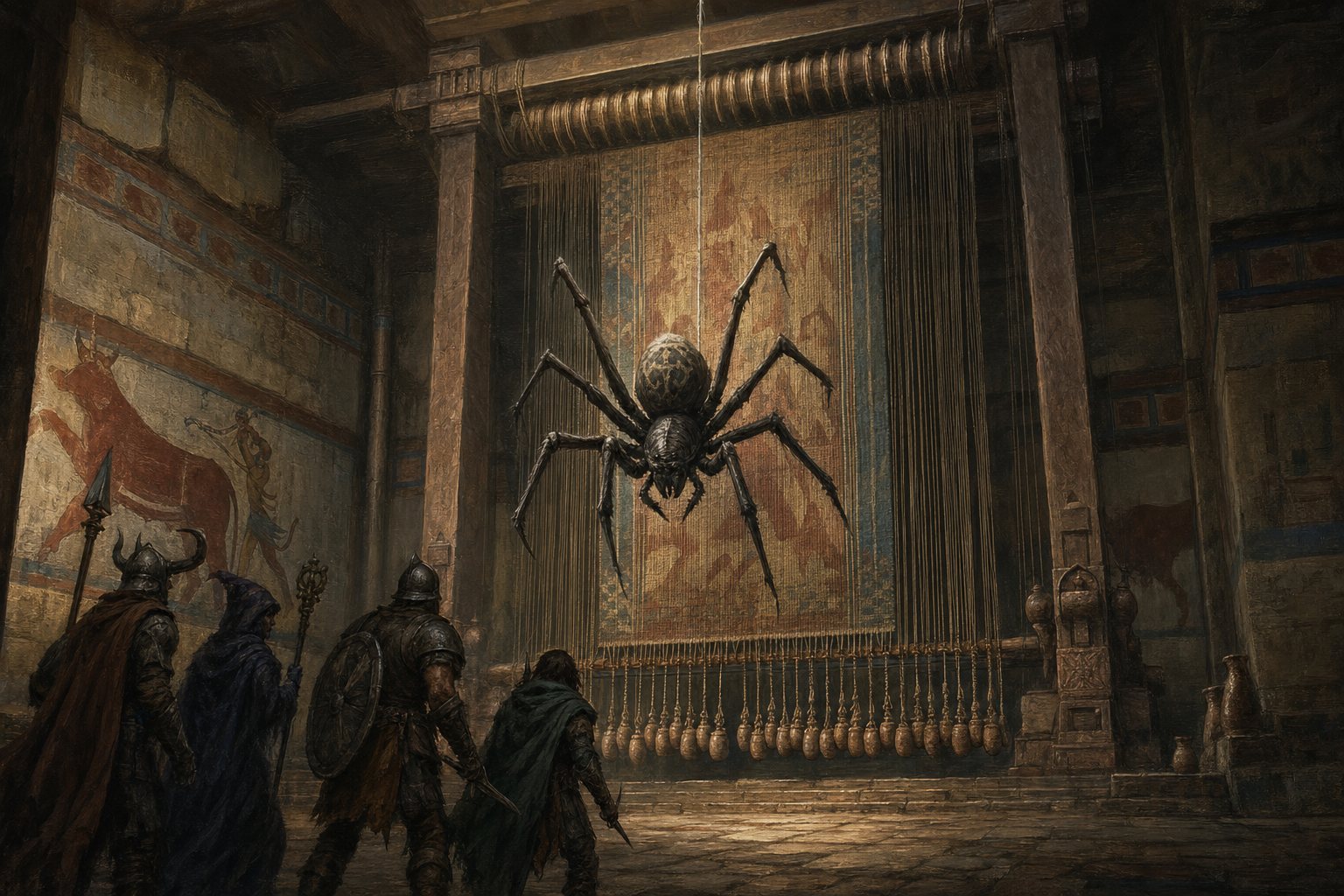
A warp-weighted loom twenty feet tall, strung floor to beam, with a hundred clay weights hanging in a row along the bottom of it like a curtain of bells. There is cloth on it. Somebody is weaving, and they are good.
Then a weight swings on its own, and another, and the pattern in the cloth turns out to be a pattern of legs, and the legs move.
DM summary. A working loom being worked by spiders, and the warp is both their high ground and the room's kill switch. Every bundle of thread the party cuts drops what is standing on it; cut the head-beam and the whole thing comes down at once.
Terrain & Features
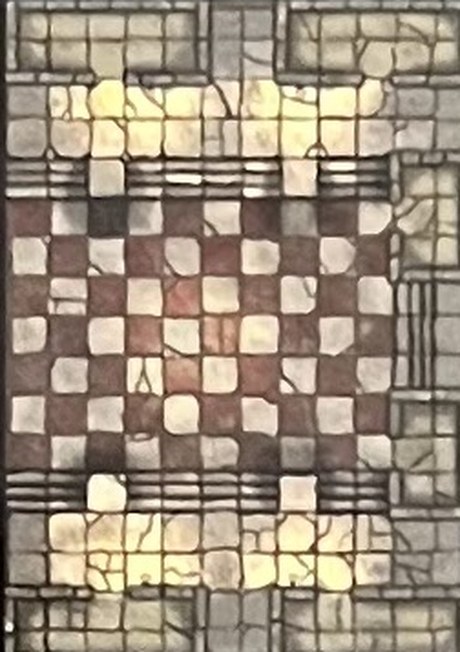
Battle map: The Hall, East End — page 30, 55 × 75 ft (one half of The Great Hall)
The hall's east end suits the loom room: the far doorways are the two good exits, printed. Wall it to 45 × 35 ft and draw the 25-ft loom line across the middle with the six warp bundles and the weight row at its foot.
- Dimensions. 45 ft × 35 ft, ceiling 25 ft. The loom stands across the middle of the room, dividing it: the party enters on the near side and both good exits are on the far side.
- Light. Dim, from a bank of small oil lamps along the weaver's bench, kept low the way you keep them when you work by feel.
- The loom. 20 ft tall, 25 ft wide, upright, warp-weighted. Six warp bundles run from the head-beam to the weight row, each 4 ft wide. A creature can climb a bundle (spiders need no check; anyone else, Athletics DC 13) and a bundle holds two Medium creatures before it sags.
- The weight row. A hundred fired-clay weights at knee height along the loom's foot. Cutting a bundle drops its weights: everyone within 5 ft makes a Dexterity save DC 13 or takes 2d6 bludgeoning, and the floor there becomes difficult terrain of broken clay.
- The head-beam. A single oak beam across the top, resting in two pegged sockets. This is the room's kill switch — see the bypass.
- The weaver's pit. A trench under the loom's foot, 3 ft deep and 3 ft wide, running the loom's whole width, where a human weaver would stand to work the low courses. It is cover, it is a crawl to the far side, and nothing tall fits in it.
- The finished bolt. Forty feet of woven cloth on the cloth-beam, tight, fine, and worth real money. It is also 60 lb and it takes two people to carry.
Encounter
Four spiders on the warp and a half-fey weaver who does not stop working.
| Count | Creature | XP each |
|---|---|---|
| 4 | Weaver Spider | 700 |
| 1 | Web-Fey Spinner | 1,800 |
Base 4,600 XP; ×2 for five bodies = 9,200 adjusted, against the APL 9 Hard budget of 9,600. Four hundred under, and the loom makes up the difference in both directions — it is the spiders' high ground and the party's demolition charge.
Round 1. The Spinner keeps weaving. That is not flavour: she spends her first round at the shuttle, and the four Weaver Spiders come down the warp bundles at the party's flanks while she works. She joins on round 2 and she is furious about having to.
Tactics. The spiders restrain, retreat up a strand, and come back — they will not stand and trade, and a party that kills one on the floor has done well. The Spinner re-spins terrain: once a round she strings a new bundle across the room at head height or cuts an existing one to drop whatever is on it, including her own spiders if it will drop a PC too. She fights to keep the party off the head-beam and away from the cloth-beam, in that order, and she will not burn the loom under any circumstances; it is hers and it took years.
Bypass Options
The whole loom hangs from one oak beam in two pegged sockets, and the pegs are oak too. Spot the sockets from the floor: Investigation DC 13 — the beam is not mortised, it is dropped in, because a loom of this size has to be re-warped by someone standing on a ladder. Knock a peg out: Athletics DC 15 with a blow from below (a spear butt, a hammer, a hurled shield), Thieves' Tools DC 14 from the ladder, or 15 damage to a socket (AC 14).
- Success: the head-beam drops. Every creature on the warp — spiders and Spinner alike — falls 15–20 ft: 3d6 bludgeoning and prone, no save for anything that was climbing rather than clinging by choice. The loom collapses into a heap of thread and clay that is difficult terrain across the room's middle, and the Spinner disengages immediately: she goes to the wreck, not to the party, and she will let the whole party walk out while she looks at it.
- Failure: the peg holds, the noise brings every spider down at once, and the character who swung is at the loom's foot with four of them.
- The cost, and it is real: the bolt of cloth is destroyed in the collapse. The party gives up this room's loot roll to end its fight in one action, and they should be told that before they swing, by describing the cloth in the same breath as the beam.
- Withdrawing instead: nothing here follows the party out. The spiders will not leave the warp's reach and the Spinner will not leave the loom. The way the party came in is open for the entire fight — say so once, plainly, in round 1.
Traps / Puzzles / Checks
Cutting bundles, one at a time. The slower, safer version of the bypass, and the room's main tactical dial.
| Element | Value |
|---|---|
| Sever one bundle | Any slashing hit (AC 12), a Strength DC 13 yank, or 3 fire damage — but see the fire note |
| Effect | Everything on that bundle falls: 2d6 bludgeoning and prone. The weights drop; Dexterity save DC 13 within 5 ft or 2d6 and difficult terrain |
| Six bundles | Cutting the sixth collapses the loom exactly as the head-beam bypass does, one bundle at a time, over six actions |
| The Spinner's answer | She re-strings one bundle per round from the cloth-beam's spare warp. The party is cutting faster than she can spin only if two of them are doing it |
| Fire | The loom burns. Any fire damage to the warp sets a bundle alight; it burns through in 1 round and then the next bundle catches at the end of each round after. Three rounds of unattended fire destroys the loom, the cloth, and any chance of loot, and fills the room with smoke: Constitution save DC 12 each round or blinded until the end of your next turn |
| Solved state | The loom is down, in pieces or in ashes, and nothing is above head height |
The weaver's pit is the room's forgotten route: anyone willing to go prone and crawl can cross the whole room under the loom in two rounds, unreachable by anything on the warp, and come up on the far side at the exits. Athletics DC 12 to move at half speed through it; the spiders can follow but hate it.
Exits
One roll on the loot table: the finished bolt on the cloth-beam, forty feet of fine cloth, taken intact. It survives only if the loom does — no collapse, no fire — and it takes two characters an action each to unroll and sling.
The Spinner's shuttle is boxwood and silver-tipped and she will come after somebody for it, later, in another room. That is a promise you can make with a straight face and keep whenever it would be funny.
Scaling — APL 6 / 12 / 15
| APL | Adjustment |
|---|---|
| 6 | Three Weaver Spiders, no Spinner — the loom is unattended and half-warped. Four bundles instead of six. All DCs −2 |
| 9 | As written |
| 12 | Six Weaver Spiders and the Spinner re-strings twice per round. The head-beam is mortised as well as pegged: two successes to drop it. DCs +1 |
| 15 | Eight Weaver Spiders, two Spinners working opposite ends of the beam, and the warp is silk rather than wool — a severed bundle whips: Dexterity save DC 16 or be restrained by it and hauled 10 ft toward the loom. DCs +3 |
- Pacing: sixteen minutes. The fight has a built-in off switch and most tables find it by round 3, which is correct and should not be discouraged. Behind schedule? Three spiders, no Spinner, and let the first bundle-cut visibly drop two of them — the table will do the rest in two rounds. Six minutes.
- Describe the loom before anything moves. The warp, the weights, the beam, the cloth. Everything the party needs to beat this room is furniture, and furniture only works if it was in the room before it was needed.
- The trade is the room. Cloth or a quick win, and the party cannot have both. Make sure they know the bolt is worth money before someone swings at the peg.
- If the party sets fire to everything, let them, and then let the Spinner watch it burn. She does not fight after that. She sits down in the wreck. A party that wins that way should have to walk past her on the way out.
- Table safety. Spiders, restraint, and being wrapped. If arachnophobia is on your table's list, the weavers reskin cleanly as crabs or as hand-sized bronze automata on the warp with no mechanical change; the Spinner becomes a fey clockmaker.
- Clue drip. Two objects: the cloth itself, whose pattern is a plan view of a corridor system woven at about one link to the fathom — she has been weaving a map without knowing or caring what it is (X14), and the spare warp on the cloth-beam, which is wool of exactly the wrong red, spliced from somewhere else with square sailor's knots (X10).
- Callback. Arachne's Weave (W12) always fights from a surface the party cannot stand on. A table that has crossed a web-choked shaft already should arrive here asking what holds this one up, and the answer is one beam and two pegs.
Creature Cards
Both belong to Arachne's Weave (W12) and recur across the deck, so the numbers live in the bestiary. The loom, the bundles, and the head-beam are this room's.
Shared across rooms, so the full cards live in the bestiary: Weaver Spider, Web-Fey Spinner. Every mention above opens the numbers here on this page.