Talos-of-Coins
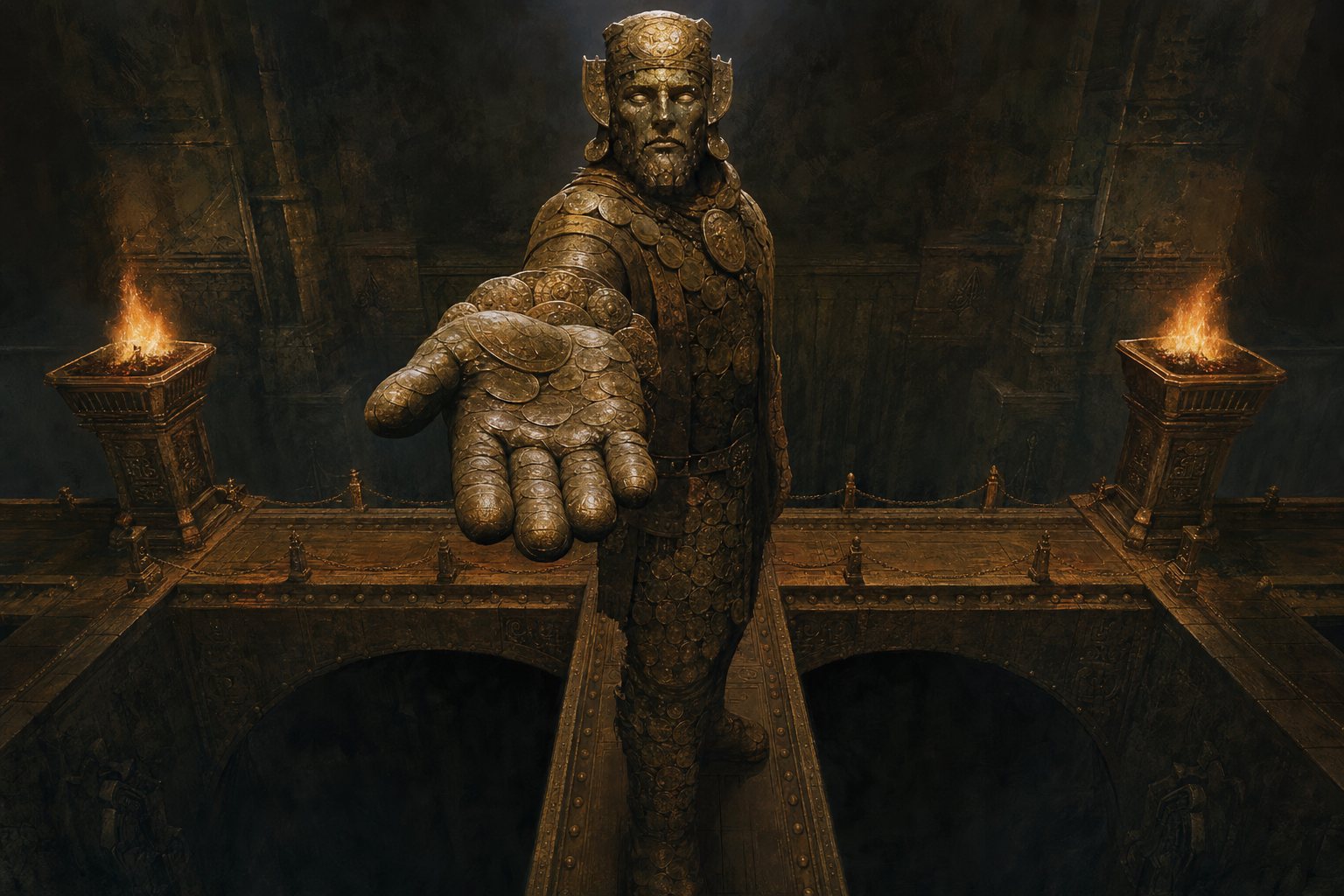
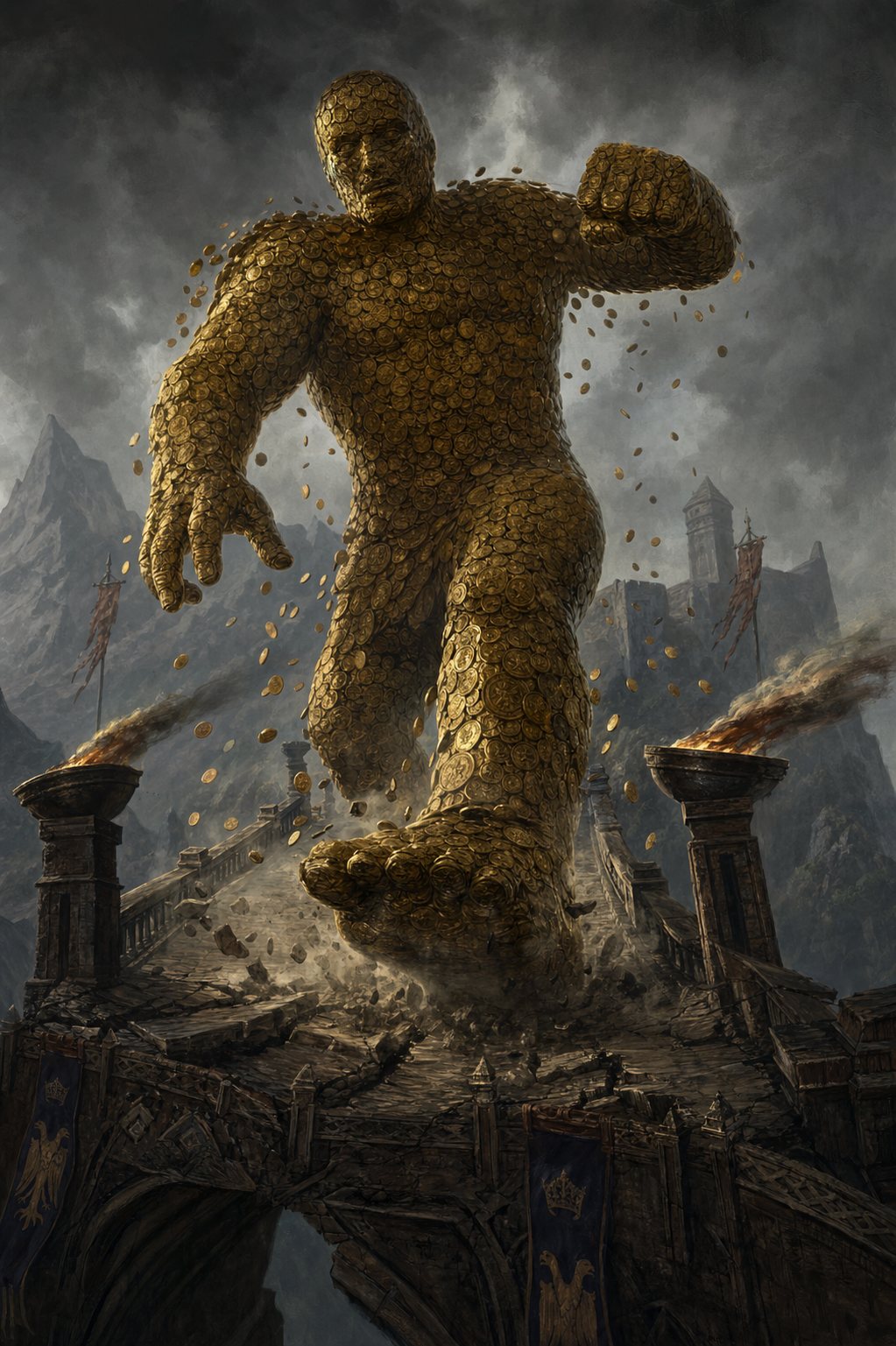
The floor ends. A bronze span crosses forty feet of black drop, and forty feet down, catching your light, there is money — a slope of it, drifted like sand against the walls, going down further than the light does.
At the near end of the span stands a bronze man three times your height, and he is not smooth. He is scaled with other people's things: coins hammered flat, a chased mirror set into one thigh, a surveyor's chain wound and fused across the chest, a child's locket, a spearhead, a ring. He is a lifetime of tolls, worn.
He turns his head. He counts you, out loud, in the dark, and gets it right — including the one you are carrying.
"Seven," says Talos-of-Coins. "Seven tolls."
DM summary. A toll machine and the gang that squats on its bridge. The toll is real, it is per head, and it takes things the party will miss. Everything about this finale is designed so that paying hurts and is still obviously the right call.
The Boon
The Under-Tongue PurseOptional item
Coin from the mouths of the dead, and the only toll Talos takes for a body being carried
What it is. A fist-sized purse of stained leather with the drawstring gone hard, holding six bronze obols green at the rims. Every coin in it came out of a dead person's mouth, lifted by whoever laid them out and kept rather than spent, because a coin that has bought one passage will not buy bread. As metal, The Under-Tongue Purse is worth three gold pieces, and that is not what it is for.
Where it comes from. Early: on a loot roll in any of the first three rooms with bodies in it, as a small purse of green coin, 3 gp, listed third so nobody looks twice — let a player ask what the green coins are. Late: the gang's shanty, here. The Cyclopean Gang takes the mouth-coins off everyone who dies on their bridge and keeps them in a jar under a stolen door, because even they will not spend them.
What it does here. The toll is one per head and the count includes the dead. One obol pays a carried body's toll in full: the whole 100 gp, or the 3rd-level slot they would otherwise lay on the plates for somebody who cannot thank them. He already waives one carried head for a party who asks politely, so the purse is for what comes after — a second body, or a party that has run out of polite. Then he lifts the body from their arms, carries it across himself, and lays it down on the far side, the only gracious thing he does.
What it doesn't do. Nothing for anybody breathing. An unconscious PC is a live head at full price, and so is a dying one. He will not take two obols for one body, will not accept the purse as metal, and will not be paid in advance. A party without it pays for its dead exactly as written, or asks him nicely, or leaves them on the south lip.
Card and numbers or jump to the card ↓
Arena
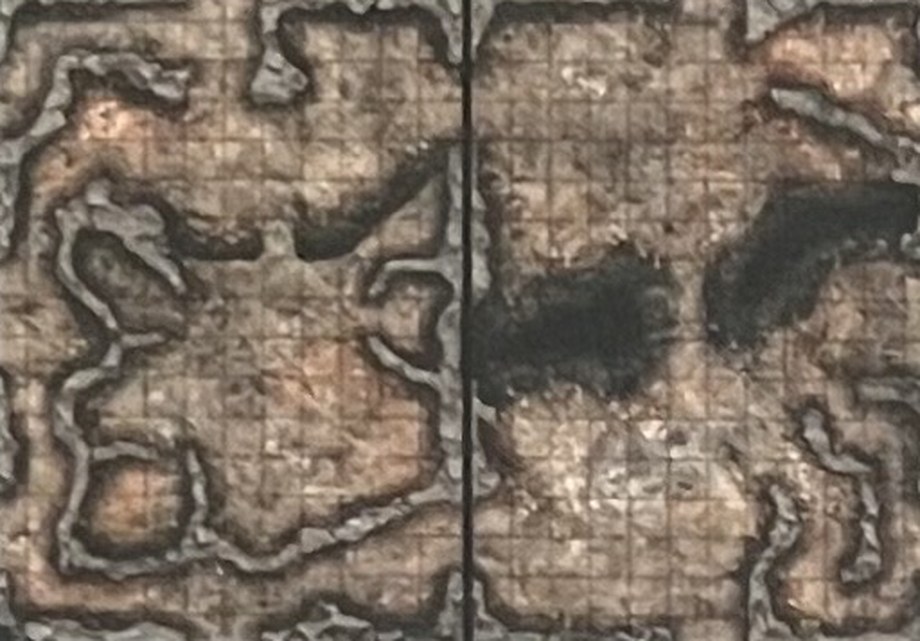
Battle map: The Broken Galleries — pages 15 & 16, 110 × 75 ft
The bridged pit is Talos's toll: extend the printed pit into the 40-ft chasm splitting the room, and keep its bridge as the bronze span (10 ft wide, no east rail). Chalk the weigh-plates on the last 15 ft of the south approach and the coin-drift glinting 40 ft down.
- Dimensions. 70 ft × 60 ft, ceiling 35 ft, split down the middle by a chasm 40 ft wide and 40 ft deep. The party arrives on the south lip.
- Light. Dim, from four coin-fed lamps on the span's rail that the gang keeps burning. The drop below is dark and the coin catches light like water.
- The span. A bronze bridge 10 ft wide, no rail on the east side, crossing the chasm. It is the only way on. It rings underfoot and everyone on it knows exactly where everyone else is.
- The weigh-plates. The last 15 ft of floor before the span is a set of bronze plates on pivots, and Talos reads them. He knows the weight of every creature and every purse that crosses them, which is how he counts, and which is why lying to him about what you are carrying does not work. Plates armed: anyone standing on them when he wills it is dropped 10 ft onto the coin-chute (see below), DC 15 Dexterity save to catch the lip.
- The coin-drift. Forty feet down: a slope of four centuries of tolls he has not yet worn. Falling in costs 14 (4d6) bludgeoning, and the drift is difficult terrain that shifts — climbing out is Athletics DC 15, two successes, and every failure sinks you to the waist. There is a fortune down there and it is guarded by the fact that it is forty feet down in the dark under a bridge.
- The gang's shanty. A lean-to of stolen doors on the south-west corner, where the Cyclopean Gang lives off the trade. Cover, junk, and a hoist with 60 ft of good rope.
- The tally-post. A bronze post at the near end of the span, stamped top to bottom with the toll of every party that has crossed. Two-thirds of the way down, the stamp reads ARIADNE — ONE SPOOL, PART-SPENT — PAID.
Roster & Budget
A machine, two half-giants with sacks of rocks, and a mechanic who would rather not be here.
| Count | Creature | XP each |
|---|---|---|
| 1 | Talos-of-Coins (boss) | 8,400 |
| 2 | Gang Slinger | 1,100 |
| 1 | Forge-Thrall Cyclops | 3,900 |
Base 10,600 XP counting the boss and the two slingers; ×2 for three bodies = 21,200 adjusted, against the APL 9 Deadly budget of 14,400 — about 1.5× over, which is what a bronze colossus on a bridge should cost.
The Forge-Thrall is not in that number. He is the machine's mechanic, he is holding the coin box, and on round 2 of any fight he takes the box and leaves by the west crawl. Count his 3,900 only if the party corners him, which makes the encounter base 14,500, ×2 for four bodies = 29,000 adjusted, and which is a choice the party will have made for a box of money.
Phases / Clock
| Phase | Trigger | What visibly changes |
|---|---|---|
| 1 — The Count | On arrival | He counts heads, states the price, and waits. He does not haggle, threaten, or move. The slingers loaf. This can last as long as the party wants it to |
| 2 — Refusal | An attempt to cross unpaid, an attack, or an explicit refusal | He steps onto the near end of the span and arms the weigh-plates. The slingers take the high junk. He states the price again, unchanged, because it is the price |
| 3 — The Seam Splits | Talos drops to half HP (115) | The hammered coin-plate across his throat splits and his collected tolls begin spilling out of him — a stream of coin down his chest and onto the floor. He stoops for it. From here he spends one action in three gathering, and a party that scatters coin can steal whole rounds from him |
Round one, whatever happens. He counts, and he is right, and he counts the unconscious. If the party is carrying a fallen friend, he counts them, and if they are carrying a body he counts that too and explains, without malice, that the dead pay the same as the living because they take up the same width of bridge.
Combat Resolution
Twenty-three hundred pounds of bronze on a ten-foot bridge.
- Tactics. He fights on the span and does not leave it — that is his post, and off it he is not a toll. He shoves people over the east edge, which is his best move and which he uses without any particular cruelty. The slingers stay at 60 ft in the junk and throw rocks; they are useless within 15 ft and they know it, so they retreat up the shanty.
- The weakness. The coin-plate at the throat. Investigation DC 15 while within 30 ft, or automatic for anyone who watches him take a hit there: the seam where he hammers new tolls into himself is the newest and softest metal on him. Attacks against the seam are made at disadvantage (it is a small target, twenty feet up) but score a critical hit on a 19 or 20 and, on any hit of 25 or more damage, spill a shower of coin — he loses his next action gathering it, at any point in the fight, not only in Phase 3.
- Coin as a weapon. Throwing money at him works, and this is not a joke. Scattering 50 gp or more of loose coin within 15 ft of him (a bonus action) forces a DC 15 Wisdom save; on a failure he stoops. He can be beaten by people who understand him and cannot be beaten by people who are indignant about him.
- The bridge. The span's near end sits on a counterweight in the shanty. Two PCs and Athletics DC 17, or 40 damage to the counterweight chain, drops the span's near end — Talos falls forty feet into the drift, takes 14 (4d6), and is out of the fight for four rounds while he climbs. It also removes the party's bridge, which is the joke and the cost.
- What winning looks like. He is a construct, killing him is permitted, and killing him takes a long time: six to nine rounds, 35 minutes. When he falls he comes apart into everything he ever collected, spread across the span in a bright slick, and every single item down there belonged to somebody.
- He will take payment at any moment. Even at 1 hit point, in the middle of the party's turn, if the toll is put into his hand or laid on the plates he stops instantly, steps aside, and the fight is over. Tell the players this in Phase 1 so it is a real option later.
Alternate Resolution
Pay the toll. It is a real cost and it is supposed to hurt.
The price is one toll per head, and the head count includes the unconscious, the carried, and the dead. Six PCs is six tolls. He accepts any of the following, mixed freely, one per head:
| Payment | What it means in practice |
|---|---|
| Metal by weight | 100 gp of coin or plate, or twenty pounds of worked bronze — a shield, a helm, a hoplite's greaves, three spearheads. He weighs it on the plates; he cannot be short-changed and he does not want gems, art, or promises of gold elsewhere |
| The charges of a magic item | Every remaining charge of one item, given willingly. The item survives and never recharges again. It is the most expensive thing on this list and the one parties reach for second |
| A spell slot of 3rd level or higher | The caster lays a hand on the plate and the slot goes into the bronze. It does not return on a long rest until that caster is out of the maze under open sky. One slot, one head |
| A weapon that has killed | He accepts it only if it has actually taken a life, which he can tell. Not a barter — a forfeit. He melts it into his forearm while you watch, and it takes about thirty seconds |
| An oath, struck in bronze | For a party with nothing left. He stamps a promise into a tag — a specific, keepable thing: come back within a year and pay, carry this letter to the gate, never cross this bridge again. He keeps the tag. Breaking it means that the next time the party meets any Daedalan machine, it has instructions |
What he does with them. He eats them. He hammers the payment flat against his own thigh with the heel of his hand and works it into his skin, right there, while the party watches, and then he steps aside. Everything on him was somebody else's. Let a player look closely and find something specific: a surveyor's chain from a crew that never came back, a locket portrait of a girl about nine, a bronze spool-core with red fibre still in the groove.
Discounts he will honour, because a toll booth is not a monster:
- Somebody offers to pay for another's head — accepted without comment.
- The party is carrying a wounded or dead person — he waives that toll if asked directly and politely. He has a rule about the injured. He does not explain it.
- Persuasion DC 18 gets one head free, once, and never a second.
- Naming what he is — a Daedalan toll-plate machine, not a Talos — History or Arcana DC 17 — makes him pause for a full minute and knock two tolls off, because nobody has known what he is in three hundred years.
If the party carries the Under-Tongue Purse, one obol settles one carried body's toll outright — no 100 gp, no bronze by weight, no slot, and no need to ask nicely, which matters most once the asking is over and the fight has started. It buys nothing for the living, he will not take two for one body, and having been paid he carries the body across himself and sets it down on the far side.
Solved state. He steps off the span to the west side and stands still. The lamps stay lit. He will let the party back across later, free, in the same direction of travel, and he will remember them.
Scaling — APL 6 / 12 / 15
| APL | Adjustment |
|---|---|
| 6 | Talos at −25% HP (173), no Scatter the Purse, and the toll is 50 gp a head. One slinger. All DCs −2 |
| 9 | As written |
| 12 | Talos at +25% HP (288) and a third legendary action. Three slingers, the Forge-Thrall stays and fights, and the toll is 250 gp a head or a 4th-level slot. DCs +1 |
| 15 | Talos at +50% HP (345) with a second phase: at half HP he pulls the tolls out of the drift below — the coin rises around him in a 20-ft cyclone (difficult terrain, 14 (4d6) slashing to anyone starting a turn in it) and he regains 20 hit points at the start of each of his turns while it lasts. A lair action on initiative 20 arms the weigh-plates. DCs +3 |
Exit to the Resolution
- Pacing. 25–35 minutes if they pay, 35–45 if they fight. Behind schedule: state the price, let them pay, and spend the saved time on the tally-post and the locket. Ten minutes, and it still lands.
- Play him as a fixture, not a villain. Flat, patient, and completely unbothered. He has no opinion about the party. The horror is that a machine with no malice will nonetheless take a child's locket and wear it, and hand you a receipt.
- Do not let the table talk him down to nothing. One free head, once, and the History discount. Beyond that he simply repeats the price, in the same voice, as long as they keep asking. That repetition does more work than any threat.
- If the party is broke, the oath is the answer and you should steer toward it rather than let a bankrupt party start a fight they will lose. Make the oath specific enough to use later.
- The dead pay too. If the party is carrying a body, the toll for it is the scene's sharpest moment. Ask them what they are giving up for someone who cannot thank them.
- Clue drip. This finale delivers the Door tier, and the tally-post carries it: every party that ever crossed, what they paid, and which way they went. The two strongest hooks are the spool-core with red fibre in the groove and the stamp reading ARIADNE — PAID (X10 Ariadne's Thread), and the surveyor's chain fused across his chest, which came off a crew that mapped their way in and can be read backwards (X14 A Thread of Your Own Making, X20 The Bronze Bird if the party needs Daedalan parts and is willing to take them off a machine that is still using them).
- Callback. A party that met the Cyclopean Gang in the larder (R043) or bargained at the one-eyed forge (R023) knows this warband trades before it fights and throws things when it does. A party that has been hoarding coin all session is about to find out what the coin was for, and if they have been spending it, that was the right call.
Boon Card
The Under-Tongue Purse
Wondrous item, uncommon · a body-layer's purse of green obols, each one taken out of a mouth · optional, and never on the loot table
Six obols, and they do not come back · Weight negligible, worth about 3 gp as metal · No attunement · Appearance: stained leather, hard drawstring, and the coins inside are not clean
Passage Already Paid. Every obol has lain under a dead person's tongue, and any machine that weighs and reads what it is handed can tell. To a Daedalan toll-plate machine one obol is a full toll for one dead body being carried across, whatever the standing price is that day.
Only for the Dead. It pays nothing for a creature that is breathing. Unconscious, dying, stable, or asleep in a sack, a live head costs the full toll, and Talos-of-Coins is never wrong about which is which.
No Courtesy Required. An obol is accepted at any moment a payment can be made: mid-fight, at 1 hit point, from a party that attacked him, laid on the weigh-plates or put into his hand. No check, no asking, no politeness. This is the whole reason to carry it rather than rely on a waiver.
He Will Carry Them. Paid an obol for a body, he takes the body out of the party's arms, carries it across the span, and lays it down on the far side, and charges nothing for the walk back. He does not explain this and should not be asked to.
Six, and No More. Six coins, spent one at a time and hammered flat into his thigh with everything else he has ever been given. The purse refills only in the way you are already thinking of, and a table that says so out loud has understood the item exactly.
Lay It on the Plates. One coin, one body, one toll settled immediately. He recounts the party aloud and says the new number, and the number is smaller by one, and nobody at the table will enjoy it.
Creature Cards
Talos-of-Coins is unique to this bridge. The gang working his crossing is the Cyclopean Gang (W11) and appears elsewhere in the deck, so their numbers live in the bestiary.
Shared across rooms, so the full cards live in the bestiary: Gang Slinger, Forge-Thrall Cyclops. Every mention above opens the numbers here on this page.
Talos-of-Coins
Huge construct, unaligned · CR 12 (8,400 XP)
AC 19 (hammered coin over bronze plate) | HP 230 (20d12 + 100) | Speed 30 ft.
Saves Str +12, Con +10 · Details Insight +7, Perception +7 · Immune to poison, psychic, charmed, frightened, exhaustion, paralysed · Darkvision 120 ft.
He Knows the Weight. He knows the exact weight of every creature and every container within 30 ft, and therefore the head count, and therefore whether the purse being offered is short. Illusions, disguises, and confident lying do nothing. Invisibility does nothing.
The Toll Is The Toll. He states his price once and repeats it unchanged. He accepts payment at any time, including in the middle of a fight and including at 1 hit point, and stops immediately when it is paid. He never pursues past the span and never takes more than the toll.
The Coin Seam. The hammered plate at his throat can be targeted at disadvantage; it scores a critical hit on a 19 or 20, and any hit dealing 25 or more damage to it spills coin, costing him his next action while he gathers it.
Stoops for Money. If 50 gp or more of loose coin is scattered within 15 ft of him, he makes a DC 15 Wisdom saving throw or spends his next action collecting it. He is not greedy. He is doing his job.
Legendary Bearing. He takes two legendary actions per round, spent at the end of another creature's turn, and regains them at the start of his.
Multiattack. Two fist attacks, or one fist attack and one Sweep from the Span.
Bronze Fist. Melee, +12 to hit, reach 10 ft, one target. Hit: 23 (3d10 + 7) bludgeoning damage.
Sweep from the Span. Melee, +12 to hit, reach 15 ft, one target of Large size or smaller. Hit: 16 (2d8 + 7) bludgeoning damage, and the target makes a DC 18 Strength saving throw or is pushed 10 ft, which over the east edge of the span means a 40-ft fall onto the coin-drift.
Scatter the Purse (recharge 5–6). He opens a hand and fires flattened coin in a 30-ft cone. Each creature in the area makes a DC 18 Dexterity saving throw, taking 27 (6d8) piercing damage on a failure or half as much on a success. The coin stays on the floor and is worth about 40 gp, and he will want it back.
The Plates. When a creature steps onto the weigh-plates, he may drop them. That creature makes a DC 15 Dexterity saving throw or falls 10 ft to the coin-chute, taking 7 (2d6) bludgeoning damage and landing prone.
Count Again. He recounts the party aloud and adjusts the price for anyone who has died, been dropped, or slipped past. Any creature that has crossed the plates unpaid this round is marked and he will not accept a discount for it.
Reach. He makes one fist attack against a creature within 15 ft.
Hammer It Home. Costs 2 actions. He works a payment into his own skin, regaining 20 hit points, and the item is gone for good. He will do this mid-fight with a toll paid by a party that then attacked him, which is precisely as galling as it sounds.