A Thread of Your Own Making
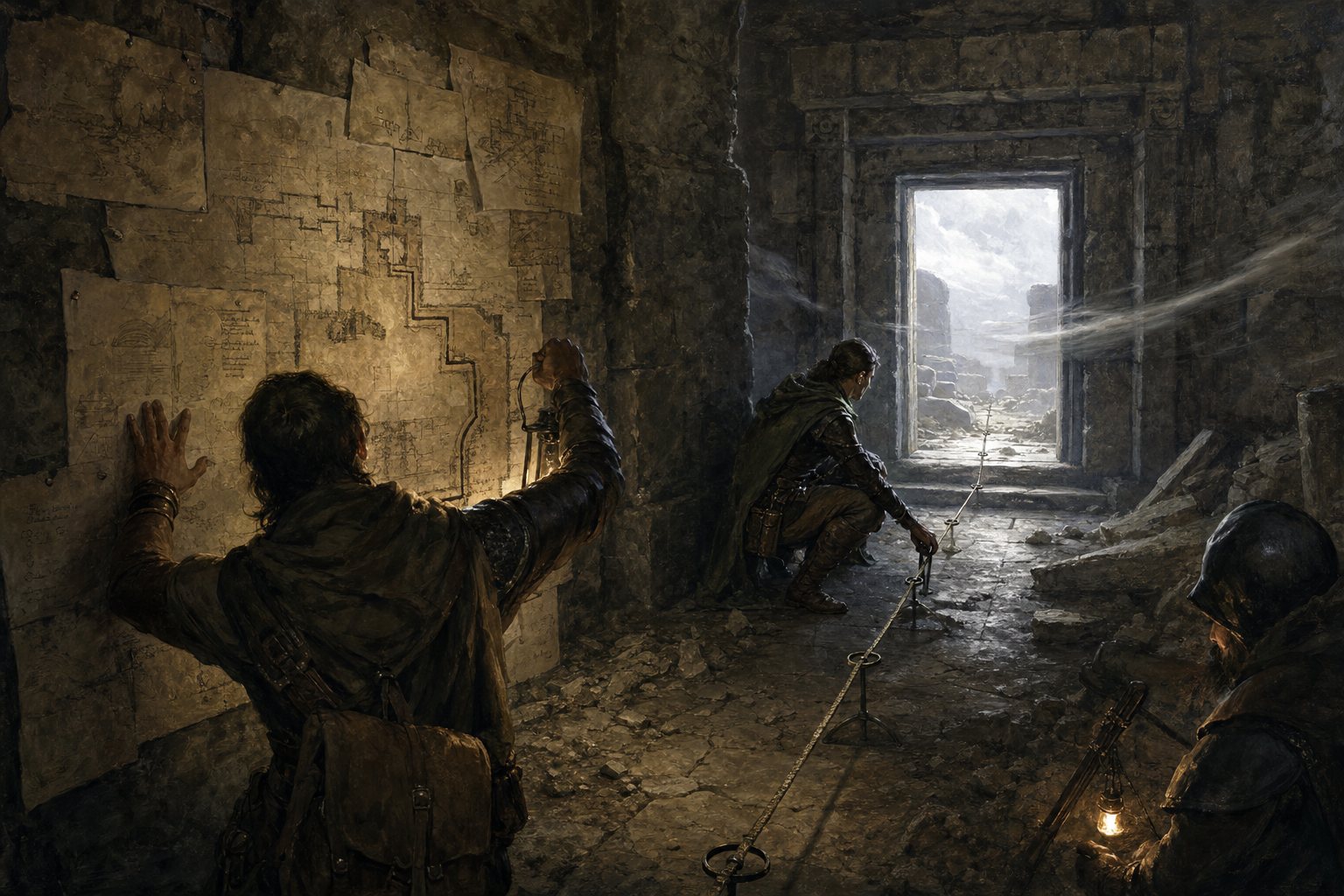
Spread it out on the floor and put a lamp at each corner.
It is not a map of the Labyrinth. It is a map of the eleven rooms you have been in and the twenty-odd doors you did not take, drawn in chalk on the back of somebody else's survey, with the depths written in and two of the corridors marked with a question mark and one marked with something ruder.
It is the only one in the world. And if you have been honest with it, it is enough.
The Way Out
The Labyrinth defeats mapping. That is its design brief and it is very good at it: the corridors curve without seeming to, the floors slope a degree and a half, three rooms rotate, and the geometry is deliberately unmemorable.
It does not defeat surveying. A crew with chalk, a knotted chain, a plumb bob, and the discipline to write down bearings and depths at every junction will, in about forty junctions, have something no one else has ever had: a reckoning of where the surface is relative to where they are standing.
This Resolution is the party's own competence, cashed in. It requires no object, no NPC, and no bargain. It requires that somebody has been keeping notes, and it is the one ending on the list that the players earn hours before they know it is available.
Requirements
| Requirement | Where it comes from |
|---|---|
| The map | B11 The Surveyor's Crew starts the party with chalk, chain, plumb bob, and a partial survey. Any party can build one from scratch — the DM should quietly note every junction where a player asked which way they came from. The bar is deliberately generous: notes on a character sheet count |
| A datum | One point whose direction and depth from the surface are known. R010 Vault of the Salt Wind gives a bearing (the sea is that way). R059 The Counting Room gives a depth. R037 The Cartographer's Cell gives both and is worth going back for |
| The maze's cheat | R099 The Cartwheel Rotunda rotates, and so do two others. A naive map is wrong by exactly the amount those rooms have turned. R062 The Mason's Unfinished Wall and R087 Ruin of the Old Temple both record it; Investigation DC 15 in a rotunda catches it live |
| Nerve | At the reckoning the map says one thing and the party's gut says another. The map is right. Wisdom or Survival DC 13 to trust it, or simply a player deciding to |
Clues
| Tier | Line to deliver |
|---|---|
| Whisper | Your chalk arrow at the last junction. You drew it two hours ago, and coming at it from this side, it is pointing somewhere you did not expect. |
| Trace | A previous crew's marks — chalk gone to dust, numbered, in a system almost but not quite like yours, stopping abruptly at a doorway. |
| Sign | A survey nail driven into a floor seam with a depth stamped on its head, in cubits, and a bearing scratched beside it. Somebody was doing this properly. |
| Proof | The dead surveyor and his book: forty junctions, bearings and depths, and on the last page a note that three of the rooms turn. |
| Path | Your own map, laid out and corrected for the rotation, with the surface where it must be — up, and thirty degrees off the bearing everybody's instinct insists on. |
| Door | A blocked stair exactly where the map said a stair would be, under a hundred years of rubble that took an hour to move, opening on a Knossian hillside. |
Resolution Scene
Fifteen to twenty minutes, and the decision is whether to trust your own arithmetic.
Phase one — the reckoning (10 minutes, at the table). Get the map out. Genuinely: if a player has been drawing one, put it in the middle of the table and work from it. If nobody has, the DM's own notes stand in.
Three corrections, in order, and each is a check any character can attempt:
- The slope. Every corridor in the maze falls about a degree and a half inward. Forty junctions of it is ninety feet of depth the party did not notice descending. Investigation or Survival DC 13.
- The rotation. Three rooms turn. Any leg of the survey that passed through one is wrong by 40°. Finding which legs is Investigation DC 15 — or free if the party ever noticed a rotunda's door being in the wrong place.
- The datum. Fix the whole thing to one known bearing and depth. History, Navigation, or Survival DC 14.
Each correction succeeded shortens the walk out by one encounter. Three successes means the party walks out clean. Zero means four fights and the map still works.
Phase two — the disagreement (5 minutes). The corrected map points at a blank wall, thirty degrees off the direction every single person in the party is certain the entrance lies. This is the scene. The map is right and the certainty is the maze doing its one trick. Let the players argue. Do not resolve it with a roll unless they ask.
Phase three — the dig. Behind the wall, where the map said, is a stair: the west service stair, bricked up when the west range was condemned. An hour of work, group Athletics DC 12, and daylight.
Fallback
Nobody kept notes and the DM has none worth using.
- Dead reckoning. The maze has two honest signals and neither requires a map: water runs to the sea, and the draught runs to the sky. Follow water downhill to find the seaward halls; follow a candle flame's lean to find a vent. Both work.
- Cost: two extra encounters, four hours, and the party arrives at whichever exit the signals led to rather than the one they chose — a vent shaft they cannot climb, or a flooded sea door. Treat that as an entry into X17 or X16 rather than a failure, and say so at the table: your reckoning got you to a door, just not this door.
- The party still gets out. Nobody is ever lost in this Resolution. The maze is a building, buildings have outsides, and water has opinions.
Resolution-owned, never on the loot table.
- The map. Corrected, signed, and the only accurate survey of the Labyrinth's western range in existence. Grants advantage on navigation anywhere in the maze, and Minos, his rivals, the Cult, and every treasure-hunter in the Aegean will pay grotesquely for it or kill for it. This is the single most valuable object any Resolution hands out, and it is a piece of paper the players made.
- The surveyor's chain, knotted at the fathom, and his plumb bob. A working kit and a dead man's professional legacy.
- The west service stair, now open — a back door into the Labyrinth that Minos does not know exists.
Scaling — APL 6 / 12 / 15
| APL | Adjustment |
|---|---|
| 6 | Two corrections instead of three: the rotation is already noted in the partial survey. DCs −2, and the dig is loose rubble |
| 9 | As written |
| 12 | Four corrections — a fourth room turns, and it is one the party has been through twice. DCs +2, and the bricked stair is mortared, not stacked: two hours |
| 15 | As APL 12, and the Cult of the Thread has been editing the party's chalk marks for hours. One leg of the survey is sabotaged and must be found (Investigation DC 17) or the reckoning lands them in the finale's antechamber |
- This is the Resolution that rewards the players rather than the characters, and it is worth protecting for exactly that reason. If somebody at the table has been drawing a map on graph paper all session, this ending is a standing ovation. Set it up early: mention the slope, mention the rotunda's door, and let them work out what it means.
- Keep the bar low. Do not demand a survey. Notes on a character sheet, a photo of a whiteboard, or three remembered junctions are all enough. The scene is about the correction, not the completeness.
- Track the party's junctions yourself from room one, whether or not they are mapping. Ten seconds per room, and it means this Resolution is always available and always specific to what they actually did.
- The disagreement in phase two is the emotional core — six characters certain the entrance is that way, and a piece of paper saying otherwise. Play the certainty straight and let the map win. A maze whose last trick is your own confidence is a better maze than one with another minotaur in it.
- B11 parties were hired to map this place. They finish the job. Let somebody say so out loud on the hillside, and let the survey be worth more than the wage.
- If the party is out of time, one correction, one argument, one dig. Eight minutes.