The Furies' Verdict
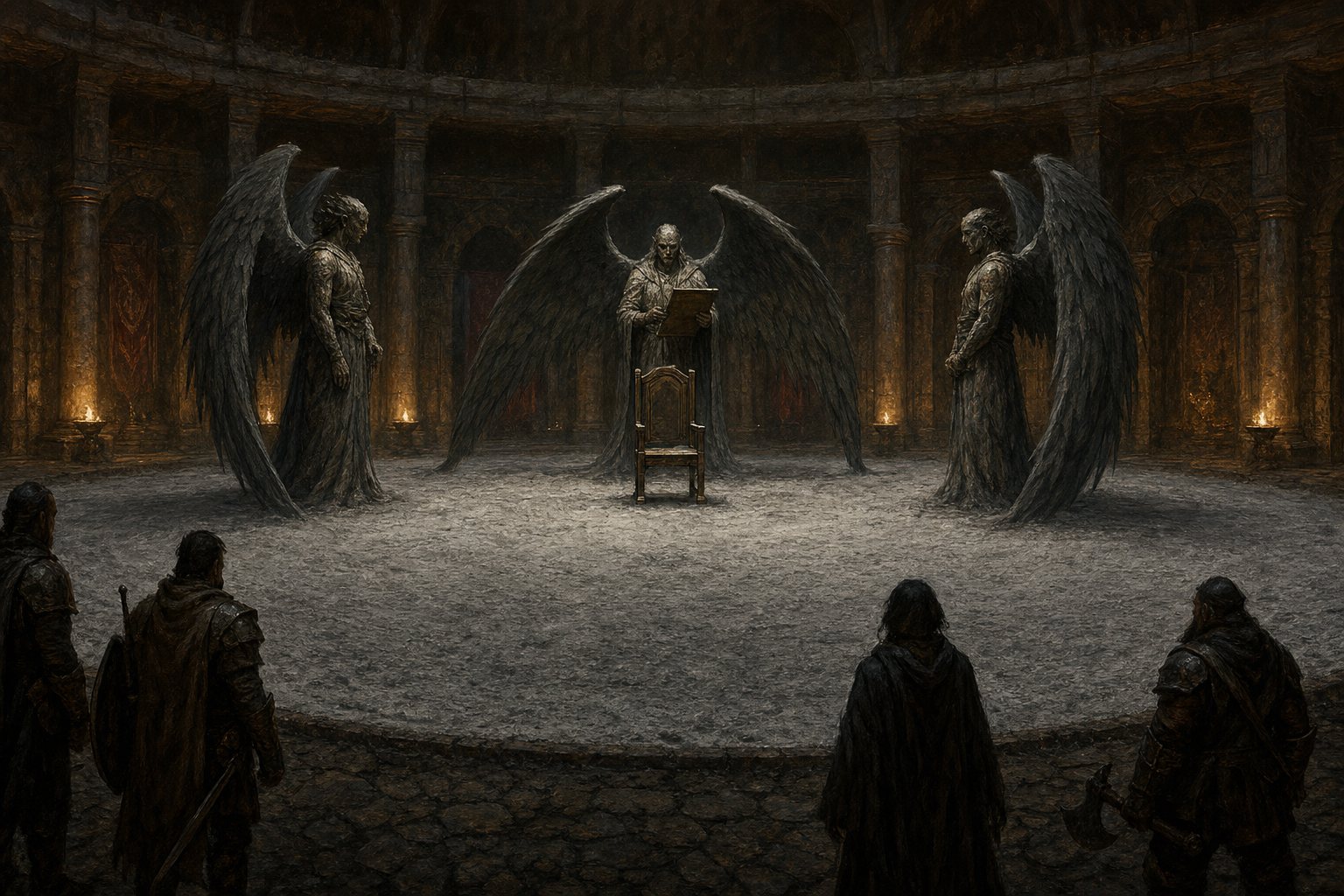
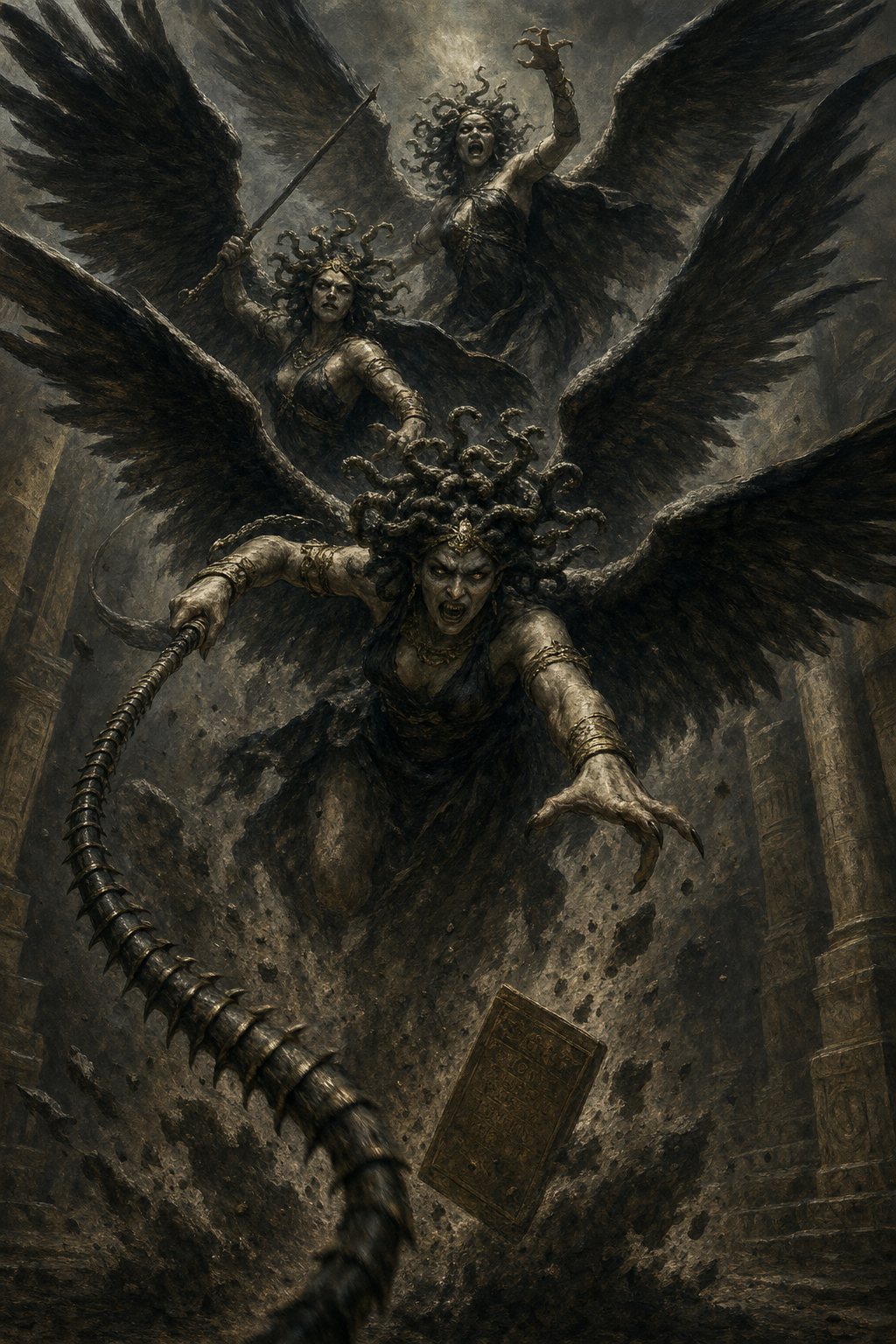
A ring of grey ash has been poured on the floor of this round chamber, fifty feet across and unbroken, and inside it a man is chained by the wrists to a bronze post. He has been weeping for some time. Three winged women stand over him — two holding the chain, one holding a beaten bronze sheet at arm's length the way an old woman holds a letter she can barely read.
She was halfway down it when you came in. She stops. All three of them turn their heads at once, without hurry, and the one with the sheet turns it over.
There is writing on the back as well. She begins to read that instead.
DM summary. A trial already in session, which the party has just been added to. The Erinyes are a trio and cannot be killed; the honest ways out are to be judged and released, or to give the court something better to do than judge you.
The Boon
The Sworn HalfOptional item
Evidence the court has to hear, and it names a guilty man who is not in the room
What it is. A palm of fired red clay, snapped across on a jagged line, on purpose. The Sworn Half is half of a lading oath: a tribute ship's manifest pressed into wet clay at the harbour, broken while soft, a half to each party so neither could produce it alone. Fourteen children's names down the face in a clerk's cramped hand. On the back, a second hand, pressed later and harder, and not the captain's.
Where it comes from. Plant it early and let it be loot: a drowned harbour clerk, satchel still buckled, a records niche in a lore room, the bottom of a purse on any coin roll — a broken sherd with names on it, worth nothing. Nobody says the word evidence. Late plant: the sisters dragged Xouthos up the chain-way and shook his pockets out, so the passage outside has a sherd in the drag-marks.
What it does here. Xouthos has kept the matching half nine years and hands it over the moment anybody asks. Fitted together, the break matches tooth for tooth — a broken oath's whole legal point — and Tisiphone's truesight settles it at a glance. Presenting it is one exchange on the verdict track and an automatic success, once: she will not proceed on memory, and she does not refuse documents. One success, not two — it is also the thing Argue the charge on its facts goes looking for, so a party may argue with it instead and drop that approach's Insight DC 15, but the court will not count the same sherd twice. The hand on the back names Antiphates of Amnisos, who owned the hull and is not in this maze.
What it doesn't do. It does not acquit Xouthos: he had hands and he used them. It is fired clay, and any fire that reaches it chars the writing. It is worth nothing once the first blow is struck: an attacked court has stopped being a court. A party who never found it stands the same trial, the same five approaches, the same DCs.
Card and numbers or jump to the card ↓
Arena
Battle map: custom map. A 70-ft round verdict chamber: the poured ash ring, the four braziers, the stele and chain — two chalked circles and five marks; draw it and keep the ring line crisp, because wiping it is the encounter. Browse the book if a page half fits your table better.
- Dimensions. A round chamber 70 ft across, ceiling 40 ft, with a gallery ledge at 15 ft running two thirds of the way around. The party enters at floor level through a doorway with no door in it.
- Light. Four bronze braziers at the compass points burn pale grey — funeral ash, not charcoal. Bright light within the ring, dim outside it.
- The poured ring. Fifty feet across, two fingers wide, unbroken: ash from a funeral fire. No Erinys will willingly cross a poured line of grave-ash or salt while a vigil stands. The trial is inside it. So is the Adjudged. So, the moment they step in, is the party.
- The braziers. Each holds enough loose ash to pour a fresh line 20 ft long. Scattering one is an action (Athletics DC 10); pouring a deliberate line is an action and covers 20 ft. New lines bind the furies exactly as the ring does. There is enough ash in the room for four lines and no more.
- The stele and the chain. A bronze post 8 ft high at the centre, and a chain running from it to the wrists of the Adjudged. The chain unhooks at the post — Thieves' Tools DC 16, or Athletics DC 18 to bend the hasp — and unhooking it ends the vigil. Read Phases before you let anyone do that.
- The docket. The bronze sheet Tisiphone reads from. It is the trial. Take it or blot it and the reading stops; she will not proceed on memory, because a sentence spoken from memory is not a sentence.
- The Adjudged. A tribute-ship captain named Xouthos, who in a storm nine years ago threw four of the fourteen children overboard to lighten his hull and made port with the rest. He is not lying about any of it. He would like the party to save him, and he will say anything.
Roster & Budget
Three furies, of whom exactly one is fighting at a time.
| Count | Creature | XP each |
|---|---|---|
| 1 | Tisiphone, Who Reads the Charge (boss) | 10,000 |
| 2 | Erinys of the Vigil | 8,400 |
Read this arithmetic in stages, because that is how the fight arrives.
- The reading. Nobody is fighting. 0 XP, and the whole scene is here.
- Tisiphone alone, which is what a party gets for interrupting: 10,000 base ×1 = 10,000 adjusted, 69% of the APL 9 Deadly budget of 14,400. Her legendary actions and the ash ring are the missing 4,400.
- The full trio, which is what a party gets for freeing the Adjudged or breaking the ring: base 26,800, ×2 for three bodies = 53,600 adjusted, nearly four times the budget. That is not a fight, and you should not run it as one. It is a sentence being carried out. See Persistence Check.
The sisters hold the chain and do nothing else. They do not move, do not retaliate, and do not look at the party while the vigil stands. Say so plainly — a table that can see two idle CR 12 monsters is a table making an informed decision.
Phases / Clock
The trial runs in three readings. Each reading is one round of initiative if combat has started and about five minutes of table time if it has not.
| Phase | Trigger | What visibly changes |
|---|---|---|
| 1 — The Charge | On the party's arrival | Tisiphone reads Xouthos's charge aloud, then the back of the sheet: one thing this party has actually done in this session. Pick it before you run the scene |
| 2 — The Testimony | The charge is finished, or anyone speaks | She lowers the sheet and asks the party a direct question about their deed. The sisters' heads turn. The ash of the ring begins to lift and turn in a slow ring of its own, waist-high |
| 3 — The Sentence | Both charges are answered, or three rounds pass | She folds the sheet. Whatever is decided is decided now, and the braziers go out one by one as she speaks. When the last goes out the court is over and the furies leave through the wall |
Round one is the whole product. She reads a real deed of theirs, in a flat clerical voice, with a date. Do not editorialise it and do not let it be a surprise you invented — use something they did in front of you tonight, ideally something they thought was fine.
Combat Resolution
Only if the party swings first, or frees Xouthos, or breaks the ring.
- Round 1. Tisiphone does not close. She finishes the sentence she was on, drops the docket, and uses Read the Sentence on whoever struck first. The sisters keep hold of the chain.
- Rounds 2–5. She fights in the ring and will not leave it. A party that retreats outside the ash is safe from her and can shoot her all day, which she knows, and which is why she opens by branding a runner. She takes two legendary actions per round.
- Phase change at half HP. One sister passes her end of the chain to the other and steps down. From here the encounter is 18,400 base, ×1.5 = 27,600 adjusted, and the party should be looking at the door.
- What winning looks like. Tisiphone at 0 HP comes apart into a column of ash that hangs there. She is not dead — see Persistence Check — but the court is disrupted, the sisters take Xouthos and go, and the party has bought their passage with something they will be carrying for a long time. Four to six rounds, 25 minutes.
- What losing looks like. She does not kill. A PC at 0 HP here is branded, bound in ash, and set aside for sentencing, which is worse and entirely survivable.
Alternate Resolution
Stand trial. Roleplay, and the DM should let it take twenty minutes.
The court is genuinely a court. It has procedure, it honours a confession, and it cannot be lied to — Tisiphone has truesight and already knows the deed. What it does not have is any interest in punishing people who admit things.
The verdict track. Three successes before two failures. Each is one exchange, and each needs a stated approach, not a die roll on its own.
| Approach | Check | Notes |
|---|---|---|
| Confess the deed plainly and name who was wronged | No check | Automatic success, once, for the PC whose deed is on the sheet. Refusing to confess is not a failure; refusing while claiming innocence is |
| Offer restitution that costs something | Persuasion DC 17 | Coin does not work. A named item, a service sworn, or carrying a message to the wronged party's family does. Advantage if the offer hurts |
| Argue the charge on its facts | Insight DC 15 then Persuasion DC 18 | Insight finds what the docket got wrong; the second check is the argument. Two rolls, one success |
| Point the court at a greater debt | History or Religion DC 16 | Name a crime in this maze older and worse than theirs — Minos's tribute, the drowned children, the man in the chain. True, legal, and shabby. Counts as a success and costs the party Tisiphone's regard |
| Say nothing at all | — | A failure per reading. Silence is contempt |
If the party carries The Sworn Half, fitting it to Xouthos's half in front of the court is one exchange and an automatic success — a document is the one form of testimony this court prefers to a voice. The sherd is one success and only one. Entering it as evidence and arguing the charge on its facts are the same act done twice: the sherd is the finding, so a party that has already put it in front of the court has argued the facts, and Tisiphone will say so if they try to run both. A table that would rather argue than submit may instead skip the Insight step of Argue the charge and make the single Persuasion DC 18 — the same one success, bought with a roll instead of without one. Two of the remaining approaches still have to land, and one of them cannot be the confession if the confession has already been spent. It also puts a name the court cannot reach on the floor: Antiphates of Amnisos owned the hull and wrote the line on the back, he is nowhere in this maze, and a court holding admissible evidence may enter him on the docket in his absence. Say that part slowly. It is the only outcome in this room where somebody who deserves it is sentenced and nobody present is hurt, and the sisters leave with somewhere to be.
Three successes: the sentence is dismissed with a mark. She brands each PC on the palm — no damage, no mechanical penalty, a grey mark that does not wash off — and the court makes room for them to pass.
Two failures: the party is added to the docket properly, sentence to be served later. Nothing happens now. They may go. Somewhere in the maze there is now a fury who knows their names, and the DM should use that in the Resolution.
Xouthos. If the party argues for him, the furies will hear it, and he can be released into their custody rather than executed — a real mercy that gives the party an NPC who is guilty of exactly what they said he was guilty of, walking out behind them.
Persistence Check
The Erinyes as a trio are a singular icon. They cannot be killed here, and the win condition is non-lethal: the verdict is spoken and the court disperses.
- The plain win. Three successes on the verdict track, or the trial completed on Xouthos with the party out of the ring. The furies leave through the east wall, taking the chain with them, and the way onward is unguarded.
- If the party kills them anyway — and they can drop all three, given a lucky night and a lot of resources — nothing dies. Each falls into ash and re-forms at the next vigil, wherever that is. What the party has actually done is interrupt an unfinished sentence, and an unfinished sentence has to go somewhere.
- The Debt. Every PC who dealt damage to a fury carries it out of the room: disadvantage on death saving throws, and the next Erinys, ker, or vengeance spirit they meet names them as the Adjudged before it names anyone else. It lifts at a temple outside the maze, with a funeral offering worth 50 gp and a day's fast. Tell the players this out loud, in the room, in Tisiphone's voice, as the ash falls: "The account is not closed. It is transferred."
- Xouthos unjudged follows the party out. He is grateful, useless, and extremely findable by anything that hunts the guilty.
Scaling — APL 6 / 12 / 15
| APL | Adjustment |
|---|---|
| 6 | Tisiphone at −25% HP (163) and no Read the Sentence. One sister only, and she leaves the moment the boss falls. All DCs −2 |
| 9 | As written |
| 12 | Tisiphone at +25% HP (272) and a third legendary action per round. The second sister steps down at one quarter HP rather than never. DCs +1 |
| 15 | Both sisters fight from round one, the ring's ash lifts into a 10-ft-high wall of grit at the start of round 3 (lightly obscured, DC 18 Con save or blinded until the end of your next turn), and Tisiphone gains a second phase: at 0 HP she re-forms once, at half HP, and reads the sentence again from the beginning. DCs +3 |
Exit to the Resolution
- Pacing. 35–45 minutes if they stand trial, 25 if they fight. Behind schedule: cut Phase 2, put the party's deed on the front of the sheet with Xouthos's, and go straight to the verdict track with two successes required.
- Pick the deed before the session ends, not during the scene. Anything the party did tonight: a room they burned, an NPC they lied to, a prisoner they left, loot taken off a body that had a name. If they have genuinely done nothing wrong tonight, use the oldest thing on a character sheet and ask that player to supply the detail — most will hand you something better than you had.
- Do not let the trial become a rules argument. The furies are not lawyers and the DCs above are the whole procedure. If a player finds a genuinely clever fourth approach, count it as a success and move on.
- Table safety. Chains, a weeping prisoner, and four drowned children. That last one is the sharp edge; if the table does not want it, Xouthos's crime is breaking an oath sworn on his mother's grave and the mechanics do not change by a single die. Offer the swap before you read the charge, not after.
- Clue drip. This finale delivers the Path tier. Two hooks: the docket itself, which lists in its margins every oath sworn in the maze and can carry a route out for X06 The Oracle's Bargain (the furies are exactly the power that offers passage for something you are carrying), and the grey palm-brand, which the great bronze gate's warden recognises for X08 The King's Writ.
- Callback. A party that met the Erinyes & Ash in the colonnade (R081) or the chimney shaft (R086) has seen the naming of the Adjudged before and should recognise it the moment Tisiphone turns the sheet over. If they interfered there, put that on the back of the sheet.
Boon Card
The Sworn Half
Document, nonmagical · half of a broken lading oath in fired clay · optional, and never on the loot table
AC 13, 3 hit points, and it is fired clay | Weight 10 oz | Attunement none
Appearance: a palm-sized sherd, red and thumb-smoothed, fourteen names down the face in a clerk's hand and one line on the back in a heavier one, with a harbour stamp broken through the middle of it
A Break Nobody Can Forge. Held against its matching half the two edges meet tooth for tooth, and no copy, cast, or illusion reproduces the line. Any creature that can examine both halves knows at once that they are the same tablet; a creature with truesight knows it from across the room. This is what makes the Half evidence rather than a claim.
Admissible. A court that honours procedure must hear a document, and Tisiphone will not proceed on memory. Presenting the Half, fitted to its match, is one exchange on the verdict track and an automatic success with no check, once per trial.
One Sherd, One Success. Everything the Half does on the verdict track it does once. Entering it as evidence, arguing the charge with it, and naming the hand on its back are three ways of putting the same object in front of the court, and Tisiphone credits the first of them and says plainly that she has already read it. The other two successes have to come from somewhere else.
The Second Hand on the Back. The reverse carries the shipowner's own undertaking, in his own hand: make port with her, whatever you have to put over the side. Naming him is how a party spends the greater-debt approach without deflecting — it costs none of Tisiphone's regard, because evidence is not an excuse — and it permits a verdict against a creature who is not present. It yields no success of its own beyond the Half's one, and if the Half has already been credited it is the docket entry against Antiphates that the party gets, which is the point of it.
It Does Not Acquit. The Half shares out guilt; it does not remove any. Whoever is standing in the ring is still answerable for what their own hands did, and a court that has been given a second name will still finish with the first.
Fired Clay. It survives a pocket, a river, and nine years in a belt. It does not survive fire: any fire damage that reaches the sherd chars the writing illegible, and a charred sherd is worth nothing to anybody. Once a fight starts, so is the Half.
Hold It Up. The bearer names what it is and fits the halves together at arm's length. Every creature in the room that can see it looks at it, including a reader mid-line, and the reading stops for as long as it takes to be examined — about one round, and it is not a stun, a charm, or a save.
Creature Cards
Tisiphone is unique to this chamber and her numbers are here. Her two sisters recur across the deck, so they live in the bestiary.
Shared across rooms, so the full cards live in the bestiary: Erinys of the Vigil. Every mention above opens the numbers here on this page.
Tisiphone, Who Reads the Charge
Medium fiend, lawful neutral · CR 13 (10,000 XP)
AC 18 (ash-scale and office) | HP 218 (23d8 + 115) | Speed 40 ft., fly 60 ft.
Saves Dex +10, Wis +10, Cha +10 · Details Insight +10, Intimidation +10, Perception +10 · Resistant to fire, cold, and nonmagical weapons · Immune to poison, charmed, frightened · Truesight 120 ft.
The Charge Is Read. On her first turn she names one deed a player character actually committed, with a date, in a flat voice. That creature is the Adjudged. While the Adjudged is conscious and within 60 ft she attacks no one else and provokes from no one else.
Honours a Confession. If the Adjudged spends its action to state the deed plainly and name who was wronged, she has disadvantage on attacks against it until the end of her next turn, and any creature that then damages her becomes complicit and is named next. She cannot be lied to and does not need to be told the truth to know it.
Bound to the Vigil. She cannot willingly cross a poured line of grave-ash or salt while the vigil stands, and she will not leave the ring while the Adjudged is chained. Outside the ring she can only be reached by ranged attacks, spells, and argument, which she considers three forms of cowardice and says so.
Legendary Bearing. She takes two legendary actions per round, spent at the end of another creature's turn, and regains them at the start of hers.
Sentence Deferred. At 0 hit points she does not die. She comes apart into a standing column of grey ash and re-forms at the next vigil, wherever her sisters hold it.
Multiattack. Three attacks with the ash scourge, or two attacks and one use of Brand the Docket.
Ash Scourge. Melee, +10 to hit, reach 10 ft, one target. Hit: 14 (2d8 + 5) slashing damage, plus 10 (3d6) fire damage if the target is the Adjudged.
Brand the Docket. One creature within 30 ft makes a DC 18 Charisma saving throw, taking 21 (6d6) fire damage on a failure or half as much on a success. On a failure it is entered on the docket for 24 hours: it sheds dim grey light in a 5-ft radius, cannot become invisible, and every fiend within a mile knows the direction it lies in.
Read the Sentence (recharge 5–6). She reads three lines from the bronze sheet. Every creature of her choice within 60 ft that can hear her makes a DC 18 Wisdom saving throw, taking 33 (6d10) psychic damage and being stunned until the end of its next turn on a failure, or half damage and no stun on a success. A creature that has confessed this encounter has advantage on the save.
Judgment Falls. When the Adjudged deals damage to a creature other than her, she makes one ash scourge attack against it.
Name the Next. She names a new Adjudged from among the creatures present. Her existing marks and effects do not transfer.
Wingbeat of Ash. She flies up to 30 ft without provoking, and every creature she passes over makes a DC 15 Constitution saving throw or is blinded by grit until the end of its next turn.
Hold the Chain. Costs 2 actions. She takes hold of the chain herself and one sister is freed to act on the next round. Use this only when the party has broken the ring, and tell them what it means.