Antechamber of the Held Breath
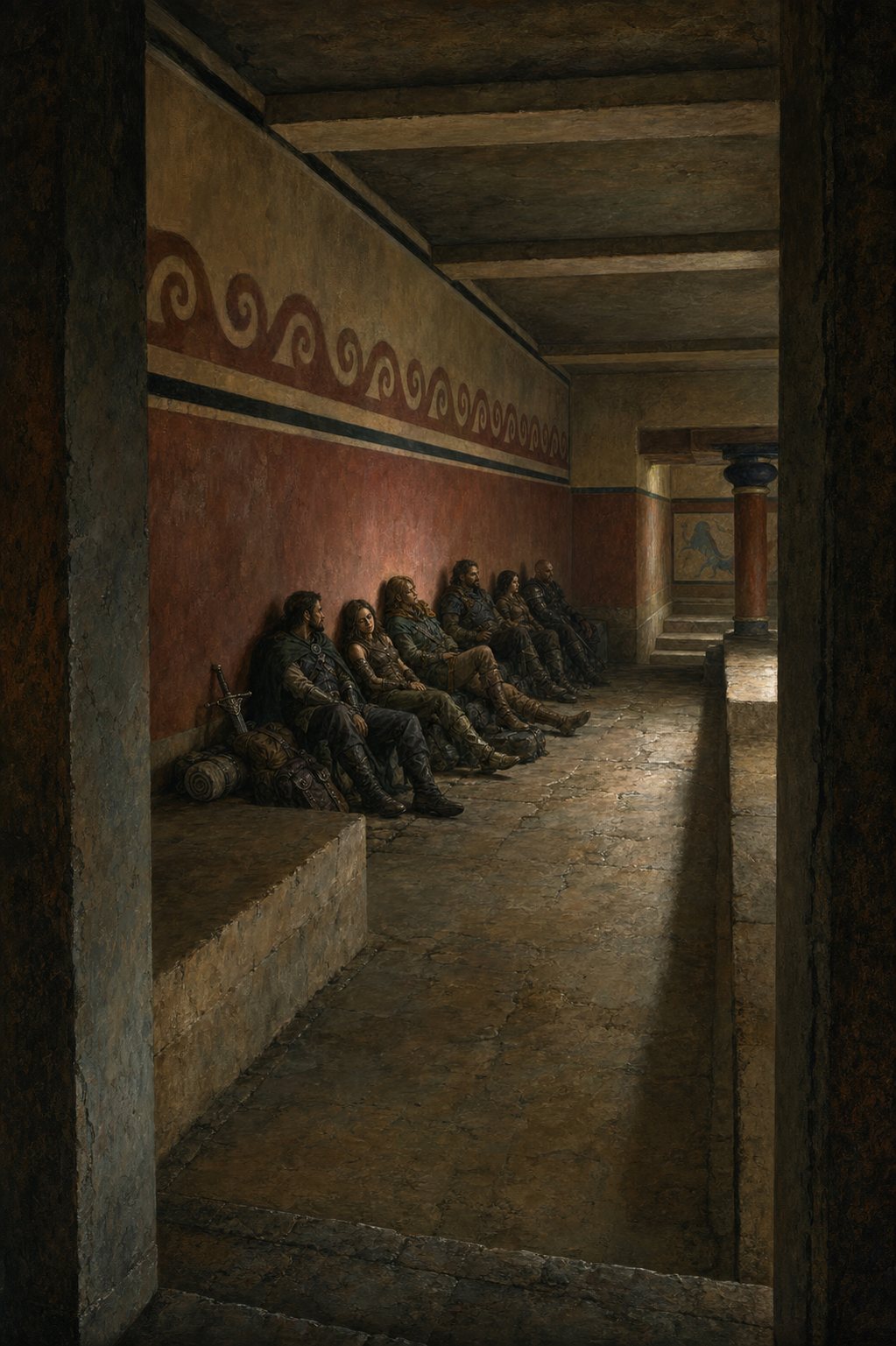
A long low room with a stone bench down one side and a stair going down at the far end, and it is quiet in a way nothing else down here has been — no drip, no grinding, no distant anything. Six people are sitting along the base of the far wall with their backs against it and their gear beside them, and none of them was hurt. They sat down and they stayed.
Then the air moves. It draws past you toward the stair, steadily, for as long as you can hold your own breath — and then it stops, and turns, and comes back up warm.
DM summary. The last quiet room before the deep. Nothing here can hurt anybody. This is the room where a DM declares the finale, plants the Path-tier clue, and lets the table sit in silence for ninety seconds before everything gets loud.
Terrain & Features
Battle map: custom map. A 50 × 20 ft antechamber: a bench, six seated dead, and a name wall — sketch it and let the room breathe. Browse the book if a page half fits your table better.
- Dimensions. 50 ft × 20 ft, ceiling 10 ft. Low, long, and quiet enough that players will lower their voices without being asked to.
- Light. None, and no soot on any wall — nobody has burned a torch in here for a long time. Every lamp the party carries seems brighter than it did.
- The breath. The room inhales and exhales on a slow cycle: about forty seconds each way, in and out, steadily, forever. On the out-breath the air is warmer and carries dust up from below. A held flame leans one way, then the other. Time it with a real forty-count at the table at least once.
- The seated dead. Six of them along the far wall, in a row, with their packs beside them. Not wounded, not robbed, not arranged: Medicine DC 12 says they died of nothing in particular, sitting down, some considerable time apart. The most recent is perhaps a year old.
- The name wall. The wall above the bench is scratched over with names — hundreds, in a dozen hands and four alphabets. Between them, in the gaps, a few whole sentences. Investigation DC 13 finds the three worth reading: I am going down, do not wait for me, and, in a very careful hand, it is not what they told you it was.
- The bench. Stone, worn smooth in six or seven places by people who sat here a long time. There is room for the whole party.
- The stair. Twelve steps down at the far end, and then a turn, and then nothing you can see. The cold comes up it and so does the breath.
Traps / Puzzles / Checks
Nothing here is dangerous. These are the ways in.
| Check | DC | What they get |
|---|---|---|
| Investigation on the name wall | 13 | The three sentences above, and the fact that the names are in four scripts spanning centuries |
| Medicine on the seated dead | 12 | Nobody killed them. They sat down and did not get up. Two of them were not old |
| Survival or Nature on the breath | 14 | It is not wind. Wind does not reverse on a count. Something below is moving a very large volume of air on a cycle, and the cycle has not changed in the hour the party could stand here and check |
| Investigation on the packs | 12 | Complete kits: rope, rations, oil, a mapping chain, a child's toy. Nothing is missing and nothing was taken |
| History or Religion | 15 | This is a prothesis room — a place for waiting before a rite. Whatever it was built to wait for, it was built by people who expected to go down those stairs and did not expect to come back, and were at peace about it |
Holding the breath. Any PC who sits on the bench and rides one full cycle — eighty seconds, no speaking, no light in hand — may ask you one question about what waits below and get an honest yes or no. Once per character, once per session. This is not magic and you should not explain it. They sat still long enough to notice something, and the answer is you telling them the truth.
What the Breath Brings Up
The purpose of this room in the deck is to let a DM start pointing at the Final Encounter without naming it. Choose the row that matches the finale you intend — or, if you have not chosen, the row that suits the run you have had, and let the d20 agree later. Plant one physical detail from it and say nothing else about it, ever.
| The shape below | What the out-breath brings, and what is in the room | Finales it fits |
|---|---|---|
| Horned, and it remembers a name | Cattle-smell, thick and warm. Somewhere far down, a chain being dragged and then carefully set down. One of the seated dead is holding a bull-mask in his lap | F01, F02 |
| An animal, entirely and only | The smell of a den. Coarse hair caught on the stair's doorframe at chest height, and more of it, older, further up the wall than a person is tall | F06, F09, F14 |
| Bronze, patient, bound by its own rules | The air is warm and tastes of metal. The dust it carries is bronze filings, fine as flour, and there is a tick under the silence that is exactly regular | F03, F15, F18, F19 |
| It will speak first | The breath carries a word, too faint to catch, on every out-breath and never the same word twice. All six of the seated dead are facing the stair | F04, F11, F13, F16, F17, F20 |
| Below you — water, or under the floor | The breath is wet. The walls sweat on the out-breath and dry on the in. Twice, far down, something knocks, in time with nothing | F07, F12 |
| Many, sharing one will | The dust comes from more than one direction at once, and it is powdered stone, and web, and bone in three layers. The name wall's last forty names are all in the same hand | F05, F08, F10 |
Do not answer follow-up questions about it. The room's power is that it is evidence rather than testimony. If a player asks what the tick is, the answer is that they can hear a tick.
Declaring the Finale
This is the best room in the deck for it, and if you draw it after roughly seventy per cent of your planned table time, take the gift.
- Run the room quietly. Let them sit. Let them read the wall.
- Deliver the Path-tier clue for your live Resolution here — not as an object the party finds, but as something they can now see is true. This is the tier at which the players should be able to name their way out, and this is the room where they have the quiet to say it out loud to each other.
- Then declare the finale, and mean it: "Whichever way you go from here, you are going to the thing at the bottom of this." Per the table procedure, once the finale is live, the next exit the party takes leads to the Final Encounter regardless of which one they pick — and this room is the one place in a hundred where that stops feeling like a rail and starts feeling like a decision they made.
- Give them one beat between this room and that one. Do not roll initiative in the same breath as you finish the read-aloud.
Exits
None, and this is the one room in the deck that asks you to hold the line on it. Six complete kits are sitting against the wall and every one of them is untouched, by everybody, for a century — which is the most frightening single fact in this room and it is worth more than a loot roll. Let the players notice. Let them decide.
If a party takes the gear anyway, they get rope, oil, a waterskin, and a child's wooden bull. It is not a roll on the table. Nothing happens to them. Nothing ever happens to them, and you should not imply otherwise.
Scaling — APL 6 / 12 / 15
| APL | Adjustment |
|---|---|
| 6 | All DCs −2. One of the seated dead is not dead: a Knossian surveyor, weeks from the end, who will answer three questions and then ask to be left where he is |
| 9 | As written |
| 12 | DCs +1. The breath's cycle has shortened to thirty seconds and is still shortening — Survival DC 15 to notice, and it means whatever is below is working harder |
| 15 | DCs +3. There are seven seated dead and one of them is wearing a piece of the party's own kit, which they have not lost yet |
- Pacing. Eight to twelve minutes, or three. It is tagged as a quick room because it can be run in three minutes and still work — the read-aloud, the wall, the declaration. Everything past that is generosity.
- Run it slower than you want to. Stop talking. Let the table fill the silence. This room is doing something no fight in the deck can do, and it does it by leaving space.
- Do the forty-count out loud once. Say "the air draws past you," count to forty at a real pace while the players talk over you, and then say "and it stops." They will go quiet on their own.
- Do not put a threat here later. Every instinct will tell you to have something come up the stair. Resist it. The deck has ninety-nine other rooms for that and exactly one for this.
- Clue drip. Two objects here take a clue well: the name wall, which is every person who ever came this far, and carries X03 (The Way You Came) or X14 (A Thread of Your Own Making) at Path tier; and the child's wooden bull in the smallest pack, which carries X05 (Carry Them Out) or X10 (Ariadne's Thread) and which will land harder than anything you could write for it.
- Table safety. Six bodies who died of despair or patience, at least one of them young, and a child's belongings. It is the quietest grief in the deck and it is deliberately unresolved. If that is not what your table wants an hour before the finale, the seated dead can be six sets of gear neatly stacked with nobody in them, and the room loses almost nothing.
- If the party has already had a quiet beat this session, you can run this room as pure mechanism: read-aloud, the breath, the wall, declare the finale, three minutes, go. It is a hundredth room and a DM who rolls it should never feel obliged to milk it.